

Rome is a city where some of the world’s most famous landmarks are only the beginning.
The Colosseum, Roman Forum, Vatican Museums, Trevi Fountain, and Pantheon deserve their reputation, especially on a first visit. But Rome becomes even more rewarding when you combine these major sights with neighborhood walks, panoramic viewpoints, historic churches, local food, and time to explore without a strict itinerary.
With thousands of years of history layered across the city, deciding what to prioritize can be difficult. You could spend several days exploring ancient archaeological sites alone, before even considering Renaissance art, Baroque piazzas, museums, churches, and Rome’s more atmospheric neighborhoods.
This guide covers the best Things to Do in Rome, from essential attractions for first-time visitors to experiences worth adding when you have more time.
If you are still planning the practical side of your trip—including where to stay, transportation, airports, and when to visit—start with our complete Rome Travel Guide (INTERNAL LINK 1).
Best Things to Do in Rome at a Glance
If this is your first trip, these are the experiences we would prioritize:
- Explore the Colosseum
- Walk through the Roman Forum
- Climb Palatine Hill
- Visit the Pantheon
- See the Trevi Fountain
- Explore Piazza Navona
- Visit the Vatican Museums
- See the Sistine Chapel
- Step inside St. Peter’s Basilica
- Walk up the Spanish Steps
- Explore Trastevere
- Visit Campo de’ Fiori
- Enjoy the views from the Pincian Terrace
- Walk along the Appian Way
- Discover the Catacombs
- Visit Castel Sant’Angelo
- Explore Rome’s historic churches
- Eat classic Roman food
- Experience Rome after dark
- Leave time to wander
You do not need to complete all 20 experiences to have a great trip.
For a first visit of around three days, prioritize the ancient city, Vatican City, the historic center, and one or two experiences that match your personal interests.
Rome Attractions Map
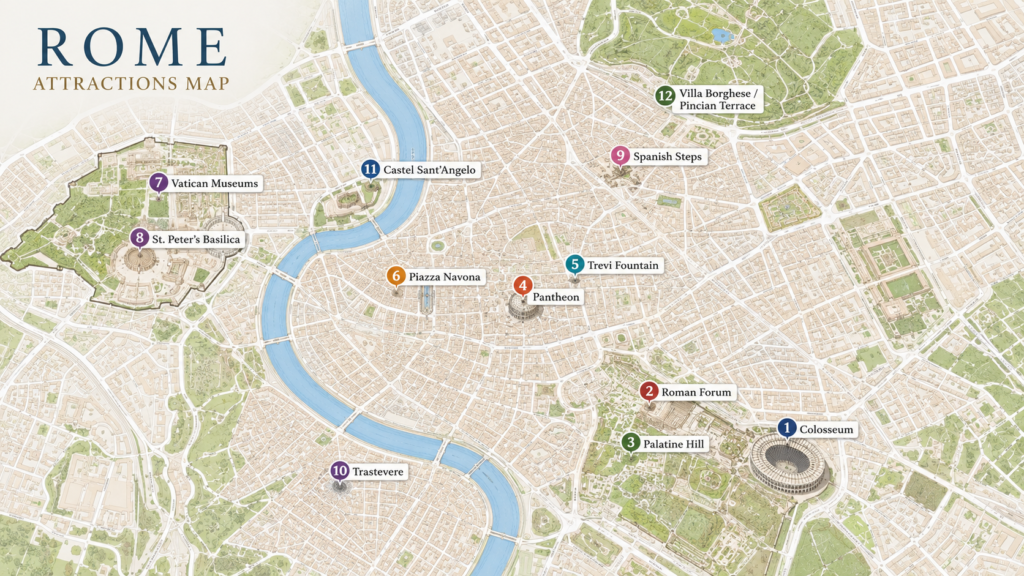
Rome’s major attractions are spread across several distinct areas, so grouping nearby sights can save a considerable amount of time.
The Colosseum, Roman Forum, and Palatine Hill form one natural sightseeing area. The Pantheon, Trevi Fountain, Piazza Navona, and Spanish Steps can largely be explored on foot through the historic center.
Vatican City sits across the Tiber, while Trastevere is best combined with other sights on the western side of the river.
Use the map above to understand the approximate locations of Rome’s main attractions before deciding how to organize each day.
1. Explore the Colosseum
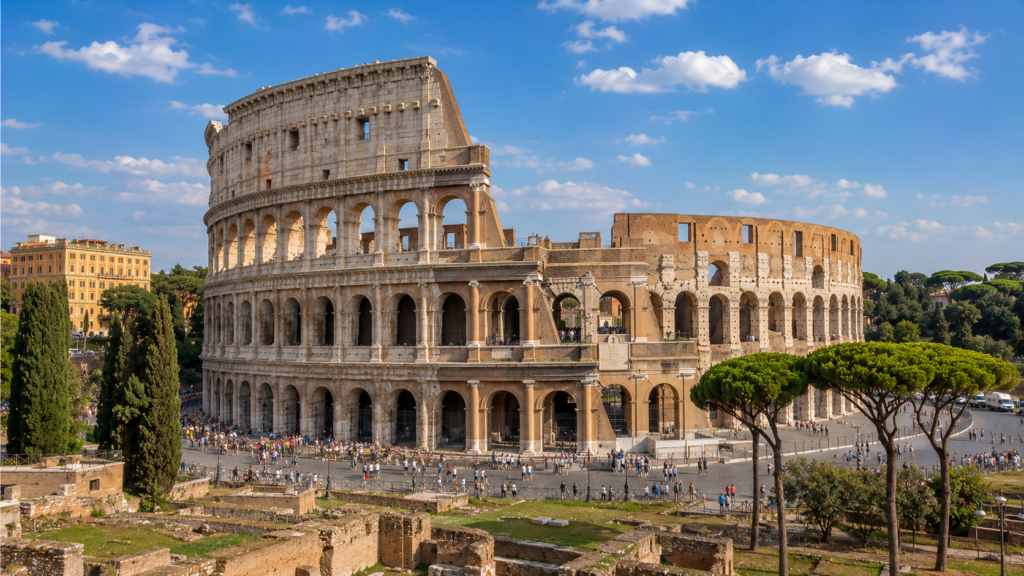
Few landmarks represent Rome as powerfully as the Colosseum.
Completed in the first century AD, this enormous amphitheater once hosted public spectacles watched by tens of thousands of spectators. Today, its surviving arches and interior structures provide one of the most recognizable connections to ancient Rome.
For first-time visitors, the Colosseum deserves more than a quick photograph from outside.
Walking through the monument gives you a much better understanding of its scale and construction. Depending on the ticket or experience you choose, access may also include different areas of the archaeological complex.
Do not visit the Colosseum in isolation.
The Roman Forum and Palatine Hill are immediately nearby and together form one of Rome’s most important archaeological areas. Allow several hours for the complete experience rather than scheduling another major attraction immediately afterward.
Ticket types, opening arrangements, and visitor access can change. Before your visit, check the official Colosseum ticket information and reserve ahead when appropriate.
Good to know: During warmer months, an early visit can make exploring the archaeological area significantly more comfortable.
2. Walk Through the Roman Forum
Standing among the ruins of the Roman Forum requires some imagination, but few places reveal the scale of ancient Rome so effectively.
For centuries, this valley was at the center of Roman political, religious, and public life.
Temples, basilicas, triumphal arches, government buildings, and public spaces once filled the area. Although many structures survive only as ruins, walking along the ancient routes gives you a sense of how closely packed the monumental center of Rome once was.
Among the most recognizable remains are the Arch of Septimius Severus, Temple of Saturn, and Arch of Titus.
The Forum becomes much more meaningful when you understand what the ruins originally represented. Consider using a good guidebook, audio guide, or guided tour if ancient Roman history is one of your main reasons for visiting.
Also allow time simply to look back across the archaeological landscape rather than rushing from ruin to ruin.
3. Climb Palatine Hill
Palatine Hill rises above the Roman Forum and is traditionally associated with the foundation of Rome.
According to Roman mythology, this is where Romulus established the city.
Centuries later, the hill became one of ancient Rome’s most prestigious residential areas, eventually developing into an imperial district filled with enormous palaces.
Today, Palatine Hill combines archaeological remains with elevated views across the Forum and surrounding parts of Rome.
It also provides a welcome change of pace after the more enclosed spaces of the Colosseum and the dense archaeological remains below.
Because these three attractions are directly connected geographically, the most efficient order is usually to treat the Colosseum + Roman Forum + Palatine Hill as one major sightseeing block.
Bring water, comfortable shoes, and sun protection during warmer months.
4. Visit the Pantheon
The Pantheon is one of the most remarkable surviving buildings from ancient Rome.
Its monumental portico gives only a partial indication of what waits inside.
The vast interior is covered by an enormous concrete dome, with a circular opening—the oculus—at its center. Nearly two thousand years after the building was completed, the engineering remains extraordinary.
Unlike many archaeological sites where visitors must reconstruct the original structure in their imagination, the Pantheon still allows you to experience an ancient Roman interior at an impressive scale.
Its location also makes it particularly easy to include in a walking day through central Rome.
Piazza Navona is only a short walk away, and the surrounding streets lead naturally toward the Trevi Fountain and other landmarks in the historic center.
Do not rush immediately after leaving the building. Spend a few minutes in Piazza della Rotonda outside and appreciate how the ancient monument has become part of everyday modern Rome.
5. Toss a Coin Into the Trevi Fountain
The Trevi Fountain is one of Rome’s most photographed landmarks, and seeing it for the first time can still be surprisingly dramatic.
The enormous Baroque composition appears at the end of relatively narrow streets, filling almost the entire side of the small piazza.
At the center is Oceanus surrounded by elaborate sculptures, rock formations, and cascading water.
According to the popular tradition, tossing a coin over your shoulder into the fountain means you will return to Rome.
Whether or not you participate, the Trevi Fountain is worth seeing at least once.
The main challenge is crowds.
If you want a calmer experience, consider arriving early in the morning. The atmosphere can also be beautiful after dark, when the fountain and surrounding architecture are illuminated.
Remember that this is a historic monument rather than a swimming pool. Follow local rules and barriers during your visit.
6. Explore Piazza Navona
Piazza Navona is one of the best places in Rome to appreciate how different layers of the city’s history overlap.
Its long, curved shape follows the footprint of the ancient Stadium of Domitian, which once occupied this location.
Today, the piazza is better known for Baroque architecture and fountains.
At its center stands Bernini’s Fountain of the Four Rivers, while the Church of Sant’Agnese in Agone forms part of the surrounding architectural scene.
Piazza Navona is most enjoyable when incorporated into a larger walk rather than treated as a destination requiring hours.
Combine it with the Pantheon, surrounding historic streets, Campo de’ Fiori, and perhaps a walk toward the Tiber.
If your schedule allows, return during the evening when the atmosphere changes and the architecture is illuminated.
7. Visit the Vatican Museums
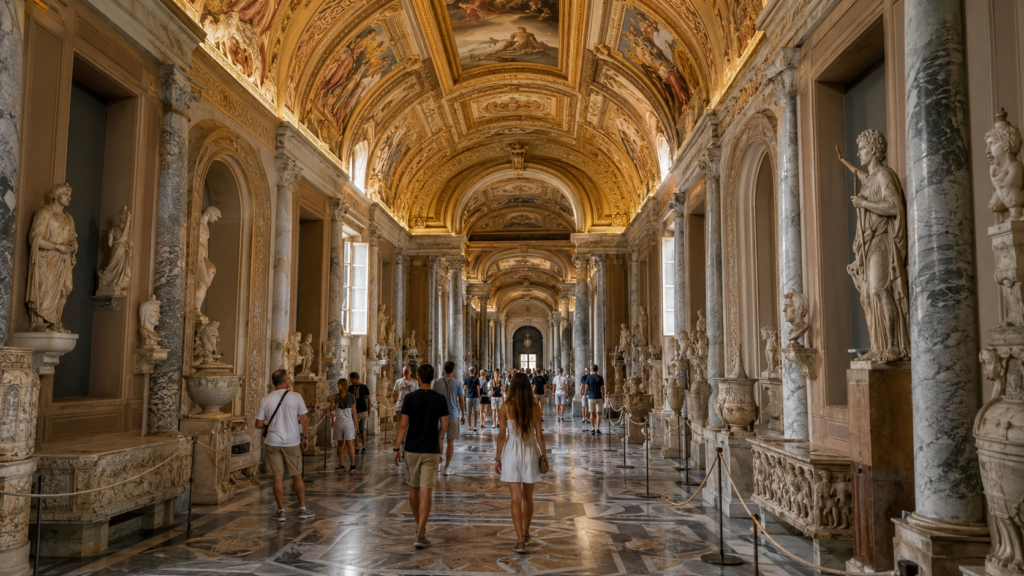
The Vatican Museums contain one of the world’s most important collections of art and historical objects.
The scale is enormous.
Visitors move through galleries containing ancient sculpture, Renaissance paintings, tapestries, historic maps, decorated rooms, and works collected by successive popes over centuries.
Trying to examine everything is almost impossible on a first visit.
Instead, identify the sections that interest you most and accept that you will pass through some galleries more quickly than others.
The journey through the museums eventually leads toward the Sistine Chapel, but the collections along the way are a major part of the experience.
Crowds can be substantial, and this is one attraction where advance planning makes a noticeable difference.
For current opening hours, ticket options, and reservation information, check the official Vatican Museums website before your visit.
Good to know: Avoid scheduling another demanding museum immediately afterward. A Vatican Museums visit can take several hours and involves a significant amount of walking.
8. See the Sistine Chapel
The Sistine Chapel is the most famous part of the Vatican Museums.
Michelangelo’s ceiling frescoes transformed the chapel into one of the defining artistic spaces of the Renaissance, while The Last Judgment covers the wall behind the altar.
Because the chapel is part of the Vatican Museums route, you should think of the two experiences together rather than planning them as completely separate attractions.
The room can become extremely busy.
Instead of focusing only on reaching the chapel as quickly as possible, give yourself enough time to appreciate the museum collections leading up to it.
Remember that the Sistine Chapel is a religious space and visitor rules are stricter than in many ordinary museum galleries. Follow current instructions regarding behavior and photography.
9. Step Inside St. Peter’s Basilica
St. Peter’s Basilica is one of the most impressive religious buildings in Europe.
Even after seeing its enormous facade from St. Peter’s Square, the scale of the interior can be difficult to anticipate.
Inside, highlights include Michelangelo’s Pietà, Bernini’s monumental baldachin, richly decorated chapels, mosaics, sculpture, and the vast dome rising above the crossing.
Visitors with additional time can consider ascending the dome.
The climb requires extra effort, but the upper levels provide remarkable views over St. Peter’s Square and across Rome.
Dress appropriately because the basilica remains an active religious site.
Security lines can also become lengthy, so avoid planning your day around unrealistically tight schedules.
If you are combining St. Peter’s Basilica with the Vatican Museums, reserve a substantial part of the day for the Vatican area.
10. Walk Up the Spanish Steps

The Spanish Steps are one of Rome’s most recognizable public spaces.
The monumental staircase rises from Piazza di Spagna toward the church of Trinità dei Monti, creating one of the most elegant urban scenes in the historic center.
You do not need much time here.
Instead, include the Spanish Steps as part of a longer walk connecting the Trevi Fountain, Via del Corso, Piazza del Popolo, and Villa Borghese.
Walk to the upper level for a different perspective over the surrounding rooftops and streets.
From there, continue toward the Pincian Terrace if you want one of the most enjoyable elevated views in central Rome.
The area around Piazza di Spagna is also one of Rome’s major shopping districts, although prices become considerably higher around the luxury streets.
As with other famous public spaces in Rome, follow local regulations and posted signs rather than assuming that sitting, eating, or drinking is permitted everywhere.
11. Explore Trastevere
After spending hours among Rome’s major monuments, cross the Tiber and explore a different side of the city.
Trastevere is known for narrow cobblestone streets, warm-colored buildings, small piazzas, restaurants, cafés, and a lively evening atmosphere.
The neighborhood is no longer a hidden corner of Rome, and its most popular streets can become busy. Even so, it remains one of the best areas for walking without a strict sightseeing schedule.
Start around the Basilica of Santa Maria in Trastevere, then move away from the main square and explore some of the smaller surrounding streets.
Late afternoon is an excellent time to arrive. You can walk through the neighborhood before sunset and stay for dinner afterward.
Trastevere is also a good place to slow down. Rather than moving between attractions, give yourself time to wander, stop for an aperitivo, and enjoy the neighborhood atmosphere.
If you want more advice on neighborhoods, transportation, and planning your first visit, see our complete Rome Travel Guide (INTERNAL LINK 2).
12. Visit Campo de’ Fiori
Campo de’ Fiori is one of central Rome’s best-known squares.
Its character changes throughout the day. During daytime hours, the square is associated with its market, while restaurants and bars give the surrounding streets a different atmosphere later in the day.
At the center of the square stands the monument to philosopher Giordano Bruno, who was executed here in 1600.
Campo de’ Fiori is conveniently located for sightseeing through the historic center.
Rather than making a special journey solely for the square, include it in a walking route connecting Piazza Navona, the Pantheon, and the Tiber.
The surrounding streets are often as interesting as the square itself, so leave some time to explore beyond the main market area.
13. See Rome From the Pincian Terrace
[CONTENT IMAGE #3 — SPANISH STEPS / PINCIAN TERRACE AREA]
Rome looks completely different from above.
One of the easiest panoramic viewpoints to reach in central Rome is the Pincian Terrace, located above Piazza del Popolo on the edge of Villa Borghese.
From here, rooftops, church domes, and parts of the historic skyline stretch across the city.
The terrace is particularly attractive in the late afternoon, when the light becomes softer and locals and visitors gather around the viewpoint.
You can reach the area after visiting the Spanish Steps and continue through the landscaped grounds of Villa Borghese.
Unlike many of Rome’s major attractions, enjoying the view does not require a complicated sightseeing schedule.
It is an excellent place to slow down after several hours of churches, museums, and archaeological sites.
14. Walk Along the Appian Way
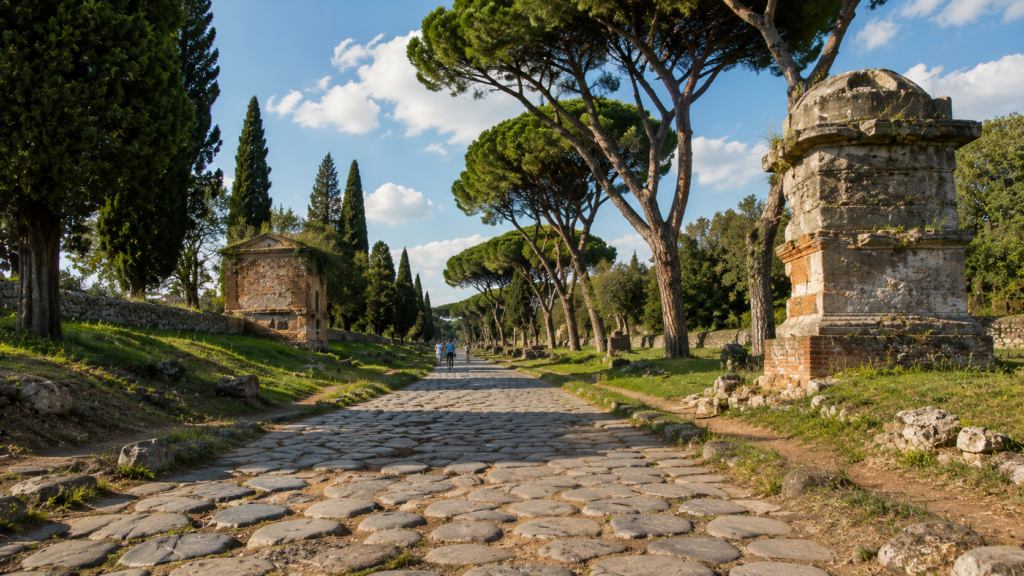
For a glimpse of Rome beyond its monumental center, spend part of a day exploring the Appian Way, or Via Appia Antica.
Originally constructed in antiquity, the road became one of the Roman Republic’s most important routes and eventually extended far into southern Italy.
Sections near Rome still preserve ancient paving stones and are surrounded by archaeological remains, tombs, greenery, and stretches of countryside.
The atmosphere feels very different from central Rome.
Instead of fountains, piazzas, and dense streets, you encounter an archaeological landscape that provides a stronger sense of how roads once connected the ancient city with the wider Roman world.
Walking is possible, while cycling can allow you to cover a larger section.
Do not try to combine the Appian Way with too many central attractions on the same day. It works better as a half-day experience when you have enough time in Rome.
15. Discover the Catacombs of Rome
Several ancient catacomb complexes can be found outside Rome’s historic center, particularly around the Appian Way area.
These underground burial networks provide a very different perspective on the city’s history.
Rather than monumental temples and imperial architecture, the catacombs reveal aspects of burial traditions and early Christian communities.
Visits are generally more structured than walking around an outdoor archaeological site, and access conditions vary between individual complexes.
For most first-time visitors, the catacombs are an optional addition rather than an essential Rome attraction.
Consider them if you have four or more days in the city, have a particular interest in early Christianity or archaeology, or are already planning to explore the Appian Way.
16. Visit Castel Sant’Angelo
Castel Sant’Angelo stands beside the Tiber, only a short distance from Vatican City.
The building began as the mausoleum of Emperor Hadrian before being transformed over the centuries into a fortress and papal stronghold.
That layered history makes it one of Rome’s more unusual monuments.
Inside, visitors move through corridors, defensive spaces, historic rooms, and terraces before reaching elevated viewpoints.
The upper levels provide particularly attractive views toward St. Peter’s Basilica and across central Rome.
Even if you do not enter, the exterior of Castel Sant’Angelo and the nearby bridge are worth seeing while walking between Vatican City and the historic center.
It fits naturally into a Vatican sightseeing day rather than requiring a separate journey across Rome.
17. Explore Rome’s Historic Churches
St. Peter’s Basilica may be Rome’s most famous church, but it is only one part of the city’s extraordinary religious heritage.
Churches appear throughout the historic center, often hiding remarkable interiors behind relatively understated facades.
Depending on your interests, you might seek out major basilicas, churches known for important artworks, or simply enter places you discover while walking.
This is one experience where leaving some flexibility in your itinerary is valuable.
You do not need to turn every church into another attraction on a checklist.
Sometimes spending fifteen quiet minutes inside an unexpected church provides a welcome contrast to Rome’s busiest monuments.
Remember that these are active places of worship. Dress appropriately, keep noise low, and respect any areas closed to sightseeing.
18. Eat Classic Roman Food

Experiencing Rome should involve more than seeing monuments.
Food is one of the easiest ways to discover another side of the city.
Start with Rome’s famous pasta dishes.
Carbonara traditionally combines pasta with egg, Pecorino Romano, guanciale, and black pepper.
Cacio e pepe uses Pecorino Romano and black pepper, while amatriciana introduces tomato and guanciale. Gricia is another Roman classic built around guanciale and Pecorino.
For something quicker, try supplì, fried rice snacks commonly filled with mozzarella, or stop for pizza al taglio, where rectangular pizzas are cut into portions.
And, of course, leave room for gelato.
Avoid judging restaurants solely by how close they are to a famous attraction. Walking several streets away from the busiest piazzas often gives you more choices and a more relaxed atmosphere.
A long lunch or dinner is not wasted sightseeing time in Rome. It is part of the experience.
19. Experience Rome After Dark
Rome deserves to be seen after sunset.
When daylight disappears, illuminated monuments and piazzas create a noticeably different atmosphere from daytime sightseeing.
You do not need a complicated night itinerary.
Walk through the historic center and revisit a few places you saw earlier in the day.
The Trevi Fountain, Pantheon area, Piazza Navona, Spanish Steps, St. Peter’s Square, and streets around the historic center can all feel different in the evening.
Trastevere is another natural choice if you want to combine an evening walk with dinner or drinks.
Rome after dark is also a good reason not to exhaust yourself during the day.
Leave enough energy to walk through the city after dinner rather than returning immediately to your accommodation every night.
20. Leave Time to Get Lost in Rome
One of the best things to do in Rome is also the easiest to leave out of an itinerary.
Walk without a destination.
Rome’s major landmarks matter, but the streets connecting them are part of what makes the city memorable.
You may find a small church you had not planned to visit, an archaeological fragment incorporated into a modern street, a quiet courtyard, a neighborhood café, or a piazza that never appeared on your original list.
This does not mean abandoning your itinerary completely.
Book the attractions that require reservations, organize the major sights geographically, and then deliberately leave gaps between them.
Those gaps give Rome room to surprise you.
If Rome is part of a longer first trip through the country, our Italy 10-Day Itinerary (INTERNAL LINK 3) continues from Rome through Florence, Tuscany, Venice, Milan, and Lake Como.
How Many Things Can You See in Rome in One Day?
One day in Rome requires serious prioritization.
Trying to complete a list of ten or fifteen attractions will usually result in spending more time rushing between sights than enjoying them.
For most first-time visitors, choose one major archaeological area and then combine it with a walking route through the historic center.
A realistic day could begin with the Colosseum, Roman Forum, and Palatine Hill before continuing toward the Pantheon, Piazza Navona, and Trevi Fountain.
Alternatively, make Vatican City the centerpiece of your day and spend the remaining time around St. Peter’s Basilica, Castel Sant’Angelo, and the Tiber.
Do not attempt both the full Colosseum archaeological complex and an extensive Vatican Museums visit in a single day unless your priority is simply seeing as much as possible.
Best Things to Do in Rome in 2 Days
With two days, divide Rome into two major sightseeing zones.
Day 1 — Ancient Rome and Historic Center
Start with the Colosseum, Roman Forum, and Palatine Hill.
Afterward, walk toward central Rome and explore the Pantheon, Piazza Navona, Trevi Fountain, and surrounding streets.
Day 2 — Vatican City and Trastevere
Spend the morning exploring the Vatican Museums and Sistine Chapel before visiting St. Peter’s Basilica.
Later, walk past Castel Sant’Angelo and continue toward Trastevere for the evening.
This itinerary is busy but gives first-time visitors a strong introduction to Rome.
Best Things to Do in Rome in 3 Days
Three days gives you much more flexibility.
Use the first two days for the major attractions described above.
On Day 3, explore the Spanish Steps, Piazza del Popolo, Pincian Terrace, and Villa Borghese, or choose a more specialized experience such as the Appian Way and catacombs.
Another option is simply to slow down.
Return to a neighborhood you enjoyed, visit additional churches, spend longer over lunch, and leave more time for wandering through the historic center.
Three days is enough to see Rome’s essential sights without turning every day into a race.
Travelers planning a larger journey can also explore our Best Places to Visit in Italy (INTERNAL LINK 4) when deciding where to go after Rome.
Free Things to Do in Rome
Rome offers plenty to experience without paying admission.
Walking through Piazza Navona, seeing the Trevi Fountain, climbing the Spanish Steps, exploring Trastevere, visiting Piazza del Popolo, and enjoying the view from the Pincian Terrace can all form part of a day without expensive attraction tickets.
Many churches can also be entered without a standard sightseeing admission fee, although access conditions can vary.
Walking itself is one of Rome’s best free experiences.
A route through the historic center can reveal fountains, piazzas, architecture, churches, street scenes, and fragments of ancient history without requiring a ticket at every stop.
If you are traveling on a budget, combine a few paid priorities—such as the Colosseum or Vatican Museums—with Rome’s many free public spaces.
Things to Do in Rome at Night
Rome becomes particularly atmospheric after sunset.
For a simple evening, begin around the Spanish Steps or Trevi Fountain and walk through the historic center toward the Pantheon and Piazza Navona.
Another option is to cross the Tiber and spend the evening in Trastevere.
If panoramic views interest you, sunset from an elevated viewpoint can provide a natural transition between daytime sightseeing and dinner.
Avoid filling every evening with reservations.
Some of Rome’s most enjoyable nights require little more than dinner followed by a long walk through illuminated streets.
What to Book in Advance
A few Rome attractions deserve advance planning.
The Colosseum and Vatican Museums should be among your first priorities once your travel dates are confirmed.
Other museums and archaeological experiences may also use timed entry or limited visitor capacity.
Do not assume that every attraction requires months of preparation, but do not wait until the morning of your visit for the places that matter most to you.
A useful strategy is to book one major timed attraction per half-day.
That gives your itinerary structure without making every hour dependent on reservations.
Tips for Visiting Rome’s Top Attractions
Start early when possible, especially during warmer months and busy travel periods.
Group attractions geographically. The Colosseum, Roman Forum, and Palatine Hill belong together, while the Pantheon, Piazza Navona, Trevi Fountain, and Spanish Steps can form a central walking route.
Wear comfortable shoes. Rome’s cobblestones, archaeological sites, stairs, and long museum corridors make footwear more important than many first-time visitors expect.
Carry water and take breaks.
Do not schedule every hour.
And most importantly, distinguish between attractions you genuinely care about and places you feel obligated to visit simply because they appear on every Rome checklist.
Your trip will usually be better with twelve experiences you enjoy than twenty completed in a hurry.
Frequently Asked Questions
What are the top things to do in Rome for first-time visitors?
For a first trip, prioritize the Colosseum, Roman Forum, Palatine Hill, Pantheon, Trevi Fountain, Vatican Museums, Sistine Chapel, St. Peter’s Basilica, and the historic center.
Add Trastevere or a panoramic viewpoint if your schedule allows.
How many days do you need to see Rome?
Three full days is a good minimum for most first-time visitors.
Two days can cover the major highlights at a faster pace, while four or five days gives you time for additional museums, neighborhoods, the Appian Way, and a more relaxed schedule.
What should you not miss in Rome?
If you must narrow the list significantly, prioritize the Colosseum and Roman Forum, Vatican City, and a walk through the historic center connecting the Pantheon, Piazza Navona, and Trevi Fountain.
Together, these experiences provide a strong introduction to ancient, Renaissance, Baroque, and modern Rome.
What are the best free things to do in Rome?
Some of the best free experiences include seeing the Trevi Fountain, walking through Piazza Navona, exploring Trastevere, climbing the Spanish Steps, visiting Piazza del Popolo, enjoying the Pincian Terrace, and wandering through Rome’s historic streets.
Is the Colosseum worth visiting inside?
For most first-time visitors, yes.
Seeing the exterior is impressive, but entering the amphitheater provides a much clearer understanding of its scale and structure.
Combine the visit with the Roman Forum and Palatine Hill rather than treating the Colosseum as an isolated attraction.
Is Vatican City worth a full day?
For travelers interested in art, architecture, history, or religion, Vatican City can easily occupy most of a day.
The Vatican Museums alone can require several hours, followed by the Sistine Chapel and St. Peter’s Basilica.
Travelers with less interest in museums can shorten the visit and spend more time elsewhere in Rome.
Can you walk to most attractions in Rome?
Many attractions in the historic center can be connected on foot.
However, Rome is a large city, and attractions such as Vatican City, the Colosseum area, and the Appian Way are not all clustered together.
Combine walking with public transportation when it saves meaningful time.
What is the best thing to do in Rome at night?
For a first visit, keep it simple: walk through the illuminated historic center.
The Trevi Fountain, Pantheon area, Piazza Navona, Spanish Steps, and Trastevere are particularly enjoyable in the evening.
Final Thoughts
The best things to do in Rome are not limited to a checklist of famous monuments.
The Colosseum, Roman Forum, Vatican Museums, Sistine Chapel, Pantheon, and Trevi Fountain provide the essential first introduction, but some of Rome’s most memorable experiences happen between those landmarks.
Walk through Trastevere. Watch the city from an elevated terrace. Eat carbonara in a neighborhood trattoria. Explore an unexpected church. Return to the historic center after dark.
Most importantly, give yourself enough time.
Rome rewards travelers who combine careful planning with room for spontaneous exploration.
Choose the attractions that matter most to you, book the difficult ones in advance, group nearby sights together, and leave part of every day unscheduled.
Related Italy Travel Guides
Rome Travel Guide
Everything you need to plan your first visit, including where to stay, transportation, food, the best time to visit, and practical travel advice.
Italy 10-Day Itinerary: The Perfect First Trip to Italy
Follow a practical first-time route through Rome, Florence, Tuscany, Venice, Milan, and Lake Como.
Best Places to Visit in Italy in 2026
Discover the cities, countryside, lakes, coastlines, and historic destinations worth considering for your Italy itinerary.
Where to Stay in Rome
Compare Rome’s best neighborhoods and areas for sightseeing, atmosphere, transportation, and different travel styles.