
France is one of those countries where ten days can feel both generous and surprisingly short. Paris alone could fill an entire trip, while the Loire Valley, Bordeaux, Provence, and Mediterranean coast each offer completely different experiences.
For a first visit, the key is not trying to see everything.
This France 10-day itinerary focuses on five distinctive parts of the country while keeping the route reasonably straightforward: Paris → Loire Valley → Bordeaux → Provence → French Riviera.
You will begin with three days in Paris, continue through the château-filled countryside of the Loire Valley, spend two days around Bordeaux, travel south to Provence, and finish beside the Mediterranean on the French Riviera.
Most of the longer journeys can be completed by train. A rental car is useful for parts of the Loire Valley and Provence, but you do not need to drive for the entire trip.
If you are still deciding which destinations belong on your trip, compare this route with our Best Places to Visit in France in 2026 before finalizing your itinerary.
France 10-Day Itinerary at a Glance
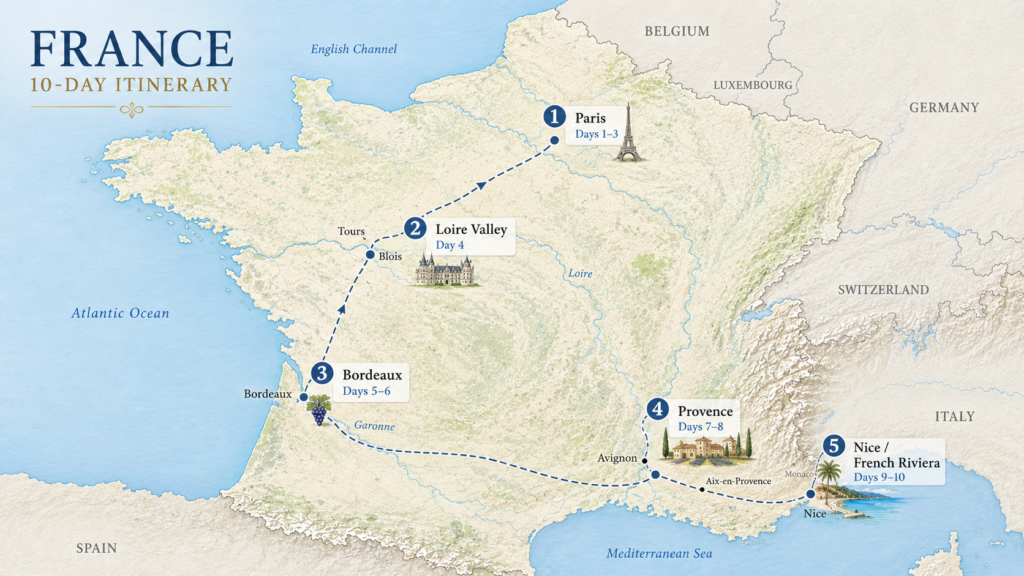
Here is the complete route:
Days 1–3 — Paris
Explore the historic center, Louvre, Eiffel Tower, Seine, Montmartre, and some of the city’s most famous neighborhoods.
Day 4 — Loire Valley
Leave Paris for the Loire Valley and spend the day exploring one or two of its famous châteaux.
Days 5–6 — Bordeaux
Continue southwest to Bordeaux for historic architecture, food, wine culture, and an optional excursion into the surrounding vineyards.
Days 7–8 — Provence
Travel south for historic towns, Provençal landscapes, markets, villages, and a slower pace.
Days 9–10 — French Riviera
Finish the trip in Nice and explore the Mediterranean coastline before departing.
The route covers a considerable distance, but it avoids changing hotels every night.
For most travelers, that balance is more enjoyable than trying to squeeze eight or ten destinations into a ten-day vacation.
France 10-Day Itinerary Map
The route begins in Paris in northern France, continues southwest through the Loire Valley and Bordeaux, then turns southeast toward Provence before finishing on the French Riviera.
The map above is designed to help you understand the overall direction of travel and the relationship between each stop before you begin booking trains, hotels, and rental cars.
Days 1–3: Paris
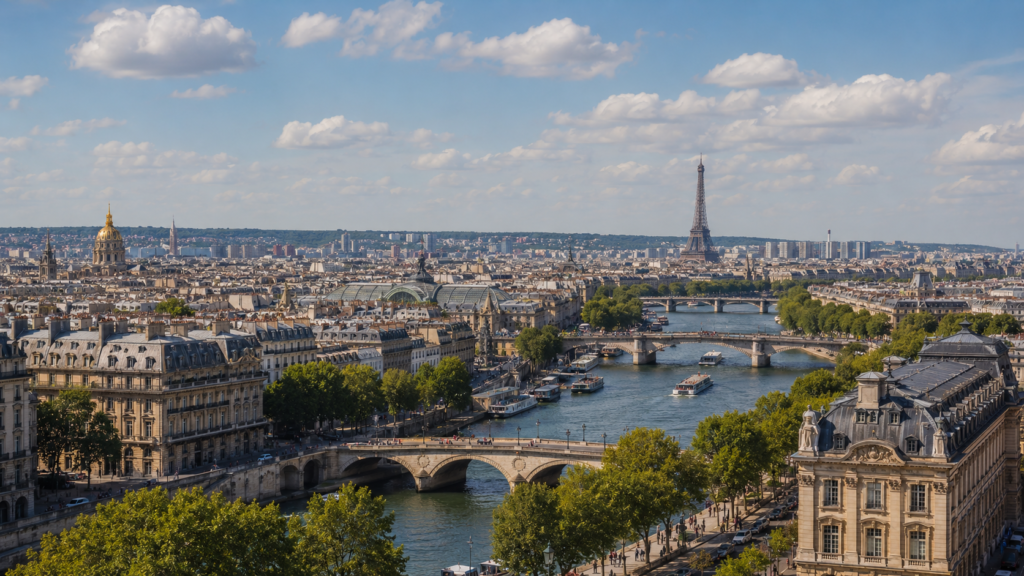
Paris deserves the largest share of this itinerary.
Three days is still only an introduction, but it gives first-time visitors enough time to see several major landmarks without reducing the city to a checklist.
If you want a deeper look at the capital before planning these three days, see our Best Places to Visit in Paris in 2026
Day 1: Arrive in Paris and Explore the Historic Center
Use your first day to settle into Paris and explore mostly on foot.
If you arrive in the morning or early afternoon, avoid scheduling a major timed museum immediately after your flight or train journey. Delays, luggage, hotel check-in, and fatigue can easily disrupt a tightly planned first day.
Instead, begin around the Seine.
Walk through the historic center, see the exterior of Notre-Dame Cathedral, explore Île de la Cité, cross toward the Latin Quarter, and continue through the streets around Saint-Germain-des-Prés.
Depending on your energy level, you can also walk toward the Louvre courtyard and the Tuileries Garden.
The goal of Day 1 is orientation rather than quantity.
Let yourself experience Paris at street level before spending the next two days moving between major attractions.
A relaxed dinner near your accommodation is usually a better ending than forcing another attraction into the evening.
Day 2: The Louvre, Eiffel Tower, and Seine
Day 2 is your major sightseeing day.
Begin with the Louvre Museum if art and history are priorities.
The museum is enormous, and trying to see everything in one visit is unrealistic. Decide in advance which collections or major works matter most to you.
For current opening hours, visitor information, and tickets, check the official Louvre website before your visit.
After the museum, continue through the Tuileries Garden and toward Place de la Concorde.
Later in the day, head toward the Eiffel Tower area.
You can admire the tower from the ground, see it from the Champ de Mars or Trocadéro area, or reserve access to the upper levels if that experience is important to you.
Finish the day with a walk along the Seine.
An evening river cruise can also be an enjoyable way to see several Paris landmarks from a different perspective without adding another demanding walking route.
Day 3: Montmartre and More of Paris
Spend your third day exploring a different side of the city.
Start in Montmartre.
Walk through the neighborhood’s steep streets, small squares, cafés, and residential corners before reaching the Basilica of Sacré-Cœur.
The elevated position provides one of the best broad views across Paris.
After Montmartre, use the afternoon for whatever you missed on the previous days.
Possible options include:
- Musée d’Orsay
- Le Marais
- Sainte-Chapelle
- Luxembourg Gardens
- Arc de Triomphe
- Champs-Élysées
- Canal Saint-Martin
- More time along the Seine
Do not choose all of them.
Pick one or two experiences based on your interests.
The advantage of spending three nights in Paris is that you can leave part of the schedule flexible rather than turning every hour into a reservation.
Day 4: Loire Valley
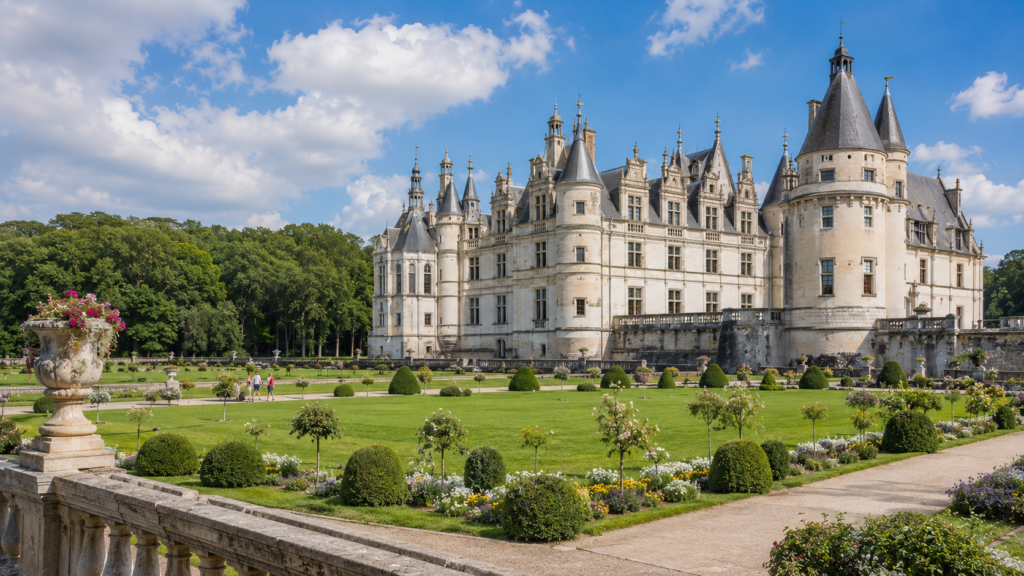
On Day 4, leave Paris and travel toward the Loire Valley.
The Loire is famous for its historic châteaux, river landscapes, small towns, gardens, and countryside.
Trying to visit four or five châteaux in a single day usually creates more driving than sightseeing.
For a first visit, choose one or two major properties and enjoy them properly.
Getting From Paris to the Loire Valley
The easiest base depends on which châteaux you want to see.
Cities such as Tours and Blois have rail connections from Paris and provide access to several parts of the region.
However, many châteaux are located outside town centers.
A rental car gives you the greatest flexibility, particularly if you want to combine multiple estates or explore smaller villages.
Another option is to take the train into the region and join an organized excursion.
This can work well for travelers who want to avoid driving.
What to See in the Loire Valley
Two of the most famous choices for a first visit are Château de Chambord and Château de Chenonceau.
Chambord is known for its extraordinary scale and distinctive French Renaissance architecture.
Chenonceau has a completely different character, extending elegantly across the River Cher.
You do not necessarily need both.
Choose based on your route, interests, and how much time you want to spend in transit.
After sightseeing, stay overnight in or near Tours, Blois, or another convenient base for the next stage of the journey.
Days 5–6: Bordeaux
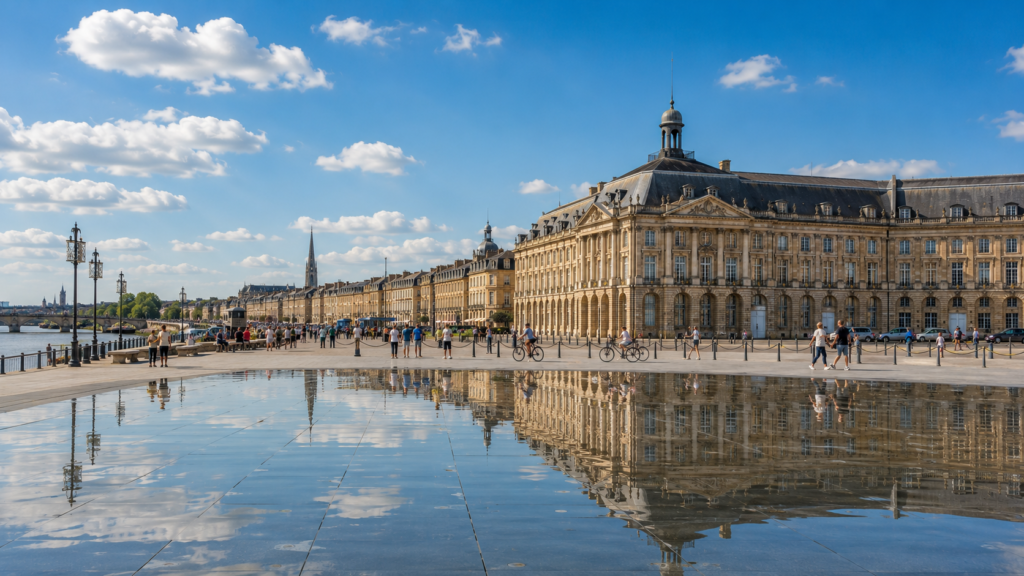
The next part of the itinerary moves southwest to Bordeaux.
The city combines elegant architecture, a walkable historic center, excellent food, and easy access to one of the world’s most famous wine regions.
Day 5: Travel to Bordeaux
Travel from the Loire Valley toward Bordeaux.
Your exact journey will depend on where you stayed the previous night, but rail connections make Bordeaux relatively easy to incorporate into a longer France itinerary.
After checking in, spend the rest of the day exploring central Bordeaux.
Walk through the historic center, see Place de la Bourse and the Miroir d’eau area, and explore the streets around the Garonne River.
Bordeaux is particularly enjoyable on foot.
Unlike Paris, where major attractions can dominate your schedule, much of the appeal here comes from architecture, streets, food, and the atmosphere of the city itself.
Keep the first evening relaxed.
Day 6: Bordeaux and the Wine Region
You have two good options for Day 6.
The first is to remain in Bordeaux and continue exploring the city.
The second is to make a wine-region excursion.
Saint-Émilion is one of the most popular choices because it combines vineyards with a historic village and works well for travelers who want a broader experience than a technical winery tour.
If you plan to visit wineries, advance reservations are often necessary.
Do not assume that every estate accepts walk-in visitors.
Travelers who are not particularly interested in wine should not feel obligated to spend the day touring vineyards.
Bordeaux itself can easily fill another day with markets, museums, river walks, cafés, and architecture.
Days 7–8: Provence

After Bordeaux, the itinerary turns southeast toward Provence.
This is one of the longer travel transitions of the trip, so Day 7 should not be overloaded with sightseeing.
Provence covers a large area rather than a single city. Historic towns, hilltop villages, vineyards, olive groves, markets, Roman monuments, and Mediterranean landscapes are spread throughout the region.
For this itinerary, Avignon or Aix-en-Provence works well as a practical base.
Day 7: Travel to Provence
Leave Bordeaux in the morning and travel toward Provence.
Depending on your chosen base and rail schedule, the journey may require a connection. Check the exact route when booking rather than assuming every city pair has a direct train.
Once you arrive, check into your accommodation and keep the remainder of the day relatively simple.
If you stay in Avignon, explore the historic center, walk around the old streets, and see the imposing Palais des Papes.
If you choose Aix-en-Provence, spend the afternoon walking through the old town, exploring its squares, fountains, cafés, and markets.
Do not schedule a distant village excursion immediately after arriving.
After several days of major sightseeing and transportation, a slower afternoon makes the overall itinerary much more enjoyable.
Day 8: Explore Provence
Day 8 is your opportunity to experience the landscapes and smaller destinations that make Provence distinctive.
Your ideal route will depend heavily on the season.
Possible destinations include Gordes, Roussillon, Saint-Rémy-de-Provence, Les Baux-de-Provence, the Luberon, or areas surrounding Avignon and Aix-en-Provence.
Choose a small number of places rather than attempting to drive through the entire region.
Two or three well-chosen stops are usually enough for one day.
If you visit during lavender season, parts of Provence become famous for fields of purple stretching across the countryside. However, lavender should not be treated as a year-round attraction. Blooming conditions and timing vary by location and year.
Outside lavender season, Provence remains worthwhile for its villages, markets, food, vineyards, historic towns, and landscapes.
A rental car is particularly useful on this day.
Regional buses exist, but they do not always make it practical to combine several rural destinations efficiently.
If you do not want to drive, consider staying in a larger base such as Avignon or Aix-en-Provence and taking a guided day trip into the countryside.
Days 9–10: French Riviera
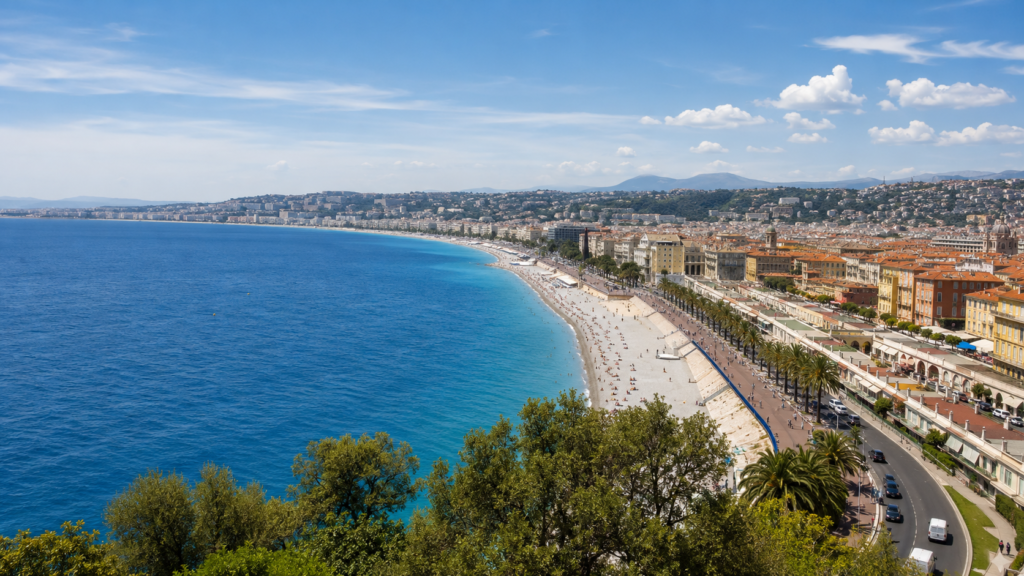
The final stage of this France 10-day itinerary takes you to the Mediterranean coast.
Nice makes the most practical base for a first visit to the French Riviera because it combines beaches, an attractive old town, restaurants, museums, transportation connections, and easy access to nearby coastal destinations.
It also gives the trip a completely different ending from the historic cities and countryside you experienced earlier.
Day 9: Provence to Nice
Travel from Provence toward Nice in the morning.
If you rented a car specifically for exploring Provence, consider returning it before or after reaching the Riviera depending on your rental arrangement.
A car is not essential for the itinerary around Nice.
After checking into your accommodation, spend the afternoon discovering the city.
Walk through Vieux Nice, explore its narrow streets and colorful buildings, and continue toward the waterfront.
The Promenade des Anglais follows the Mediterranean and provides an easy introduction to the coastal atmosphere.
For a higher viewpoint, walk up to Castle Hill, or Colline du Château.
Despite the name, the hill is better known today for its park and panoramic views than for a surviving castle.
From the viewpoints, you can look across Nice, the coastline, and the blue Mediterranean.
Spend your final evening enjoying the old town or waterfront rather than immediately leaving Nice for another destination.
Day 10: Nice and the French Riviera
How you use the final day depends on your departure time.
If you have most of the day available, you can remain in Nice or make a short excursion along the French Riviera.
Popular possibilities include Villefranche-sur-Mer, Èze, Antibes, or Monaco.
Do not attempt all of them.
For a relaxed final day, choose one destination that can be reached conveniently from Nice and return with plenty of time before your departure.
Villefranche-sur-Mer is particularly easy to combine with Nice and offers a smaller coastal setting.
Èze appeals to travelers interested in a dramatic hilltop village and Mediterranean views.
Antibes combines an old town with a different stretch of coastline.
Monaco offers an entirely different atmosphere and can also be reached from Nice, but remember that Monaco is a separate sovereign country rather than part of France.
If your flight or train leaves early, simply spend the morning in Nice.
Ten days of travel does not need to end with one final race between attractions.
How to Get Around France
France’s rail network makes this itinerary possible without renting a car for the entire trip.
High-speed trains are particularly useful for long journeys between major cities.
For current train schedules and booking options, check the official SNCF Connect website (EXTERNAL LINK 2).
Book important long-distance journeys in advance when your itinerary is fixed, especially if you are traveling during busy periods.
Paris itself does not require a car.
Public transportation and walking are much more practical for most visitors.
Bordeaux is also easy to explore without driving.
A car becomes more useful in the Loire Valley and especially in rural Provence, where many villages and countryside attractions are spread across a larger area.
One practical approach is therefore:
Paris — no car
Loire Valley — optional rental car or organized tour
Bordeaux — no car
Provence — rental car recommended for countryside exploration
Nice / French Riviera — no car required
This avoids paying for a rental vehicle on days when it would mostly remain parked.
How Much Does a 10-Day Trip to France Cost?
The cost of ten days in France varies significantly depending on accommodation, season, transportation, dining habits, and how many paid attractions you visit.
Paris and the French Riviera can be particularly expensive, while spending carefully in other parts of the itinerary can help balance the overall budget.
For a mid-range trip, your largest expense will usually be accommodation.
Train tickets can also become expensive when purchased close to departure, particularly on popular high-speed routes.
Food costs are easier to control.
You do not need a formal restaurant for every meal. Bakeries, markets, casual cafés, supermarkets, and simple local restaurants can keep daily spending manageable while still allowing you to experience French food.
Attractions add another layer to the budget.
Museums, monuments, château admissions, wine tours, and organized excursions can accumulate quickly.
Instead of trying to calculate one universal budget, divide your planning into:
- Accommodation
- Long-distance transportation
- Local transportation
- Food
- Attractions
- Tours and excursions
- Rental car and fuel, if needed
- Travel insurance
- Personal spending
A traveler using hostels and simple meals will spend very differently from someone choosing central four-star hotels, private tours, and fine dining.
Build your budget around your own travel style rather than relying on a single daily figure.
Where to Stay During This France Itinerary
Location matters more than luxury for a fast-moving itinerary.
In Paris, choose accommodation with convenient Metro or RER access rather than automatically booking beside one specific landmark.
You will be moving around the city throughout the day, so good transportation connections can save more time than a famous address.
For the Loire Valley, Tours and Blois are practical bases for many first-time itineraries.
If you have a rental car, smaller towns and countryside accommodation become easier options.
In Bordeaux, staying near the historic center or convenient tram connections makes exploring without a car straightforward.
In Provence, choose your base according to the type of experience you want.
Avignon is convenient for history and access to parts of western Provence.
Aix-en-Provence works well for travelers interested in an attractive city base with access to surrounding countryside.
On the French Riviera, Nice is the strongest all-around choice for this particular itinerary because of its transportation connections and variety of accommodation.
Avoid changing hotels simply to save a small amount of travel time.
Five main bases in ten days is already a relatively active itinerary.
Best Time to Follow This Itinerary
Spring and early autumn are excellent periods for this route.
April, May, September, and early October can provide a useful balance between pleasant weather and manageable visitor numbers, although conditions vary from year to year.
Summer brings long daylight hours and lively destinations, but it also means higher temperatures, larger crowds, and stronger demand for accommodation and transportation.
Paris, Provence, and the French Riviera can all become extremely busy during peak periods.
If lavender is a major reason for visiting Provence, research expected blooming periods for the specific area you intend to visit rather than planning around a generic assumption that lavender is visible throughout summer.
Winter creates a very different trip.
Paris, Bordeaux, and the larger cities remain viable, but countryside experiences and the atmosphere of coastal destinations can differ considerably from warmer months.
There is no single perfect month for every traveler.
Choose based on whether your priorities are weather, lower crowds, seasonal landscapes, swimming, cultural sightseeing, or budget.
What to Book in Advance
You do not need to reserve every hour of a ten-day trip, but several parts deserve advance planning.
Book your international transportation and major accommodation first.
Once your dates are fixed, look at the long-distance train journeys connecting the main stages of the itinerary.
In Paris, major museums and monuments may use timed admission.
If the Louvre or Eiffel Tower is essential to your trip, do not leave those plans until the last minute.
Loire Valley château tickets may be easier to manage, but transportation or organized tours can still require advance booking.
Wine experiences around Bordeaux frequently require reservations.
Rental cars should also be arranged in advance if you plan to drive through Provence during a busy season.
The goal is not to schedule every moment.
Reserve the experiences that could sell out or disrupt the itinerary if unavailable, then leave enough flexibility for meals, walks, weather changes, and spontaneous discoveries.
Can You Do This France Itinerary Without a Car?
Yes.
You can complete the major route without renting a car for all ten days.
Paris, Bordeaux, and Nice are particularly suitable for car-free travel.
Long-distance trains connect the major stages of the trip, while local transportation covers many urban areas.
The challenge comes in the countryside.
In the Loire Valley, reaching multiple châteaux independently can be less convenient without a car.
In Provence, small villages and rural landscapes are even more dispersed.
If you do not drive, replace independent countryside exploration with organized day tours or choose destinations that have workable public transportation.
This can actually make the trip easier because you avoid parking, navigation, fuel costs, and rental logistics.
A car should solve a transportation problem rather than become an automatic part of the vacation.
Alternative 10-Day France Itineraries
The Paris → Loire Valley → Bordeaux → Provence → French Riviera route is designed for a broad first introduction to France.
It is not the only good option.
If you prefer slower travel, reduce the number of regions.
For example:
Paris → Loire Valley → Bordeaux
This gives you more time in each destination and fewer long travel days.
Travelers more interested in eastern France could consider:
Paris → Strasbourg → Alsace → Lyon → Provence
If Normandy is a priority, another route could combine:
Paris → Normandy → Mont-Saint-Michel → Loire Valley
And travelers focused primarily on southern France could spend the entire trip between Provence and the French Riviera.
There is no advantage in following a popular itinerary if it includes places that do not interest you.
Use this route as a framework and adjust it around the experiences you actually want.
Frequently Asked Questions
Is 10 days enough for France?
Ten days is enough for an excellent first trip to France, but not enough to see the entire country.
A well-planned ten-day itinerary can combine Paris with several other regions while still allowing meaningful time in each destination.
Avoid trying to include every famous city.
Four or five main stops is a much more realistic target.
How many days should you spend in Paris?
Three full days is a good starting point for first-time visitors following a larger France itinerary.
It allows time for major attractions such as the Louvre and Eiffel Tower while still leaving room for neighborhoods, walking, food, and the Seine.
If Paris is your main priority, four or five days would be even better.
What is the best itinerary for a first trip to France?
There is no single route that suits everyone, but a first trip should usually combine Paris with destinations that provide contrasting experiences.
This itinerary uses Paris, the Loire Valley, Bordeaux, Provence, and the French Riviera to combine major landmarks, historic architecture, countryside, food and wine culture, villages, and the Mediterranean coast.
Travelers who dislike frequent transportation should choose fewer regions and spend longer in each one.
Do you need a car for 10 days in France?
No.
France can be explored extensively by train, particularly between major cities.
For this itinerary, a rental car is most useful for countryside exploration in the Loire Valley and Provence.
You do not need one in central Paris, Bordeaux, or Nice.
How much should you budget for 10 days in France?
There is no reliable single budget because accommodation and travel styles vary enormously.
Start by pricing accommodation and long-distance transportation for your actual dates.
Then add realistic daily allowances for food, local transportation, attractions, tours, and personal spending.
Traveling outside peak periods, booking trains earlier, and mixing restaurants with bakeries and markets can reduce the total cost considerably.
What is the best month for a 10-day trip to France?
May, June, September, and early October are attractive periods for many travelers because they can offer comfortable sightseeing weather and long enough daylight hours.
July and August are also popular but can bring larger crowds, higher accommodation demand, and hotter conditions in southern France.
The best month ultimately depends on the regions you want to visit and the experiences that matter most to you.
Final Thoughts
A successful France 10-day itinerary is not about seeing as much of the country as physically possible.
It is about choosing a route that gives you several different experiences without spending the entire vacation checking into hotels and sitting on trains.
This itinerary begins with the landmarks, museums, neighborhoods, and streets of Paris before moving through the château country of the Loire Valley.
Bordeaux introduces another historic city and the surrounding wine region.
Provence changes the pace with villages, markets, landscapes, and countryside.
Finally, Nice and the French Riviera provide a Mediterranean ending to the journey.
If ten days is your first introduction to France, resist the temptation to keep adding destinations.
You will almost certainly leave with places you still want to visit.
That is a better outcome than returning home exhausted from trying to see the entire country in one trip.
For additional ideas before finalizing the route, return to our Best Places to Visit in France in 2026 and compare the destinations that best match your interests.
Related France Travel Guides
Best Places to Visit in France in 2026
Discover France’s most rewarding cities, regions, historic destinations, countryside, mountains, and coastal areas.
Best Places to Visit in Paris in 2026
Explore the major landmarks, neighborhoods, museums, viewpoints, and experiences worth prioritizing on your first visit to Paris.