
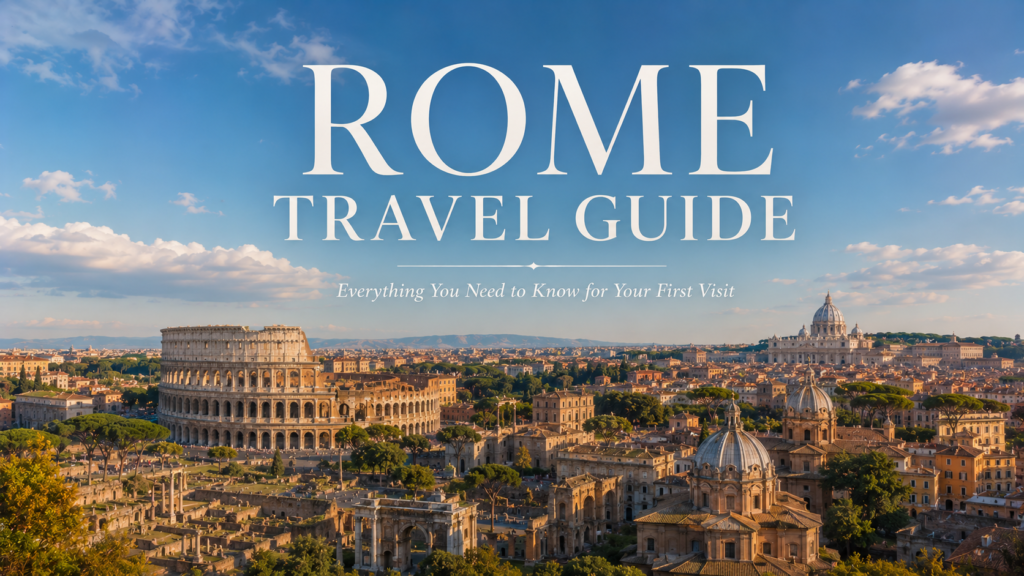
Rome is one of those cities where the past never feels far away. Ancient ruins rise beside busy streets, Renaissance churches open onto lively piazzas, and some of the city’s most remarkable sights appear unexpectedly as you walk through the historic center.
For a first-time visitor, however, Rome can also feel overwhelming. There is an enormous amount to see, from the Colosseum and Roman Forum to the Vatican Museums, St. Peter’s Basilica, the Pantheon, and dozens of neighborhoods, churches, fountains, and archaeological sites in between.
The key is not trying to see everything.
A good first trip to Rome combines the major landmarks with enough unplanned time to walk through its historic streets, stop for coffee or gelato, enjoy a long Roman meal, and experience neighborhoods beyond the busiest attractions.
This Rome travel guide covers the practical details you need to plan that trip, including how many days to spend in Rome, the essential sights, where to stay, how to get around, what to eat, when to visit, what to book in advance, and useful tips for your first visit.
Why Visit Rome?
Few cities offer the same combination of archaeology, art, architecture, food, and everyday street life as Rome.
The city’s history stretches across thousands of years, and many of its most important periods remain visible today. You can walk through the ruins of the Roman Forum in the morning, enter a Renaissance church in the afternoon, and have dinner in a neighborhood built around streets that have been used for centuries.
For first-time visitors, several experiences make Rome particularly memorable.
The Colosseum, Roman Forum, and Palatine Hill provide the clearest introduction to ancient Rome. The Pantheon demonstrates the extraordinary engineering of the Roman Empire, while the streets surrounding Piazza Navona and the Trevi Fountain reveal another side of the historic center.
Then there is Vatican City.
The Vatican Museums contain one of the world’s most important art collections, while the Sistine Chapel and St. Peter’s Basilica make the Vatican an essential part of many first trips to Rome.
But Rome is not only about famous monuments.
Some of the city’s best moments come from walking without a strict itinerary: crossing the Tiber, exploring Trastevere in the evening, finding a quiet piazza away from the busiest streets, or sitting down for a plate of carbonara after a long day of sightseeing.
That combination of monumental history and everyday city life is one of the main reasons Rome deserves more than a rushed visit.
How Many Days Do You Need in Rome?
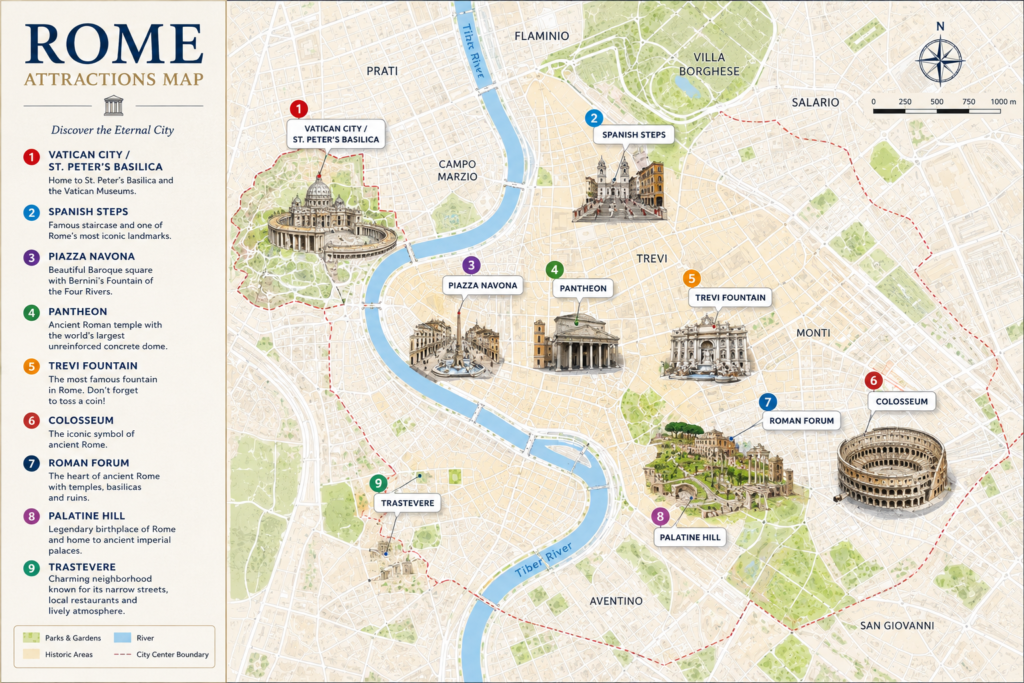
For most first-time visitors, three full days is a good minimum for Rome.
Three days gives you enough time to divide the city into logical sightseeing areas rather than crossing Rome repeatedly throughout the day.
A practical first visit could look something like this:
Day 1: Colosseum, Roman Forum, Palatine Hill, Monti, and the historic center.
Day 2: Vatican Museums, Sistine Chapel, St. Peter’s Basilica, and the area around the Tiber.
Day 3: Pantheon, Piazza Navona, Trevi Fountain, Spanish Steps, additional churches or museums, and time in Trastevere.
With only two days, Rome is still possible, but you will need to prioritize. The Colosseum area and Vatican City can easily consume a large part of one day each, leaving relatively little time for wandering through the historic center.
With four or five days, the pace becomes much more comfortable. You can visit the major sights without stacking too many reservations into each day and have time for places such as the Borghese Gallery, Appian Way, additional archaeological sites, local neighborhoods, or a slower afternoon away from the main tourist routes.
If Rome is part of a longer journey through Italy, three days works especially well for a first trip before continuing north toward Florence and other destinations.
Best Things to Do in Rome
Rome has enough attractions to fill a week, but first-time visitors do not need to see everything.
The following places form a strong foundation for a first visit.
Visit the Colosseum, Roman Forum, and Palatine Hill
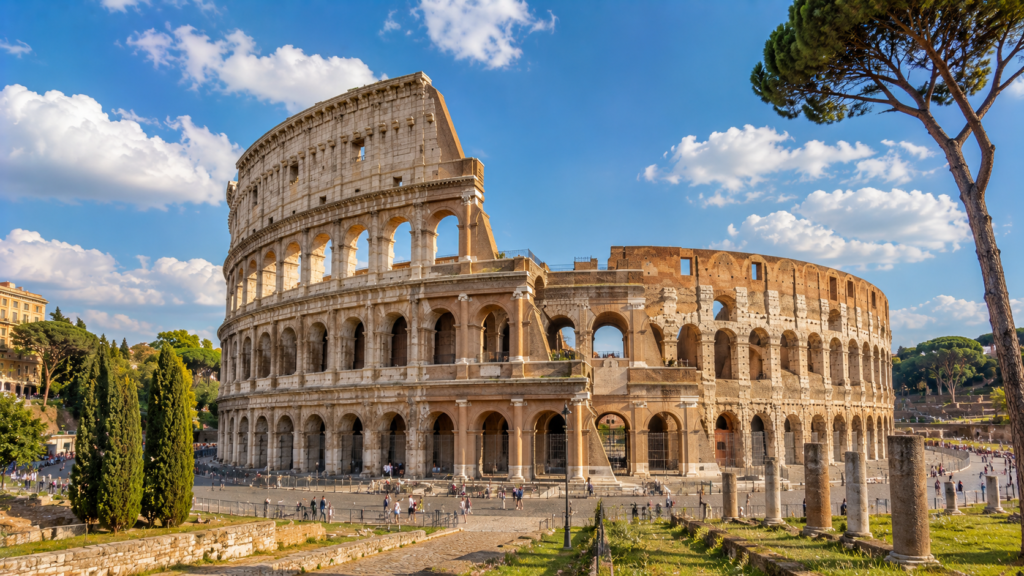
The Colosseum is Rome’s most recognizable ancient monument and one of the sights worth prioritizing on a first trip.
Rather than treating it as an isolated attraction, combine your visit with the Roman Forum and Palatine Hill. Together, these sites provide a much better understanding of ancient Rome.
The Roman Forum was once the political, religious, and commercial center of the city. Today, its temples, arches, columns, and archaeological remains stretch through the valley between the Capitoline and Palatine hills.
Palatine Hill rises above the Forum and is traditionally associated with the origins of Rome. It later became an important residential area for emperors and Rome’s elite.
Allow several hours for the entire archaeological area.
Because entry arrangements and ticket types can change, check the official booking information before your visit and reserve ahead when necessary, particularly during busy travel periods.
Step Inside the Pantheon

The Pantheon is one of the best-preserved monuments of ancient Rome.
Its enormous concrete dome remains an extraordinary architectural achievement, and the circular opening at its center—the oculus—provides the building’s natural light.
The exterior can appear relatively understated compared with some of Rome’s grander monuments, which makes entering the vast interior even more impressive.
The Pantheon is also conveniently located in the historic center, making it easy to combine with Piazza Navona, the Trevi Fountain, and surrounding streets.
Toss a Coin Into the Trevi Fountain
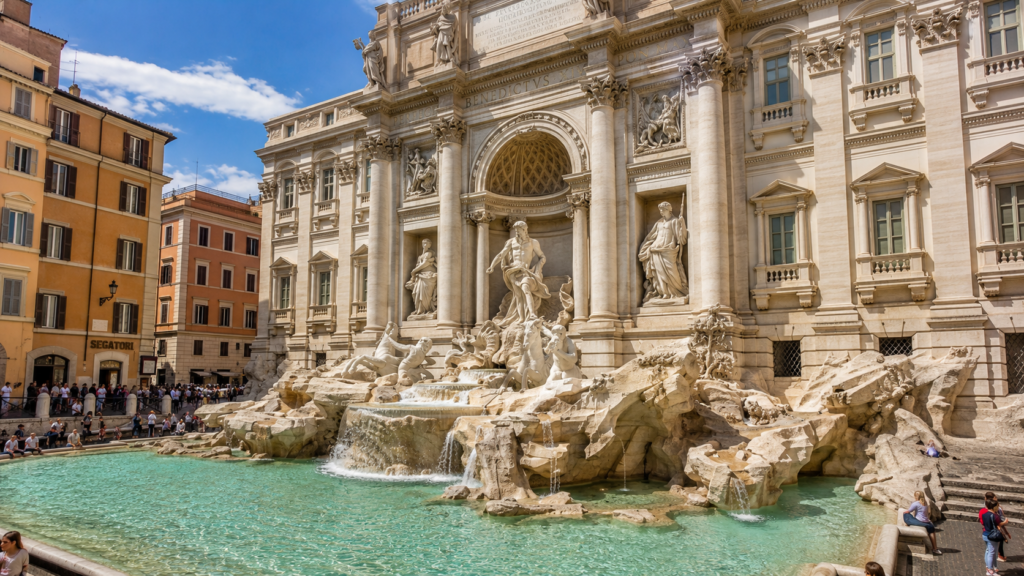
The Trevi Fountain is one of Rome’s most famous landmarks and one of the busiest places in the historic center.
Its monumental Baroque design fills a relatively compact piazza, creating one of the city’s most dramatic urban scenes.
The traditional ritual is to toss a coin into the fountain, which according to popular tradition means you will return to Rome.
Expect crowds, particularly during the middle of the day.
If seeing the fountain in a quieter atmosphere matters to you, an early-morning visit is usually more enjoyable than arriving during peak sightseeing hours.
Walk Through Piazza Navona
Piazza Navona is one of Rome’s great public spaces.
Its long shape follows the footprint of the ancient Stadium of Domitian that once occupied the site. Today, the piazza is surrounded by Baroque architecture, restaurants, cafés, churches, and fountains.
At its center stands Bernini’s Fountain of the Four Rivers.
Piazza Navona works particularly well as part of a walking route through central Rome. The Pantheon is nearby, and from here you can continue toward Campo de’ Fiori, the Trevi Fountain, or cross the river toward the Vatican.
Visit Vatican City

Vatican City is technically an independent state, but for travelers it forms an essential part of a visit to Rome.
The two major experiences are the Vatican Museums and St. Peter’s Basilica.
The Vatican Museums contain an enormous collection assembled over centuries. Visitors pass through galleries filled with sculpture, paintings, tapestries, maps, archaeological objects, and decorated rooms before eventually reaching the Sistine Chapel.
Trying to see every room in detail can quickly become exhausting. For a first visit, it is usually better to identify the collections that interest you most and leave enough energy to appreciate the Sistine Chapel.
Advance planning is particularly important here because the Vatican Museums are among Rome’s most popular attractions. Check the official Vatican Museums website for current opening hours, ticket options, and reservations.
See St. Peter’s Basilica
St. Peter’s Basilica is one of the world’s most significant churches and one of Rome’s most impressive interiors.
The scale becomes difficult to appreciate until you are inside.
Among its many artistic highlights is Michelangelo’s Pietà, while the enormous dome dominates both the basilica and the Vatican skyline.
Visitors who want a panoramic view can also consider climbing to the dome. The experience requires additional time and involves stairs, but the upper levels provide remarkable views over St. Peter’s Square and Rome.
Remember that St. Peter’s Basilica is an active religious site. Appropriate clothing is required, and security checks can create queues.
Walk the Spanish Steps
The Spanish Steps connect Piazza di Spagna with the church of Trinità dei Monti above.
The surrounding area is one of Rome’s busiest shopping and walking districts, with streets leading toward Via del Corso, Villa Borghese, and the Trevi Fountain.
The steps themselves do not require much sightseeing time, so they work best as part of a larger walking route rather than as a standalone destination.
From the upper level near Trinità dei Monti, you can continue toward the terraces and green spaces around Villa Borghese.
Explore Trastevere

Cross the Tiber and Rome begins to feel different.
Trastevere is known for narrow lanes, ochre-colored buildings, small piazzas, restaurants, bars, and a lively evening atmosphere.
The neighborhood is no longer an undiscovered part of Rome—it is firmly on the tourist map—but it still provides a useful contrast to the monumental sights around the Colosseum and Vatican.
Late afternoon and evening are particularly pleasant times to explore.
Walk through the side streets, visit the Basilica of Santa Maria in Trastevere, and stay for dinner if your schedule allows.
Leave Time to Wander
One of the easiest mistakes on a first trip to Rome is scheduling every hour around attractions.
Rome rewards walking.
Many of the historic center’s best-known places are close enough to connect on foot, and the streets between them are part of the experience.
Instead of immediately taking transportation from one landmark to another, allow time to walk between the Pantheon, Piazza Navona, Trevi Fountain, Spanish Steps, Campo de’ Fiori, and nearby neighborhoods.
You will see churches you had not planned to visit, small fountains, courtyards, cafés, archaeological remains, and quiet streets that rarely appear on a must-see checklist.
In Rome, those unscheduled discoveries can be just as memorable as the monuments you booked months in advance.
Where to Stay in Rome
Choosing where to stay in Rome can have a significant impact on your trip.
Rome is a large city, but many of its most famous attractions are concentrated around the historic center, Vatican City, and the archaeological areas surrounding the Colosseum. For a first visit, staying relatively central usually saves time and makes it easier to explore on foot.
There is no single best neighborhood for everyone. The right area depends on whether you prioritize sightseeing, atmosphere, nightlife, transportation, or value.
Centro Storico
For first-time visitors who want to be surrounded by Rome’s historic streets, Centro Storico is one of the most convenient places to stay.
Depending on your exact location, you may be within walking distance of the Pantheon, Piazza Navona, Trevi Fountain, Campo de’ Fiori, and many smaller churches and piazzas.
The biggest advantage is location. You can begin exploring early, return to your accommodation during the day, and enjoy central Rome after many day visitors have left.
The trade-off is price. Accommodation in the most desirable parts of the historic center can be expensive, particularly during popular travel periods.
Best for: First-time visitors, couples, and travelers who want to walk to many major sights.
Monti
Monti sits close to the Colosseum and Roman Forum while still feeling like a neighborhood rather than simply an attraction zone.
Its streets contain restaurants, cafés, small shops, and bars, and the area is particularly convenient if ancient Rome is high on your itinerary.
Monti also has useful public transportation connections, making it easier to reach other parts of the city.
Best for: Travelers who want atmosphere, restaurants, and easy access to the Colosseum.
Trastevere
Trastevere is one of Rome’s most atmospheric neighborhoods.
Its narrow streets, old buildings, restaurants, piazzas, and evening activity make it attractive to travelers who want to experience Rome beyond the immediate surroundings of its largest monuments.
The neighborhood becomes particularly lively after sunset.
However, not every part of Trastevere is equally convenient for sightseeing. Depending on where you stay, reaching attractions such as the Colosseum or Spanish Steps may require a longer walk or public transportation.
Best for: Food, nightlife, evening atmosphere, and travelers who do not mind being slightly removed from some major sights.
Prati
Located near Vatican City, Prati offers broad streets, shopping, restaurants, and convenient access to the Vatican Museums and St. Peter’s Basilica.
It generally feels more residential than the busiest parts of the historic center.
Metro connections also make it relatively easy to travel toward other areas of Rome.
Best for: Vatican-focused visits, families, and travelers who prefer a somewhat quieter base.
Near Termini Station
Staying around Roma Termini can be practical if transportation is your priority.
Rome’s main railway station provides connections to other Italian cities and both metro lines serving the station make it easier to move around Rome.
This can be particularly useful if you are arriving late, leaving early, or using Rome as the starting point for a longer Italian itinerary.
The area varies considerably from street to street, however, and it does not offer the same atmosphere as the historic center.
Best for: Train connections, shorter stays, and travelers prioritizing convenience or potentially lower accommodation prices.
Which Area Should First-Time Visitors Choose?
If budget allows, staying in or near the historic center is difficult to beat for a first trip.
If you want more neighborhood atmosphere, consider Monti or Trastevere.
Choose Prati if Vatican City is a major priority, while accommodation near Termini can make sense when transportation and onward train travel matter more than historic atmosphere.
Before booking, check the exact location rather than relying only on the neighborhood name. A difference of several streets can significantly change walking times and access to public transportation.
Getting Around Rome
Rome is best explored using a combination of walking and public transportation.
You do not need a car for a typical city visit.
In fact, driving can create unnecessary complications because of traffic, parking restrictions, limited-traffic zones, and the fact that many of the most interesting parts of central Rome are better experienced on foot.
Walking
Walking is one of the best ways to experience Rome.
Many major attractions in the historic center are closer together than they appear when planning a trip on a map.
For example, it is easy to create a walking route connecting several central sights rather than using transportation between every stop.
Comfortable shoes are essential. Rome’s cobblestones, uneven surfaces, stairs, and long sightseeing days can make fashionable but uncomfortable footwear a poor choice.
Also remember that Rome is larger than its historic center. Walking works extremely well within individual sightseeing areas, but you may want public transportation when moving between distant parts of the city.
Metro
Rome’s metro system is useful but relatively limited compared with those of some other major European capitals.
It is particularly helpful for certain journeys, including travel between Termini, the Colosseum area, the Spanish Steps, and areas near Vatican City.
The metro can save significant time when your next destination is far from your current location.
During busy periods, trains and stations can become crowded, so keep an eye on your belongings.
Buses and Trams
Buses cover much more of Rome than the metro and can reach areas without nearby underground stations.
They are useful, but traffic means journey times can be less predictable.
For visitors, buses work best when they solve a specific transportation problem rather than as the default way to move between every attraction.
Trams serve selected parts of the city and can also be useful depending on where you are staying.
Ticket systems, fares, and validation requirements can change, so check current information from Rome’s official public transportation provider before traveling.
Taxis
Official taxis can be useful when you have luggage, are traveling early or late, or need to reach somewhere that is inconvenient by public transportation.
Use licensed taxis and official taxi ranks where possible.
For airport journeys, check current official fare information and rules before your trip rather than relying on old prices found in travel articles.
Getting From Rome Airport to the City
Rome is primarily served by two airports: Leonardo da Vinci–Fiumicino Airport (FCO) and Ciampino Airport (CIA).
Your best transfer option depends on which airport you use, where you are staying, your arrival time, and how much luggage you have.
From Fiumicino Airport
Fiumicino is Rome’s main international airport and is located outside the city center.
One of the most straightforward options for many travelers is the Leonardo Express, which connects the airport with Roma Termini.
This is particularly convenient if your accommodation is near Termini or you can easily continue from the station by metro, taxi, or other transportation.
Other regional rail services may be more convenient if your destination is not near Termini.
Buses and taxis are additional options.
If you are arriving after a long international flight with several bags, a taxi or prearranged transfer may be worth considering despite the higher cost.
From Ciampino Airport
Ciampino is smaller and is often used by low-cost airlines.
Unlike Fiumicino, it does not have the same direct airport rail connection to central Rome.
Travelers commonly use buses or combinations of local transportation to reach the city.
A taxi can be convenient for groups or travelers with significant luggage.
Whichever airport you use, check transportation schedules close to your travel date, especially if your flight arrives very early or late.
What to Eat in Rome
Food is an essential part of experiencing Rome.
Roman cuisine is traditionally straightforward and intensely flavored, with many classic dishes relying on relatively few ingredients.
You do not need to eat beside a famous monument to have a memorable meal. Exploring neighborhoods and streets slightly removed from the busiest attractions can often lead to a more relaxed dining experience.
Carbonara
Roman carbonara is one of the city’s most famous pasta dishes.
Traditional versions are built around pasta, eggs, Pecorino Romano, guanciale, and black pepper.
The result should be rich and creamy without depending on the heavy cream sometimes found in versions outside Italy.
Cacio e Pepe
Cacio e pepe demonstrates how a small number of ingredients can produce a distinctive dish.
Pasta is combined with Pecorino Romano and black pepper to create a creamy, intensely savory sauce.
It sounds simple, but achieving the correct texture is part of what makes a well-prepared version memorable.
Amatriciana
Amatriciana combines tomato, guanciale, and Pecorino Romano.
Although the dish has roots in Amatrice outside Rome, it has become deeply associated with Roman trattoria cooking.
It is an excellent choice if you want a tomato-based alternative to carbonara or cacio e pepe.
Gricia
Gricia can be thought of as another member of Rome’s classic pasta family.
It typically combines guanciale, Pecorino Romano, and black pepper without tomato or egg.
Trying several of Rome’s classic pasta dishes during your stay is one of the easiest ways to understand the similarities and differences between them.
Supplì
Supplì are fried rice snacks, often filled with tomato-seasoned rice and mozzarella.
They make an excellent quick snack between sightseeing stops and can be found at pizzerias and casual food shops around the city.
Roman-Style Pizza
Rome offers several styles of pizza.
For a quick meal, look for pizza al taglio, where rectangular pizzas are cut into portions.
Sit-down pizzerias may serve thin, crisp Roman-style round pizzas.
Both are worth trying, particularly if you want something faster and less formal than a full restaurant meal.
Gelato
Gelato is an obvious addition to a Rome itinerary, especially after a long day of walking.
Quality varies considerably in heavily visited areas.
Rather than choosing solely based on enormous displays or proximity to a landmark, look for shops where the gelato appears naturally colored and where seasonal flavors are treated seriously.
Best Time to Visit Rome
Rome can be visited throughout the year, but weather, crowds, prices, and daylight vary considerably by season.
For many travelers, spring and autumn provide the best balance.
Spring
Spring is one of the most attractive times to visit Rome.
Temperatures are generally more comfortable for walking than during the hottest part of summer, and longer daylight hours make sightseeing easier.
However, spring is not automatically quiet. Popular attractions can still be very busy, especially around holidays and major events.
Booking important sights in advance remains a good idea.
Summer
Summer brings long days and plenty of activity, but it can also bring intense heat and large numbers of visitors.
If you visit during hot weather, structure your day accordingly.
Use the cooler morning hours for outdoor archaeological sites, take breaks during the hottest part of the afternoon, stay hydrated, and avoid creating an itinerary that requires hours of continuous walking without rest.
Attractions such as the Roman Forum offer limited shade in some areas, making timing particularly important.
Autumn
Autumn can be an excellent time for Rome.
As temperatures become more comfortable, walking around the historic center and archaeological sites is generally easier than during peak summer heat.
Early autumn can remain busy, so do not assume that major attractions will be empty simply because summer has ended.
Later in the season, shorter days and a greater chance of rain become factors to consider.
Winter
Winter offers a different version of Rome.
Days are shorter and the weather can be cool or wet, but sightseeing conditions may be more comfortable for travelers who dislike heat.
Outside major holiday periods, winter can also feel less intense than the busiest months of the year.
Bring layers and a waterproof outer layer, and plan indoor attractions such as museums and churches alongside outdoor sightseeing.
So, When Should You Go?
For a first visit, April to May and late September into October are often attractive periods if you want relatively comfortable sightseeing weather.
But there is no perfect month that guarantees low crowds, low prices, and ideal weather simultaneously.
If your dates are fixed, it is usually better to adapt your daily schedule to the season rather than postponing a trip solely in search of a supposedly perfect time to visit Rome.
Suggested Rome Itinerary
Rome rewards slow exploration, but having a basic plan helps you avoid wasting time traveling back and forth across the city.
For a first visit, organize your days geographically and avoid scheduling too many timed attractions on the same day.
One Day in Rome
One day is not enough to experience Rome properly, but if that is all the time you have, focus on the city’s most important sights rather than trying to cover everything.
Start early at the Colosseum, then continue through the Roman Forum and Palatine Hill.
Afterward, walk toward the historic center. Depending on your pace, continue to the Pantheon, Piazza Navona, and Trevi Fountain.
Finish the day with dinner in the historic center, Monti, or Trastevere.
With only one day, trying to add the Vatican Museums usually makes the itinerary too rushed. If Vatican City matters more to you than ancient Rome, build your day around the Vatican instead.
Two Days in Rome
With two days, divide Rome into two major sightseeing areas.
Day 1: Ancient Rome and the Historic Center
Begin with the Colosseum, Roman Forum, and Palatine Hill.
After lunch, continue toward central Rome and explore the Pantheon, Piazza Navona, Trevi Fountain, and surrounding streets.
Day 2: Vatican City and Trastevere
Reserve the morning for the Vatican Museums and Sistine Chapel.
Continue to St. Peter’s Basilica, then cross the Tiber and spend the late afternoon or evening exploring Trastevere.
Two days will still feel busy, but this structure allows you to experience Rome’s two major historical centers without constantly crossing the city.
Three Days in Rome
Three days provides a much better introduction to Rome and is the length of stay we recommend for most first-time visitors.
Day 1: Colosseum and Ancient Rome
Visit the Colosseum, Roman Forum, and Palatine Hill. Afterward, explore Monti and enjoy a slower evening nearby.
Day 2: Vatican City and Trastevere
Visit the Vatican Museums, Sistine Chapel, and St. Peter’s Basilica. Later, walk toward the Tiber and spend the evening in Trastevere.
Day 3: Historic Center
Dedicate your final day to the Pantheon, Piazza Navona, Trevi Fountain, Spanish Steps, and the streets connecting them.
If you prefer art to additional walking, consider replacing part of the day with a museum or gallery that interests you.
Most importantly, leave some unscheduled time.
Rome is a city where wandering between attractions is part of the experience.
What to Book in Advance
Not everything in Rome requires advance reservations, but several major attractions are much easier to visit when planned beforehand.
During popular travel periods, waiting until you arrive can mean inconvenient time slots—or no availability at all.
Colosseum
If the Colosseum is important to your trip, treat it as one of your priority reservations.
Ticket types and access arrangements can vary, particularly for special areas of the archaeological complex.
Before purchasing, decide whether you simply want standard access or are interested in additional areas or guided experiences.
Always check current ticket information through the official attraction website before booking.
Vatican Museums
The Vatican Museums should also be high on your advance-booking list.
They are among the most visited attractions in Rome, and arriving without a plan can result in unnecessary waiting or limited options.
A timed reservation helps structure your Vatican day and makes it easier to plan St. Peter’s Basilica and the surrounding area afterward.
Borghese Gallery
If you plan to visit the Borghese Gallery, do not assume you can simply arrive whenever you want.
Visitor access is controlled, making advance planning especially important.
Art lovers should consider placing this reservation early in the planning process rather than treating the gallery as a last-minute addition.
Restaurants
You do not need reservations for every meal in Rome.
However, if there is a particular restaurant you strongly want to visit—especially a popular or small restaurant—booking ahead can be worthwhile.
For the rest of your trip, leave some flexibility. Part of the pleasure of Rome is discovering a trattoria, pizzeria, or casual restaurant while exploring a neighborhood.
Rome Travel Tips for First-Time Visitors
A little preparation can make Rome significantly easier to navigate.
Start Your Days Early
Rome’s major attractions become busy, particularly during popular travel periods.
Starting early gives you cooler walking conditions in warmer months and often a more pleasant atmosphere around outdoor landmarks.
This is especially useful for places such as the Trevi Fountain and other open public spaces that do not depend on a timed ticket.
Group Attractions by Area
Do not plan your itinerary simply by ranking attractions from most to least important.
Look at where they are located.
The Colosseum, Roman Forum, and Palatine Hill belong together. The Pantheon, Piazza Navona, and Trevi Fountain can form another walking route. Vatican City deserves its own substantial block of time.
Grouping sights geographically reduces unnecessary transportation and gives you more time to enjoy the city.
Wear Comfortable Shoes
You will probably walk much more than expected.
Historic streets, cobblestones, stairs, archaeological sites, and long museum visits can be tiring.
Comfortable shoes are one of the most useful things you can pack for Rome.
Carry Water
Rome can become extremely warm during summer, and sightseeing often involves long periods outdoors.
Carry water and refill when appropriate rather than waiting until you are already dehydrated.
Rome is also famous for its public drinking fountains, commonly known as nasoni. Where the water is designated as drinkable, they can be useful for refilling a bottle while exploring.
Respect Church Dress Codes
Rome contains an extraordinary number of churches, including St. Peter’s Basilica and many smaller churches you may enter spontaneously while sightseeing.
Dress requirements can apply at religious sites.
If you are visiting during hot weather, carry a light layer or other suitable clothing so that you can enter churches respectfully without having to return to your accommodation.
Watch Your Belongings
As in many heavily visited European cities, crowded transportation and major tourist areas require normal big-city awareness.
Keep valuables secure, particularly in crowded metro trains, stations, and around busy attractions.
There is no need to spend your trip worrying, but basic precautions are sensible.
Build Breaks Into Your Schedule
A common planning mistake is treating Rome like a checklist.
Walking through archaeological sites in the morning, spending several hours in museums, and then crossing the city for another reservation can quickly become exhausting.
Leave room for lunch, coffee, gelato, and simply sitting in a piazza.
You will probably remember those moments as clearly as another monument squeezed into an already full day.
Common Mistakes to Avoid in Rome
Trying to See Everything
Rome has thousands of years of history.
You will not see everything in two, three, or even five days.
Prioritize the experiences that matter most to you and accept that there will always be another reason to return.
Booking Major Attractions Too Late
Leaving your most important attractions until the last minute creates unnecessary risk.
Once your travel dates are confirmed, identify the sights requiring timed reservations and check when official tickets become available.
Scheduling the Colosseum and Vatican Too Close Together
Both areas deserve time.
Trying to rush through one major attraction because you have a timed reservation across the city can turn what should be a memorable day into a logistical exercise.
Whenever possible, place them on different days.
Eating Only Beside Major Attractions
Convenience sometimes matters, and there is nothing wrong with eating near a landmark when it suits your schedule.
But if every meal takes place immediately beside Rome’s busiest sights, you miss an opportunity to explore its neighborhoods and broader food culture.
Walk a few streets away and compare your options.
Underestimating Walking Distances
Rome’s center is very walkable, but that does not mean every destination is close.
Several short-looking walks combined throughout the day can add up to many kilometers.
Check routes before leaving and use public transportation when it genuinely saves time and energy.
Renting a Car for Central Rome
A car is unnecessary for a standard Rome city break.
Traffic, parking, restricted driving zones, and narrow historic streets generally make a car more of a burden than an advantage.
If Rome is part of a larger Italian road trip, consider collecting your rental car when you are ready to leave the city rather than using it for central sightseeing.
Frequently Asked Questions
Is Rome expensive?
Rome can be expensive, particularly for accommodation in central areas and tickets to major attractions, but the overall cost depends heavily on how you travel.
Many of the city’s pleasures—walking through historic neighborhoods, visiting piazzas, seeing fountains, and exploring streets—cost nothing.
You can also control food costs by mixing restaurant meals with pizza al taglio, bakeries, markets, and other casual options.
Accommodation is often the largest variable, so comparing neighborhoods can make a substantial difference to your budget.
Is Rome walkable?
Yes, especially within the historic center.
Walking is often the best way to connect places such as the Pantheon, Piazza Navona, Trevi Fountain, and Spanish Steps.
However, Rome is a large city. Public transportation is useful when moving between more distant areas or when your feet need a break.
Is Rome safe for tourists?
Rome is visited by millions of travelers and most visits are trouble-free.
The practical concerns for visitors are similar to those in other busy European cities: keep track of valuables, be alert in crowded transportation and tourist areas, and use normal precautions at night.
How many days are enough for Rome?
Three full days is a good starting point for most first-time visitors.
Two days allows you to see several highlights but requires a faster pace.
Four or five days gives you more flexibility for museums, neighborhoods, archaeological sites, and slower exploration.
Do you need a car in Rome?
No.
Walking, metro, buses, trams, and taxis are sufficient for most visitors.
A car is generally unnecessary for sightseeing in central Rome and can create additional problems with traffic, parking, and restricted driving areas.
Can you visit Rome without booking attractions in advance?
Yes, but you should not rely on this strategy for every major attraction.
Public spaces such as Piazza Navona and the Trevi Fountain can be visited without traditional admission reservations, while major ticketed attractions may require much more planning.
If the Colosseum or Vatican Museums are essential to your trip, check official booking arrangements before you travel.
What is the best area to stay in Rome for first-time visitors?
For many first-time visitors, the historic center offers the most convenient sightseeing location.
Monti is an excellent alternative near the Colosseum, Trastevere works well for atmosphere and evenings, and Prati is particularly convenient for Vatican City.
There is no universally best neighborhood, so choose based on your itinerary and budget.
What should you not miss on your first trip to Rome?
For a classic first visit, prioritize the Colosseum and Roman Forum, the Pantheon, Trevi Fountain, Piazza Navona, Vatican Museums, Sistine Chapel, and St. Peter’s Basilica.
Just as importantly, leave time to walk through Rome without moving directly from one attraction to the next.
Final Thoughts
Rome can seem overwhelming when you first begin planning.
There are ancient monuments, world-famous museums, churches filled with masterpieces, historic neighborhoods, archaeological sites, fountains, piazzas, and enough restaurants to make choosing dinner feel like another travel decision.
You do not need to experience all of them on your first trip.
Give Rome at least three days if your itinerary allows, reserve the attractions that matter most, organize sightseeing by neighborhood, and leave enough space in your schedule to enjoy the city between the landmarks.
Walk through the historic center. Stop for coffee. Try the classic Roman pastas. Cross the Tiber in the evening. Enter a church you had not planned to visit.
The Colosseum and Vatican may be the places that bring you to Rome, but the city often becomes most memorable in the hours between those major sights.
And if Rome is the beginning of a longer journey, it is an excellent starting point for traveling north through Florence, Tuscany, Venice, Milan, and Lake Como.
Related Italy Travel Guides
Continue planning your trip with these Velkeno Italy guides:
Best Places to Visit in Italy in 2026
Discover the cities, coastal destinations, countryside, lakes, and historic places worth considering when planning a trip through Italy.
Italy 10-Day Itinerary: The Perfect First Trip to Italy
Follow a practical first-time route through Rome, Florence, Tuscany, Venice, Milan, and Lake Como.
Best Things to Do in Rome
A detailed guide to Rome’s essential attractions, historic sites, museums, neighborhoods, and experiences.
Where to Stay in Rome
A detailed comparison of Rome’s best neighborhoods and areas for different budgets and travel styles.
Florence Travel Guide
Plan the next stage of your Italian journey with practical advice for visiting Florence.
Best Time to Visit Italy
Compare Italy by season to decide when to plan your trip based on weather, crowds, destinations, and travel style.