
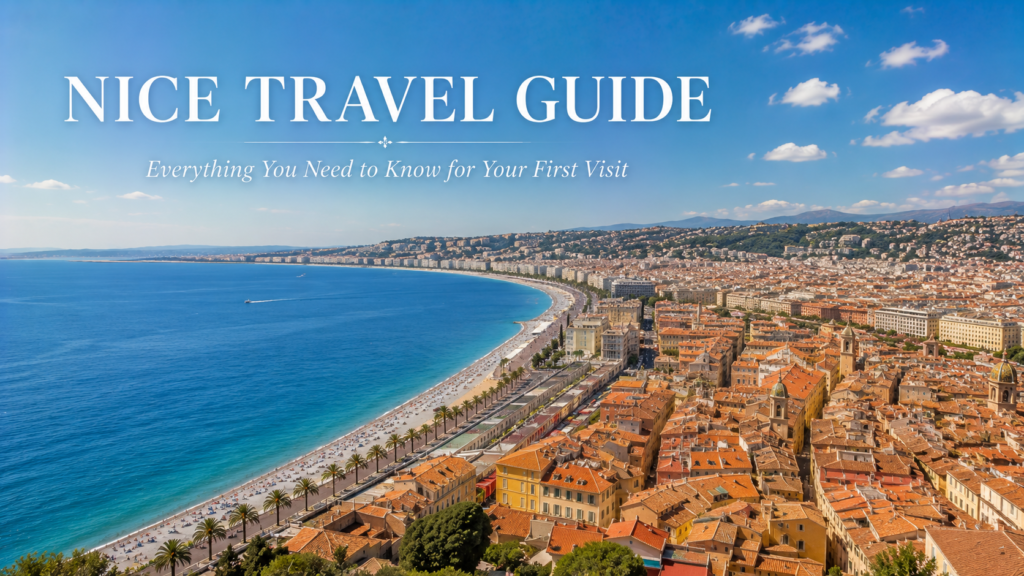
Nice feels different from many of France’s classic city-break destinations.
Here, the Mediterranean is part of everyday life. The Old Town sits only minutes from the waterfront, local markets spill into colorful squares, and regional trains make it surprisingly easy to explore other towns along the French Riviera without changing hotels.
That combination makes Nice particularly useful for a first trip to southern France. You can spend the morning wandering through Vieux Nice, swim or walk beside the Mediterranean in the afternoon, and take a train to another Riviera town the following day.
This Nice travel guide focuses on the practical decisions that matter when planning your first visit: how long to stay, where to base yourself, how to get around, what deserves your time, and which nearby destinations work well as day trips.
If Nice is part of a longer journey through the country, our France 10-Day Itinerary shows how to combine the French Riviera with Paris, the Loire Valley, Bordeaux, and Provence.
Is Nice Worth Visiting?
Yes, especially if you want to combine a city break with the Mediterranean coast.
Nice is not simply a beach destination. Its appeal comes from the combination of Vieux Nice, markets, museums, viewpoints, waterfront walks, regional food, and easy access to other parts of the Côte d’Azur.
It also works extremely well as a base.
Instead of moving hotels between several Riviera towns, you can stay in Nice and use regional trains or buses for day trips. Villefranche-sur-Mer, Monaco, Antibes, and other coastal destinations can all fit into a wider Nice itinerary.
There is one expectation worth adjusting before you arrive: Nice is not known for long stretches of soft sandy beach.
Much of the city’s shoreline consists of smooth pebbles. The water can be beautiful, but the beach experience is different from a typical sandy Mediterranean resort.
Come primarily for the combination of coast, city, food, culture, and access to the Riviera.
Nice at a Glance
Nice sits on the Mediterranean coast of southeastern France, relatively close to the Italian border.
It is one of the main gateways to the French Riviera and has its own international airport, major railway station, tram network, and extensive regional transport connections.
For a first trip, these are the essentials:
Best for:
Mediterranean scenery, Old Town streets, food, coastal walks, museums, beaches, and Riviera day trips.
Ideal stay:
About 3 days for Nice plus one nearby destination.
Getting around:
Walking and public transportation are sufficient for most visitors.
Car:
Usually unnecessary if you are staying in Nice and visiting destinations connected by train.
Best base:
Central Nice, especially somewhere convenient for Vieux Nice, the waterfront, or tram connections.
Major first-time highlights:
Vieux Nice, Castle Hill, Promenade des Anglais, Cours Saleya, Port Lympia, and the Mediterranean waterfront.

How Many Days Should You Spend in Nice?
Three days is a strong starting point.
With two days, you can cover the major sights in Nice itself but will have limited time for the surrounding Riviera.
Three days gives you more flexibility:
Day 1 can focus on Vieux Nice, Cours Saleya, Castle Hill, and the waterfront.
Day 2 can cover another side of the city, including museums, neighborhoods, food, and more time beside the Mediterranean.
Day 3 can become a day trip to somewhere such as Villefranche-sur-Mer, Èze, Monaco, or Antibes.
Four or five days makes sense if you want Nice to function as your main base for exploring the Côte d’Azur.
In that case, resist the temptation to change hotels every night. Nice’s transportation connections make day trips much easier than repeatedly packing and moving.
Understanding Nice Before Your Trip
Nice is easier to plan once you understand how its main areas relate to one another.
The sections most visitors use are relatively close together, but each has a different atmosphere.
Vieux Nice

Vieux Nice, or Old Nice, is the historic heart of the city.
Its narrow streets are packed with restaurants, small shops, cafés, churches, colorful façades, and local food businesses.
This is one of the best areas for wandering without a strict sightseeing plan.
Cours Saleya sits along the edge of the Old Town and is known for its market activity. From here, the Mediterranean waterfront is only a short walk away.
Vieux Nice becomes lively in the evening, which is convenient for dining but worth considering if you prefer extremely quiet accommodation.
The Promenade des Anglais
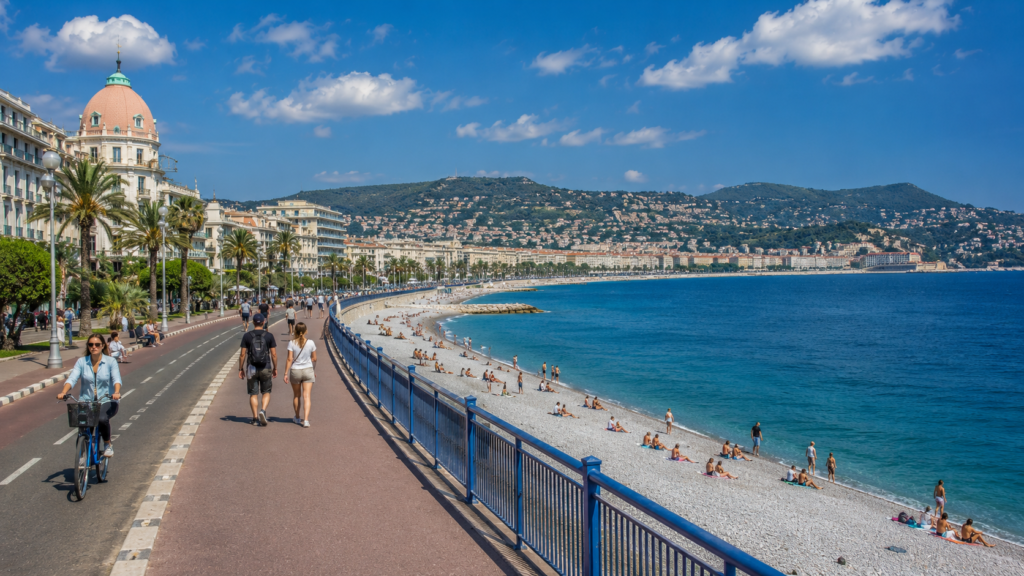
The Promenade des Anglais follows the curve of the Baie des Anges and forms one of Nice’s defining public spaces.
It is used by walkers, runners, cyclists, locals, and visitors throughout the day.
For first-time travelers, walking at least part of the promenade is one of the simplest ways to understand the geography of Nice.
The Mediterranean remains on one side while hotels and city streets extend inland on the other.
You do not need to walk its entire length.
The central sections around the Old Town and city center are enough to experience the waterfront without turning sightseeing into a long endurance walk.
Port Lympia
On the eastern side of central Nice, Port Lympia provides another perspective on the city.
The harbor, colorful buildings, boats, restaurants, and surrounding streets feel different from the broad Promenade des Anglais.
It is easy to combine the port with Castle Hill and Vieux Nice in the same day.
Rather than treating it as a major attraction requiring several hours, include it as part of a walking route through eastern central Nice.
Cimiez
Cimiez sits inland and uphill from the busiest waterfront areas.
It is particularly interesting for travelers who want museums, history, and a quieter side of Nice.
The district is associated with Roman remains and important cultural sites, and it feels noticeably removed from the beach-oriented atmosphere closer to the Mediterranean.
Cimiez is a good example of why Nice should not be reduced to its coastline.
The Coast Around Nice
One of Nice’s greatest strengths is what lies beyond the city itself.
The coastline east and west of Nice contains a series of towns and communities connected by regional transportation.
Villefranche-sur-Mer lies immediately east of Nice and offers a picturesque bay and smaller-town atmosphere.
Continue farther east and you can reach destinations toward Monaco and the Italian border.
Travel west and places such as Antibes become practical options.
This geography is the main reason Nice works so well as a French Riviera base.
Getting to Nice
Nice is one of the easiest destinations in southern France to reach without a car.
You can arrive by air or rail, and once you are in the city, public transportation handles most everyday journeys.
Flying Into Nice
Nice Côte d’Azur Airport sits unusually close to the city.
That is a major advantage compared with destinations where the main airport is an hour or more from the historic center.
Tram services connect the airport area with central Nice, making public transportation a practical option for many travelers.
Before automatically booking a private airport transfer, check whether your accommodation is close to a tram stop.
Traveling light makes this particularly easy.
For very early departures, late arrivals, large amounts of luggage, or accommodation poorly connected to public transportation, a taxi may be more convenient.
Arriving by Train
Nice-Ville is the city’s principal railway station.
Rail is particularly useful if Nice comes after another destination in southern France.
Once you arrive, you can continue by tram, local bus, taxi, or on foot depending on where you are staying.
The railway also becomes important after check-in because regional trains provide one of the easiest ways to explore the Riviera.
Continuing to Nice From Provence
Travelers following a wider southern France route often visit Provence before Nice.
Rail is generally the easiest option when traveling between major cities, although your exact route depends on where you stay in Provence.
Avignon, Aix-en-Provence, and Marseille have different connections, so check the actual journey for your dates instead of treating “Provence” as a single transportation point.
This is also where itinerary design matters.
If you rent a car to explore rural Provence, you may not need to keep it once you reach Nice.
Returning the vehicle before spending several days on the Riviera can eliminate parking costs and unnecessary driving.
Getting Around Nice
For most visitors, Nice is a public-transportation-and-walking city.
A rental car can actually create more problems than it solves if your accommodation is central and your planned day trips are along the railway corridor.
Walking
Walking should be your default for central sightseeing.
Vieux Nice, Cours Saleya, the waterfront, Castle Hill area, Place Masséna, and many central streets can be combined naturally on foot.
The advantage is not simply saving money.
Nice rewards the spaces between attractions: side streets, bakeries, small squares, architecture, and unexpected views toward the Mediterranean.
Wear comfortable shoes, particularly when exploring older streets or climbing toward viewpoints.
Trams and Buses
Nice’s tram and bus network is useful when your destination is too far to walk comfortably.
Trams are particularly practical for several central journeys and airport connections.
Buses extend the network farther into the city and surrounding area.
Do not build your itinerary around memorizing every route before arrival.
Know how to reach your accommodation, then use current local transportation information for individual journeys as needed.
Regional Trains Along the Riviera
Regional trains are one of the most useful tools for travelers based in Nice.
They make it possible to visit several coastal destinations without renting a car or joining a tour.
This is particularly valuable on a short trip because you can leave Nice in the morning, explore another town, and return to the same accommodation that evening.
For destinations served conveniently by rail, this is often preferable to driving and searching for parking.
Do You Need a Car?
For a typical three-day Nice trip: no.
If your plan consists of Nice, Monaco, Antibes, Villefranche-sur-Mer, and other well-connected Riviera destinations, public transportation is usually sufficient.
A car becomes more useful when your itinerary moves away from the main coastal transportation corridors or into rural areas where public connections are limited.
Rent one because your route requires it, not because a Mediterranean road trip sounds automatically more convenient.
Where to Stay in Nice
The best area depends on what you want outside your hotel door.
A first-time visitor generally benefits from staying relatively central rather than saving a small amount on accommodation far from the areas they will visit every day.
Vieux Nice
Stay in or near Vieux Nice if atmosphere and walkability are priorities.
Restaurants, historic streets, Cours Saleya, Castle Hill, and the waterfront are all close.
The trade-off is activity.
Some streets remain busy into the evening, and historic buildings do not always provide the same space, elevators, or sound insulation as newer accommodation.
Check individual hotel details rather than assuming every Old Town property offers the same experience.
Carré d’Or
The Carré d’Or area is a practical compromise for many first-time visitors.
It provides access to restaurants, shopping, central streets, and the waterfront while remaining convenient for exploring other parts of Nice.
This can be a strong choice if you want a central base without staying directly inside the narrow streets of Vieux Nice.
Near the Promenade des Anglais
Waterfront accommodation is appealing if Mediterranean views and immediate beach access matter to you.
The important question is how far west along the promenade you stay.
A hotel facing the sea may look perfect on a booking page but still require additional walking or public transportation to reach Vieux Nice and other attractions.
Check the location on a map before paying a premium simply for the words “Promenade des Anglais.”
Port Area
The streets around Port Lympia offer another interesting base.
You remain close to the harbor, eastern side of Vieux Nice, and routes toward some destinations east of the city.
The atmosphere can feel more residential than the busiest parts of the central waterfront.
For travelers planning several days in Nice rather than a single overnight stay, it is worth considering.
What to Do in Nice on Your First Visit
This section intentionally focuses on a manageable first-visit shortlist rather than trying to catalog every attraction in the city.
For broader destination inspiration around the country, see our Best Places to Visit in France in 2026
Explore Vieux Nice
Start with the Old Town.
There is no need to create a street-by-street itinerary.
Walk through the narrow lanes, step into churches that interest you, browse local shops, and allow time for food rather than treating Vieux Nice as something to cross off in thirty minutes.
Morning and evening offer different experiences, so you may naturally pass through more than once during your stay.
Walk the Promenade des Anglais
The promenade is Nice’s most recognizable waterfront experience.
Walk a central section, stop along the sea, and use it to connect other parts of your day.
During warm weather, you can combine the walk with time on the beach, but remember that much of Nice’s shoreline is pebbled.
See Nice From Castle Hill

Castle Hill, or Colline du Château, provides one of the city’s classic viewpoints.
From the elevated area you can look across the Old Town, Baie des Anges, waterfront, and port.
The panorama is particularly useful early in your visit because it helps you understand how Nice fits together geographically.
Visit Cours Saleya
Cours Saleya is closely associated with Nice’s market culture and Old Town atmosphere.
Visit as part of your exploration of Vieux Nice rather than treating it as an isolated attraction.
Market activity varies by day and time, so the experience can be different depending on when you arrive.
Explore the Port
Continue around Castle Hill toward Port Lympia.
The transition from the Old Town and Mediterranean waterfront to the harbor creates a pleasant walking route and shows another side of central Nice.
Stop for a meal or drink if the timing works rather than rushing back toward the main tourist streets.
Spend Time by the Mediterranean
Do not plan every hour around monuments.
Nice is one of those destinations where simply spending time beside the Mediterranean is part of the trip.
Walk, sit by the water, swim when conditions are appropriate, or give yourself a slower afternoon after several days of sightseeing elsewhere in France.
That contrast is one of the main reasons Nice works so well near the end of a longer French itinerary.
A Practical 3-Day Nice Itinerary
Nice works best when you avoid turning each day into a race between landmarks.
The historic center is compact enough to explore at a comfortable pace, while the railway makes it easy to dedicate one day to another part of the French Riviera.
This three-day plan gives you two days in Nice and one day beyond the city.
Day 1 — Vieux Nice, Castle Hill and the Waterfront
Begin your first morning in Vieux Nice.
Walk through the Old Town before the busiest part of the day, stopping around Cours Saleya and exploring whichever streets catch your attention.
This is a good time to try a local bakery or café rather than starting with a long formal breakfast.
From the Old Town, continue toward Castle Hill.
Allow enough time at the viewpoints to look across both sides of the hill. One direction opens toward the Baie des Anges and Nice’s waterfront, while another looks toward Port Lympia.
After descending, spend the afternoon around the Mediterranean.
Walk part of the Promenade des Anglais and, if the weather is suitable, leave time for the beach.
Return to Vieux Nice in the evening for dinner.
Because many of the day’s stops are close together, you should be able to complete this route mostly on foot.
Day 2 — Markets, Museums and Another Side of Nice
Use Day 2 to move beyond the most obvious sights.
Your morning could begin with more time around Cours Saleya if you missed the market atmosphere on Day 1.
Then choose a museum or neighborhood according to your interests.
Art lovers may want to prioritize one of Nice’s major museums, while travelers interested in history can spend more time around Cimiez.
Do not try to visit every museum simply because they appear on a list of attractions.
Choose one that genuinely interests you and use the rest of the day to experience the city.
Later, explore Port Lympia and the surrounding streets.
This is also a good day to make food part of the itinerary rather than treating meals as gaps between attractions.
Try regional specialties, visit a bakery, and leave enough time for a relaxed dinner.
Finish with another waterfront walk if you enjoyed the Promenade des Anglais on your first day.
Day 3 — Explore the French Riviera
Use your third day for one destination outside central Nice.
The most important decision is not which town is objectively “best.” It is which experience is missing from your first two days.
Choose Villefranche-sur-Mer for a picturesque bay and a smaller coastal setting.
Choose Èze for a dramatic hilltop village.
Choose Monaco if you want a completely different urban atmosphere and the experience of visiting another country.
Choose Antibes for an attractive Old Town and another perspective on the Mediterranean coast.
One well-planned day trip is better than attempting to visit three Riviera destinations in a single day.
Return to Nice for your final evening rather than checking into another hotel for one night.
Best Day Trips From Nice
Nice’s position is one of its biggest advantages.
Several destinations that would require significant planning elsewhere can be reached relatively easily from the city.
That does not mean you should visit all of them.
For a three-day trip, select one. For four or five days, two day trips become much more realistic.
Villefranche-sur-Mer

Villefranche-sur-Mer is one of the easiest additions to a Nice itinerary.
It lies immediately east of the city and offers a beautiful natural bay, colorful waterfront buildings, narrow streets, and a more compact atmosphere.
It works particularly well for travelers who want a slower coastal experience without spending much of the day in transit.
You can explore the waterfront, walk through the old streets, stop for lunch, and return to Nice later in the day.
Èze
Èze offers a completely different landscape.
The historic village sits high above the Mediterranean and is known for its steep stone lanes and elevated coastal views.
Because the village is uphill, transportation requires slightly more planning than a straightforward railway stop beside the coast.
Wear appropriate shoes and expect slopes and steps.
Èze can be combined with another nearby destination, but only if the transportation schedule works comfortably. There is no need to force a multi-stop day simply because the places appear close together on a map.
Monaco
Monaco is close enough to Nice to make an easy day trip, but remember that you are crossing into a separate sovereign country.
Its dense urban landscape, harbor, hillside setting, and high-end image create a sharp contrast with Nice.
You can explore the historic area around Monaco-Ville, see the harbor, and walk through different districts before returning to France.
Travelers primarily interested in quiet villages may prefer Villefranche-sur-Mer or Èze.
Those curious about Monaco itself can visit without needing to stay overnight.
Antibes
Antibes lies west of Nice and provides another good alternative.
Its historic center, waterfront, marina, markets, and coastal setting give it a different character from both Nice and Monaco.
It can be especially appealing if you want another Old Town experience without traveling far along the Riviera.
Whichever destination you choose, check return transportation before setting out so you are not planning the journey home at the end of a long day.
Beaches in Nice: What to Expect
Nice has a long Mediterranean shoreline, but first-time visitors are sometimes surprised by the beaches.
Most are pebbled rather than sandy.
That changes the experience considerably.
Walking barefoot can be uncomfortable, and getting in and out of the water may feel less effortless than on a soft sandy beach.
Water shoes can be useful if swimming is a priority.
You will also find a mixture of public beach areas and private beach establishments offering facilities such as loungers, umbrellas, changing areas, food, and drinks.
Private facilities can make a full beach day more comfortable, but they are not necessary simply to enjoy the Mediterranean.
For many visitors, the coast works best as part of the city rather than an all-day resort experience: swim for a while, relax beside the water, then return to sightseeing or dinner.
Always pay attention to current sea and weather conditions before swimming.
What to Eat in Nice

Food in Nice reflects its Mediterranean location and the culinary traditions of southeastern France.
Rather than searching only for generic “French food,” look for dishes connected specifically with Nice and the surrounding region.
One of the best known is socca, a thin chickpea-flour specialty traditionally cooked at high heat.
You may also encounter salade niçoise, pissaladière, petits farcis, pan bagnat, and dishes influenced by Mediterranean vegetables, olive oil, seafood, and herbs.
Markets can be useful for understanding local ingredients even when you are not buying food to cook.
Bakeries are equally practical.
A simple bakery breakfast or lunch can keep costs down while leaving more of your budget for a memorable dinner.
Be cautious about choosing restaurants solely because they sit beside a major tourist route.
Walk a street or two away, look at the menu, and choose somewhere that fits what you actually want to eat.
Nice also has strong Italian influence, which makes sense when you consider the city’s geography and history.
That influence is part of the local character rather than something separate from the Nice food experience.
How Much Does a Trip to Nice Cost?
Nice can be expensive, particularly during the busiest periods of the French Riviera season.
Accommodation is likely to create the largest difference between a budget trip and a more expensive one.
A centrally located room with a Mediterranean view during peak summer can cost dramatically more than accommodation a little farther inland or a visit outside the busiest months.
Do not evaluate hotel prices without considering transportation.
Saving money on a distant property is less attractive if you spend additional time and money traveling into the center every day.
Food can be managed across a wide range of budgets.
Bakeries, markets, takeaway meals, casual restaurants, and supermarkets can balance more expensive dinners.
Local transportation is generally easier to control than accommodation spending, especially if you walk extensively and use public transportation rather than taxis.
Your main budget categories should include:
- Accommodation
- Transportation to and from Nice
- Local public transportation
- Food and drinks
- Attractions and museums
- Beach facilities, if used
- Day trips
- Travel insurance
- Personal spending
Price your actual dates before deciding whether Nice is “expensive.”
Season can change the answer substantially.
Best Time to Visit Nice
The best time depends on whether your priority is sightseeing, swimming, weather, events, or lower visitor numbers.
Late spring can be excellent for travelers who want comfortable conditions for walking and day trips without making beach time the entire focus.
Summer brings the strongest beach atmosphere, long daylight hours, and warm conditions, but it is also a high-demand period.
Expect busier waterfront areas and greater pressure on accommodation.
Early autumn can provide an appealing balance for travelers who still want Mediterranean conditions while avoiding part of the peak summer period.
Winter is quieter and creates a different experience.
Nice remains a functioning city rather than closing down completely when beach season ends, but a winter trip should be planned around urban sightseeing, food, museums, walks, and regional exploration rather than guaranteed swimming weather.
Check seasonal events for your dates as well.
Major events can significantly affect accommodation availability and prices.
What to Book Before Visiting Nice
Nice does not require every hour to be reserved in advance.
In fact, overbooking can work against the relaxed pace that makes the city enjoyable.
Prioritize the reservations that could materially affect your trip.
Accommodation should come first, especially during summer and major events.
Book long-distance transportation once your wider France itinerary is fixed.
If there is a particular museum, restaurant, tour, or private beach establishment that is essential to your trip, check its reservation policy rather than assuming availability.
For current destination information, events, practical planning, and official visitor resources, use the Nice Côte d’Azur tourism website
For local tram and bus information, routes, fares, and current network details, consult the official Lignes d’Azur transport website
Keep the rest of the schedule flexible enough to respond to weather.
A clear morning may be better used for a viewpoint or coastal excursion than for an indoor activity that could easily be moved to another time.
Common Mistakes to Avoid on Your First Nice Trip
One of the easiest mistakes is treating Nice only as a place to sleep between French Riviera day trips.
The surrounding coast is worth exploring, but Nice deserves time of its own.
Another mistake is renting a car automatically.
If your plans revolve around central Nice and rail-connected coastal towns, driving can add parking and navigation problems without providing much benefit.
Do not assume the beaches are sandy.
Knowing that the central shoreline is largely pebbled helps you pack appropriately and avoids an unnecessary surprise.
Avoid scheduling too many Riviera towns into one day.
Nice, Èze, Monaco, Antibes, and Villefranche-sur-Mer may appear close together geographically, but transportation, walking, meals, and sightseeing still consume time.
Finally, do not pay a large accommodation premium without checking the exact location.
“Near the beach,” “Nice center,” and “Promenade des Anglais” can describe properties with very different relationships to the Old Town and transportation.
Is Nice Safe for Tourists?
Nice is a major tourist destination, and the practical precautions you would use in other busy European cities are appropriate here.
Keep control of valuables in crowded areas, on public transportation, around stations, and in heavily visited parts of the city.
Do not leave phones, wallets, passports, or bags unattended on the beach.
At night, pay attention to your surroundings and transportation options, particularly when returning to accommodation outside the central areas.
For emergencies or important safety issues, rely on current official local information rather than travel anecdotes from years earlier.
Safety conditions can change, so practical awareness matters more than labeling an entire city simply “safe” or “unsafe.”
Useful Nice Travel Tips
Nice becomes much easier when you plan around geography rather than a long attraction checklist.
Group Vieux Nice, Cours Saleya, Castle Hill, and Port Lympia together because they naturally fit into the same part of the city.
Use another block of time for the Promenade des Anglais, beach, central streets, or museums.
Save a separate day for your Riviera excursion.
Comfortable walking shoes matter more than they might appear to. Old streets, hills, viewpoints, and pebbled beaches create different surfaces throughout the trip.
Carry sun protection during warmer months and water when spending significant time outdoors.
Keep some flexibility for weather, particularly if swimming, viewpoints, or coastal excursions are important.
And use Nice as a base rather than treating every attractive town on the Riviera as a reason to change hotels.
Frequently Asked Questions
Is Nice a good base for the French Riviera?
Yes.
Nice combines accommodation, restaurants, an international airport, urban transportation, and regional rail connections with a central position on the Riviera.
That makes it possible to explore several nearby destinations while returning to the same hotel each evening.
It is particularly practical for travelers who do not want to rent a car.
Is 3 days enough for Nice?
Three days is enough for a strong first visit.
Spend roughly two days exploring Nice and use the third for one French Riviera day trip.
Travelers who want several excursions should consider four or five days.
Is Nice expensive?
Nice can be expensive, especially for accommodation during high-demand periods.
However, total costs depend heavily on season, hotel location, dining choices, and activities.
Walking, public transportation, bakeries, markets, and careful accommodation selection can reduce daily spending.
Do you need a car in Nice?
Most first-time visitors do not.
Central Nice is walkable, the city has public transportation, and regional trains serve several popular Riviera destinations.
A car becomes more valuable when your itinerary includes places poorly connected by public transportation.
Can you visit Monaco from Nice?
Yes.
Monaco is a popular day trip from Nice and can be reached using regional transportation.
Remember that Monaco is an independent country, even though it sits directly beside France on the Mediterranean coast.
Is Nice walkable?
Central Nice is very walkable.
Vieux Nice, Cours Saleya, Place Masséna, sections of the Promenade des Anglais, Castle Hill, and Port Lympia can be explored largely on foot.
Trams and buses are useful for longer distances and destinations farther from the center.
Should I stay in Nice or Monaco?
For many first-time French Riviera visitors, Nice is the more versatile base.
It provides a larger range of accommodation and dining options, a substantial Old Town, beaches, transportation connections, and easy access to multiple day-trip destinations.
Monaco makes more sense when experiencing Monaco itself is a major priority.
Final Thoughts
Nice is most rewarding when you allow the city and the Riviera to complement each other.
Spend enough time in Vieux Nice to wander rather than simply photograph it. Walk beside the Mediterranean without turning the entire waterfront into a sightseeing task. Choose one museum because it interests you, not because a checklist says you should visit five.
Then use Nice’s transportation connections to see another part of the coast.
That might mean a quiet afternoon beside the bay in Villefranche-sur-Mer, climbing through Èze, exploring Antibes, or crossing into Monaco for the day.
The result is a trip that combines a genuine city break with the Mediterranean rather than treating Nice as either a beach resort or a transportation hub.
Related France Travel Guides
France 10-Day Itinerary
Combine Nice and the French Riviera with Paris, the Loire Valley, Bordeaux, and Provence on a practical first journey through France.
Best Places to Visit in France in 2026
Compare cities, historic destinations, countryside, and coastal regions across France.
Best Places to Visit in Paris in 2026
Plan the sightseeing portion of a first visit to the French capital. (INTERNAL LINK 4)