
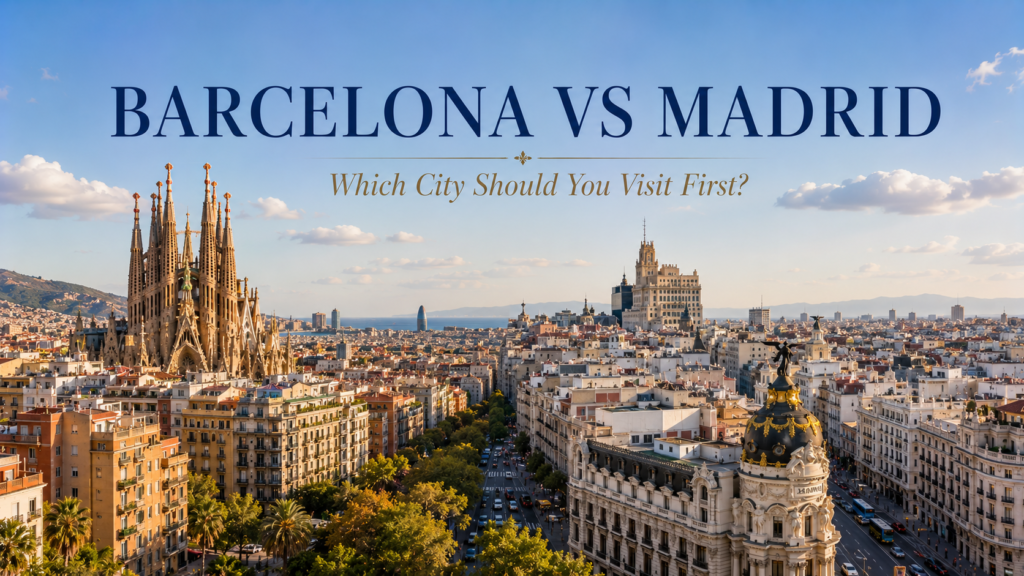
Choosing between Barcelona and Madrid is not really a question of
which city is better.
It is a question of what you want your first experience of Spain
to feel like.
Barcelona places striking architecture, dense historic streets,
neighborhood life, and the Mediterranean coast within the same
city break. Madrid offers something different: monumental
boulevards, major art museums, late dinners, grand public spaces,
and a location that makes exploring central Spain remarkably easy.
Both can fill several days without effort.
But they reward different travelers.
If you only have enough time for one, comparing them by atmosphere,
sightseeing, food, museums, transportation, cost, and possible day
trips is far more useful than simply counting attractions.
This guide does exactly that.
Barcelona vs Madrid at a Glance
Here is the simplest way to think about the choice.
Choose Barcelona if your ideal trip combines distinctive
architecture, atmospheric neighborhoods, famous landmarks, and
time beside the Mediterranean.
Choose Madrid if you care more about art museums, traditional
Spanish city life, monumental streets, food, nightlife, and easy
day trips into central Spain.
Barcelona often creates the stronger immediate visual impression.
Madrid tends to reveal itself more gradually.
That difference shapes almost every other comparison between them.
The Biggest Difference Is the Experience, Not the Attractions
It is easy to compare Barcelona and Madrid by making two lists of
landmarks.
That misses the point.
Barcelona’s identity is unusually visible as you move through the
city.
The medieval lanes of the Gothic Quarter can give way to the
geometric streets of Eixample, where elaborate façades and
Modernisme architecture change the character of an ordinary walk.
Continue farther and the towers of the Sagrada Família transform
the skyline.
Elsewhere, the city eventually reaches the Mediterranean.
Madrid feels less dependent on individual visual icons.
Its appeal comes from the scale and energy of the city itself:
large plazas, elegant avenues, historic neighborhoods, parks,
markets, museums, tapas bars, and streets that remain active late
into the evening.
For travelers attracted to spectacular architecture, Barcelona
usually has the advantage.
For travelers who enjoy experiencing the rhythm of a large capital,
Madrid can be more rewarding.
Which City Has Better Major Sights?
Barcelona probably wins the contest for instantly recognizable
landmarks.
The Sagrada Família is the obvious example, but Gaudí’s influence
extends well beyond a single building.
Park Güell, Casa Batlló, La Pedrera and other Modernisme landmarks
give Barcelona an architectural identity that is difficult to
confuse with another European city.
The Gothic Quarter adds a completely different layer, while
Montjuïc, the waterfront and surrounding neighborhoods broaden the
experience beyond Gaudí.
Madrid’s major attractions are less concentrated around one
architectural movement.
Instead, its strength is variety.
The Royal Palace represents the city’s monumental side. Retiro Park
provides a large green space close to the historic center, while
Plaza Mayor and nearby streets reveal an older Madrid.
Then there are the museums.
For travelers who measure a city by famous architectural sights,
Barcelona has the edge.
For those who want palaces, plazas, parks and world-class art in
the same trip, the comparison becomes much closer.
Madrid Has the Stronger Case for Art Lovers

This is one category where the choice is easier.
Madrid is one of Europe’s major museum destinations.
The Prado is particularly important for European painting, while
the Reina Sofía shifts the experience toward modern and
20th-century Spanish art. The Thyssen-Bornemisza adds further range.
Because these institutions are relatively close to one another,
art can become a major part of a Madrid itinerary without requiring
complicated travel across the city.
Barcelona certainly has worthwhile museums.
But museums are rarely the primary reason a first-time visitor
chooses Barcelona.
Architecture and urban exploration usually play that role.
If spending several hours in major art collections sounds like a
highlight rather than an obligation, Madrid should move considerably
higher on your list.
Barcelona Wins If You Want Architecture to Shape the Trip

In Barcelona, architecture is not something you experience only
after entering a museum or monument.
It accompanies you through the city.
Eixample is particularly important.
Its broad grid gives you room to notice façades, balconies and
corners that would be easy to overlook in a denser medieval center.
Gaudí’s buildings then interrupt that order with forms that feel
completely different from the surrounding blocks.
The contrast with the Gothic Quarter makes the city even more
interesting.
You can spend the morning among medieval lanes and later stand in
front of one of Europe’s most recognizable modern architectural
works.
Madrid has impressive architecture too, but Barcelona makes
architecture a larger part of the everyday sightseeing experience.
Does Barcelona’s Beach Make It the Obvious Winner?
Not necessarily.
Barcelona’s Mediterranean location is a genuine advantage, but it
helps to understand what that means in practice.
The waterfront gives you another way to use the city.
After several hours of churches, architecture and crowded streets,
you can walk toward the sea, have lunch near the waterfront, or
spend part of an afternoon outside the historic core.
That flexibility is especially appealing in warmer months.
However, travelers planning a dedicated beach holiday should not
choose Barcelona simply because it has a beach.
Spain has far stronger destinations if beaches are the main purpose
of the trip.
Think of Barcelona’s coast as an additional dimension to a city
break rather than the sole reason to visit.
Madrid obviously cannot compete in this category.
If having the Mediterranean within the city matters to you,
Barcelona wins.
Food: Don’t Choose Between Them Too Quickly
Food is a more complicated comparison because both cities reward
curious travelers.
Madrid offers a strong introduction to food from across Spain.
Traditional taverns, markets, contemporary restaurants and
neighborhood bars coexist throughout the capital.
Rather than trying to complete a checklist of famous dishes, one
of the best approaches is simply to leave the most tourist-heavy
streets and spend time in areas where eating and drinking are part
of ordinary evening life.
Barcelona has its own advantages.
Catalan culinary traditions give the city a regional identity that
differs from what you will encounter in Madrid, while markets and
Mediterranean ingredients add another dimension.
The important distinction is not “which city has better food?”
It is whether you want the regional character of Catalonia or the
breadth of a large national capital.
For most travelers, food alone should not decide the winner.
Which City Is Easier for a First-Time Visitor?
Both cities have extensive public transportation and both are
manageable without a car.
Barcelona can feel easier initially because many first-trip
attractions fall within a relatively understandable collection of
central neighborhoods.
Walking between nearby areas is often part of the experience.
However, famous attractions such as Park Güell and the Sagrada
Família mean you will still use the metro or other public transport.
Madrid is geographically larger, and distances can be deceptive.
The metro solves much of that problem.
Once you understand the central districts, moving between the
historic center, museum area, Retiro and other neighborhoods becomes
fairly straightforward.
Neither city should be rejected because of transportation.
For a short first visit, Barcelona may feel slightly more compact.
For a longer stay, the difference matters much less.
Where Will You Feel More Crowds?
Both are major European tourism destinations.
But the crowds can feel different.
Barcelona has several attractions that almost every first-time
visitor wants to see.
That concentrates demand around places such as the Sagrada Família,
Park Güell and parts of the historic center.
Timed-entry planning therefore matters.
Madrid also receives enormous numbers of visitors, yet its larger
urban scale can sometimes distribute people more effectively.
Major museums, central plazas and certain shopping streets can still
be extremely busy.
The practical lesson is not to choose Madrid merely to avoid
tourists.
Instead, Barcelona generally requires a little more advance planning
around specific blockbuster attractions.
Barcelona or Madrid for Nightlife?
Madrid has a particularly strong reputation for late-night city
life.
Dinner starts late, neighborhoods remain active well into the
evening, and going out does not necessarily mean entering a
nightclub.
An evening can move naturally from dinner to a bar and then to
another neighborhood without feeling highly planned.
Barcelona also has extensive nightlife, from casual bars to clubs
and waterfront venues.
But Madrid’s late-night culture feels especially integrated into
the character of the city.
If nightlife and late dinners are central to your trip, give Madrid
the advantage.
If nightlife is secondary to daytime sightseeing, this difference
may barely affect your decision.
Which Is Better for Day Trips?
This is where Madrid’s location becomes a major strength.
The capital sits in a useful position for exploring historic
destinations in central Spain.
Toledo is one of the most obvious possibilities, while Segovia
offers another dramatically different historic setting.
Other destinations can be incorporated depending on how much time
you have.
Barcelona also has excellent excursions.
Montserrat combines mountain scenery with a famous monastery, while
Girona provides a historic urban alternative. Travelers interested
in the coast have additional options.
The difference is character.
Madrid’s strongest day trips often deepen the historical and
cultural side of a Spain itinerary.
Barcelona’s can add mountains, smaller cities and Mediterranean
landscapes.
There is no universal winner here.
Choose based on what your main city is missing.
What About the Weather?
Barcelona’s coastal position moderates its climate, although summers
can still be hot and humid.
Madrid sits inland at a much higher elevation.
Its seasonal contrasts are stronger.
Summer can be intensely hot, while winter nights are noticeably
colder than many first-time visitors expect from Spain.
Spring and autumn are particularly attractive for both cities.
If you are traveling during the hottest part of summer, Barcelona’s
coastal location may sound preferable, but humidity and crowds can
still make sightseeing tiring.
Madrid requires even more respect for midday heat.
Weather should influence how you structure your days rather than
automatically eliminate either city.
Which City Is Cheaper?
Neither Barcelona nor Madrid should automatically be considered a
budget destination.
Accommodation can consume a large share of your spending,
particularly in well-located neighborhoods and during busy periods.
Prices also fluctuate enough that a simple statement such as
“Barcelona is more expensive” can be misleading for an individual
trip.
Your neighborhood, dates and booking timing matter enormously.
Madrid’s size gives you many accommodation areas beyond the most
touristed core.
Barcelona also has alternatives outside the Gothic Quarter and
central Eixample, particularly if you are comfortable using the
metro.
Food can be managed at different budgets in both cities.
The best strategy is to compare accommodation for your exact dates
before allowing cost to decide between them.
Which City Is Better for Couples?
Barcelona has an easy advantage for travelers who imagine their trip
around architecture, neighborhood walks, viewpoints and the
Mediterranean.
There are many opportunities to combine sightseeing with slower
periods during the day.
Madrid offers a different type of couple’s trip.
Long dinners, museum visits, Retiro Park and evenings moving between
bars and plazas can be equally appealing.
So the decision depends less on romance and more on travel style.
For visual variety and Mediterranean atmosphere:
Barcelona.
For food, culture and evenings in a large capital:
Madrid.
Which Is Better for Families?
The answer depends heavily on children’s ages.
Barcelona’s unusual architecture can be engaging even for travelers
who normally have limited interest in traditional sightseeing.
The waterfront and parks also create opportunities to break up long
days of monuments.
Madrid provides large public spaces, Retiro Park and a wide range
of attractions, but museum-heavy itineraries may need to be adjusted
for younger children.
Families should prioritize manageable daily schedules over the total
number of attractions.
On that basis, Barcelona may be slightly easier to diversify.
But both can work extremely well.
Which Is Better for Solo Travelers?
Both are strong choices.
Barcelona makes it relatively easy to construct days around walking,
architecture, markets, neighborhoods and the waterfront.
Madrid’s social energy is particularly appealing in the evening,
when streets, restaurants and bars remain active late.
Public transportation in both cities removes the need for a car.
Solo travelers who prioritize daytime exploration may lean toward
Barcelona.
Those who enjoy museums, food and late urban evenings may prefer
Madrid.
What If You Only Have Two Days?
With two days, concentration matters more than completeness.
Barcelona can deliver a very recognizable experience quickly.
You could combine the Gothic Quarter and central neighborhoods with
a carefully selected group of Gaudí landmarks without trying to
see everything.
Madrid also works for two days, particularly if your priorities are
the historic center, Retiro and one major museum.
But Madrid often benefits from additional time because its appeal
is not limited to a handful of landmarks.
For a very short first visit:
Barcelona has a slight advantage.
Three or Four Days Changes the Decision
Once you reach three or four days, both cities become excellent
options.
Barcelona gives you enough time to move beyond the headline
attractions and explore neighborhoods more slowly.
Madrid gives you room for museums without sacrificing parks,
historic streets, food and evening life.
Four days can also open the possibility of a day trip.
At this point, duration should stop being the deciding factor.
Your interests matter more.
Can You Visit Barcelona and Madrid on the Same Trip?
Yes, and for many first-time visitors this is the best answer to the
entire debate.
Spain’s high-speed rail network makes combining the two cities much
more practical than their position on opposite sides of the country
might suggest.
The mistake is trying to squeeze both into too little time.
If you have only four or five days in Spain, splitting the trip may
leave you feeling as though you have mostly seen stations, hotels
and headline attractions.
With a longer itinerary, the combination becomes much more
attractive.
Barcelona provides the Mediterranean and Catalan side of the trip.
Madrid introduces the capital and creates a natural gateway toward
central or southern Spain.
They complement each other better than they compete.
A Simple Decision by Travel Style
Still undecided?
Use your strongest priority.
Choose Barcelona if you care most about:
- Gaudí and distinctive architecture
- Mediterranean atmosphere
- combining city sightseeing with the waterfront
- highly recognizable landmarks
- compact neighborhood exploration
- visual variety
Choose Madrid if you care most about:
- major art museums
- traditional capital-city atmosphere
- late dinners and nightlife
- large parks and monumental streets
- central Spain day trips
- experiencing a city beyond a checklist of landmarks
Choose both if you have enough time and want to understand how
different Spain’s major cities can feel.
Useful Resources for Planning Your Spain Trip
If this is your first journey through the country, start with our
Best Places to Visit in Spain in 2026 guide to compare Barcelona
and Madrid with destinations elsewhere in Spain.
As the Spain section expands, our guides to Andalusia,
accommodation in Barcelona, and practical trip planning can help
you decide what to add after choosing your first city.
For current attractions, events, practical travel information, and visitor services in Barcelona, check the official Barcelona tourism website.
For Madrid, the official Madrid tourism website provides current information on attractions, museums, events, transportation, maps, and practical trip planning.
Final Verdict: Barcelona or Madrid?
For a first trip, Barcelona is likely to appeal more immediately to
travelers who want famous architecture, varied neighborhoods and a
Mediterranean setting.
Madrid is the stronger choice for travelers whose ideal city break
revolves around art, food, nightlife and the everyday energy of a
large European capital.
Neither choice represents Spain as a whole.
That is precisely why the comparison is useful.
Barcelona introduces one distinctive side of the country. Madrid
introduces another.
If you have enough time, visit both.
If you do not, choose the city whose strengths match the way you
actually like to travel rather than the one with the longer list of
famous attractions.