
It Is Far Longer Than Most People Imagine
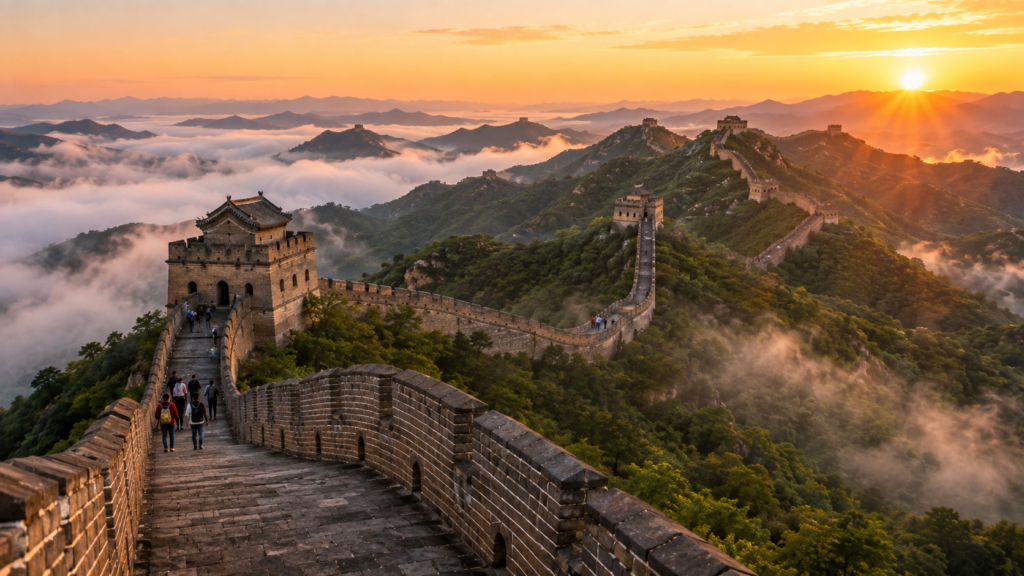
The Great Wall of China is not a single continuous wall stretching from one end of the country to the other. Instead, it is an enormous network of walls, watchtowers, mountain fortifications, trenches, and defensive barriers constructed by different Chinese dynasties over more than two thousand years.
According to archaeological surveys, the complete defensive system measures over 21,000 kilometers, making it one of the longest construction projects ever completed by humans.
The wall crosses deserts, forests, rivers, grasslands, and some of China’s most rugged mountain ranges. Travelers quickly realize that its greatest achievement is not simply its length but the extraordinary landscapes through which it passes.
It Took More Than 2,000 Years to Build
Construction began as early as the 7th century BC, when several independent kingdoms built defensive walls to protect their territories.
After China was unified under Emperor Qin Shi Huang in 221 BC, many existing walls were connected and expanded to strengthen the country’s northern defenses.
Later dynasties continued repairing, extending, and rebuilding different sections.
The Ming Dynasty, which ruled from 1368 to 1644, constructed many of the stone and brick sections visitors admire today. These are also the best-preserved parts of the wall and the most popular destinations for international tourists.
Rather than being the work of a single emperor or generation, the Great Wall represents the efforts of millions of workers across many centuries.
More Than a Military Barrier
Many people assume the Great Wall existed only to stop invasions.
In reality, its purpose was much broader.
The wall functioned as:
- A military defense system.
- A communication network.
- A border control system.
- A transportation route for soldiers.
- A platform for surveillance.
- A customs checkpoint for merchants.
Watchtowers allowed soldiers to send smoke signals during the day and fire signals at night, enabling messages to travel hundreds of kilometers within hours.
This communication system was remarkably advanced for its time and helped protect vast regions of northern China.
One of the Greatest Engineering Achievements in History
Building a wall across mountains, steep cliffs, deserts, and remote valleys without modern machinery required extraordinary engineering.
Workers transported massive stones, bricks, timber, and other materials using animals, wooden carts, ropes, and human labor.
Construction methods varied depending on the surrounding environment.
Mountain sections were often built with locally quarried stone.
Desert areas used compacted earth mixed with gravel and natural materials.
Brick construction became increasingly common during the Ming Dynasty because of its durability.
Even today, engineers continue to admire how many sections have survived earthquakes, harsh winters, heavy rainfall, and centuries of natural erosion.
The Wall Is Full of Myths
Perhaps the most famous myth claims that the Great Wall can be seen from the Moon with the naked eye.
This is not true.
Astronauts have confirmed that the wall is extremely difficult to distinguish from space without visual assistance because its color blends naturally into the surrounding landscape.
Another common misconception is that the wall is one continuous structure.
In reality, it consists of numerous separate walls, fortresses, mountain passes, and defensive systems built during different historical periods.
These myths have become part of the wall’s global reputation, but the true history is even more impressive.
Millions of Travelers Visit Every Year
The Great Wall has become one of the world’s most visited historical attractions.
Several sections near Beijing welcome millions of visitors annually.
Among the most famous are:
- Badaling
- Mutianyu
- Jinshanling
- Simatai
- Jiankou
Badaling is the most accessible and best restored, making it ideal for first-time visitors.
Mutianyu offers beautiful scenery with fewer crowds.
Jinshanling attracts photographers and hikers looking for dramatic mountain views.
Jiankou is known for its steep, wild landscape and is recommended only for experienced hikers.
Each section offers a different perspective on the scale and beauty of this ancient monument.
A UNESCO World Heritage Site
In 1987, UNESCO recognized the Great Wall of China as a World Heritage Site.
The designation acknowledged not only its remarkable architecture but also its cultural, historical, and engineering significance.
Today, preservation has become a major priority.
Weather, erosion, vegetation, and tourism all present challenges to maintaining such a vast monument.
Chinese authorities continue restoring damaged sections while balancing historical authenticity with visitor safety.
These conservation efforts help ensure that future generations can continue experiencing one of humanity’s greatest achievements.
Why the Great Wall Still Inspires the World
The Great Wall represents far more than stone and brick.
It symbolizes determination, resilience, and the extraordinary ambition of ancient civilizations.
Few places allow travelers to walk along a structure that has witnessed more than two thousand years of history.
Standing on one of its watchtowers, surrounded by mountains stretching to the horizon, visitors gain a powerful sense of the scale of ancient China.
The experience goes beyond sightseeing.
It becomes a journey through history, engineering, culture, and human perseverance.
For many travelers, visiting the Great Wall is not simply another stop on an itinerary—it is one of the defining moments of a lifetime.