
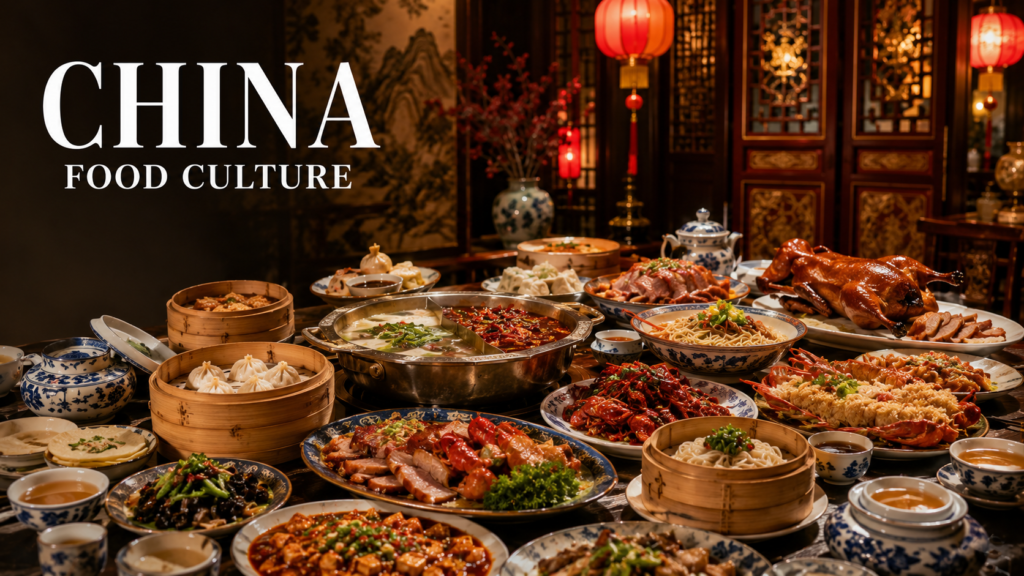
Eight Great Culinary Traditions, One Remarkable Food Culture
Ask someone to name a Chinese dish, and you will probably hear answers like fried rice, dumplings, sweet and sour pork, or Peking duck. While these dishes are famous worldwide, they represent only a tiny part of Chinese cuisine.
China is the world’s fourth-largest country by land area, stretching from snowy northern plains and fertile river valleys to tropical coastlines, high mountain ranges, deserts, and subtropical forests. With such enormous geographical diversity, it is hardly surprising that food developed differently from one region to another.
Today, Chinese cuisine is considered one of the most diverse culinary traditions in the world. Rather than following a single style, it consists of countless regional recipes, local ingredients, cooking techniques, and flavors that have evolved over thousands of years.
Geography Changed Everything
China’s vast landscape has shaped the way people eat for centuries.
Northern China experiences long, cold winters that favor wheat cultivation. As a result, noodles, dumplings, steamed buns, and pancakes became daily staples.
Southern China enjoys a warmer, wetter climate ideal for growing rice. Rice therefore became the foundation of most meals across southern provinces.
Coastal communities naturally developed seafood-based cuisines featuring fish, shrimp, crab, oysters, and shellfish.
Mountain regions relied on preserved meats, mushrooms, herbs, and seasonal vegetables that could survive difficult growing conditions.
Climate, geography, and agriculture together created remarkably different regional food cultures.
The Eight Great Culinary Traditions
Chinese food is often divided into the Eight Great Culinary Traditions, each representing a unique cooking philosophy.
These include:
- Cantonese Cuisine
- Sichuan Cuisine
- Hunan Cuisine
- Jiangsu Cuisine
- Zhejiang Cuisine
- Fujian Cuisine
- Anhui Cuisine
- Shandong Cuisine
Each region emphasizes different ingredients, cooking methods, and flavor profiles.
Rather than competing with one another, these traditions together demonstrate the incredible richness of Chinese gastronomy.
Cantonese Cuisine: Freshness Above Everything
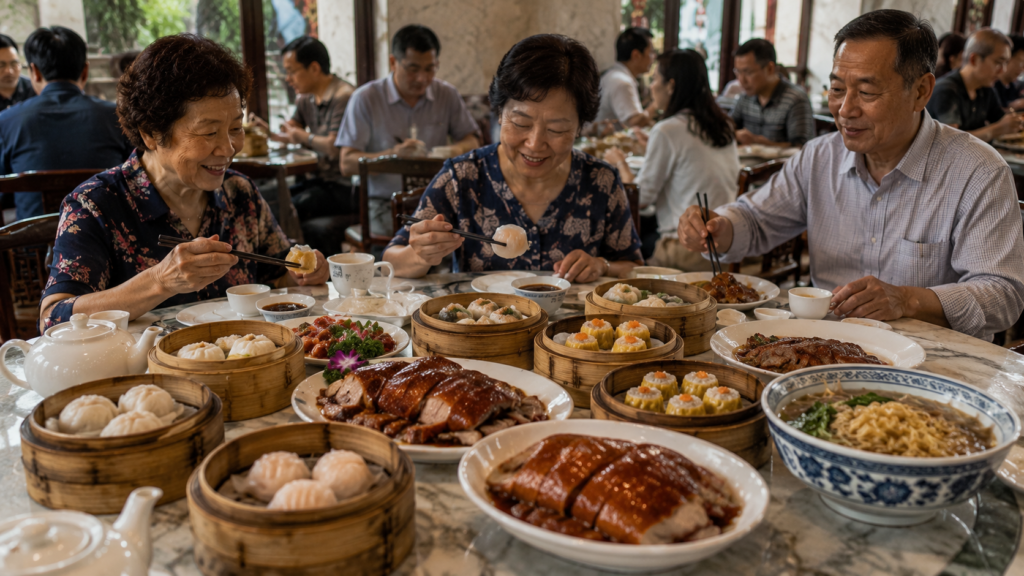
Originating in Guangdong Province, Cantonese cuisine is probably the most internationally recognized style of Chinese cooking.
Its philosophy is simple.
Fresh ingredients should remain the star of every dish.
Rather than overwhelming food with strong spices, Cantonese chefs use light seasoning to preserve natural flavors.
Popular dishes include:
- Dim Sum
- Char Siu
- Roast Goose
- Steamed Fish
- Wonton Noodles
Because of its delicate flavors and elegant presentation, Cantonese cuisine has become highly popular around the world.
Sichuan Cuisine: The Kingdom of Spice
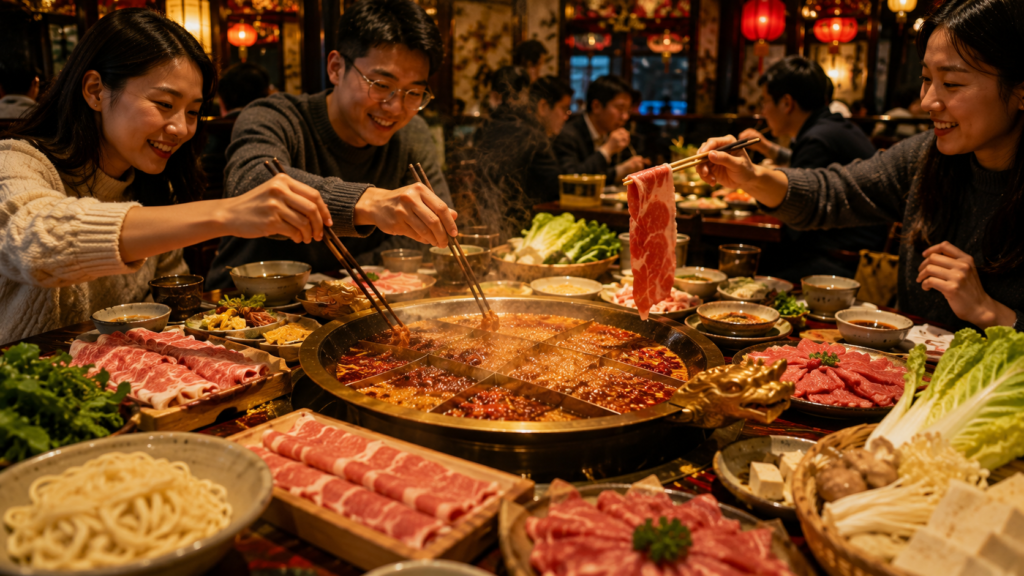
No regional cuisine is more famous for bold flavors than Sichuan cuisine.
Its signature characteristic is the unique combination of chili peppers and Sichuan peppercorns.
Together, they create the famous málà sensation—a combination of spicy heat and a distinctive numbing feeling.
Some of Sichuan’s best-known dishes include:
- Mapo Tofu
- Kung Pao Chicken
- Sichuan Hot Pot
- Dan Dan Noodles
- Twice-Cooked Pork
Although many people associate Sichuan food only with extreme spiciness, skilled chefs carefully balance sweetness, saltiness, sourness, aroma, and heat.
Hunan Cuisine: Hot, Fresh and Fragrant
Hunan cuisine is frequently compared with Sichuan cuisine because both use chili peppers generously.
However, the two styles are quite different.
While Sichuan relies on peppercorns for its famous numbing flavor, Hunan cuisine focuses on fresh chilies, smoked ingredients, garlic, and aromatic herbs.
The result is a cleaner, sharper heat that highlights the freshness of each ingredient.
Popular dishes include:
- Steamed Fish Head with Chopped Chili
- Chairman Mao’s Red Braised Pork
- Smoked Pork
- Stir-fried Beef with Chilies
For travelers who enjoy spicy food, Hunan Province offers an unforgettable culinary experience.
Jiangsu Cuisine: Refined Imperial Cooking
Jiangsu cuisine developed around the prosperous cities of Nanjing, Suzhou, and Yangzhou.
Historically, many imperial chefs came from this region, influencing palace cuisine for centuries.
Presentation is considered almost as important as flavor.
Dishes are often beautifully arranged, carefully balanced, and prepared using precise knife skills.
Freshwater fish, shrimp, crab, duck, and seasonal vegetables feature prominently in Jiangsu cooking.
Its refined style continues to influence fine dining throughout China.
Zhejiang Cuisine: Elegant Flavors from the East Coast
Zhejiang cuisine reflects the region’s beautiful lakes, rivers, and coastline.
The cooking style emphasizes freshness, delicate seasoning, and visually attractive presentation.
Seafood plays a major role, while chefs also make excellent use of freshwater fish, bamboo shoots, mushrooms, and seasonal vegetables.
Famous dishes include:
- Dongpo Pork
- West Lake Vinegar Fish
- Longjing Tea Shrimp
- Beggar’s Chicken
Many visitors describe Zhejiang cuisine as light, refined, and perfectly balanced.
Fujian Cuisine: The Art of Soup and Seafood
Located along China’s southeastern coast, Fujian Province is famous for combining seafood with mountain ingredients.
Its chefs are especially skilled at preparing complex soups that require many hours of careful cooking.
Common ingredients include:
- Abalone
- Sea cucumber
- Oysters
- Mushrooms
- Bamboo shoots
- Fresh fish
Perhaps the region’s most famous dish is Buddha Jumps Over the Wall, a luxurious soup prepared with numerous premium ingredients.
Fujian cuisine is admired for its rich aromas without being overly heavy.
Anhui Cuisine: Cooking with Nature
Anhui cuisine developed in the mountainous interior of eastern China.
Because forests cover much of the region, local cooking traditionally relies on wild herbs, mushrooms, bamboo shoots, freshwater fish, and locally raised poultry.
Slow braising and stewing are common techniques.
Rather than using strong spices, Anhui chefs often allow natural ingredients to create deep, earthy flavors.
For travelers seeking authentic countryside cuisine, Anhui offers a completely different experience from China’s larger coastal cities.
Shandong Cuisine: One of China’s Oldest Culinary Traditions
Shandong cuisine is considered one of the oldest and most influential cooking styles in China.
Its techniques helped shape imperial cuisine for centuries.
Seafood is naturally abundant because of the province’s long coastline.
Popular ingredients include:
- Sea cucumber
- Scallops
- Shrimp
- Crab
- Squid
Shandong chefs are particularly famous for clear broths, seafood dishes, and expert knife skills.
Many cooking techniques now used across China originated in this historic culinary region.
More Than Eight Regional Cuisines
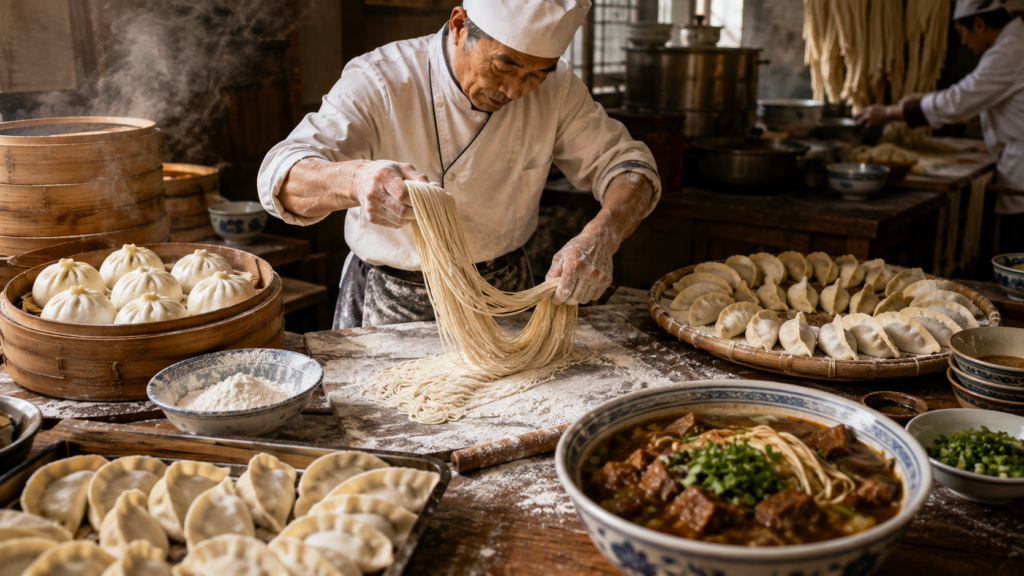
Although the Eight Great Culinary Traditions provide a useful introduction, they represent only part of China’s incredible food diversity.
Nearly every province has developed its own specialties.
Beijing is famous for Peking Duck.
Xi’an is known for hand-pulled noodles and roujiamo.
Shanghai specializes in soup dumplings known as Xiaolongbao.
Chongqing attracts visitors with its fiery hot pot.
Yunnan offers dishes influenced by dozens of ethnic minority communities.
Xinjiang combines Chinese cooking with Central Asian flavors, producing famous lamb skewers, hand-pulled noodles, and naan bread.
Traveling across China often feels like visiting several different countries through food alone.
The Importance of Seasonal Ingredients
Seasonality remains one of the defining characteristics of Chinese cooking.
Rather than serving the same menu throughout the year, many restaurants adjust recipes according to the season.
Spring introduces tender vegetables and bamboo shoots.
Summer features lighter dishes and refreshing ingredients.
Autumn brings mushrooms, chestnuts, and freshwater crab.
Winter favors warming hot pots, braised meats, and nourishing soups.
This close relationship with nature has shaped Chinese cuisine for thousands of years.
Shared Meals Bring Families Together
Food in China is rarely viewed as an individual experience.
Instead, meals are designed to be shared.
Families and friends gather around a round table where multiple dishes are placed in the center.
Everyone serves themselves small portions from shared plates, creating a relaxed and social dining atmosphere.
This tradition encourages conversation, generosity, and togetherness.
It also allows diners to enjoy a much wider variety of flavors during a single meal.
For many travelers, this communal style of dining becomes one of the most memorable aspects of visiting China.
Why Travelers Should Explore Regional Food
One of the greatest mistakes visitors make is assuming that all Chinese food tastes the same.
Trying only familiar dishes available overseas means missing much of what makes China’s culinary culture extraordinary.
Every city offers something unique.
Markets, family-run restaurants, traditional tea houses, and local food streets often provide the most authentic experiences.
Whether tasting delicate dim sum in Guangzhou, spicy hot pot in Chengdu, soup dumplings in Shanghai, or hand-pulled noodles in Xi’an, each destination reveals another chapter of China’s rich culinary story.
Exploring regional cuisine allows travelers to understand China’s history, geography, and cultural diversity through one of its greatest treasures—its food.