
You could spend three weeks traveling through Vietnam, eat something different every day, and still return home having tasted only a fraction of the country’s food.
That becomes obvious when traveling from north to south.
A bowl of noodles eaten on a cool Hanoi morning may be delicate and restrained, built around a clear broth and fresh herbs. Travel south to Hue and suddenly lemongrass, chili, fermented flavors, and richer seasonings begin appearing more confidently. Continue toward Ho Chi Minh City and the table changes again, with sweeter sauces, abundant herbs, coconut, tropical produce, grilled meats, and influences created by generations of cultural exchange.
The distance between Hanoi and Ho Chi Minh City is more than 1,500 kilometers.
Along the way are mountains, river deltas, fishing communities, former imperial capitals, trading ports, farming regions, and cities shaped by very different histories.
Naturally, people don’t eat exactly the same food everywhere.
That is perhaps the most important thing international travelers should understand about Vietnamese regional cuisine.
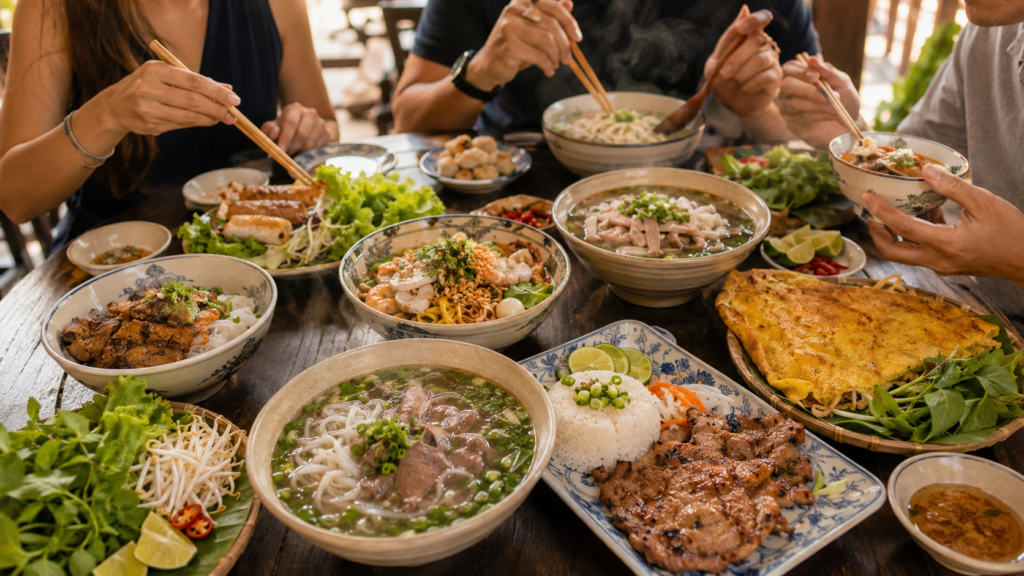
Vietnamese food is not one single flavor.
It is a journey.
And one of the best ways to understand the country is to begin that journey with an empty stomach.
The Journey Begins With Breakfast in Hanoi
Hanoi wakes early.
Before many cafés have opened their doors, small restaurants are already busy.
Metal pots release clouds of steam into the morning air. Motorbikes stop briefly beside the pavement. Office workers sit shoulder-to-shoulder with students on low stools, finishing breakfast before another working day begins.
There may be no menu.
No elaborate decoration.
Sometimes the restaurant specializes in just one dish.
That is usually a good sign.
Sit down and within minutes a steaming bowl appears.
For many first-time visitors, that bowl is phở bò.
Phở in Hanoi Is Quieter Than You Might Expect
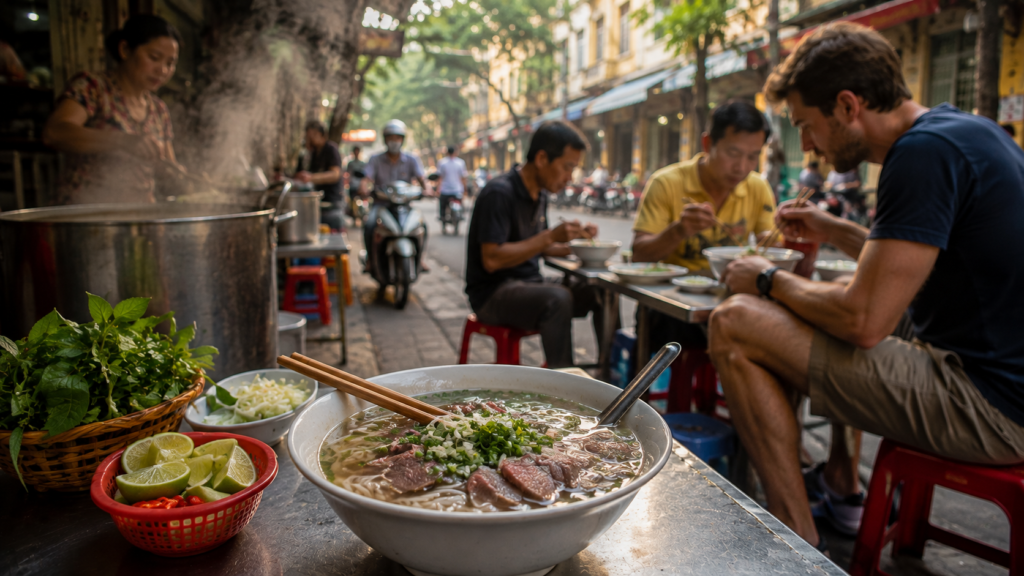
Phở has become so internationally famous that many travelers arrive believing they already understand it.
Then they eat it in Hanoi.
The difference can be surprisingly subtle.
A traditional northern-style bowl often begins with a clear beef broth that has been carefully simmered to create depth without becoming heavy. Flat rice noodles sit beneath thin slices of beef, while spring onions and herbs add freshness.
The fragrance arrives before the first spoonful.
Star anise.
Ginger.
Perhaps cinnamon.
Beef broth.
Nothing needs to dominate.
That balance is part of the appeal.
At the table, there may be lime, chili sauce, fresh chili or vinegar available, but resist the temptation to add everything immediately.
Taste the broth first.
A good bowl has already been carefully balanced by the cook.
Around you, breakfast continues at remarkable speed. Someone arrives, eats, pays and disappears within fifteen minutes. Another customer immediately takes the empty stool.
Phở may be internationally famous.
Here, it is simply breakfast.
Then Comes the Smoke of Bún Chả

By lunchtime, another smell begins drifting through certain Hanoi streets.
Charcoal.
More specifically, pork cooking over charcoal.
Follow it and you may find bún chả.
The dish arrives in separate components rather than one bowl.
There is a plate of soft rice noodles.
A basket of fresh herbs.
A bowl of lightly sweet and savory dipping broth containing grilled pork patties and slices of caramelized pork belly.
Eating it becomes an assembly process.
Take some noodles.
Add herbs.
Dip them into the warm broth.
Pick up a piece of smoky pork.
Eat everything together.
The contrast is what makes the dish memorable: cool herbs against warm meat, soft noodles against caramelized edges, freshness against smoke.
The aroma from the charcoal grill often becomes as much a part of the experience as the food itself.
A Hot Pan of Chả Cá
Then there is chả cá, one of Hanoi’s most distinctive dishes.
Instead of arriving completely prepared, pieces of seasoned fish continue cooking at the table in a small pan.
Dill and spring onions are added generously.
The herbs wilt almost instantly when they touch the hot surface, releasing an aroma that seems inseparable from the fish.
Rice noodles, peanuts, herbs and sauce complete the meal.
For international travelers, the quantity of dill can be surprising.
In many Western cuisines, dill is used carefully.
Here, it becomes one of the main characters.
This is the kind of meal that demonstrates why understanding Vietnamese food through ingredient lists alone is difficult.
Temperature matters.
Texture matters.
The smell coming from the pan matters.
The experience happens at the table.
The Quiet Pleasure of Bánh Cuốn
Not every memorable northern dish is intense.
Bánh cuốn can seem almost impossibly delicate.
A thin layer of rice batter is steamed over cloth until translucent, then carefully lifted and rolled around a filling that may include seasoned minced pork and wood ear mushrooms.
The rolls are soft enough to almost disappear on the tongue.
Fried shallots provide crunch.
Fresh herbs provide fragrance.
Fish sauce ties everything together.
Watching someone make bánh cuốn is almost as satisfying as eating it.
The cook spreads batter across the steaming surface in one practiced movement, waits only moments, then lifts the fragile rice sheet without tearing it.
Breakfast can be finished in twenty minutes.
The technique behind it took years to master.
Understanding Northern Flavors
Travelers sometimes describe northern Vietnamese food simply as “less spicy” or “less sweet.”
There is some truth in those comparisons, but they oversimplify a complicated cuisine.
A better word might be restraint.
Many northern dishes allow the original ingredients to remain recognizable.
Broths can be clear rather than heavily seasoned.
Fresh herbs provide aroma without overwhelming everything else.
Sauces support the main ingredient instead of completely covering it.
Climate and agricultural traditions also matter.
Northern Vietnam experiences a cooler winter than the south, influencing ingredients, cooking methods and eating habits.
But before you become too comfortable with these flavors, the journey continues.
Travel south.
The landscape narrows.
Mountains approach the coastline.
And somewhere in Central Vietnam, the food begins speaking much louder.
Hue Changes the Conversation
Hue does not announce itself through skyscrapers.
The former imperial capital feels slower than Hanoi or Ho Chi Minh City.
The Perfume River moves quietly through the city. Historic gates and walls recall the Nguyen Dynasty, while small restaurants and markets preserve another form of heritage entirely.
Food.
Hue cuisine has connections to both royal culinary traditions and everyday street cooking.
That combination created something fascinating.
Some dishes are carefully presented in small portions.
Others are powerful, spicy and deeply comforting.
Few demonstrate this better than bún bò Huế.
Bún Bò Huế Is Not Just Another Noodle Soup

The first thing you notice is the aroma of lemongrass.
Then comes the color.
The broth is richer and more assertive than the delicate bowls many travelers associate with northern phở.
Thick round rice noodles sit beneath slices of beef and other traditional accompaniments. Chili adds heat. Herbs provide freshness. Lemongrass gives the broth its unmistakable fragrance.
The first spoonful makes one thing clear.
You’ve traveled somewhere different.
Calling bún bò Huế simply “spicy beef noodle soup” does it little justice.
Its character comes from layers of fragrance, heat, savory depth and texture.
Eat it early in the morning beside local customers and the experience becomes even better.
In Central Vietnam, a powerful bowl of noodles before 8:00 a.m. feels completely normal.
Tiny Dishes With Enormous Attention to Detail
Hue also introduces travelers to an entirely different style of eating.
Small dishes begin appearing across the table.
Bánh bèo arrives in tiny saucers, topped with ingredients such as dried shrimp, crispy elements and scallion oil.
Bánh nậm is softer and more delicate, traditionally steamed inside banana leaves.
Bánh bột lọc offers a chewy tapioca texture surrounding shrimp or pork.
Individually, each portion may appear tiny.
Order several and the table becomes a landscape of colors and textures.
This is where the influence associated with Hue’s refined culinary traditions becomes particularly visible.
Food does not need to be large to feel elaborate.
Sometimes one bite contains everything the cook wants you to notice.
Continue South to Quang Nam
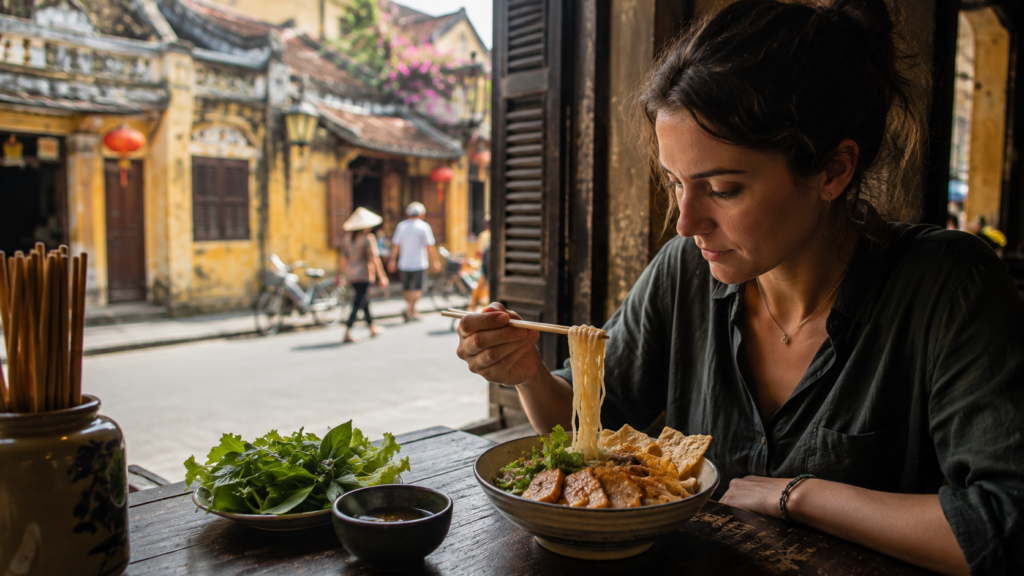
A few hours farther south, the food changes again.
Hoi An may be famous internationally for yellow buildings and colorful lanterns, but anyone who spends more than a day there quickly discovers that food is equally important to the town’s identity.
One of the first dishes to look for is cao lầu.
At first glance, it appears to be another Vietnamese noodle dish.
It isn’t.
Thick, chewy noodles are combined with slices of pork, greens, herbs, crunchy elements and a relatively small amount of intensely flavored liquid.
Unlike phở, the noodles are not swimming in broth.
The texture becomes the defining feature.
Eat it inside the Ancient Town after a morning of walking and it feels inseparable from Hoi An itself.
Cao lầu is one of those rare dishes that travelers often struggle to find reproduced convincingly elsewhere.
That alone makes it worth trying where it belongs.
Mì Quảng Is a Different Kind of Noodle Bowl
Move beyond Hoi An and another Central Vietnamese classic appears everywhere.
Mì Quảng.
The first surprise is the amount of broth.
There isn’t much.
Wide noodles are topped with combinations that can include chicken, pork, shrimp or other proteins, accompanied by herbs, peanuts and crispy rice crackers.
A concentrated broth sits at the bottom rather than filling the bowl.
Break the rice cracker.
Mix everything together.
Add herbs.
Take a bite containing several textures at once.
Soft noodles.
Crunchy peanuts.
Crisp cracker.
Tender meat.
Fresh greens.
This is not a dish designed around one dominant ingredient.
The pleasure comes from everything meeting at once.
Central Vietnam Doesn’t Whisper
By this point in the journey, the contrast with Hanoi becomes easier to recognize.
Central Vietnamese cooking frequently uses stronger seasoning, more chili and deeply flavored sauces.
But geography matters as much as taste.
The central coastline is narrow, squeezed between mountains and sea. Fishing communities, farming traditions, difficult weather conditions and the history of former kingdoms and trading centers all contributed to cuisines that vary dramatically within relatively short distances.
Hue does not taste exactly like Quang Nam.
Da Nang does not eat exactly like Hoi An.
Central Vietnamese cuisine is not one category.
It is dozens of local food cultures compressed into a remarkably narrow stretch of land.
Then the journey continues south.
The climate becomes warmer.
Fruit becomes more abundant.
The Mekong approaches.
And sweetness begins appearing more confidently at the table.
Ho Chi Minh City Eats at Every Hour
Food in Ho Chi Minh City seems almost impossible to escape.
Breakfast happens on sidewalks.
Coffee happens everywhere.
Lunch spills into tiny restaurants hidden inside alleys.
Afternoon snacks appear from carts.
Dinner stretches late into the evening.
Then night markets and street stalls continue feeding people who apparently weren’t finished.
The city has attracted migrants from across Vietnam for generations, alongside Chinese and other cultural influences.
As a result, eating in Saigon can sometimes feel like sampling the entire country at once.
But several dishes immediately reveal the character of the south.
Cơm Tấm Before the City Gets Busy

Wake early and follow the smell of pork grilling over charcoal.
You may discover cơm tấm.
The foundation is broken rice, historically associated with fractured grains separated during rice processing.
Today, it forms one of southern Vietnam’s most beloved meals.
A classic plate may include grilled pork, shredded pork skin, steamed egg meatloaf, pickled vegetables and a fried egg.
Then fish sauce is spooned over everything.
The grilled pork provides smoke and sweetness.
Pickles cut through the richness.
The egg adds another layer.
The rice absorbs the sauce underneath.
It is filling, inexpensive and remarkably satisfying.
And yes, eating grilled pork and rice for breakfast feels completely normal here.
Bánh Xèo Gets Bigger in the South
Travelers who tasted bánh xèo in Central Vietnam may recognize the name but not necessarily the plate arriving in front of them.
Southern versions can be considerably larger.
The thin turmeric-colored pancake develops crisp edges while ingredients such as shrimp, pork and bean sprouts cook inside.
But eating bánh xèo properly requires more than cutting off a piece.
Take fresh greens.
Add herbs.
Place a portion of pancake inside.
Wrap everything together.
Dip.
Eat.
Suddenly the fried pancake feels surprisingly fresh because half the mouthful consists of raw leaves and herbs.
This balance between richness and freshness appears repeatedly across Vietnamese cuisine.
Hủ Tiếu Tells a Story of Migration
Few dishes demonstrate southern Vietnam’s cultural connections as clearly as hủ tiếu.
Its history reflects exchanges between communities, particularly Chinese and Cambodian influences, before developing numerous Vietnamese regional variations.
Depending on where you eat it, hủ tiếu may arrive with broth or dry, with pork, seafood, minced meat, offal or combinations of several toppings.
The noodles themselves differ from those used in phở.
So does the broth.
So does the way the dish is seasoned.
Trying hủ tiếu in Ho Chi Minh City is a reminder that cuisines rarely develop within neat national borders.
People move.
Recipes travel with them.
Ingredients change.
New generations adapt dishes.
Eventually something new becomes local.
Then Comes the Mekong Delta
Leave Ho Chi Minh City and the landscape begins flattening.
Water appears everywhere.
Rivers.
Canals.
Rice fields.
Fruit orchards.
The Mekong Delta is one of Vietnam’s great agricultural regions, and that abundance reaches the table.
Meals often contain fish from rivers and canals, vegetables, herbs, coconut and tropical fruits grown nearby.
One classic combination captures the southern preference for contrasting flavors beautifully.
Canh chua, a sour soup.
Cá kho tộ, fish slowly braised in a clay pot.
One is bright and tangy.
The other is rich, salty, sweet and caramelized.
Eat them with steamed rice and each dish seems to improve the other.
Fruit Becomes Part of the Journey
By the time you reach the Mekong Delta, visiting a fruit market can be as interesting as visiting a restaurant.
Mango.
Rambutan.
Mangosteen.
Longan.
Dragon fruit.
Jackfruit.
Pomelo.
Durian.
Some are familiar internationally.
Others may be completely new.
The best approach is not to buy everything at once.
Choose one.
Ask the vendor how to eat it.
Return tomorrow and try another.
Food travel does not always require a famous restaurant.
Sometimes it requires nothing more than a plastic knife, a piece of fruit and somewhere shady to sit.
Why Southern Vietnamese Food Often Tastes Sweeter
Travelers frequently notice more sweetness in southern dishes.
The observation is valid, but again, the explanation is more interesting than simply saying “southern food is sweet.”
The tropical climate supports sugarcane, coconut and abundant fruit.
The Mekong Delta provides enormous agricultural diversity.
Historical interaction with Cambodian, Chinese and other culinary traditions also contributed to the region’s food culture.
Fresh herbs remain extremely important.
So do contrasting flavors.
Sweet may meet sour.
Rich coconut may meet fresh vegetables.
Grilled meat may be wrapped inside handfuls of raw herbs.
The goal is often balance, even when that balance looks completely different from what you tasted in Hanoi.
Three Regions, One Vietnamese Table
After traveling through all three regions, reducing Vietnamese cuisine to “north is mild, central is spicy, south is sweet” becomes almost impossible.
Those descriptions can help beginners recognize broad tendencies.
But reality is much more complicated.
Every region contains smaller regions.
Every city has specialties.
Recipes change between families.
Migration moves dishes across the country.
Modern restaurants reinterpret traditional food.
Ingredients change with the seasons.
Even the same dish can look dramatically different after traveling a few hundred kilometers.
Bánh xèo in Central Vietnam and bánh xèo in the Mekong Delta demonstrate this beautifully.
Both are unmistakably bánh xèo.
Yet their size, fillings, accompaniments and eating experience can be noticeably different.
That diversity is not a problem that needs simplifying.
It is exactly what makes Vietnamese food so rewarding to explore.
If You Could Try Only Nine Dishes
If this is your first trip to Vietnam and time is limited, nine dishes provide a useful starting point.
Northern Vietnam
Phở bò
Begin with the dish everyone thinks they know.
Taste the broth before adding condiments.
Bún chả
Go at lunchtime and follow the smell of charcoal.
Chả cá
Choose somewhere that cooks the fish with dill and spring onions directly at the table.
Central Vietnam
Bún bò Huế
Try it in Hue rather than treating it as simply another noodle soup.
Mì Quảng
Look for the contrast between noodles, concentrated broth, herbs, peanuts and rice crackers.
Cao lầu
Eat it in Hoi An, preferably somewhere simple where the dish is the focus.
Southern Vietnam
Cơm tấm
Try it for breakfast at least once.
Bánh xèo
Eat it wrapped generously in herbs rather than by itself.
Hủ tiếu
Try both soup and dry versions if you have enough time.
Nine dishes will not teach you everything about Vietnamese cuisine.
They will probably make you want to try another ninety.
How to Eat Your Way Through Vietnam Without Turning Food Into a Checklist
There is a temptation when traveling for food to research everything.
The best restaurant.
The most famous stall.
The dish with the highest rating.
The place that appeared on television.
Research helps.
But leave some meals unplanned.
Walk around in the morning and notice where local customers are eating.
Look for restaurants specializing in one or two dishes rather than enormous menus.
Watch what people at nearby tables order.
Ask hotel staff where they personally eat rather than where tourists usually go.
Try breakfast outside your hotel.
Visit a market without knowing exactly what you want.
If a small restaurant is packed at 7:00 a.m., there is probably a reason.
Some meals will be extraordinary.
Others will simply be good.
A few might not suit your taste at all.
That is part of food travel.
The Meal You Remember Might Cost Almost Nothing
Vietnam can deliver remarkable meals in beautiful restaurants.
But price and memory do not always move together.
You might remember an elegant dinner overlooking the Thu Bon River.
Or you might remember sitting on a plastic stool in Hanoi eating a bowl of noodles that cost less than your coffee back home.
Perhaps it will be grilled pork eaten beside a busy Saigon street.
A plate of tiny Hue cakes shared between friends.
Fresh rambutan bought from a market in the Mekong Delta.
Food becomes memorable because of where you were, who you were with, what you could smell, what was happening around you and how unexpectedly good something tasted.
That cannot be measured on a restaurant rating.
Final Thoughts
Start the journey in Hanoi and Vietnamese food may seem precise, balanced and quietly confident.
Reach Hue and suddenly the flavors become more intense.
Continue through Quang Nam and noodles change shape, broth nearly disappears and textures become increasingly important.
Arrive in Ho Chi Minh City and sweetness, herbs, charcoal smoke and cultural influences seem to meet on every street.
Then enter the Mekong Delta and the landscape itself appears on the table through fish, rice, coconut, vegetables and tropical fruit.
By the end of the journey, one thing becomes clear.
There is no single answer to the question, “What does Vietnamese food taste like?”
It tastes like a clear bowl of phở on a cool Hanoi morning.
Like lemongrass rising from bún bò Huế.
Like chewy cao lầu noodles beneath the lanterns of Hoi An.
Like pork sizzling over charcoal before breakfast in Saigon.
Like sour soup and caramelized fish beside a river in the Mekong Delta.
Each belongs to a different place.
Each tells a different story.
And somehow, every one of them still tastes unmistakably like Vietnam.