
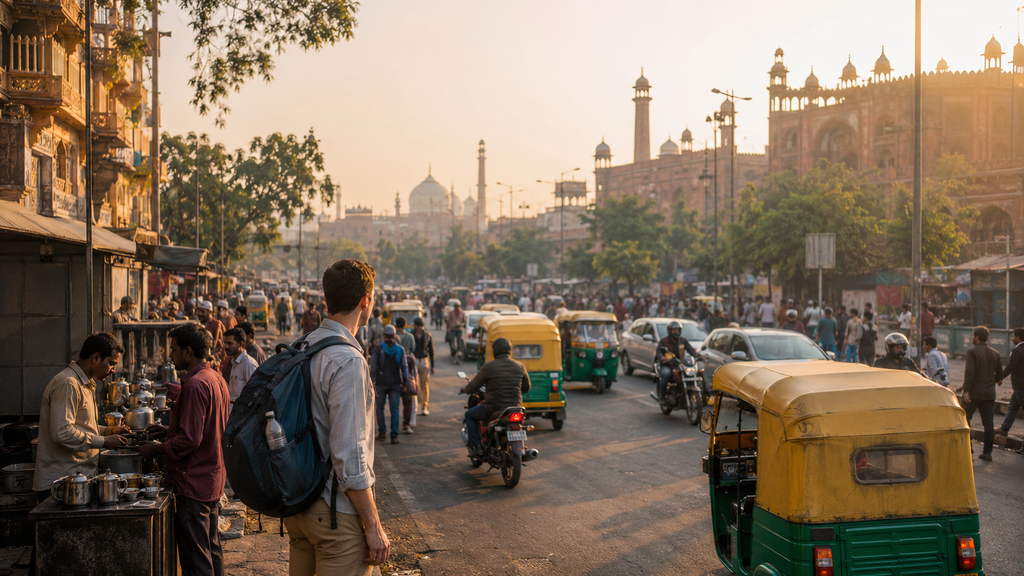
India is one of those countries that is difficult to understand before you actually arrive.
You can read about the Taj Mahal, watch videos of crowded streets in Delhi, save photographs of Rajasthan’s palaces, and make a long list of Indian dishes you want to try. But none of that completely prepares you for the feeling of stepping outside an Indian airport for the first time.
The traffic seems to move according to rules you cannot immediately understand. Horns sound constantly. Motorbikes squeeze through tiny spaces between cars. Street vendors prepare food beside busy roads, while temples, modern shopping centers, old neighborhoods, markets, and construction sites seem to exist side by side.
At first, it can feel overwhelming.
Then, slowly, India begins to make sense.
You learn how to cross the street. You stop reacting to every horn. You discover that a railway station that looked impossibly confusing on the first day becomes manageable once you understand the platform system. You find a small restaurant where the food is better than anything you expected. A chai seller remembers your order. A tuk-tuk ride that initially seemed chaotic becomes part of the experience.
India is not necessarily an easy destination for a first international trip, but it can be one of the most memorable.
This guide is written for travelers preparing for their first journey to India, with practical advice about planning, transportation, food, money, safety, cultural etiquette, and the small everyday experiences that often matter more than the famous attractions.
The First Few Hours in India
For many international travelers, the first introduction to India happens in Delhi or Mumbai.
Inside the airport, everything feels familiar: immigration counters, baggage carousels, currency exchange desks, cafés, and signs in English.
The real transition begins when you walk outside.
In Delhi, particularly during busy hours, the road from the airport can immediately introduce you to the scale of the city. Cars, buses, motorcycles, auto-rickshaws, pedestrians, and delivery vehicles all share the road. Lane markings sometimes feel more like suggestions than strict boundaries.
The constant honking can be surprising.
In many countries, a horn usually signals anger. In India, it often simply means, “I am here,” “I am passing,” or “please notice me.”
After a few days, the noise becomes less intimidating.
One thing I would avoid after a long international flight is trying to negotiate everything immediately outside the terminal. When you are tired, carrying luggage, and still trying to understand local prices, arranging an airport taxi through an official counter or using a reputable ride-hailing service is usually easier.
Getting to your hotel without unnecessary stress is a good first victory in India.
Save the tuk-tuk negotiations for later.
Give Yourself Time to Adjust
One mistake travelers make is planning too much for the first day.
India rewards energy, but it also consumes it.
Heat, traffic, unfamiliar food, jet lag, crowds, and the constant stream of new sights can make a simple afternoon of sightseeing surprisingly tiring.
If you arrive in Delhi in the morning, for example, you do not need to immediately visit five monuments.
Check into your accommodation. Take a shower. Drink some water. Walk around the neighborhood. Find somewhere comfortable for your first meal.
Then perhaps visit one major attraction later in the afternoon.
There will be plenty of time for India.
Trying to conquer the country on your first day usually makes the experience harder than it needs to be.
Choosing Where to Go on Your First Trip
India is enormous.
Looking at a map can be misleading because distances between destinations are much greater than many first-time visitors expect.
Trying to combine Delhi, Rajasthan, Varanasi, Mumbai, Goa, Kerala, and the Himalayas into a two-week trip might look possible on paper. In reality, you would spend a significant part of the journey checking out of hotels, waiting at stations, sitting in vehicles, and catching flights.
For a first visit of around 10 to 14 days, choosing one region usually creates a better experience.
The classic introduction is the Golden Triangle:
Delhi → Agra → Jaipur
Delhi gives you history, markets, monuments, modern neighborhoods, and an intense introduction to urban India.
Agra is home to the Taj Mahal.
Jaipur introduces you to Rajasthan through forts, palaces, bazaars, and the distinctive architecture of the Pink City.
If you have additional time, you could continue deeper into Rajasthan toward places such as Jodhpur or Udaipur.
Travelers more interested in tropical scenery and a slower atmosphere might instead choose southern India, particularly Kerala.
The important thing is not to treat India like a checklist.
Two weeks spent understanding a smaller part of the country will usually leave stronger memories than two weeks spent rushing between airports.
When Is the Best Time to Visit India?
There is no single perfect month for the entire country because India covers an enormous range of climates and landscapes.
For many first-time visitors traveling through Delhi, Agra and Rajasthan, roughly October through March is generally the most comfortable period.
Temperatures are usually easier for walking and sightseeing than during the hottest months.
December and January can actually become surprisingly cool in northern India, especially early in the morning and after sunset. A light jacket can be useful.
From around April, temperatures begin rising significantly across many northern destinations.
Exploring forts and old cities in intense afternoon heat is a completely different experience from visiting during winter.
The monsoon usually affects large parts of India between approximately June and September, although timing and intensity vary considerably by region.
Rain should not automatically stop you from traveling. Landscapes become green, crowds may be smaller in some places, and the atmosphere can be beautiful.
But transportation delays, flooding, humidity, and heavy rainfall can complicate an itinerary.
The Himalayas follow another seasonal pattern entirely.
Always check the climate for the specific region you plan to visit rather than treating India as if it has one national travel season.
Getting Around Indian Cities
Transportation is one of the most memorable parts of traveling through India.
Sometimes for the wrong reasons.
And eventually for the right ones.
Auto-rickshaws — commonly called tuk-tuks by travelers — are everywhere in many cities.
Your first ride can feel slightly ridiculous.
You sit in a small three-wheeled vehicle while buses pass nearby, motorcycles appear from every direction, pedestrians cross the road, and your driver somehow finds gaps in traffic that you were certain did not exist.
Then you arrive.
After a few rides, tuk-tuks become an enjoyable way to travel short distances.
The important question is price.
Some drivers use meters, while others prefer negotiating a fare before departure. If the meter is not being used, agree on the price first.
Do not wait until the destination to discover that you and the driver had completely different ideas about the fare.
Ride-hailing apps can also be extremely useful in larger cities because they reduce the need for negotiation and give you an approximate idea of normal transportation costs.
Delhi also has an extensive metro system.
Once you understand the network, the metro can be dramatically faster than sitting in road traffic.
Taking a Train in India
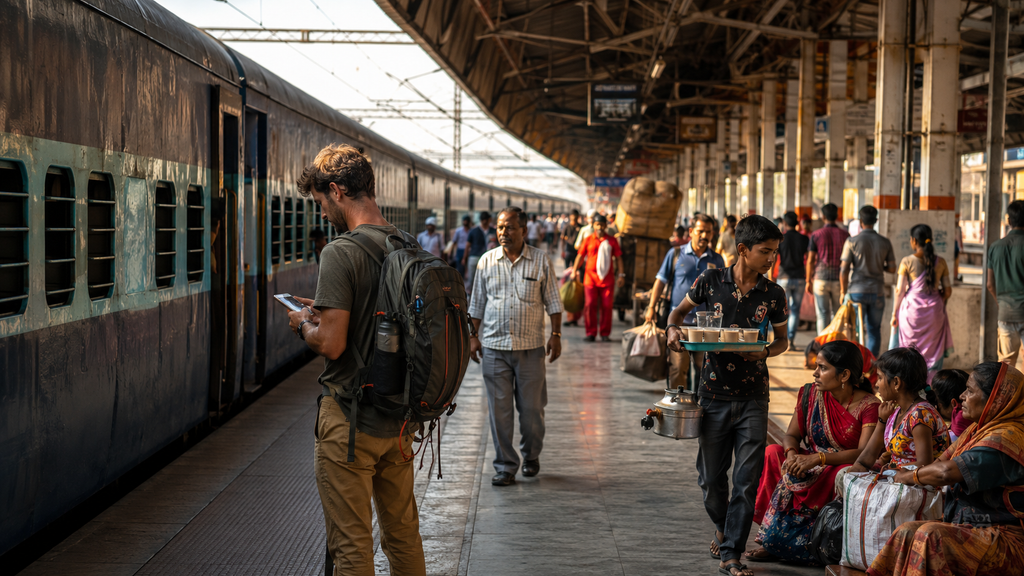
At least one train journey is worth experiencing if your itinerary allows it.
Indian railway stations are worlds of their own.
Families sit together waiting for trains. Vendors walk along platforms selling snacks and chai. Porters move luggage through crowds. Announcements echo across the station while enormous trains arrive carrying hundreds of passengers.
The first time can feel confusing.
Arrive early.
Check your train number carefully rather than relying only on the destination name. Confirm the platform using official information displays or railway information sources.
Keep your ticket available on your phone and save a screenshot in case mobile data becomes unreliable.
For overnight journeys, choosing a more comfortable air-conditioned class can make a significant difference, particularly if this is your first experience with Indian railways.
Train travel is not always the fastest option.
That is not really the point.
Watching towns, farmland, stations, villages, and everyday life pass outside the window shows you a side of India that you will never see from an airplane.
Indian Food Is Much Bigger Than “Curry”
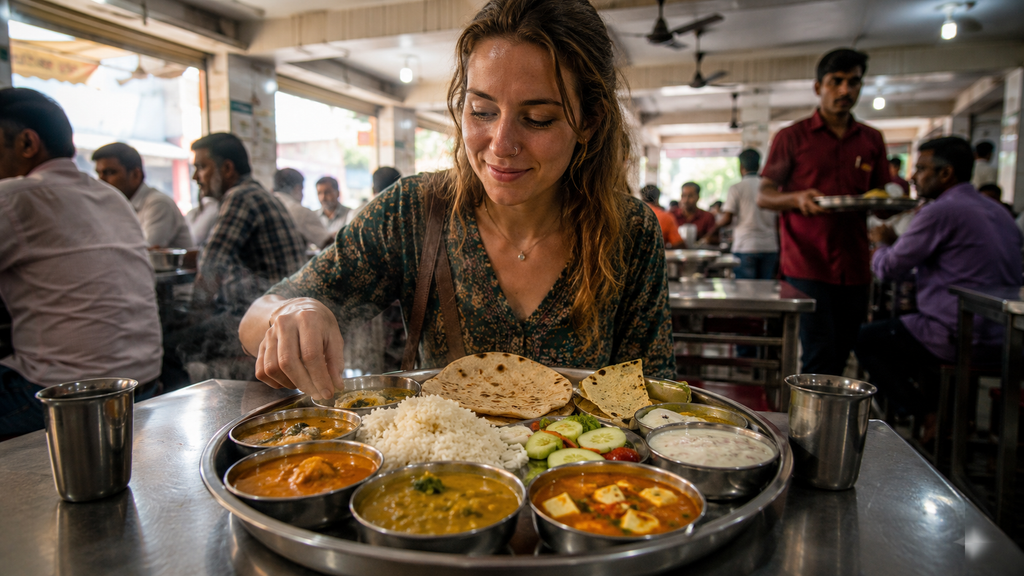
One of the best reasons to travel through India is food.
The problem is that many travelers arrive with a very simplified idea of Indian cuisine.
There is no single “Indian food.”
The dishes change dramatically as you move around the country.
Northern India is famous for foods such as naan, roti, dal, paneer dishes, kebabs, butter chicken, and rich gravies.
Travel south and you begin encountering dosa, idli, sambar, coconut-based curries, rice dishes, and completely different flavors.
Hyderabad is famous for biryani.
Mumbai has its own street-food culture.
Rajasthan developed dishes influenced by its dry environment and regional traditions.
And almost everywhere, there is chai.
One of the simplest pleasures of traveling in India is stopping for a small cup of hot masala chai.
It may come from a polished café or a tiny roadside stall where tea is boiled in a metal pot with milk, sugar, spices, and strong black tea.
The second version is often the one you remember.
Eating Street Food Without Ruining Your Trip
Indian street food is difficult to resist.
You see samosas frying in hot oil, pani puri being assembled rapidly, dosa cooking on large metal griddles, kebabs over charcoal, jalebi coming straight from the fryer.
But stomach problems are a genuine concern for international travelers.
You do not need to avoid street food completely.
Choose carefully.
Busy stalls are generally a better sign because ingredients move quickly and food is constantly being prepared.
I prefer food that is cooked thoroughly in front of me and served hot.
Be more cautious with raw vegetables, pre-cut fruit, sauces that have been sitting outside, ice from uncertain sources, and anything involving water that you are not confident is safe.
For drinking water, sealed bottled water or properly filtered water is the safest choice for most travelers.
Check that the bottle seal is intact before drinking.
You might see locals eating something that looks incredible from a tiny roadside stall. That does not necessarily mean your stomach, arriving from another part of the world two days earlier, is prepared for exactly the same thing.
Start gradually.
India’s food is worth exploring for weeks. There is no need to test your digestive system on the first afternoon.
Vegetarian Travelers Have an Advantage Here
India is one of the easiest countries in the world for finding interesting vegetarian food.
Vegetarianism is deeply connected to religious, regional, and family traditions, so vegetarian dishes are not simply meat dishes with the meat removed.
They have their own identity.
Dal, paneer, chana masala, aloo gobi, dosa, idli, vegetable thali, rajma, and countless regional dishes can keep a vegetarian traveler busy for an entire trip.
A thali is particularly useful when you do not know what to order.
You receive several small portions of different dishes together with rice, bread, pickles, and other accompaniments.
Your only challenge may be figuring out what everything is.
Sometimes that is part of the fun.
Money and Everyday Spending
India can be remarkably affordable, but it is not automatically a cheap destination.
You can stay in very inexpensive guesthouses and eat local meals for relatively little money.
You can also stay in former palaces, luxury resorts, and international hotels where prices are comparable to other major tourist destinations.
For everyday travel, it is useful to carry some cash.
Cards are widely accepted in many hotels, restaurants, shops, and larger businesses, but cash remains important for markets, small food stalls, tuk-tuks, entrance fees in some places, and small purchases.
Avoid carrying only large-denomination notes.
Having smaller notes makes daily transactions much easier.
ATMs are widely available in cities, although international card fees and withdrawal limits vary.
I also would not exchange a large amount of money at the first airport counter you see without checking the rate.
Having enough local currency for transportation and your first day is useful. You can deal with the rest once you have slept and know where you are.
SIM Cards and Staying Connected
Mobile internet makes traveling through India considerably easier.
Maps, train information, hotel addresses, translation, ride-hailing apps, restaurant reviews, and communication with accommodation owners all become simpler when you have reliable data.
Getting a local SIM as an international visitor can involve identity verification and may take more effort than buying a SIM in some other Asian countries.
Requirements can also change.
If your phone supports eSIM, checking available travel eSIM options before departure can save time, although a local SIM may offer better value for longer stays.
Whichever option you choose, download offline maps for your main destinations.
Do not assume you will always have mobile data exactly when you need it.
I also keep screenshots of hotel addresses, train tickets, flight information, passport details, and important reservations.
It takes almost no effort and becomes extremely useful when your connection suddenly disappears.
Markets, Shopping and Learning to Negotiate
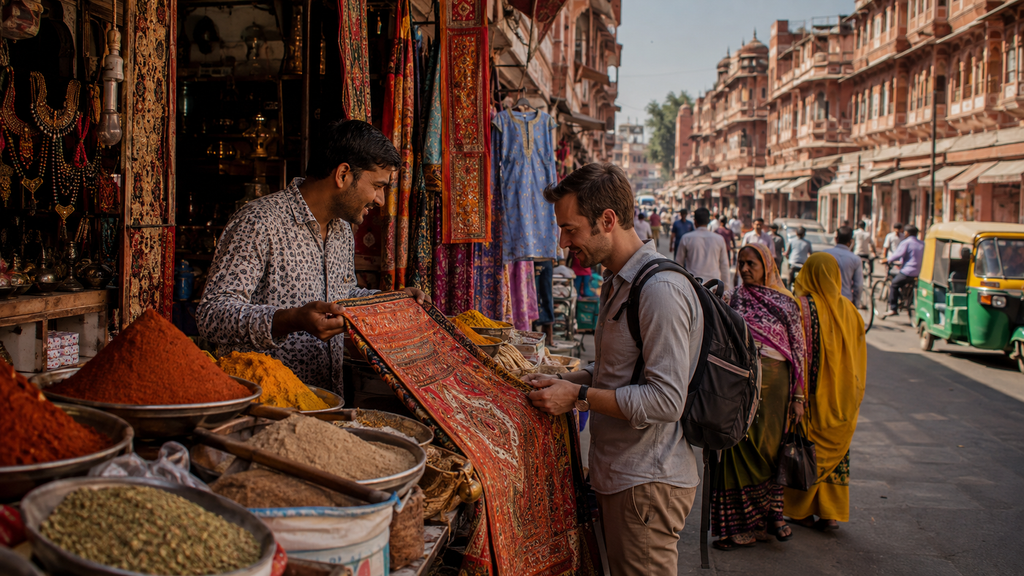
Indian markets can be addictive.
Textiles, spices, jewelry, leather goods, handicrafts, tea, clothing, paintings, souvenirs — there is always something else to look at.
They can also be exhausting.
In tourist areas, the first price you hear may not necessarily be the final price.
Negotiation is normal in many markets.
The easiest approach is to keep it friendly.
Ask the price.
Make a reasonable counteroffer.
If you cannot agree, smile and walk away.
Sometimes the seller calls you back with another price.
Sometimes they do not.
Either outcome is fine.
Do not turn a small difference in price into an argument.
There is little satisfaction in spending ten minutes aggressively negotiating over an amount that is insignificant to you but meaningful to the person selling the item.
The experience should remain enjoyable for both sides.
Temples, Mosques and Religious Sites
Religion is visible throughout daily life in India.
You may hear temple bells in the morning, see roadside shrines covered in flowers, pass mosques during the call to prayer, encounter Sikh gurdwaras serving community meals, or see religious ceremonies happening beside a river.
These are fascinating experiences, but they are not performances created for tourists.
Dress respectfully when visiting religious sites.
Some places require shoes to be removed.
Others may require shoulders or legs to be covered.
Photography may be restricted in certain areas.
If you are uncertain, watch what local visitors are doing or ask before taking photographs.
This becomes particularly important in places associated with funerals and cremation ceremonies.
Varanasi is the clearest example.
The ghats along the Ganges are extraordinary to experience, but some are also sacred spaces where families are mourning and performing religious rites.
Not everything needs to become a photograph.
Sometimes the most respectful thing a traveler can do is simply observe.
What to Wear in India
India is diverse, so clothing norms differ between major cities, beach destinations, rural areas, religious sites, and different regions.
There is no need for international visitors to dress in traditional Indian clothing.
Comfortable, lightweight clothing works well in hot weather.
However, relatively modest clothing is useful, particularly when visiting temples, mosques, smaller towns, and conservative communities.
Loose trousers and lightweight shirts are often more comfortable than very short clothing anyway because they protect you from sun, dust, mosquitoes, and aggressive air conditioning.
A lightweight scarf is surprisingly useful.
It can provide sun protection, cover shoulders when entering a religious site, protect against dust, or provide extra warmth on an unexpectedly cold train or bus.
Comfortable walking shoes are essential.
India has too many fascinating streets to explore in uncomfortable shoes.
Dealing With Attention, Touts and Scams
Tourist areas in India can involve persistent attention.
Someone may offer a tour.
Another person may insist that your hotel is closed.
A driver might tell you that the attraction you want to visit is unavailable and recommend somewhere else.
A stranger may suddenly become extremely interested in helping you find a particular shop.
Not everyone who speaks to you wants something.
Some people are simply curious and genuinely friendly.
Learning to distinguish friendliness from a sales approach takes a little time.
The safest rule is simple: if someone unexpectedly tells you that your hotel, railway station, ticket office, attraction, or booking is unavailable, verify the information independently.
Do not immediately change your plans based on the advice of a stranger who happens to have an alternative service to sell.
A calm but firm “no, thank you” is often enough.
You do not need to explain yourself.
Personal Safety
India receives millions of international visitors, and most trips happen without serious problems.
But the same basic precautions that apply elsewhere are important here.
Keep your passport and important documents secure.
Avoid displaying large amounts of cash.
Pay attention to your phone in crowded areas.
Use transportation you trust, especially late at night.
Share your itinerary with someone when traveling alone.
Female travelers may need to take additional precautions, particularly around transportation and walking alone after dark.
Choosing accommodation with strong recent reviews, arranging reliable late-night transport, and avoiding isolated areas can reduce unnecessary risks.
Trust your instincts.
If a situation feels uncomfortable, leave.
There is no attraction, photograph, cheap taxi ride, or cultural experience worth ignoring your own sense of safety.
Crossing the Street Is a Skill
This sounds like a joke until you arrive.
Some Indian intersections can initially look impossible to cross.
Vehicles seem to come from everywhere.
Waiting for the road to become completely empty may mean waiting for a very long time.
Watch local pedestrians.
You will notice that people often move steadily and predictably rather than suddenly running across traffic.
When possible, use pedestrian crossings, traffic lights, footbridges, or cross alongside local pedestrians.
Do not blindly follow someone into traffic, but observing how residents navigate the road teaches you quickly.
By the end of your trip, you may look back at your first day and wonder why crossing a Delhi street seemed so intimidating.
Do Not Expect Everything to Run Perfectly
A train can be delayed.
Traffic can turn a 20-minute journey into an hour.
A museum may have different opening hours than you expected.
Your driver may take the wrong road.
A hotel room might look less impressive than the photographs.
There may be construction beside a monument you traveled thousands of kilometers to see.
India becomes much easier when you leave some space in your itinerary.
Do not schedule a long-distance train to arrive two hours before an international flight.
Do not plan six attractions across different parts of Delhi in one day.
Do not assume that Google Maps travel times will always account for what Indian traffic decides to do that afternoon.
Build flexibility into the trip.
Some of the best experiences appear in the spaces between your plans anyway.
The Moments You Do Not Plan
Before visiting India, most travelers imagine the famous places.
The Taj Mahal at sunrise.
The forts of Rajasthan.
The ghats of Varanasi.
The beaches of Goa.
Kerala’s backwaters.
Those places deserve their reputation.
But when you leave India, your strongest memories may be much smaller.
Drinking chai from a tiny cup while waiting for a train.
Watching a family prepare breakfast outside a small shop.
Getting completely confused in a market and having a stranger point you in the right direction.
Sitting on a rooftop in Jaipur as the evening call to prayer mixes with traffic noise below.
Watching cows wander through streets that seem far too busy for cows.
Sharing a train compartment with a family who wants to know where you are from, where you are going, whether you like Indian food, whether you are married, and approximately twenty other questions within ten minutes.
India creates interaction.
It rarely allows you to remain a passive observer.
A Few Things I Would Do Differently on a First Trip
If I were planning a first journey through India again, I would travel more slowly.
I would spend three nights somewhere instead of two.
I would leave one afternoon completely empty in every few days.
I would book my important train journeys earlier.
I would eat cautiously for the first couple of days rather than immediately trying every street-food stall that smelled good.
I would carry fewer clothes.
Laundry is easy to arrange in many places, and dragging an oversized suitcase through railway stations is not enjoyable.
Most importantly, I would stop worrying about seeing everything.
You cannot see India in one trip.
That realization is actually liberating.
Practical Things to Prepare Before Departure
Before flying to India, check the current entry and visa requirements for your nationality through official Indian government sources.
Keep digital and offline copies of your passport, visa or entry authorization, travel insurance, flight reservations, and important accommodation bookings.
Make sure your bank knows about international travel if necessary.
Bring at least one backup payment method.
Pack any regular medication you need and keep essential medication in your hand luggage.
A small travel medical kit can also be useful for minor stomach issues, dehydration, cuts, headaches, and other common travel problems.
Travel insurance is strongly recommended, particularly if your itinerary includes trekking, motorbike riding, or remote destinations.
And do not forget a suitable power adapter.
These preparations are not exciting.
They are exactly the things you will be grateful you handled before leaving home.
India Is Easier Once You Stop Trying to Control It
India can test your patience.
It can also reward your curiosity more generously than almost anywhere else.
The first day may feel chaotic.
A week later, you might be drinking chai beside a railway platform while watching hundreds of people move around you and wondering why everything suddenly feels completely normal.
That transition is part of traveling here.
You begin by noticing the noise.
Then you notice the people.
You begin by worrying about transportation.
Then you start enjoying the journey itself.
You arrive wanting to photograph famous monuments.
You leave remembering conversations, meals, train rides, markets, mistakes, unexpected kindness, and ordinary moments you never planned.
India does not need to be romanticized. It can be tiring, crowded, frustrating, beautiful, welcoming, complicated, and fascinating — sometimes within the same hour.
That is exactly why a first trip here stays with you.
Travel slowly, stay curious, prepare for the practical challenges, and leave enough room for India to surprise you.
You probably will not understand the country completely by the time you leave.
But you may already be thinking about coming back.