
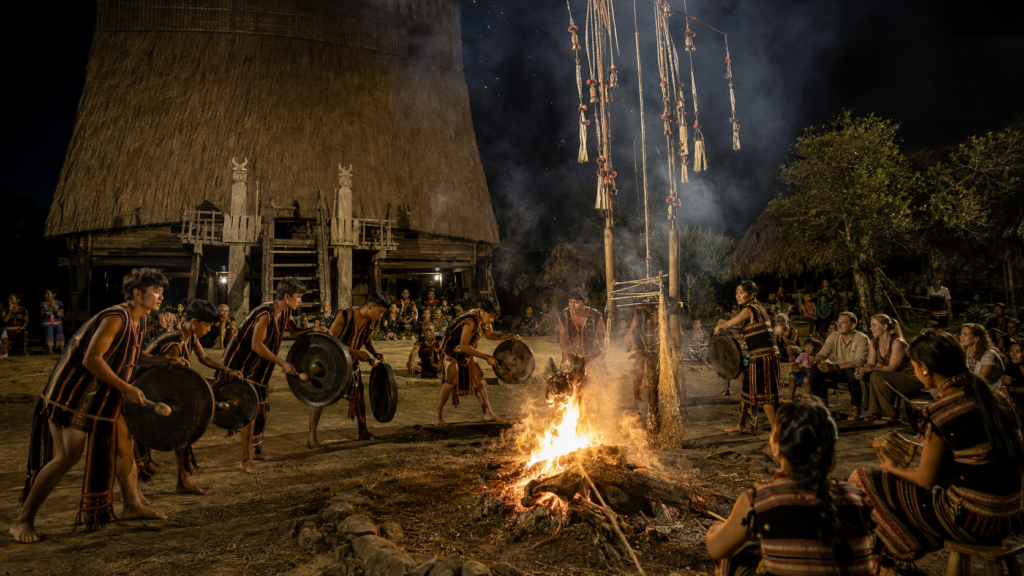
The first sound does not come from a stage.
It comes from somewhere beyond the fire.
A deep metallic note travels through the evening air, hangs for a moment, and disappears into the darkness. Another follows. Then another. Within seconds, several gongs begin answering one another, creating a rhythm that seems to move through the ground as much as through the air.
Around the fire, conversations become quieter.
Visitors who had been taking photographs lower their phones. Children move closer to their families. The musicians form a loose circle, each holding a different gong, and what initially sounds like a collection of individual beats gradually becomes something much larger.
This is one of the most distinctive cultural experiences a traveler can encounter in Vietnam’s Central Highlands.
Known internationally as the Space of Gong Culture in the Central Highlands of Vietnam, the tradition was recognized by UNESCO in 2005 and is now inscribed on the Representative List of the Intangible Cultural Heritage of Humanity.
But describing it simply as traditional music misses much of what makes it important.
For generations, gongs have accompanied significant moments in community life among several ethnic groups of the Central Highlands. Their sounds have been associated with ceremonies, celebrations, harvests and gatherings, connecting music with family, village and spiritual traditions.
For an international visitor, however, understanding this culture rarely begins with history.
It begins with sound.
And often, with an evening in the Central Highlands that feels very different from anything experienced in Vietnam’s major cities.
Leaving the Vietnam Most Travelers Know
For many international visitors, the familiar image of Vietnam is shaped by places such as Hanoi, Ho Chi Minh City, Hoi An and Ha Long Bay.
The Central Highlands feel different almost immediately.
The coastline disappears.
Large cities become smaller.
The road begins climbing into a landscape of rolling hills, coffee plantations, forests and red basalt soil.
Motorbikes still pass frequently, but the scenery changes. Coffee trees stretch across hillsides. Pepper vines climb tall poles beside rural homes. Small villages appear between plantations before disappearing behind another bend in the road.
Cities such as Buon Ma Thuot and Pleiku provide convenient gateways into this region, but some of the most meaningful cultural experiences happen beyond their busy centers.
As the afternoon moves toward evening, temperatures become more comfortable.
Smoke begins rising from village kitchens.
Children return home.
The smell of wood fires mixes with the cooler mountain air.
This is the environment in which the sound of gongs begins to make sense.
Before the First Gong Is Played
A gong gathering does not necessarily begin when the musicians start playing.
The atmosphere develops long before that.
People begin assembling around a communal space. Depending on the community and setting, visitors may see a traditional communal house, a longhouse or an open village courtyard nearby.
A fire is prepared.
Food may be arranged for the evening.
Musicians bring out the instruments.
At first glance, the gongs appear surprisingly simple.
Some are large and heavy.
Others are considerably smaller.
Their surfaces reveal years of use, with subtle marks that make each instrument feel individual rather than decorative.
Then you notice how carefully they are handled.
They are not simply props brought out for tourists.
Within the cultures that maintain these traditions, gongs can carry meanings connected to community identity, ceremonies and spiritual life.
That distinction matters.
Travelers are not merely waiting for a musical performance to begin.
They are being introduced to a cultural tradition that existed long before tourism reached the Central Highlands.
When the First Sound Changes the Evening
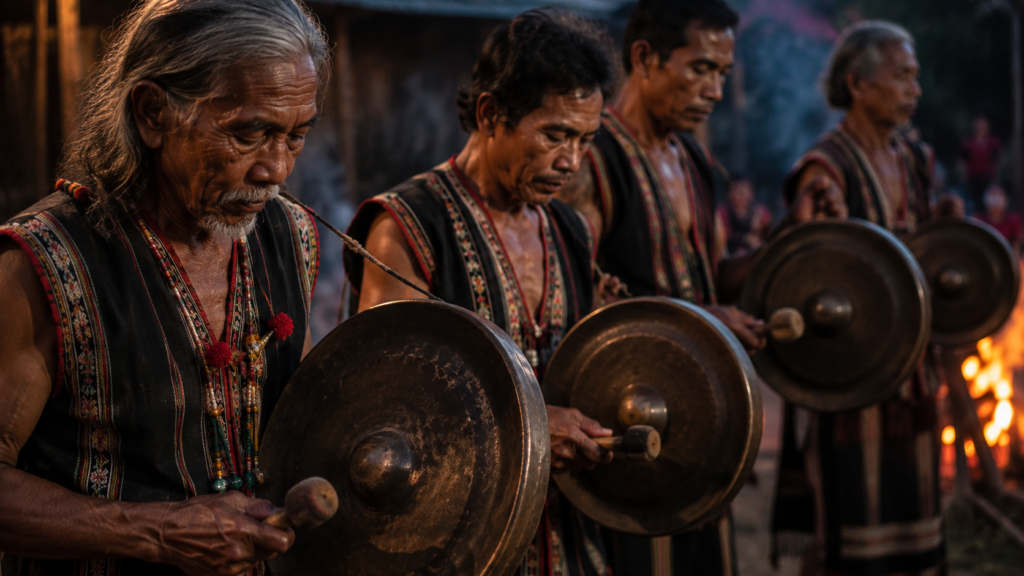
The first gong is often the moment everyone remembers.
It is deeper than expected.
You don’t simply hear it.
You feel it.
The vibration seems to travel through the open space before fading into the surrounding night.
Then another musician responds.
A third rhythm appears.
Soon the entire group is playing.
There is no conductor standing at the front.
Instead, the musicians listen carefully to one another.
Each gong contributes a particular sound to the larger rhythm. Played alone, an individual instrument may seem simple. Together, they create layers of sound that rise and fall repeatedly.
The effect becomes almost hypnotic.
Stand close enough and you can watch how differently each musician plays.
One strikes with controlled movements.
Another appears to move naturally with the rhythm.
Hands occasionally touch the surface of the gong to alter or control the resonance.
Nothing feels accidental.
Skills like these are traditionally passed between generations rather than learned from written musical scores.
That may be one reason the music feels so closely connected to the people performing it.
More Than a Musical Performance
It is easy for a first-time visitor to focus entirely on the sound.
But gong culture is much larger than music.
Across communities of the Central Highlands, gongs have traditionally been connected with important events in life.
They may accompany celebrations.
Harvest-related activities.
Community gatherings.
Ceremonies.
Important family or village occasions.
The precise traditions are not identical everywhere, and that is important to understand. “Central Highlands gong culture” does not describe one standardized performance shared uniformly by every community.
Different ethnic groups have their own practices, rhythms and cultural meanings.
UNESCO identifies the cultural space across several Central Highlands provinces and associates it with numerous ethnic communities.
For travelers, this means the respectful approach is not to treat every gong performance as interchangeable.
Ask where the musicians are from.
Learn which community’s traditions you are witnessing.
Listen when someone explains the meaning behind a particular rhythm or ceremony.
Those conversations often become as memorable as the music itself.
The Fire Changes Everything
As darkness settles completely, the fire becomes the visual center of the gathering.
Flames rise and fall.
Sparks occasionally disappear into the night sky.
The bronze surfaces of the gongs catch flashes of orange light whenever the musicians move.
The atmosphere becomes warmer and more intimate.
This is where photographs struggle to capture the experience.
A picture can show the musicians.
It can show traditional clothing.
It can show the fire.
What it cannot reproduce is the vibration of several gongs being played only a few meters away.
Nor can it capture the changing rhythm of the group or the feeling of standing beneath a dark Central Highlands sky while the sound travels beyond the village.
Sometimes putting the camera down is the better choice.
Watch instead.
When Visitors Are Invited to Join

At some cultural gatherings, the boundary between audience and participant gradually becomes less obvious.
A dance may begin around the fire.
At first, visitors tend to remain outside the circle.
They watch.
They hesitate.
Someone eventually gestures for them to join.
This can become one of the most enjoyable moments of the evening, provided it is approached respectfully.
There is no need to exaggerate the movements or turn the experience into a performance for the camera.
Watch what everyone else is doing.
Follow the rhythm.
Move slowly.
Accept that you probably will not get every step right.
Nobody expects you to.
The important thing is participating without making yourself the center of attention.
Within a few minutes, the nervousness usually disappears.
Locals, Vietnamese visitors and international travelers may find themselves moving together around the same fire while the musicians continue playing.
Language suddenly matters much less.
Rhythm does most of the communication.
Tasting the Central Highlands
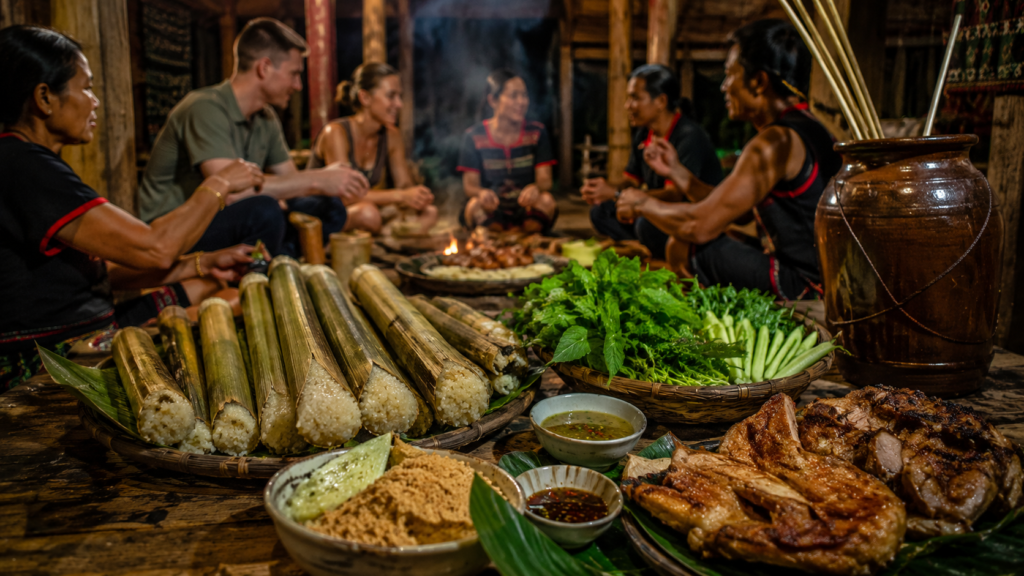
Food often adds another layer to the evening.
Central Highlands cuisine tends to feel particularly appropriate in this setting because many dishes rely on simple ingredients, grilling and communal eating.
One dish travelers may encounter is cơm lam, sticky or glutinous rice cooked inside bamboo tubes.
The outside of the bamboo becomes dark over the heat while the rice inside remains soft and fragrant.
Peeling away the bamboo layer reveals a compact cylinder of warm rice that can be eaten with grilled meat or sesame salt.
Grilled chicken is another familiar dish associated with trips through the region.
The preparation is often relatively simple, allowing the smoky flavor from the fire to become part of the meal.
Then there is rượu cần, a traditional fermented drink consumed communally from a large jar through long bamboo straws in some communities.
For international visitors, the ritual of sharing can be more interesting than the alcohol itself.
If you are invited to participate, observe how local hosts approach it first.
You never need to drink more than you are comfortable with.
Respect works in both directions.
The People Behind the Gongs
Perhaps the most important moment comes after the music slows down.
The instruments are lowered.
People begin talking again.
This is when travelers have an opportunity to look beyond the performance itself.
Many cultural traditions around the world face the same challenge: how to remain meaningful to younger generations while society changes rapidly around them.
The Central Highlands are no exception.
Young people increasingly study and work in cities.
Modern entertainment is available everywhere through smartphones.
Village life changes.
Tourism changes communities as well.
Yet gong traditions continue to be taught, practiced and performed in many places.
Seeing an older musician standing beside a younger player can therefore carry more meaning than visitors initially realize.
One represents knowledge accumulated over decades.
The other represents the possibility that the sound will continue.
Preserving intangible culture is not simply about keeping old instruments inside museums.
Culture survives when people continue to use it.
Cultural Experience or Tourist Show?
This is an important question.
Not every gong experience available to travelers has the same level of authenticity or cultural context.
Some performances are organized specifically for tourism.
That does not automatically make them meaningless.
Tourism can provide income for performers and create opportunities for cultural traditions to reach new audiences.
The difference lies in how the experience is presented.
A thoughtful cultural program explains who the performers are, what community they represent and why the music matters.
A weaker experience may reduce everything to costumes, photographs and a short performance with little context.
When choosing an experience, look for community-based programs or responsible cultural tours that involve local people directly.
Ask questions.
Who are the musicians?
Which ethnic community do they belong to?
Is the program organized with the village?
Where does the money go?
Those questions help travelers make better choices.
How to Experience Gong Culture Respectfully
You do not need to understand every tradition before attending.
You simply need to arrive with the right attitude.
Ask before photographing people closely, particularly elders.
Avoid interrupting ceremonies for photographs.
Do not touch gongs or other cultural objects unless invited.
Dress respectfully when entering community spaces.
Listen when local hosts explain customs.
If food or drink is offered, receive it politely even if you choose not to consume everything.
Most importantly, remember that the people you are meeting are not part of an attraction.
They are welcoming visitors into a part of their culture.
That difference should guide how you behave throughout the experience.
Where Travelers Can Experience Gong Culture
The Central Highlands cover a large area, so there is no single destination for experiencing gong culture.
Buon Ma Thuot is one of the most practical bases for international travelers.
The city is strongly associated with Vietnam’s coffee culture and provides access to communities and cultural attractions across Dak Lak.
Pleiku and the surrounding areas of Gia Lai offer another route into the region, combining highland landscapes with opportunities to learn about local ethnic cultures.
Travelers exploring Kon Tum can also encounter distinctive communal architecture and indigenous cultural traditions.
Rather than arriving in a village unannounced, consider arranging the experience through a reputable local guide, community tourism initiative or accommodation that works directly with nearby communities.
A good guide does more than provide transportation.
They explain what you are seeing.
That context can completely change the experience.
The Best Time to Visit
The Central Highlands generally have a dry season and a rainy season rather than the four seasons familiar to travelers from temperate climates.
For outdoor exploration, the dry months are usually easier because roads are more predictable and evenings are comfortable for cultural activities.
The period from roughly November through April is particularly attractive for many travelers.
December and January can bring pleasantly cool mornings and evenings.
Coffee lovers may find the region especially interesting around the coffee flowering and harvest cycles, although exact timing varies with location and weather.
Whatever month you choose, bring a light layer for evenings.
The Central Highlands can feel surprisingly cool after sunset, particularly if you have spent the previous week traveling through Vietnam’s warmer coastal regions.
How Much Should You Budget?
Experiencing gong culture does not require a luxury budget.
Costs vary considerably depending on whether you join a group program, arrange a private guide or stay in a community-based accommodation.
For a comfortable two-day cultural experience for two international travelers, a reasonable planning budget might include:
| Expense | Estimated Cost |
|---|---|
| Mid-range accommodation for 1 night | 800,000–1,500,000 VND |
| Local meals for two | 600,000–1,000,000 VND |
| Guided cultural experience | 800,000–1,800,000 VND |
| Local transportation | 500,000–1,000,000 VND |
| Coffee, snacks and extras | 300,000–500,000 VND |
A couple could therefore budget approximately 3–5.8 million VND, excluding transportation to the Central Highlands.
These figures should be treated as planning estimates rather than fixed prices. Community programs, private transportation and accommodation standards can change the total considerably.
Why This Experience Feels Different
Vietnam offers plenty of spectacular travel experiences.
You can cruise between the limestone islands of Ha Long Bay.
Walk through lantern-lit streets in Hoi An.
Watch traffic flow endlessly through Ho Chi Minh City.
Wake before sunrise beside Hoan Kiem Lake in Hanoi.
The Central Highlands offer something quieter.
There may be no famous monument standing in front of you.
No skyline.
No attraction that can be captured perfectly in a single photograph.
Instead, the experience is built around people, sound and memory.
That makes it harder to package.
It also makes it harder to forget.
When the Last Gong Falls Silent
Eventually, the rhythm begins to slow.
One musician stops.
Then another.
The final gong rings out across the open space and gradually disappears into the night.
For a few seconds, nobody says much.
The fire continues crackling.
Smoke rises into the darkness.
People slowly return to their conversations.
The instruments are carefully carried away.
Tomorrow morning, travelers will continue toward another destination.
There will be coffee plantations to visit, waterfalls to photograph and roads leading toward other parts of Vietnam.
But the sound remains surprisingly easy to remember.
Perhaps that is what makes the gong culture of Vietnam’s Central Highlands so powerful.
You arrive expecting to watch a performance.
You leave understanding that you have witnessed something much larger.
A tradition carried through generations.
A way for communities to gather.
A sound connected to a landscape and its people.
And for one evening, if you are fortunate enough to experience it respectfully, you are allowed to stand quietly inside that world and listen.