
Before traveling around Vietnam, I thought I understood Vietnamese coffee.
Strong coffee.
Condensed milk.
Ice.
Simple.
Then I started noticing that people were not just drinking coffee.
They were spending entire mornings around it.
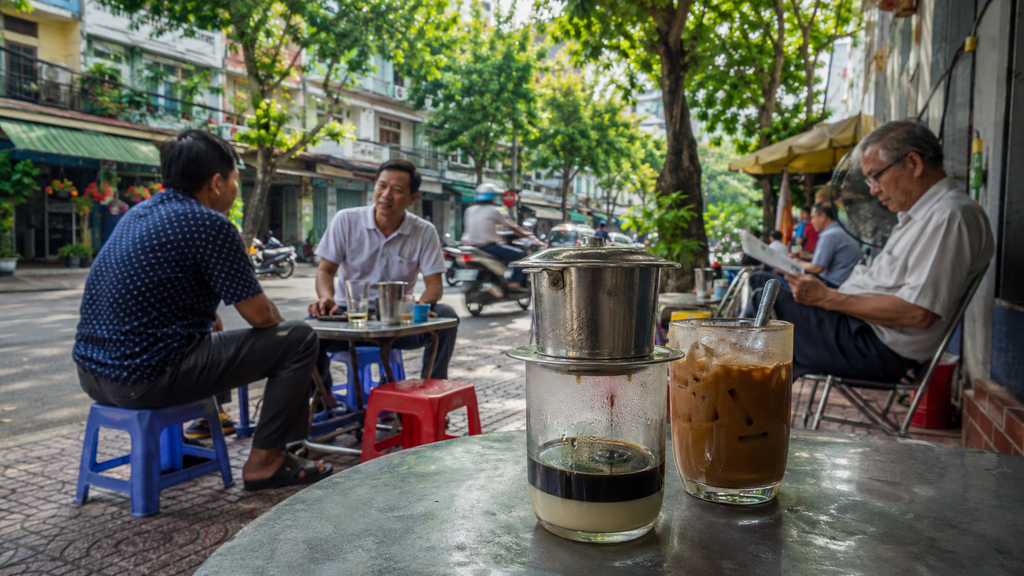
Plastic stools appeared on sidewalks before many shops had opened. Small glasses of dark coffee sat beside iced tea. Friends met before work. Office workers disappeared into cafés at lunch. Older men sat outside watching traffic while a metal phin slowly dripped into a glass.
In Hanoi, I drank coffee in narrow old buildings where finding the café was sometimes harder than ordering.
In Hue, I discovered coffee with salt.
In Ho Chi Minh City, cà phê sữa đá seemed almost inseparable from the heat, motorcycles and energy of the streets.
The drinks changed from city to city.
The cafés changed too.
But one thing remained surprisingly consistent.
Coffee in Vietnam was rarely only about caffeine.
It was an excuse to sit down.
To talk.
To watch the street.
To meet someone.
Or sometimes to do absolutely nothing for a while.
That was the part of Vietnamese coffee culture I had not understood before traveling here.
My First Proper Vietnamese Coffee Took Forever
I was used to coffee arriving quickly.
Order.
Machine makes noise.
Coffee appears.
Then I ordered traditional Vietnamese coffee made with a phin.
A small metal filter was placed above my glass.
And nothing happened.
Well, almost nothing.
Coffee began falling one drop at a time.
Slowly.
Very slowly.
My first reaction was impatience.
Was something wrong?
Should I move it?
Was I supposed to stir it?
The person beside me was completely relaxed.
So I waited.
A few minutes later, I realized that waiting was part of the experience.
The phin was doing exactly what it was supposed to do.
What Is a Vietnamese Phin?
A phin is a small metal coffee filter commonly used to prepare Vietnamese coffee.
It is simple.
There is no electricity.
No complicated machine.
No pressure gauge.
Ground coffee goes inside the chamber.
Hot water is added.
Then gravity does the work.
Coffee slowly drips through the filter into the cup or glass below.
Depending on how it is prepared, the process can take several minutes.
That slow extraction produces a concentrated drink with a strong flavor.
The first time I watched it, the method seemed almost too basic.
After seeing phins everywhere, I began appreciating how perfectly the design fits Vietnamese coffee culture.
You do not need expensive equipment.
You need coffee.
Hot water.
A phin.
And a little patience.
Vietnamese Coffee Was Stronger Than I Expected
I like strong coffee.
At least I thought I did.
Then Vietnam tested that confidence.
Vietnam is one of the world’s major coffee-producing countries, and robusta has historically played an especially important role in its coffee industry.
Robusta tends to produce a stronger, more bitter flavor than the arabica coffee many travelers may be accustomed to.
Combine that with the concentrated phin brewing method and you get a drink that does not disappear quietly into the background.
You notice it.
That intensity also helps explain why sweetened condensed milk works so well.
Cà Phê Sữa Đá Made Immediate Sense
There are foods and drinks you need time to understand.
Cà phê sữa đá was not one of them.
Strong coffee.
Sweetened condensed milk.
Ice.
Vietnamese heat.
It makes sense almost immediately.
The coffee provides bitterness and intensity.
Condensed milk adds sweetness and richness.
Ice cools everything down and gradually softens the strength of the drink.
On a hot afternoon in southern Vietnam, I struggled to imagine a more appropriate coffee.
It was sweet.
Very sweet sometimes.
But against the bitterness of the coffee, it worked.
The Condensed Milk Has a History
Sweetened condensed milk is not simply a modern addition designed to make coffee more appealing to tourists.
Vietnamese coffee developed through a complicated history that includes French colonial influence and the availability of ingredients.
Fresh dairy milk was not always readily available or practical in the tropical environment.
Condensed milk provided a shelf-stable alternative.
Over time, coffee with condensed milk became something distinctly associated with Vietnam.
That is one of the things I find interesting about food and drink culture.
Something can arrive through foreign influence and eventually become so adapted to local tastes that it develops an identity of its own.
Vietnamese coffee is a good example.
Then I Tried Cà Phê Đen
Without condensed milk, there is nowhere for the coffee to hide.
Cà phê đen is essentially black Vietnamese coffee.
It can be served hot or over ice.
My first iced black coffee was intense.
Bitter.
Roasted.
Strong.
And surprisingly refreshing once the ice began melting.
If you normally drink coffee without sugar or milk, I would try Vietnamese black coffee at least once.
It gives you a much clearer idea of the coffee itself.
Just do not order several in quick succession unless you know how your body reacts to caffeine.
I learned that lesson.
Vietnamese Coffee Shops Are Not All the Same
Before traveling around Vietnam, I had a very specific image of a Vietnamese café.
Tiny plastic stools.
A low table.
Motorcycles outside.
Phin coffee.
That version absolutely exists.
But it is only one version.
Vietnam has an enormous variety of coffee spaces.
Sidewalk cafés.
Old family-run shops.
Garden cafés.
Minimalist specialty coffee shops.
Huge modern chains.
Tiny hidden cafés inside apartment buildings.
Rooftop cafés.
Air-conditioned spaces full of students with laptops.
Places where the furniture looks older than everyone sitting on it.
Coffee culture here is not frozen in the past.
It evolves constantly.
My Favorite Cafés Were Often the Simplest
Some of the most memorable places had almost nothing.
A few stools.
A fan.
Small tables.
Coffee equipment.
Maybe a tree providing shade.
Traffic passing a few meters away.
Nobody had designed the space to become Instagram famous.
People were there because it was their local coffee place.
I started enjoying these cafés more than the elaborate ones.
Not necessarily because the coffee was always better.
Because the experience felt connected to the neighborhood.
Sit down long enough and you begin noticing the rhythm of the street.
Deliveries arrive.
Children go to school.
Motorcycles stop.
Someone recognizes a friend.
Another coffee appears.
The city becomes entertainment.
Sitting on a Tiny Plastic Stool Became Normal
At first, Vietnamese sidewalk stools looked impossibly small.
Then I sat on one.
Then another.
After a while, I stopped thinking about it.
Sidewalk coffee is one of the easiest ways to experience everyday Vietnamese street life.
You are not separated from the city behind glass.
You are sitting directly beside it.
Sometimes very directly.
Motorcycles pass.
Vendors move along the street.
People park beside you.
The sounds never stop.
For travelers accustomed to quiet cafés, it can feel chaotic.
I came to enjoy it.
Coffee Is an Excuse to Meet
This may have been the biggest lesson.
In Vietnam, asking someone to “go for coffee” does not necessarily mean coffee itself is the main objective.
It can mean:
Let’s talk.
Let’s meet.
Let’s discuss work.
Let’s catch up.
Let’s sit somewhere for an hour.
The drink creates the setting.
This is not unique to Vietnam, of course.
Coffee plays a social role in many countries.
But the frequency with which cafés appeared in everyday Vietnamese life surprised me.
Morning.
Afternoon.
Evening.
There always seemed to be an appropriate time for coffee.
Hanoi Taught Me to Look Up
Finding cafés in Hanoi was sometimes an adventure.
A sign might point toward an entrance that looked like it belonged to someone’s house.
Then there would be stairs.
Maybe another staircase.
Then suddenly I would emerge into a café overlooking the Old Quarter.
Hanoi rewards curiosity.
Some of the most interesting coffee spaces are hidden above street level or inside old buildings.
From a balcony, the chaos below changes.
Motorcycles become movement.
Horns become background noise.
You sit with a small cup of coffee and watch Hanoi happen underneath you.
I could do that for hours.
Then Hanoi Gave Me Egg Coffee

I had doubts.
Coffee and egg sounded like two breakfast items that should remain separate.
Then I tried cà phê trứng.
Egg coffee is strongly associated with Hanoi.
A rich mixture traditionally involving egg yolk and sugar is whipped into a thick, creamy topping and combined with strong coffee.
The result was not what I expected.
It did not taste like someone had dropped breakfast eggs into coffee.
It was closer to a dessert.
Rich.
Sweet.
Creamy.
With strong coffee underneath preventing the whole thing from becoming overwhelmingly sugary.
I understood the popularity after the first few spoonfuls.
Egg Coffee Is Better When You Stop Comparing It to Normal Coffee
This was my mistake.
I initially judged it according to the question:
“Is this better than regular coffee?”
That is not particularly useful.
Egg coffee is its own experience.
I would order it when I wanted something rich and slow rather than when I simply needed caffeine.
It also made more sense in Hanoi than it would have sitting beside a swimming pool somewhere else.
Place matters.
Drinks collect memories from where you consume them.
For me, egg coffee will always taste a little like Hanoi.
Hanoi Coffee Felt Slower
This is a general impression, not a rule.
But many of my Hanoi coffee experiences felt slower and more enclosed.
Small spaces.
Old buildings.
Balconies.
Narrow streets.
People sitting close together.
There was something about drinking hot coffee while watching the Old Quarter below that encouraged me to stay.
Maybe it was the architecture.
Maybe the weather.
Maybe I was simply tired from walking.
Either way, Hanoi made coffee feel like a pause.
Hue Introduced Me to Salt Coffee

Just when I thought I understood the basic Vietnamese coffee menu, Hue changed it again.
Cà phê muối.
Salt coffee.
Again, I was skeptical.
Again, Vietnam was right.
Salt coffee generally combines strong coffee with a creamy, lightly salty component.
Recipes vary from café to café.
The important part is the contrast.
Sweetness.
Bitterness.
Creaminess.
A small salty edge.
The salt does not make the drink taste like seawater.
Used properly, it changes how you perceive the sweetness and bitterness.
The result can be surprisingly balanced.
Salt Coffee Fit Hue Somehow
Hue feels different from Hanoi and Ho Chi Minh City.
The pace can seem calmer.
The historical landscape is different.
The Perfume River shapes the city.
Imperial architecture changes the atmosphere.
Sitting with a salt coffee felt appropriate.
I was not rushing to finish it.
The drink almost demanded that I slow down because the flavors changed as I continued drinking.
Like egg coffee in Hanoi, salt coffee became connected to the city in my memory.
Today you can find it elsewhere.
But trying it in Hue made the experience more meaningful.
Ho Chi Minh City Needed Ice
Then there was Saigon.
Heat.
Traffic.
Energy.
Motorcycles everywhere.
A hot phin coffee could still be enjoyable, but I repeatedly returned to iced coffee.
Cà phê sữa đá felt made for the city.
Sit beside a street.
Watch traffic.
Stir the condensed milk into dark coffee.
Add ice.
Drink.
Wait.
Order another if you are brave.
Ho Chi Minh City has an enormous modern café scene, but some of my favorite moments were still the simplest street-side ones.
Then I Discovered Bạc Xỉu
Bạc xỉu looked similar to cà phê sữa đá at first.
Then I tasted it.
Much milkier.
Much sweeter.
Less coffee-forward.
A simple way to think about the difference is that cà phê sữa đá is coffee with condensed milk, while bạc xỉu leans much more toward milk with coffee.
That distinction is simplified because recipes vary, but it helps first-time visitors understand what to expect.
If Vietnamese coffee feels too strong, bạc xỉu can be a friendlier introduction.
I would still try the stronger version later.
Bạc Xỉu Has Strong Connections to Southern Vietnam
The drink is particularly associated with Saigon and the city’s historical Chinese community.
Like so much Vietnamese food culture, the story reflects cultural exchange.
That made ordering it more interesting.
A menu item that initially looked like “sweet coffee” became part of a larger story about the city.
This happened repeatedly while traveling in Vietnam.
The more I learned about a dish or drink, the more the city around it made sense.
Morning Coffee and Evening Coffee Felt Completely Different
I assumed coffee culture belonged mainly to mornings.
Vietnam corrected that assumption.
Morning cafés can feel practical.
People stop before work.
Read news.
Meet friends.
Have breakfast nearby.
Coffee wakes up with the city.
Later in the day, the atmosphere changes.
Students gather.
Friends meet.
Couples sit together.
People work on laptops.
At night, many cafés remain active.
Coffee becomes less about waking up and more about being somewhere.
That distinction helped me understand why Vietnam can support so many cafés.
I Learned Not to Assume Everyone Was Drinking Coffee
This sounds obvious once you notice it.
Cafés in Vietnam often serve much more than coffee.
Tea.
Fruit drinks.
Juices.
Yogurt drinks.
Smoothies.
Other local beverages.
A group may say they are going for coffee while several people order something else entirely.
Again, the café is the social space.
The exact drink is secondary.
Modern Vietnamese Cafés Surprised Me
If your image of Vietnam is entirely plastic stools and metal phins, spend an afternoon in a modern café in Hanoi or Ho Chi Minh City.
Vietnam’s younger coffee scene can be extremely sophisticated.
Specialty beans.
Different brewing methods.
Beautiful interiors.
Locally sourced coffee.
Baristas discussing processing and roast profiles.
Minimalist design.
People working remotely.
The traditional phin has not disappeared.
It now exists alongside an increasingly diverse specialty coffee culture.
I liked that contrast.
Vietnam does not have to choose between old and new.
Both can exist on the same street.
Coffee Chains Are Part of the Culture Too
Travelers sometimes dismiss chains because they want an “authentic” experience.
I understand the instinct.
But local and international-style chains are part of modern Vietnamese urban life too.
Students use them.
Office workers meet there.
Families visit.
People work.
Air conditioning is appreciated.
Especially after walking through Ho Chi Minh City at midday.
I would not spend an entire trip only visiting polished chains.
But I would not pretend they are somehow outside Vietnamese culture either.
Modern culture is still culture.
The Most Beautiful Café Is Not Always the Best Experience
Vietnam has some extraordinary café interiors.
Rooftops.
Converted villas.
Apartment cafés.
Garden spaces.
Highly designed specialty shops.
They photograph beautifully.
But the café I remember most might be one with six plastic stools and absolutely no interior design.
Why?
Because an older man at the next table started talking to someone passing by.
Then another person joined.
Then someone moved a stool.
Five minutes later, what had been one person drinking coffee became a small social gathering.
Nobody planned it.
That felt more interesting than any decorative wall.
Learning to Order Coffee Was Easier Than I Expected
You do not need fluent Vietnamese to order coffee.
A few names help enormously.
Cà phê đen – black coffee.
Cà phê sữa – coffee with condensed milk.
Cà phê sữa đá – iced coffee with condensed milk.
Bạc xỉu – a milkier, sweeter coffee drink.
Cà phê trứng – egg coffee.
Cà phê muối – salt coffee.
Menus vary, and modern cafés may have many additional drinks.
But those names will get you started.
“Đá” Became One of My Most Useful Words
Đá means ice in this context.
When I saw it in drink names, I knew roughly what direction things were going.
Vietnamese pronunciation is much more complicated than simply reading the Latin letters as an English speaker would.
I made mistakes.
Many.
But people were generally patient.
Pointing at the menu also remains one of humanity’s most reliable international communication systems.
I Started Watching How Other People Drank Their Coffee
This is one of my favorite travel habits.
Instead of immediately asking, “What am I supposed to do?”, watch.
With phin coffee, some people wait until most of the coffee has finished dripping before stirring.
With iced coffee, the drink naturally changes as the ice melts.
People may drink slowly while talking.
There is rarely a need to rush.
Observing local habits often teaches more than reading a list of etiquette rules.
Don’t Expect Every Coffee to Taste Identical
Even when ordering the same drink, I noticed differences.
More condensed milk.
Less condensed milk.
Stronger roast.
More ice.
Different beans.
Different proportions.
Different preparation.
This is normal.
“Cà phê sữa đá” is a category, not one globally standardized recipe.
I enjoyed comparing versions.
Some were balanced.
Some were incredibly sweet.
Some felt powerful enough to restart a motorcycle.
That variation became part of the fun.
The Caffeine Can Sneak Up on You
This deserves a warning.
Vietnamese coffee can be strong.
The small glass can be misleading.
You drink one.
Feel fine.
Drink another.
Still fine.
Then suddenly your afternoon has a completely different energy level.
If you are sensitive to caffeine, start slowly.
Especially if you are also trying egg coffee, salt coffee and several other drinks in one day because someone wrote a travel article telling you to try everything.
You do not need to complete Vietnamese coffee culture before dinner.
Coffee With Breakfast Became a Routine
One of my favorite Vietnamese mornings became extremely simple.
Wake up.
Find breakfast.
Then coffee.
Sometimes the café was next door.
Sometimes coffee came from the same place.
Sometimes I walked until I found a sidewalk that looked interesting.
The routine gave structure to the morning without requiring an itinerary.
This is something I increasingly value when traveling.
Not every hour needs an attraction.
A repeated daily habit can make you feel more connected to a place than another museum ticket.
The Sidewalk Was Often the Best Seat
A sidewalk café does not give you silence.
It gives you Vietnam.
Motorcycles.
Delivery drivers.
Street vendors.
Neighbors.
Students.
Office workers.
Dogs sleeping in impossible locations.
People carrying things on motorcycles that you would have assumed required a truck.
All of it passes directly in front of you.
I stopped wishing the street were quieter.
The noise was the view.
Coffee Helped Me Understand the Difference Between Visiting and Staying
When you visit a city quickly, you move constantly.
Next temple.
Next market.
Next restaurant.
Next photograph.
Coffee interrupted that rhythm.
For thirty minutes or an hour, I stayed in one place.
That gave the city time to move around me.
It is a subtle difference.
But it changed what I noticed.
Instead of asking, “What should I see?”, I started asking, “What is happening here?”
Travel became more observational.
Vietnamese Coffee Is Also an Agricultural Story
Sitting in cafés made me curious about where the coffee came from.
Vietnam’s Central Highlands are at the heart of the country’s coffee production.
Places such as Dak Lak and the area around Buon Ma Thuot are closely associated with the industry.
The landscapes there are completely different from Hanoi’s Old Quarter or central Ho Chi Minh City.
Coffee farms.
Red soil.
Highland climate.
Agricultural communities.
Understanding that added another layer to the drink in front of me.
Coffee was not simply a city habit.
There was an enormous agricultural system behind it.
Buon Ma Thuot Changed the Scale of the Story
If Hanoi taught me about coffee shops, the Central Highlands helped me understand coffee as a crop.
Buon Ma Thuot is often described as Vietnam’s coffee capital.
Whether or not a traveler visits specifically for coffee, the connection is difficult to miss.
This is where Vietnamese coffee stopped being only something served in a glass.
It became farming.
Processing.
Trade.
Livelihoods.
Export.
Landscape.
The café at the end of the chain suddenly felt very far away from the beginning.
Robusta Deserves More Respect Than It Sometimes Gets
In some specialty coffee conversations, robusta has historically been treated as inferior to arabica.
That view is increasingly being challenged.
Quality depends on farming, harvesting, processing, roasting and preparation, not simply the species name.
Vietnamese producers and specialty coffee businesses have increasingly experimented with higher-quality robusta and different processing methods.
As a traveler, I did not need to become a coffee expert.
But I became more interested in asking what I was drinking.
Not every Vietnamese coffee is the same dark roast.
The industry is changing.
Coffee Culture Is Changing With Younger Generations
Spend time in modern Vietnamese cities and this becomes obvious.
Young consumers are experimenting.
Cold brew.
Pour-over.
Specialty robusta.
Arabica from Vietnamese growing regions.
Creative milk drinks.
Minimalist cafés.
Traditional ingredients used in new ways.
The phin remains important, but it is no longer the only story.
I liked seeing young cafés reinterpret something deeply familiar rather than simply copying foreign coffee trends.
The most interesting places often combined both.
I Would Try Traditional and Modern Cafés
If you have only a few days in Vietnam, do not choose one side.
Drink cà phê sữa đá on a plastic stool.
Then visit a specialty café.
Try egg coffee in Hanoi.
Try salt coffee in Hue.
Try bạc xỉu in Ho Chi Minh City.
Order a Vietnamese single-origin coffee if you find one.
The contrast tells you much more than repeating the same drink everywhere.
How Much Does Coffee Cost in Vietnam?
Prices vary enormously.
A simple local sidewalk coffee can be inexpensive.
A stylish specialty café in central Hanoi or Ho Chi Minh City can cost several times more.
Rooftop locations and tourist areas may charge more again.
I would not give one fixed price because it becomes outdated quickly and depends heavily on location.
Instead, check the menu before ordering.
In general, coffee remains accessible across a wide range of budgets.
That may be one reason café culture can exist at so many levels of Vietnamese society.
Don’t Judge a Café by the Furniture
Some of the simplest places serve excellent coffee.
Some beautiful cafés serve average coffee.
Sometimes you are paying for air conditioning and a view.
Sometimes that is exactly what you want.
I stopped trying to find the “best coffee in Vietnam.”
That question became meaningless.
Best for what?
Best beans?
Best egg coffee?
Best street atmosphere?
Best place to work?
Best view?
Best memory?
Different cafés win different categories.
What I Would Recommend to a First-Time Visitor
If this is your first trip to Vietnam, I would try at least four different coffee experiences.
First:
Cà phê sữa đá.
This is the obvious introduction.
Second:
Traditional phin coffee.
Sit and actually watch it drip.
Third:
Choose the regional specialty that fits your itinerary.
Egg coffee in Hanoi.
Salt coffee in Hue.
Bạc xỉu in Ho Chi Minh City.
Fourth:
Visit a modern Vietnamese specialty café.
That final stop shows you where the culture is going, not only where it came from.
Don’t Try Everything in One Morning
I know.
You have limited vacation time.
There are many coffees.
Still.
Coffee contains caffeine.
Egg coffee can be rich.
Condensed milk is sweet.
Salt coffee can feel almost like dessert.
Four cafés before lunch sounds like an excellent travel plan until your hands begin vibrating.
Spread the experience across the trip.
Coffee culture is better when it becomes part of your days rather than another checklist.
My Ideal Coffee Morning in Hanoi
I would wake early.
Walk through the Old Quarter before the streets become completely crowded.
Eat breakfast.
Then find a small café inside an old building.
Order traditional coffee.
Sit near a balcony if possible.
Do nothing for a while.
Later, after sightseeing, I would find egg coffee.
Not immediately.
Give the caffeine some time.
That would be enough.
My Ideal Coffee Afternoon in Hue
I would avoid the hottest part of the day.
Find somewhere quiet.
Order salt coffee.
Sit longer than necessary.
Then walk toward the Perfume River when the temperature begins dropping.
Hue is not a city I would rush.
The coffee experience should match that.
My Ideal Coffee Morning in Ho Chi Minh City
This one needs movement.
Breakfast first.
Then a sidewalk cà phê sữa đá.
Preferably somewhere with a good view of normal street life rather than a famous landmark.
Watch the motorcycles.
Watch people arrive and leave.
Let the ice melt.
Then start the day.
In the afternoon, when the heat becomes unreasonable, that is when I would appreciate a modern air-conditioned café.
Balance.
Coffee Became One of My Ways of Remembering Cities
When I think about Hanoi, I remember old buildings and egg coffee.
Hue brings back rain, slower streets and salt coffee.
Ho Chi Minh City makes me think about ice melting into strong coffee while motorcycles passed constantly.
The Central Highlands make me think about where the beans actually begin.
Those memories overlap.
The drink and the place become difficult to separate.
That is when food culture becomes travel culture.
What Vietnamese Coffee Culture Taught Me
I arrived thinking Vietnamese coffee was a recipe.
Coffee.
Condensed milk.
Ice.
I left thinking of it as a social habit.
The recipe matters.
Of course it does.
But the more interesting part happens around the glass.
Who is sitting there?
How long do they stay?
What are they talking about?
Where is the café?
What is happening on the street?
Why does this particular drink belong to this particular city?
Those questions taught me more than memorizing ingredients.
Final Thoughts
You can drink Vietnamese coffee almost anywhere in the world now.
Coffee shops outside Vietnam serve cà phê sữa đá.
Egg coffee has become internationally known.
Vietnamese beans are exported across the globe.
Phin filters can be ordered online.
You can recreate the drink at home.
But Vietnamese coffee culture is harder to export.
It is the tiny stool beside a busy street.
The sound of a spoon against a glass.
Condensation running down the outside of an iced coffee in Saigon heat.
A metal phin dripping slowly while nobody seems impatient.
A hidden Hanoi balcony above a street full of motorcycles.
The first strange sip of salt coffee in Hue.
Friends arriving one at a time and pulling more chairs toward the table.
A morning that somehow becomes an hour longer because nobody is ready to leave yet.
That was what I had missed before traveling around Vietnam.
I thought coffee was something people drank.
In Vietnam, I began to understand it as somewhere people went.
“Đi cà phê” can mean much more than consuming a cup of coffee.
It can mean meeting.
Talking.
Waiting.
Working.
Watching.
Taking a break.
Spending time together.
Or simply sitting still while the city keeps moving.
So if you travel to Vietnam, try the famous drinks.
Order cà phê sữa đá.
Wait for a phin to finish dripping.
Try egg coffee in Hanoi.
Try salt coffee in Hue.
Order bạc xỉu in Ho Chi Minh City.
But do not drink everything and immediately leave.
Stay for a while.
Look at the street.
Watch the other tables.
Let the ice melt.
Let the conversation continue.
Because the coffee itself is only half of Vietnamese coffee culture.
The other half is everything that happens while you are sitting there.