

Before traveling in India, I expected the biggest cultural differences to be obvious.
The food would be different.
The languages would be different.
The streets would feel different.
Religion would be more visible.
The cities would be louder and more crowded than many places I had visited before.
All of that was true.
But some of the cultural differences that stayed with me were much smaller.
They happened around dining tables.
Over cups of chai.
At the entrance to someone’s home.
In conversations about parents, grandparents, weddings and children.
And in the way people treated a guest who had arrived expecting nothing more than a short visit.
The more time I spent around Indian families, the more I realized that understanding India only through monuments would leave out an enormous part of the country.
The Taj Mahal can tell you something about Indian history.
A family dining table can tell you something about Indian life today.
Of course, there is no single “Indian family.”
India is too large, diverse and complicated for that.
A family in Delhi may live very differently from one in Kerala.
Life in Mumbai is not the same as life in Rajasthan.
Religion, language, region, generation, education and income all shape family traditions.
Still, certain themes appeared often enough that I began noticing them.
Hospitality.
Respect for elders.
Food as a way of caring for people.
Strong family connections.
And the idea that a guest should rarely leave hungry.
Especially that last one.
My First Lesson: Never Say You Are Hungry Unless You Mean It
I learned this quickly.
In some places, saying you are a little hungry might result in someone offering you a snack.
In India, it can accidentally begin a catering operation.
What started as:
“Would you like some chai?”
could become:
“Have some biscuits.”
Then something fried appeared.
Then fruit.
Then another plate.
Then someone asked whether I had eaten lunch.
I had.
That information did not seem particularly important.
Food kept arriving.
At first, I thought people were being unusually generous because I was a foreign visitor.
Eventually, I noticed similar behavior among relatives and friends.
Offering food was not simply about feeding someone.
It was a way of welcoming them.
Hospitality Often Begins Before You Sit Down
Entering someone’s home taught me more about Indian hospitality than any cultural guide I had read.
The exact customs differed from household to household.
In many homes, shoes were removed before entering or before moving into certain areas.
Sometimes I could see immediately what everyone else had done.
A collection of shoes near the entrance is a fairly effective instruction manual.
When I was unsure, I asked.
That became one of my basic rules in India:
Watch first.
Ask when necessary.
Do not assume.
Once inside, I was often immediately offered something.
Water.
Chai.
A cold drink.
Snacks.
Fruit.
Refusing everything felt almost impossible.
And after a while, I stopped trying.
Chai Was Rarely Just Chai
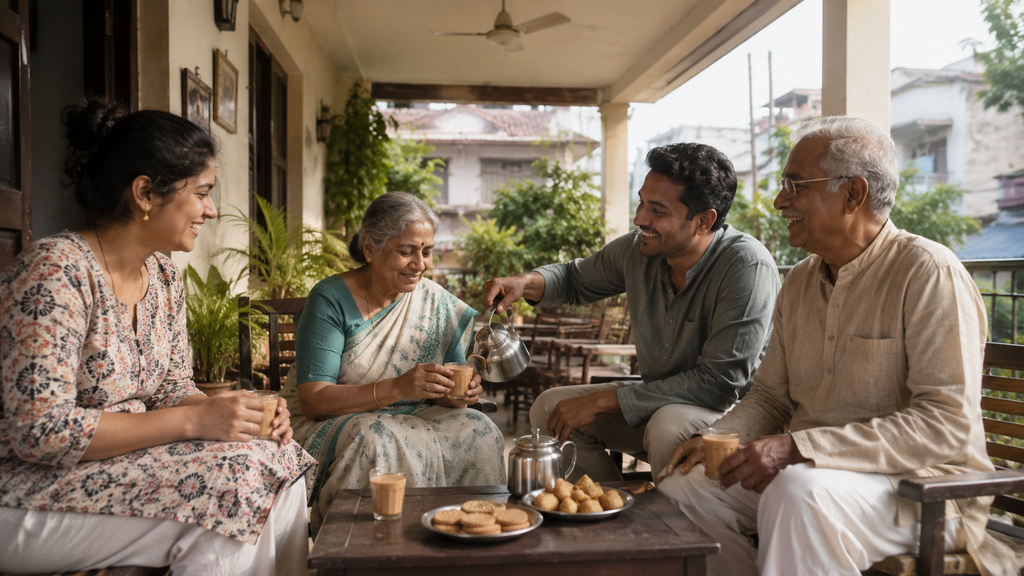
Tea became one of the recurring rhythms of my time in India.
Masala chai can be prepared in many ways, but the familiar combination of tea, milk, sugar and spices appeared again and again.
Sometimes it came from a street stall.
Sometimes from a restaurant.
Sometimes from someone’s kitchen.
The version served at home felt different.
Not necessarily because the recipe was better.
Because chai created time.
You sat.
Someone asked where you were from.
Another person joined.
Then someone wanted to know where you had traveled in India.
Then came questions about family.
Then food appeared.
The cup of chai was simply the beginning.
Family Questions Can Arrive Quickly
One thing that surprised me was how quickly conversations sometimes became personal by the standards I was used to.
Are you married?
Do you have children?
How many brothers and sisters do you have?
What do your parents do?
Where does your family live?
At first, I wondered why someone I had met ten minutes earlier wanted to know so much.
Then I began understanding that family information often helps place someone socially.
Family is a natural conversation topic.
Questions that might feel unusually personal in another culture may be ordinary curiosity in a different context.
That does not mean every traveler must answer every question.
You can always maintain your own boundaries.
But understanding the intention helped me react less defensively.
Family Can Be a Much Larger Daily Presence
In many Western travel narratives, adulthood is strongly associated with independence.
Move out.
Live alone.
Build your own household.
See your parents occasionally.
India showed me another model.
Multi-generational households remain part of life for many families, although living arrangements are changing, particularly in large cities.
Parents.
Adult children.
Grandparents.
Sometimes other relatives.
Living close to family can create support systems that would be difficult to reproduce otherwise.
Childcare.
Cooking.
Finances.
Care for older relatives.
Everyday responsibilities can be shared across generations.
Of course, this can also create tension.
Close family relationships are not automatically easy relationships.
But the importance of the family unit was difficult to miss.
Respect for Elders Was Visible in Small Ways
I expected respect for elders to appear mainly in formal traditions.
Instead, I noticed it in everyday behavior.
Who was greeted first.
Who was offered a particular seat.
Who was consulted during a conversation.
How younger family members spoke to older relatives.
How decisions were discussed.
In some families, younger people may touch the feet of elders as a traditional gesture of respect and seek their blessings.
I did not see everyone doing this all the time.
India is not culturally uniform, and younger generations may practice traditions differently.
But the broader idea of respecting older family members appeared frequently.
I Learned Not to Copy Every Gesture I Saw
This became an important travel rule.
When visitors see a meaningful cultural gesture, there can be a temptation to imitate it immediately.
Sometimes that is appropriate.
Sometimes it looks awkward.
Sometimes it can remove the meaning from the gesture.
I preferred to observe.
If someone explained a tradition and invited me to participate, that was different.
But I did not need to perform every cultural practice I encountered to prove that I respected it.
Respect can also mean knowing when to remain a guest.
Namaste Was More Complicated Than I Expected
Before India, “namaste” was probably the Indian greeting I knew best.
Hands together.
Small nod.
Namaste.
Simple.
Except India has hundreds of languages and many different greeting traditions.
Namaste or namaskar may be common in some contexts and regions, but other greetings are widely used depending on language, religion and location.
You may hear greetings connected to Sikh, Muslim or regional traditions.
English greetings are also common, particularly in urban and professional settings.
The lesson was the same:
India does not have one cultural script.
The Country Became Easier When I Stopped Looking for “The Indian Way”
This was one of my biggest mistakes early in the trip.
I wanted rules.
How do Indians greet people?
How do Indian families eat?
What do Indians wear at home?
How do Indian weddings work?
The questions sounded reasonable.
But India contains more than a billion people across an enormous range of cultures.
There is rarely one answer.
A better question is:
How does this family do it?
Or:
What is common in this region?
That small change made my observations much more useful.
Meal Times Could Become Major Social Events

Eating with a family felt very different from grabbing lunch alone while sightseeing.
A home meal could involve several dishes arriving at once.
Rice.
Flatbreads.
Dal.
Vegetables.
Pickles.
Yogurt.
Curries.
Something fried.
Something sweet.
And almost certainly something else I had forgotten was coming.
Regional differences are enormous.
A meal in Punjab may look very different from one in Tamil Nadu.
A Gujarati table has its own traditions.
Bengali cuisine brings another set of flavors.
Kerala changes the experience again.
There is no single Indian family meal.
But generosity around food appeared again and again.
My Plate Was Never Empty for Long
This became almost a problem.
I would finish something.
Immediately:
“Have more.”
I would say I was full.
Apparently, this meant:
“Please give me a slightly smaller second serving.”
Then came another spoonful.
Eventually I learned that leaving a little space in my stomach was a useful strategy.
Meals could last longer than expected.
Dessert might still be coming.
Chai might follow.
And someone could suddenly produce fruit after everything else.
The objective sometimes seemed to be making sure the guest was physically incapable of requesting more food.
Refusing Food Politely Became a Skill
There is a difference between:
“No.”
and:
“That was delicious, but I really cannot eat another bite.”
The second approach worked better.
Appreciation mattered.
I tried the food.
I complimented dishes I enjoyed.
If I was genuinely full, I said so politely.
You do not need to make yourself uncomfortable to demonstrate respect.
At the same time, accepting at least a small amount when something special was offered often felt like the friendlier choice.
Travel is full of these small negotiations.
Eating With Your Hands Can Be Completely Normal
In parts of India and with certain meals, eating with the hand is traditional and completely ordinary.
For someone accustomed to cutlery, it can initially feel unfamiliar.
The general convention in many contexts is to eat with the right hand, particularly when handling shared food or eating directly.
But again, practices vary.
I watched what other people were doing.
If everyone had spoons, I used a spoon.
If people were eating with their hands and the meal suited it, I tried.
Nobody expected perfection.
Eating With My Hand Was Harder Than It Looked
Watching someone mix rice and curry efficiently with their fingers made the technique look easy.
Then I tried.
It was not easy.
My first attempts were less “traditional dining technique” and more “adult rediscovering basic motor skills.”
Food went in the correct general direction.
That was a success.
Eventually I improved.
More importantly, nobody treated my lack of skill as a serious cultural failure.
People laughed.
I laughed.
Then someone showed me what to do.
Those moments were far more memorable than pretending I already knew everything.
The Right Hand Matters in Many Situations
I became more conscious of which hand I used.
In many Indian cultural contexts, the right hand is preferred for eating, giving something to another person or receiving something.
The left hand has traditionally been associated with personal hygiene.
Modern life is obviously more complicated than a single rule, and customs vary.
Still, using the right hand when offering or receiving food was an easy habit to adopt.
When uncertain, I watched the people around me.
The Kitchen Often Felt Like the Center of the House
Some of my favorite conversations happened nowhere near a tourist attraction.
They happened while someone was cooking.
A pot was boiling.
Spices were being added.
Someone was making bread.
Another family member walked in.
Then another.
Food preparation created a natural gathering point.
This is where I began understanding how recipes carry family history.
Someone cooked something the way their mother had taught them.
A spice combination came from a particular region.
A dish was associated with a festival.
Another was made when relatives visited.
Food became a map of family memory.
Recipes Were Often Explained Without Measurements
I asked how much spice went into something.
“A little.”
How much is a little?
Enough.
How long should it cook?
Until it is ready.
This is not particularly useful if you are trying to write a recipe.
But it makes perfect sense when someone has cooked the same dish hundreds of times.
Their hands know.
Their eyes know.
Their nose knows.
Cooking is not always performed according to written instructions.
It can be inherited through repetition.
Mothers and Grandmothers Seemed to Know Whether I Had Eaten
There appears to be an international technology shared by mothers and grandmothers.
It allows them to detect hunger even when the person insists they are not hungry.
India has an advanced version.
I could have finished lunch an hour earlier.
It did not matter.
“Eat something.”
This could sound stereotypical if applied to every family.
Obviously, not everyone behaves the same way.
But the connection between food, hospitality and care was one of the strongest themes I experienced.
Feeding someone can be a language of affection.
Gender Roles Are Changing
Writing about Indian family culture without discussing gender would create an incomplete picture.
Traditional gender roles remain influential in many households.
Women have historically carried a large share of domestic responsibilities, including cooking, childcare and household management.
But India is changing rapidly.
Women participate across education, business, government, science, technology, medicine and virtually every other area of public life.
In urban households especially, I saw younger couples negotiating family responsibilities in ways that did not fit the traditional model neatly.
Change is not uniform.
Progress happens differently across class, region and generation.
That complexity matters.
I Avoided Judging an Entire Country From One Household
This seems obvious.
Travelers still do it constantly.
You visit one family.
Then write:
“In India, women always…”
Or:
“Indian families never…”
That is dangerous.
A household can tell you about itself.
It may also reflect broader patterns.
But one family cannot represent a country of India’s scale.
I tried to describe what I observed without turning every observation into a national law.
That made the cultural experience more interesting, not less.
Marriage Came Up in Conversation Often
Marriage has enormous social significance in many Indian communities.
Even casual conversations sometimes moved toward weddings.
Who was married?
Who was getting married?
How large was the wedding?
How did the couple meet?
Arranged marriage also came up frequently.
Before visiting India, I had a simplified understanding of what that term meant.
Reality was more varied.
Arranged Marriage Does Not Always Mean What Outsiders Imagine
Some outsiders hear “arranged marriage” and imagine two strangers being forced to marry without choice.
Forced marriage exists and is a serious issue.
But it should not automatically be confused with every form of arranged marriage.
Modern arrangements can involve families introducing potential partners while the individuals themselves communicate, meet and decide whether to continue.
Technology has changed the process too.
Matrimonial websites and apps now exist alongside family networks and more traditional introductions.
Love marriages are also common.
Once again, there is no single Indian model.
Weddings Can Bring Entire Family Networks Together
Indian weddings are famous internationally for color, clothing, music and large celebrations.
What interested me more was the family structure surrounding them.
A wedding can involve far more than two individuals.
Relatives travel.
Families coordinate.
Multiple events may take place.
Food becomes a major undertaking.
Different religious and regional communities have their own ceremonies.
Even within the same broad tradition, practices vary.
Calling something simply an “Indian wedding” can hide enormous diversity.
A Punjabi Sikh wedding and a Tamil Hindu wedding, for example, may look and feel very different.
Festivals Made Family Connections More Visible
Family relationships become particularly noticeable during major festivals.
Diwali.
Eid.
Holi.
Christmas.
Onam.
Pongal.
Durga Puja.
Raksha Bandhan.
And many regional or religious celebrations.
Not every Indian celebrates the same festivals.
That point is essential.
India includes Hindus, Muslims, Christians, Sikhs, Buddhists, Jains and many other religious and cultural communities.
But across different traditions, festivals often create opportunities for families to gather.
Travel.
Eat.
Exchange gifts.
Visit relatives.
Perform rituals.
Celebrate together.
Diwali Showed Me How Homes Become Part of a Festival
Before India, I associated Diwali mainly with lights.
That is certainly part of its visual identity.
But inside homes, the festival can involve cleaning, decorating, preparing sweets, visiting relatives, religious observances and spending time together.
The exact practices vary between communities and regions.
What struck me was how the home itself became part of the celebration.
Doors.
Floors.
Balconies.
Courtyards.
Tables.
Food.
Clothing.
Everything could participate.
A festival was not simply an event somewhere in the city.
It entered domestic life.
Hospitality Can Extend Beyond Close Friends
I was surprised by how easily introductions sometimes expanded.
Meet one person.
Then meet their friend.
Then a cousin appears.
Then you are invited somewhere.
Suddenly you are drinking chai with people you did not know existed two hours earlier.
This did not happen everywhere.
Large cities can be anonymous.
People are busy.
Not every stranger is waiting to invite a traveler home.
But when hospitality happened, it could expand quickly.
Social networks felt flexible.
Being a Guest Also Comes With Responsibilities
Hospitality is not permission to forget manners.
If someone invites you into their home, remember that you are entering a private space.
I tried to follow a few simple principles.
Arrive reasonably on time, while understanding that attitudes toward time vary by situation.
Remove shoes if the household does.
Dress appropriately for the context.
Accept food or drink graciously when possible.
Ask before photographing people or private spaces.
Do not treat the home like a tourist attraction.
Thank the host.
These rules are not uniquely Indian.
They are simply good guest behavior.
Bringing a Small Gift Can Be a Nice Gesture
If I knew in advance that I was visiting someone’s home, I sometimes considered bringing something small.
Sweets.
Fruit.
Something from my own country.
Nothing extravagant.
The purpose was not repayment.
Hospitality is not a transaction.
A small gift simply acknowledged the invitation.
If you know the family’s dietary or religious practices, take them into account.
When uncertain, asking the person who invited you is perfectly reasonable.
Dietary Traditions Can Be Important
This is one area where assumptions can cause awkward situations.
Many Indians are vegetarian.
Others eat meat.
Some avoid particular meats for religious reasons.
Some households may have strict rules about what food enters the kitchen.
Jain dietary practices can involve additional restrictions.
Muslim families may follow halal requirements.
Individual practices vary enormously.
If bringing food into someone’s home, I would never assume.
Ask first.
Religion and Family Life Often Overlap
In many homes, religious practice is visible.
A small prayer space.
Images.
Lamps.
Flowers.
Sacred objects.
Scripture.
Daily or occasional rituals.
In other households, religion may be much less visible.
India contains deeply religious communities and very secular ones.
What interested me was how naturally faith could fit into domestic space.
It was not always separated into a building visited once a week.
For some families, religious practice was woven into everyday routines.
I Learned to Treat Home Shrines With Respect
If a home contained a prayer area, I treated it differently from ordinary decoration.
I did not touch objects casually.
I did not photograph them automatically.
If someone explained the shrine, I listened.
If invited to observe a ritual, I followed instructions.
Religious curiosity is fine.
Turning someone’s sacred space into a photo opportunity is different.
This distinction became increasingly important as I traveled.
Urban India Is Changing Family Life
The traditional joint-family household is still an important cultural reference, but modern urban life is reshaping how families live.
Young adults move for education.
Jobs pull people toward Bengaluru, Mumbai, Delhi, Hyderabad, Pune and other major cities.
Housing can be expensive.
Commutes can be long.
Careers may require international relocation.
Couples may establish independent households far from their parents.
Technology helps maintain family connections across those distances.
Video calls.
Family messaging groups.
Frequent visits.
Financial support.
Physical distance does not necessarily mean emotional distance.
Smartphones Entered Family Culture Too
One stereotype about traditional cultures is that modern technology destroys tradition.
Reality is much more interesting.
A grandmother can participate in a religious ritual and then immediately join a family video call.
Wedding invitations circulate digitally.
Relatives coordinate events through messaging apps.
Family photographs travel instantly across countries.
Recipes are shared through videos.
Tradition does not always disappear when technology arrives.
Sometimes technology becomes another tool for maintaining it.
Younger Indians Are Negotiating Tradition Differently
Some of the most interesting conversations I had were with younger people.
They were not necessarily rejecting family traditions.
They were deciding which parts mattered to them.
Career choices.
Marriage.
Where to live.
Gender roles.
Religious practice.
Clothing.
Relationships.
Expectations from parents.
These negotiations happen in many societies.
In India, the strength of family relationships can make them particularly visible.
Modernization is not a simple journey from “traditional” to “Western.”
People create combinations.
Respect Does Not Mean Agreement
This became another useful lesson.
A younger person may deeply respect their parents while disagreeing with them.
Someone may participate in a family tradition while questioning part of it.
A couple may maintain religious customs but reject traditional expectations about careers.
Cultures are not internally consistent.
People negotiate.
Compromise.
Argue.
Adapt.
That is normal.
Travel writing becomes much more realistic once we stop describing cultures as if everyone follows the same instruction manual.
Regional Differences Matter Enormously
If you travel through several parts of India, family culture changes with the geography.
Languages change.
Food changes.
Clothing changes.
Religious traditions change.
Architecture changes.
Social customs shift.
A home in Rajasthan may feel different from one in Kerala.
Bengal brings different culinary and festival traditions.
Punjab has another cultural landscape.
Tamil Nadu another.
The Northeast contains communities with histories and traditions that many international visitors know very little about.
The word “Indian” is useful.
It is also extremely broad.
Food Was the Easiest Door Into Those Differences
Even when I did not understand a language or ritual, I could ask about food.
What is this?
Where is it from?
When do you eat it?
Who taught you to make it?
Is it made for festivals?
Do you eat it at home often?
One question could lead into an entire family history.
A grandmother’s recipe.
A village.
A wedding.
A religious celebration.
A childhood memory.
That is why eating in someone’s home felt so different from ordering the same dish in a restaurant.
The food came with context.
I Stopped Worrying About Making Small Cultural Mistakes
At the beginning of the trip, I was nervous.
Which hand?
Shoes off?
Should I say namaste?
Where should I sit?
Can I photograph this?
Am I eating correctly?
Eventually I realized something obvious.
Most people understand that visitors do not know every local custom.
Respect matters more than flawless performance.
If I was unsure, I asked.
If I made a harmless mistake, I apologized.
If someone corrected me, I listened.
That was enough.
Curiosity Worked Better Than Pretending to Know
People often seemed happy to explain things when I asked respectfully.
Why is this food served today?
What does this decoration mean?
Is this a family tradition?
Should I remove my shoes?
How do I eat this?
Questions created conversations.
Pretending I already understood everything would have prevented them.
Travel becomes more interesting when you are comfortable admitting ignorance.
What Visitors Should Avoid
There are a few behaviors I would avoid when spending time with Indian families.
Do not photograph people without permission simply because their clothing or home looks interesting.
Do not mock religious practices.
Do not assume everyone speaks Hindi.
Do not assume everyone is Hindu.
Do not describe every tradition as “exotic.”
Do not treat arranged marriages as a joke.
Do not make sweeping statements about gender, caste, religion or poverty based on one interaction.
And do not compare everything immediately with your own country.
Sometimes it is better to observe before evaluating.
Don’t Expect Everyone to Invite You Home
Travel stories about hospitality can create unrealistic expectations.
You may read about someone meeting a stranger on a train and ending up at a family dinner.
That happens.
It does not mean you should expect invitations from everyone.
Indian cities contain millions of people living ordinary busy lives.
People have jobs.
Families.
Responsibilities.
Privacy.
Hospitality is meaningful precisely because it is offered, not because travelers are entitled to it.
Use Common Sense With Invitations From Strangers
Warm hospitality does not eliminate the need for normal travel awareness.
If you have just met someone and an invitation makes you uncomfortable, you can decline.
Tell someone where you are going.
Use reliable transportation.
Trust your judgment.
Cultural openness and personal safety are not opposites.
You can be curious without abandoning common sense.
What Surprised Me Most About Indian Family Culture
It was not one ritual.
It was the amount of time people seemed willing to give.
Sit.
Drink tea.
Eat.
Talk.
Stay a little longer.
Have another cup.
Meet another relative.
In travel, I was accustomed to measuring days through attractions.
India repeatedly interrupted that schedule.
A conversation that should have lasted twenty minutes became two hours.
At first, I worried about what I was missing.
Then I realized:
This was what I had come to experience.
A Home Taught Me More Than Another Monument Could Have
India has extraordinary monuments.
I would never suggest skipping them.
The forts of Rajasthan.
The temples of southern India.
The Mughal architecture of Delhi and Agra.
Ancient sites.
Palaces.
Mosques.
Gurdwaras.
They matter.
But monuments show only part of a culture.
Homes reveal another part.
Where people leave their shoes.
What they eat on an ordinary Tuesday.
How grandparents interact with children.
What happens when a guest arrives.
Which traditions continue.
Which traditions are changing.
That is the living culture around the historical one.
My Understanding of Hospitality Changed
Before India, I often thought of hospitality as service.
Hotels provide hospitality.
Restaurants provide hospitality.
India reminded me of the older meaning.
Hospitality is what happens when someone makes space for another person.
A chair.
A cup of chai.
A plate of food.
Time.
Conversation.
You do not need a luxury setting.
Some of the warmest welcomes happened in completely ordinary places.
I Also Learned to Receive
This sounds strange, but receiving generosity can be uncomfortable.
You want to repay immediately.
You worry you are taking too much.
You insist you do not need anything.
Sometimes that instinct can prevent someone from expressing hospitality in the way they want.
I learned to say thank you.
Accept the chai.
Eat the sweet.
Appreciate the effort.
You can return kindness later.
Not every human interaction needs to become an immediate transaction.
What I Would Do Differently on My Next Trip
I would spend less time trying to complete sightseeing lists.
India rewards slow travel.
I would stay longer in fewer places.
Take cooking classes run by local families.
Visit neighborhood markets.
Learn more regional food traditions.
Spend time outside major tourist districts.
Ask more questions.
And accept more invitations when they felt appropriate.
The country is too complicated to understand quickly.
That is not a weakness.
It is one of the reasons to return.
What First-Time Visitors Should Remember
If you are invited into an Indian home, you do not need to arrive knowing every rule.
Pay attention.
Watch what your host does.
Ask about shoes.
Use your right hand when appropriate.
Be respectful around religious spaces.
Accept food graciously.
Explain politely when you are full.
Ask before photographing.
Do not assume one household represents the entire country.
And prepare for chai.
Probably more than once.
Indian Family Culture Is Changing, Not Disappearing
It is tempting to frame modern India as a battle between tradition and change.
I do not think that captures what I saw.
Families adapt.
Young people move.
Women build careers.
Technology changes communication.
Couples make different choices.
Households become smaller in some cities.
Old expectations are questioned.
At the same time, family gatherings continue.
Festivals continue.
Parents remain important.
Food traditions survive.
Weddings bring relatives together.
Grandparents video-call grandchildren living thousands of kilometers away.
Culture rarely disappears cleanly.
It changes shape.
Final Thoughts
When I first imagined traveling through India, I pictured places.
The Taj Mahal at sunrise.
Jaipur’s palaces.
Delhi’s crowded streets.
Varanasi beside the Ganges.
Kerala’s waterways.
The mountains of the north.
I did not picture sitting inside someone’s home waiting for a metal cup of chai.
I did not imagine discussing marriage with someone I had met an hour earlier.
I did not expect a grandmother to keep offering food after I had already said I was full.
I did not think learning when to remove my shoes would become part of understanding a country.
But those small experiences stayed with me.
Indian family culture cannot be summarized with one rule.
There is no universal Indian household.
No universal meal.
No universal marriage tradition.
No universal greeting.
India is far too diverse for that.
But hospitality gave me a way into that diversity.
It taught me to stop searching for one definition of Indian culture and start paying attention to individual people, families and regions.
Sometimes the lesson arrived through a conversation.
Sometimes through a festival.
Sometimes through a family story.
And very often, it arrived on a plate.
If you are fortunate enough to be invited into an Indian home during your travels, do not worry too much about performing every custom perfectly.
Be respectful.
Be curious.
Watch.
Listen.
Ask questions.
And leave a little room for food.
Because when someone in India asks whether you would like another serving, there is a very good chance the food is already on its way.