
The alarm went off while Can Tho was still completely dark.
For a few seconds, I wondered why I had decided that waking up before sunrise was a reasonable thing to do on vacation.
Then I remembered.
Cai Rang Floating Market.
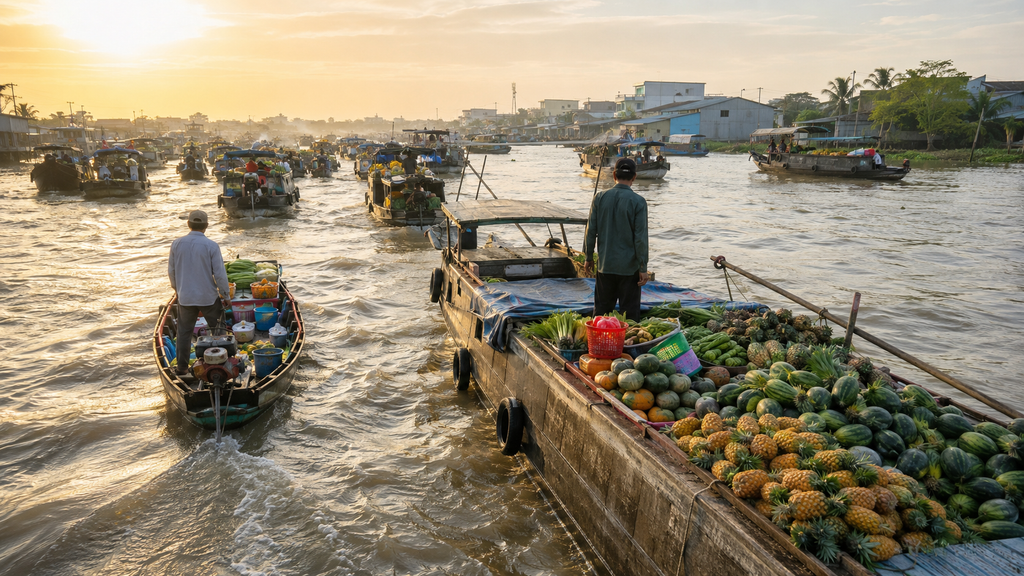
I had seen photographs before coming to the Mekong Delta: wooden boats loaded with pineapples and watermelons, bowls of steaming noodles being passed between boats, coffee served in the middle of the river and the first sunlight appearing over the water.
It looked colorful, chaotic and unmistakably Vietnamese.
But photographs had also given me the wrong expectation.
I imagined a floating version of a normal street market, with dozens of boats packed tightly together and vendors calling loudly to tourists.
The reality felt different.
Cai Rang was larger, more spread out and much more connected to the working life of the river than I expected.
And to understand it properly, I had to arrive early.
Very early.
Why I Wanted to Visit Cai Rang Floating Market
The Mekong Delta had been on my Vietnam itinerary for a long time.
I wanted to see a side of the country beyond Hanoi, Ho Chi Minh City, Hoi An and the famous coastal destinations.
Can Tho seemed like the right base.
It is a major city, but the river is never far away.
Boats still matter.
Markets still connect communities.
And just outside the center is one of the best-known floating markets in the Mekong Delta.
Cai Rang Floating Market has become a popular tourist attraction, but it did not begin as one.
The market developed around river commerce.
Before roads and bridges transformed transportation across the delta, waterways were among the most practical ways to move agricultural products between communities.
Farmers, wholesalers and traders used boats to buy and sell produce.
The river was not simply scenery.
It was infrastructure.
That history was what interested me.
I did not want to visit only because boats full of tropical fruit looked good in photographs.
I wanted to see what remained of a trading culture shaped by the Mekong.
Staying in Can Tho Made the Morning Much Easier
If Cai Rang is a priority, I would stay overnight in Can Tho.
Trying to arrive from somewhere far away on the same morning would remove one of the best parts of the experience: seeing the river wake up.
I stayed close enough to the central riverfront that getting to the boat in the early morning was straightforward.
The night before, Can Tho had felt lively.
Restaurants were busy.
Motorcycles moved through the streets.
People walked along the river.
A few hours later, everything was different.
The streets were quiet.
Most storefronts were closed.
The air was cooler.
For once, I could hear individual motorcycles instead of a continuous wall of traffic.
It felt like I had woken up before the city.
Leaving Before Sunrise
We reached the river while the sky was still dark blue.
There was enough light to see the outlines of buildings and boats, but not enough to make out every detail.
I stepped into a small wooden motorboat.
The engine started.
Within minutes, the city began sliding away behind us.
This was one of my favorite parts of the entire morning.
Nothing dramatic was happening.
We were simply traveling down the river.
Lights from houses and businesses reflected on the dark water.
Occasionally another boat passed.
The air felt surprisingly cool.
I knew the Mekong Delta would become hot later in the day, so I appreciated every minute of that early-morning temperature.
Gradually, the horizon became brighter.
Black water turned brown.
Buildings gained color.
People appeared along the riverbanks.
Can Tho was waking up.
The Journey Is Part of the Experience
I would not treat the boat ride to Cai Rang as transportation that you need to get through before reaching the attraction.
The journey itself tells you something about the city.
From the road, Can Tho looks like a modern Vietnamese city.
From the river, you see another layer.
Houses facing the water.
Boats tied beside homes.
Small docks.
Warehouses.
Riverside businesses.
People beginning work.
The river connects all of it.
That was the moment when the phrase “Mekong Delta” stopped being just a geographic name for me.
Life here had developed around water.
Even though roads now play a much larger role, that relationship has not disappeared.
My First View of Cai Rang
I knew we were approaching the market before anyone told me.
More boats started appearing.
Some were small.
Others were surprisingly large.
Several sat low in the water because they were carrying heavy loads.
Pineapples.
Watermelons.
Pumpkins.
Vegetables.
Root crops.
Produce was stacked across decks in quantities far larger than anything I had expected from a tourist market.
That was my first clue that Cai Rang was not primarily about selling one mango to someone holding a camera.
Traditionally, much of the activity here has been wholesale trade.
Boats arrive with agricultural products.
Traders buy and redistribute them.
The scale makes more sense once you understand that.
The Market Is Not a Floating Street Market
This was probably my biggest misconception.
I expected narrow lanes between boats.
Instead, the river itself is the market.
Boats move.
Engines start and stop.
Vessels approach one another.
Goods change hands.
Small boats weave between larger ones.
There is no entrance.
No obvious beginning.
No row of identical stalls.
Everything feels fluid because everything literally is.
That makes the experience less predictable than visiting a conventional market.
You do not walk from stall number one to stall number two.
You move through the market with the river.
Then I Noticed the Poles Above the Boats

Some boats had long wooden poles rising high above their decks.
Products were attached near the top.
A pineapple.
A pumpkin.
Another type of produce.
At first, I thought they were decorations.
They were not.
This traditional system is commonly associated with the cây bẹo, a simple way for sellers to advertise what they have for sale.
When customers are approaching from across the water, a conventional sign at eye level is not especially useful.
Raise the product high above the boat and people can see it from farther away.
Simple.
Practical.
And completely adapted to the environment.
Once someone explained it, I started searching the skyline above the boats instead of only looking at their decks.
The Pineapple Boats Were Impossible to Miss
Pineapples became one of the visual memories I carried away from Cai Rang.
They were everywhere.
Stacked in large piles.
Hanging from poles.
Being cut.
Being transferred.
Being sold directly to visitors from smaller boats.
At one point, we pulled alongside a boat loaded with them.
The seller cut a pineapple with the speed of someone who had probably done it thousands of times.
No elaborate preparation.
No decorative plate.
Just fresh pineapple on a boat in the middle of the Mekong Delta.
I ate it while our boats moved gently beside each other.
It was one of the simplest things I ate in Vietnam.
It was also one of the meals I remember most clearly.
Breakfast Arrived by Boat
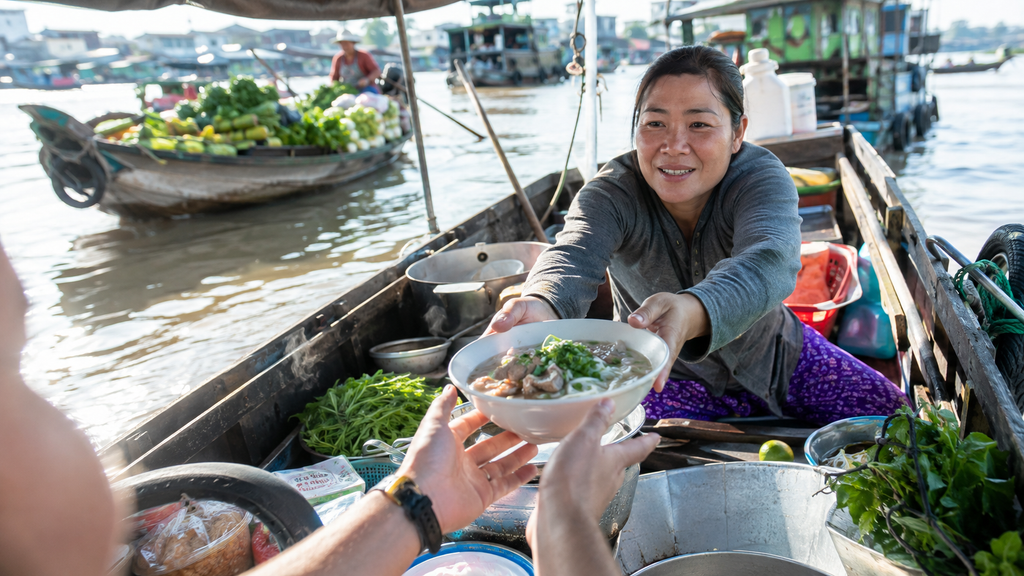
Then came one of the experiences I had been waiting for.
Breakfast on the river.
Small food boats move among customers and other vessels, serving dishes that would normally come from a street stall.
Except there is no street.
The kitchen is floating.
A vendor pulled alongside.
Bowls were prepared in a tiny working space that somehow seemed to contain everything necessary.
Broth.
Noodles.
Herbs.
Meat.
Condiments.
Bowls.
Utensils.
I watched the vendor work while both boats moved slightly with the river.
Preparing breakfast in my own kitchen suddenly seemed embarrassingly easy.
Eating Noodles on a Moving Boat Is a Skill
There is something mildly ridiculous about trying to eat a bowl of hot Vietnamese noodles while sitting on a small boat.
The river moves.
Your boat moves.
Another boat passes and creates a wake.
You are trying not to spill broth on yourself.
At the same time, you want to look around because the entire market is happening beside you.
It is not elegant.
That is part of the fun.
The noodles themselves were good.
But if I had eaten the exact same bowl inside a restaurant, I probably would not remember it years later.
Context changes food.
Breakfast in the middle of Cai Rang was not only breakfast.
It became part of the place.
Then Someone Sold Me Coffee
Vietnam will find a way to give you coffee almost anywhere.
Apparently, the middle of a river is no exception.
Another small boat approached carrying drinks.
Soon I had Vietnamese coffee in my hand while floating between produce boats.
This was the moment when waking up before sunrise finally seemed completely reasonable.
Coffee.
Morning light.
Engines in the distance.
Boats moving around us.
Can Tho somewhere behind.
The river ahead.
There are travel experiences that sound better in descriptions than they feel in reality.
This was the opposite.
It was better because it felt ordinary.
The vendor was not creating a special “Mekong coffee experience” for me.
They were selling coffee.
I happened to be there.
The Market Was Already Changing as the Sun Rose
Morning arrived quickly.
The soft early light became brighter.
The river became busier.
Then the heat started building.
By that point, I understood why everyone had told me to come early.
Cai Rang is a morning market.
Arriving late does not simply mean worse light for photographs.
You may miss much of the activity that makes the market interesting.
Wholesale trading traditionally begins early.
By the time many travelers are finishing breakfast at their hotels, parts of the market may already be winding down.
If you want to experience Cai Rang properly, this is one morning when I would not use the snooze button.
What Time Should You Visit Cai Rang Floating Market?
I would aim to leave Can Tho around 5:00 to 5:30 a.m.
Exact timing depends on where you depart, season, weather and the type of tour or boat you arrange.
The goal is to be on the river around sunrise and reach the market while trading activity is still underway.
I would rather arrive slightly too early than too late.
The darkness is temporary.
The atmosphere of the early river is part of the experience.
And sunrise gives you beautiful natural light without needing to chase a specific photography spot.
Before visiting, check current local conditions because market activity and tour schedules can change.
Cai Rang Today Is Not the Same Market It Once Was
This is important.
It is easy for travel articles to describe Cai Rang as though nothing has changed for generations.
That is not true.
The Mekong Delta has changed enormously.
Roads improved.
Bridges were constructed.
Trucks became more efficient for transporting goods.
Supply chains changed.
People gained alternatives to river transport.
All of this affected floating markets.
Cai Rang still exists, but the role of the market has evolved.
Tourism has also become increasingly important.
Some boats serve visitors.
Tours arrive every morning.
Food and drink vendors know travelers are coming.
That does not automatically make the experience fake.
It means the market is adapting.
I Would Not Expect the Photographs You See From Decades Ago
This is where managing expectations matters.
Old photographs may show an extremely dense river filled with trading boats.
Modern Cai Rang can look less crowded.
The number and concentration of boats vary.
If you arrive expecting hundreds of boats packed together in every direction, you may be disappointed.
I preferred to look at what was actually there.
Working boats.
Traders.
Food vendors.
Tour boats.
Produce.
Riverfront businesses.
A market caught between its traditional economic role and its modern identity as a cultural attraction.
That story is more interesting to me than pretending time stopped.
Tourism Is Helping Preserve Interest in the Market
There is an obvious contradiction.
Tourism changes places.
But tourism can also give communities an economic reason to maintain traditions that might otherwise disappear more quickly.
Cai Rang is a good example.
Visitors come because they want to experience floating-market culture.
That creates demand for boat operators, guides, food vendors and other local businesses.
At the same time, too much tourism can turn a working environment into a performance.
The balance is complicated.
As a visitor, the best thing I could do was treat the market as a real community rather than a theme park.
I Tried Not to Photograph Everyone Like They Were an Attraction
Cai Rang is incredibly photogenic.
That creates a temptation.
A weathered face.
A colorful boat.
Someone cutting fruit.
A vendor preparing noodles.
Click.
Click.
Click.
But these are people working.
I tried to remember that.
Wide photographs of the river were easy.
Close portraits required more consideration.
When possible, I asked or followed the guidance of the person accompanying me.
A camera does not remove normal standards of respect.
The River Is Busy, So Pay Attention
Cai Rang is not a calm decorative canal.
Boats are working.
Engines are running.
Larger vessels move through the area.
Your boat operator understands the traffic far better than you do.
Listen to instructions.
Do not stand suddenly if the boat is unstable.
Keep your hands inside when vessels are pulling alongside.
Protect cameras and phones.
I kept my phone attached securely rather than holding it casually over the water.
The Mekong would not return it.
A Small Boat Felt Better Than a Large Group Tour
If budget allows, I prefer smaller boats for this kind of experience.
A small boat sits closer to the water.
It can move more easily between different parts of the market.
The experience feels less separated from what is happening around you.
Large group boats may be cheaper per person and perfectly practical.
But if I were returning, I would choose a small private or small-group boat again.
Especially for photography.
You have more flexibility and can spend longer where something interests you.
How Long Do You Need?
For the floating market itself, you do not need an entire day.
Many visits are combined with other experiences around Can Tho.
Depending on the route, a morning trip might include:
Cai Rang Floating Market.
Breakfast on the river.
A fruit garden.
A noodle workshop.
Smaller waterways.
Local villages.
Other stops around the countryside.
I would avoid choosing a tour simply because it includes the greatest number of stops.
More stops often means less time actually experiencing anything.
I would rather have a slower morning.
Don’t Leave Can Tho Immediately After the Market
One mistake would be treating Can Tho purely as a place to sleep before Cai Rang.
The city deserves some time too.
After returning from the market, I would rest through the hottest part of the day and explore again later.
Ninh Kieu Wharf becomes pleasant toward evening.
The riverfront comes alive.
Restaurants fill.
Boats move along the Hau River.
The atmosphere is completely different from the pre-dawn departure.
Seeing both versions of the river in one day helped me understand Can Tho better.
The Mekong Delta Is About More Than Cai Rang

Cai Rang may be the famous name that brings travelers to Can Tho, but the broader delta is what makes the experience meaningful.
This region is shaped by rivers and canals.
Agriculture.
Fruit orchards.
Rice.
Fishing.
Small communities.
Large cities.
Religious traditions.
Food cultures.
And an environment that is constantly changing.
If you have time, I would stay longer than one night.
Travel into smaller waterways.
Visit communities outside the city.
Eat local dishes.
Watch the landscape from the road as well as the river.
The floating market makes more sense when you understand the region around it.
What Should You Bring?
Very little.
That is one of the nice things about the trip.
I would bring:
- A light shirt or thin layer for the cool early boat ride
- Sunscreen for later in the morning
- Hat
- Water
- Small amount of cash
- Phone or camera with a secure strap
- Waterproof protection for electronics
- Mosquito repellent
- Comfortable clothes
I would not bring a large backpack unless necessary.
Space on smaller boats can be limited.
The less you carry, the easier the morning becomes.
Bring Cash
This is not the morning when I would rely entirely on cards.
You may want coffee.
Fruit.
Breakfast.
Small local purchases.
Cash is simple.
I would carry smaller Vietnamese dong denominations rather than expecting every vendor to change a large note.
It also makes transactions faster when two boats are sitting beside each other.
What Should You Wear?
Nothing complicated.
Lightweight, comfortable clothing works.
I would avoid anything that becomes uncomfortable after several hours in humidity.
Early morning can feel surprisingly cool on a moving boat, so a thin outer layer can be useful.
Later, you will probably want it off.
Sun protection matters even in the morning.
Once the sun rises over the open river, there is not always much shade.
The Dry and Rainy Seasons Create Different Experiences
Can Tho can be visited throughout the year, but conditions change with the seasons.
The Mekong Delta has a tropical climate with wet and drier periods.
Rain does not necessarily ruin the trip.
Tropical showers can arrive and disappear quickly.
But heavy rain can obviously affect comfort, visibility and boat activities.
I would check the forecast the evening before.
If rain looks possible, bring lightweight waterproof protection rather than cancelling immediately.
The river does not stop existing because the sky is gray.
Is Cai Rang Floating Market Worth Visiting?
Yes.
But only if you arrive with the right expectations.
If you expect an enormous untouched floating market exactly as it looked decades ago, you may leave disappointed.
If you expect a working river tradition that has changed alongside modern Vietnam, I think the experience becomes much more interesting.
Cai Rang is not frozen in time.
That is precisely the point.
Vietnam is changing.
The Mekong Delta is changing.
Transportation is changing.
Commerce is changing.
The market reflects all of that.
Would I Take Children?
Yes, with some preparation.
Children may enjoy the boat ride, fruit and breakfast on the river.
But parents should remember that this is an active water environment.
Life jackets should be available and used appropriately.
Small children need close supervision.
The early wake-up can also be difficult.
A five-year-old who hates mornings may not suddenly become fascinated by wholesale pineapple distribution at 5:30 a.m.
Know your child.
What About Older Travelers?
The biggest issue may be getting in and out of smaller boats.
Some boats require stepping down or across uneven surfaces.
If mobility is limited, I would discuss this with the operator before booking.
Do not assume every boat has easy access.
A slightly larger or more suitable vessel may make the experience far more comfortable.
This is another reason to arrange the trip in advance rather than choosing randomly in the dark at the riverfront.
Choosing a Boat or Tour
I would compare more than price.
Ask:
What time do we leave?
How long is the trip?
Is it private or shared?
What type of boat?
Are life jackets provided?
What stops are included?
Does the guide speak a language you understand?
Are food and drinks included?
Where exactly do we depart?
When do we return?
If the answers are vague, I would keep looking.
A good operator makes the early morning easy.
Don’t Choose the Cheapest Option Automatically
Vietnam can be inexpensive for international travelers, which sometimes creates an obsession with saving tiny amounts of money.
I do not think that makes sense for an experience like this.
A reliable boat.
A good operator.
Proper safety equipment.
A knowledgeable guide.
A sensible itinerary.
Those are worth paying a little more for.
I would rather save money on a coffee later than choose an uncomfortable four-hour boat trip to save the equivalent of a few dollars.
The Best Part Was Not a Famous View
There was no single dramatic viewpoint.
No mountain.
No palace.
No enormous monument.
The experience was made from small moments.
Leaving Can Tho in darkness.
Watching sunrise appear over the river.
Spotting produce hanging from a cây bẹo.
Pulling beside a pineapple boat.
Trying not to spill noodle soup.
Drinking coffee while another boat passed.
Watching traders move produce.
Seeing houses facing the water.
Returning toward the city after the sun was fully awake.
Individually, none of those moments sounds extraordinary.
Together, they created one of my favorite mornings in southern Vietnam.
What I Would Do Differently Next Time
I would spend more time in Can Tho.
On my first visit, the floating market was the objective.
Next time, I would make the river only one part of a slower Mekong Delta trip.
I would stay several nights.
Explore smaller canals.
Spend more time eating.
Visit areas outside the busiest tourist routes.
Talk to people who live and work around the waterways.
And I would still wake up early for Cai Rang.
Just maybe not every morning.
My Ideal Cai Rang Morning
If I were planning the experience again, I would keep it simple.
Around 4:45 a.m.
Wake up.
Question my life choices.
Get dressed.
Around 5:15 a.m.
Board a small boat in Can Tho.
Travel toward Cai Rang while the sky begins changing color.
Around sunrise
Reach the market.
Watch trading activity.
Learn how the cây bẹo works.
Move among the larger produce boats.
Breakfast
Order noodles or another local breakfast from a food boat.
Get Vietnamese coffee.
Obviously.
Later in the morning
Continue through nearby waterways or visit one carefully chosen local stop.
Before midday
Return to Can Tho.
Shower.
Sleep.
Then go looking for lunch.
That is enough.
There is no need to turn a peaceful Mekong morning into a twelve-stop race.
Final Thoughts
Cai Rang Floating Market was not exactly what I expected.
It was better for a different reason.
I expected spectacle.
What interested me was ordinary life.
A seller cutting pineapple.
A food vendor balancing bowls inside a tiny boat.
A trader checking produce.
A motor starting.
Coffee crossing from one boat to another.
A wooden pole quietly advertising what was for sale.
The market has changed.
It will continue changing.
Modern roads and transportation have reduced the economic importance of many floating markets across the Mekong Delta, while tourism has created a new reason for travelers to seek them out.
That makes Cai Rang more complicated than the romantic photographs suggest.
And more interesting.
Go early.
Do not expect a floating theme park.
Do not expect the Mekong Delta of fifty years ago.
Watch what is happening now.
Eat breakfast on the river.
Buy a pineapple.
Drink a coffee.
Put the camera down occasionally.
And pay attention to the small working details around you.
By the time I returned to Can Tho, the city was fully awake.
Traffic had returned.
The heat was building.
Restaurants were preparing for lunch.
It felt strange knowing that I had already spent hours on the river before most of the day had even begun.
For once, waking up before sunrise had been completely worth it.