
There was a moment on a train in Switzerland when I realized I had stopped looking at my phone completely.
The train had left the station only a few minutes earlier.
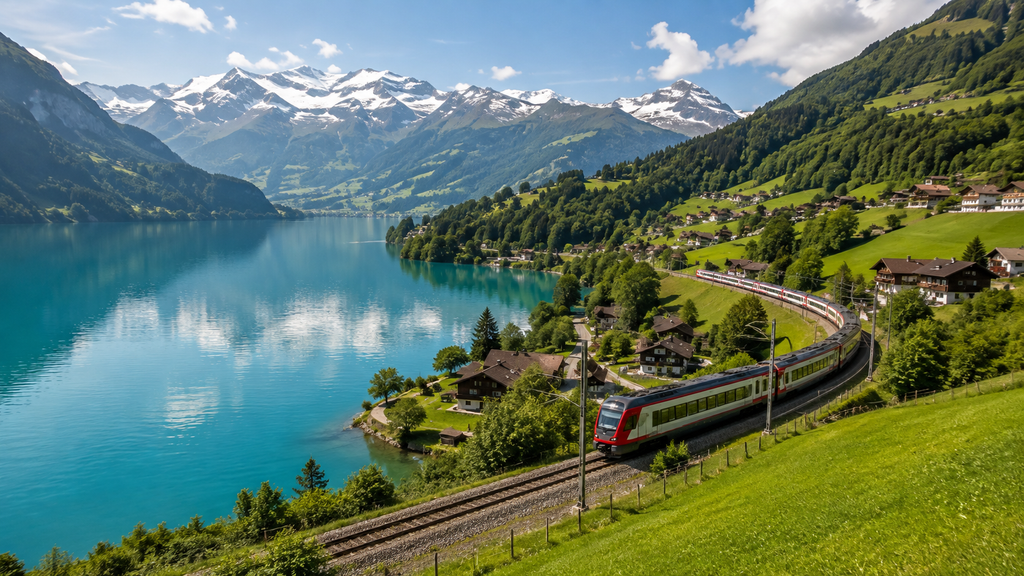
Outside the window, a lake stretched alongside the railway, almost unnaturally blue in the morning light. Small houses appeared between green fields. A church tower passed by. Behind everything, mountains rose higher and higher until their upper slopes disappeared into cloud.
Nobody in the carriage seemed particularly surprised.
A man across the aisle was reading.
Someone was drinking coffee.
A woman near the door was answering emails.
I was the only person staring through the window like something extraordinary was happening.
That became one of my favorite things about traveling through Switzerland.
The train is not simply transportation between attractions.
Very often, the journey is one of the attractions.
You do not need to book the most expensive panoramic train to experience this either. Some of the ordinary trains I took passed through landscapes that would have been major sightseeing excursions almost anywhere else.
If I were planning a first trip around Switzerland again, I would deliberately leave more time for rail travel rather than treating every train journey as something to get through as quickly as possible.
Here is what I would actually want to know before doing it.
Why I Would Choose Trains Over a Rental Car
Switzerland is one of the few countries where I rarely found myself wishing I had rented a car.
Normally, having a car gives you freedom.
In Switzerland, trains often give you more.
You do not need to find parking in mountain villages.
You do not need to concentrate on narrow roads while everyone else looks at the scenery.
You can arrive in the center of a town, walk a few minutes to your hotel and leave again without worrying about the car.
More importantly, public transport reaches places where ordinary cars cannot.
Wengen is reached by mountain railway.
Mürren is connected through mountain transport.
Cable cars, funiculars, boats and trains work together in a way that makes a car surprisingly unnecessary for many itineraries.
That does not mean driving in Switzerland is a bad idea.
If you are visiting remote rural areas or traveling with a lot of luggage, a car may still make sense.
But for a first trip connecting cities, lakes and the Alps, I would choose the train.
The First Thing to Understand: Swiss Trains Are Not Just One Type of Train
Before arriving, I imagined the Swiss railway system as one enormous network of similar trains.
It is more varied than that.
You have fast intercity services connecting major cities.
Regional trains stop at smaller towns.
Mountain railways climb slopes that look far too steep for ordinary trains.
There are panoramic trains designed around scenery.
Then there are funiculars, cable cars and boats that often connect directly with the railway network.
The good news is that you do not need to understand every operator before your trip.
From a traveler’s perspective, the system generally feels connected.
You search for the journey.
You see the connections.
Then you follow them.
The complicated part is usually deciding which ticket or pass makes financial sense.
Actually taking the trains is much easier.
Zurich to Lucerne Is a Good Introduction
If you arrive in Switzerland through Zurich, Lucerne is an excellent first rail journey.
It is not the most dramatic train ride in the country.
That is exactly why I like it as an introduction.
You leave a major city and gradually begin seeing the Switzerland you probably imagined before arriving.
Urban areas become smaller.
Green countryside appears.
Traditional houses become more common.
Then you arrive in Lucerne with the lake and mountains almost immediately accessible from the station.
The railway station is right beside Lake Lucerne.
You can step off the train, walk outside and see boats leaving from the waterfront.
That transition is one of the great advantages of Swiss rail travel.
Stations are often part of the destination rather than somewhere inconveniently located outside it.
Lucerne to Interlaken Is Where the Scenery Changes
If I had to recommend one ordinary journey to someone who wanted to understand why train travel in Switzerland is special, I would seriously consider Lucerne to Interlaken.
The route is part of the Luzern–Interlaken Express journey.
This is where the scenery becomes difficult to ignore.
The train passes lakes, green valleys and mountain settlements as it crosses toward the Bernese Oberland.
At certain points, the railway climbs enough to give you broad views across the landscape.
Then another lake appears.
Then another village.
You start wondering whether you should photograph everything.
Do not.
You will spend the entire journey looking at your screen.
Take a few photographs and then put the phone down.
The view changes constantly.
Sit by the Window, But Do Not Obsess Over the Perfect Side
Before scenic journeys, people often search:
Which side of the train should I sit on?
I understand why.
I did the same thing.
Sometimes one side genuinely offers better views for part of a route.
But Switzerland has an annoying habit of putting beautiful scenery on both sides.
A lake may appear on the left.
Ten minutes later, the better mountain view is on the right.
The railway curves.
The valley changes direction.
You end up moving your head from one window to another anyway.
If the train is not crowded, this is easy.
If it is busy, take whatever window seat you can get and enjoy the journey.
Missing one photograph will not ruin Switzerland.
Interlaken Is Where Trains Become Part of the Mountains
Arriving at Interlaken Ost changes the nature of rail travel.
From here, trains begin heading deeper into the Bernese Oberland.
Lauterbrunnen.
Grindelwald.
Wengen.
The Jungfrau region.
These journeys are shorter than the long cross-country routes, but some are even more memorable.
The train toward Lauterbrunnen follows the valley as mountains close around you.
Then from Lauterbrunnen, the railway toward Wengen climbs above the valley floor.
This is one of those journeys where I would deliberately avoid reading anything during the ride.
Sit near the window.
Watch Lauterbrunnen shrink beneath you.
Look for Staubbach Falls across the valley.
Watch the railway curve around the mountainside.
The journey is relatively short.
It still feels like an excursion.
The Train to Wengen Changed How I Thought About Public Transport
In most countries, public transport is something you tolerate to reach somewhere beautiful.
Here, I was sitting on public transport while the beautiful part was happening outside the window.
The train climbs steadily from Lauterbrunnen toward Wengen.
Houses become smaller below.
The valley opens.
Waterfalls appear against the cliffs.
Forests move past the windows.
Then you arrive at a car-free mountain village.
There is no dramatic announcement telling you that you have just completed one of the most scenic little railway journeys in Europe.
People simply get off and continue with their day.
That understatement somehow makes it better.
Ordinary Trains Can Be Better Than Panoramic Trains

This may be the most useful thing I learned.
You do not need to build your entire Switzerland itinerary around famous scenic trains.
The Glacier Express and Bernina Express are famous for good reason.
But regular Swiss trains also travel through extraordinary landscapes.
And ordinary services sometimes give you more flexibility.
You can stop.
Spend a few hours somewhere.
Continue later.
You are not always tied to a long reserved journey.
For travelers with limited time, this can be more enjoyable than spending an entire day aboard one train simply because it appears on every Switzerland bucket list.
Think about what you actually enjoy.
If you love slow travel and watching landscapes for hours, a panoramic route may be perfect.
If you prefer mixing train journeys with walking and exploring towns, regular services may suit you better.
The GoldenPass Route Is Easy to Fit Into a Trip
For many first-time visitors, the GoldenPass area makes more practical sense than crossing the country specifically for one famous scenic railway.
The route connects central Switzerland and the Bernese Oberland toward the Lake Geneva region through a series of beautiful landscapes.
Depending on your itinerary and service, you can travel through places such as Interlaken, Zweisimmen and Montreux.
What I like about this journey is the variety.
Mountains.
Green valleys.
Traditional villages.
Lakes.
Then eventually the landscape begins changing as you approach the French-speaking part of Switzerland.
You are not simply seeing mountains for several hours.
You are watching the country change.
Interlaken to Montreux Feels Like Crossing Between Two Switzerlands
One of the fascinating things about Switzerland is how quickly the atmosphere changes between regions.
Leaving the Bernese Oberland, the landscape feels unmistakably Alpine.
Wooden houses.
Mountain pastures.
Deep valleys.
As you continue toward Montreux, the environment gradually becomes softer.
Vineyards appear.
Lake Geneva comes into view.
Architecture changes.
French becomes more common.
By the time you reach Montreux, you feel as though you have traveled much farther than the map suggests.
That cultural transition is one reason I enjoy long train journeys.
A flight shows you two airports.
A train shows you what exists between them.
Is the Glacier Express Worth It?
This depends on your itinerary.
The Glacier Express is probably Switzerland’s most famous scenic train.
It crosses the Alps between Zermatt and St. Moritz, traveling through mountain landscapes, valleys, gorges and high passes.
The journey is long.
That is part of the appeal.
This is not a train you take because you are trying to reach St. Moritz as efficiently as possible.
You take it because you want the railway journey itself.
If that sounds appealing, it can be a memorable experience.
If you become restless after two hours on a train, do not book an all-day scenic journey because social media told you that you should.
There are other ways to experience parts of the same landscape.
You Can Travel Similar Routes Without the Glacier Express
This is something many first-time visitors do not realize.
The tracks used by famous panoramic trains are not necessarily exclusive to those services.
Regional trains operate across many of the same areas.
That means you may be able to travel similar sections using regular services, often with greater flexibility.
You may need to change trains more frequently.
The windows may not be designed specifically for panoramic sightseeing.
There may be commuters sitting beside you.
I actually like that.
It feels less like a packaged attraction and more like traveling through Switzerland.
If the panoramic experience matters to you, book the famous train.
If the landscape matters more than the branding, investigate regular services too.
The Bernina Route Is Different
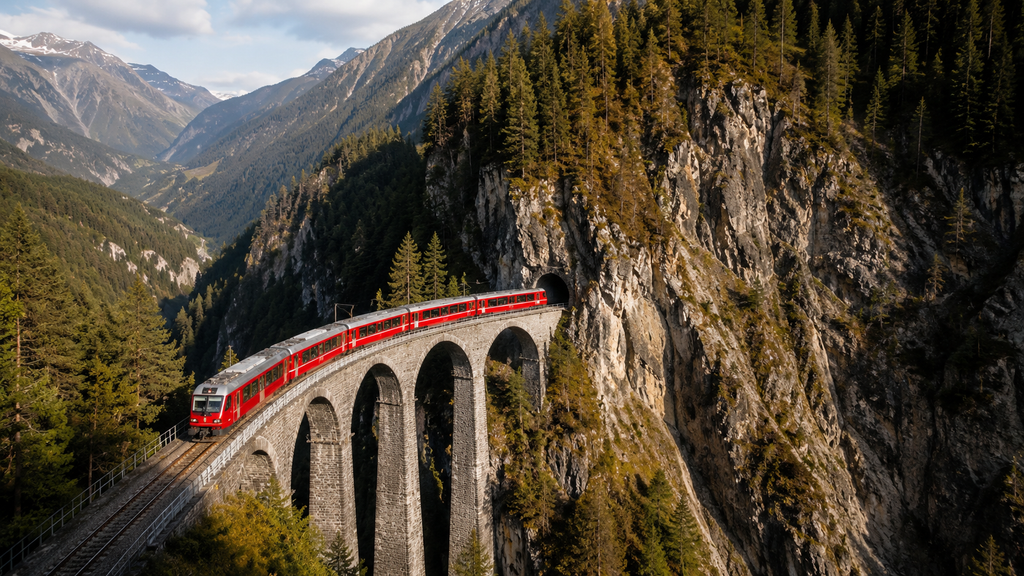
If your itinerary reaches eastern Switzerland, the Bernina route deserves attention.
The railway crosses dramatic Alpine terrain toward Italy, and the change in landscape is remarkable.
High mountain scenery eventually gives way to a noticeably different environment as the route descends south.
The engineering is part of the experience.
The railway curves through difficult terrain, crosses viaducts and negotiates large changes in elevation without feeling like an amusement ride.
This is one of those journeys where the railway itself becomes almost as interesting as the mountains.
But I would only add it if it fits your broader itinerary.
Switzerland is too beautiful to spend half your holiday repositioning simply to collect famous train names.
Do Not Build a Trip Around Instagram
This applies particularly to scenic rail travel.
It is easy to see photographs of the Glacier Express, Bernina Express and GoldenPass and decide that you need all three.
Then you look at the map.
They are not all conveniently located along one simple route.
Trying to include every famous train can create a strange itinerary where you spend most of your holiday traveling toward your next train journey.
Choose one major scenic route if it fits naturally.
Let the ordinary trains provide the rest.
You will still see plenty of mountains.
Buying Tickets Is Easier Than Understanding the Discounts
Taking a Swiss train is simple.
Paying the smartest price requires more thought.
Point-to-point tickets are straightforward.
Then you encounter the Swiss Travel Pass.
The Half Fare Card.
Regional passes.
Saver fares.
Mountain railway discounts.
Suddenly the easy train system begins feeling like mathematics.
My advice is to work backward from your itinerary.
Write down the major journeys you expect to make.
Zurich to Lucerne.
Lucerne to Interlaken.
Interlaken to Lauterbrunnen.
Mountain excursions.
Interlaken to Montreux.
Then compare the approximate cost of individual travel with the passes available for your trip.
Do not begin by buying a pass and then designing the holiday around it.
Swiss Travel Pass: Convenience Has Value Too
Not every travel decision needs to produce the absolute lowest possible price.
The Swiss Travel Pass can be attractive because of convenience.
Having broad transport coverage means fewer moments standing at a station wondering which ticket you need.
That matters if you are moving frequently.
It can also encourage spontaneity.
You may decide to take a boat across a lake simply because you have time.
Or stop in a town you had not planned to visit.
But coverage varies, especially for mountain transport.
Some journeys may be included.
Others may be discounted.
Some expensive mountain excursions require additional payment.
Check the current conditions before buying.
The Half Fare Card Can Make More Sense Than You Expect
For some itineraries, the Swiss Half Fare Card can be a strong alternative.
Instead of purchasing broad unlimited travel, you pay for individual journeys at reduced rates where applicable.
This can work well if you are taking several expensive train and mountain journeys but do not need unlimited transport every day.
Again, there is no universal winner.
Someone traveling across Switzerland every day has different needs from someone staying four nights in Lauterbrunnen.
Calculate based on your actual trip.
Switzerland rewards people willing to spend ten minutes with a calculator.
Use the SBB App
This is one thing I would set up before the trip.
The SBB system is extremely useful for checking connections, platforms and journey times.
Swiss train journeys sometimes involve transfers that look stressful when you first see them.
Seven minutes?
Different platform?
Another train?
Then you arrive and discover the next platform is a short walk away and the connection has been designed around this movement.
Having the timetable on your phone removes a lot of unnecessary uncertainty.
Still, check the platform displays at the station.
Real-world information always wins over a screenshot you took yesterday.
Short Connections Are Normal
I come from the school of travel that becomes nervous when a connection is less than twenty minutes.
Switzerland forced me to adjust.
Short rail connections are common.
The system is often scheduled so that trains arrive and connecting services depart within relatively small windows.
At first, I kept thinking:
There is no way.
Then everyone calmly stepped off the train, crossed the platform and boarded the next one.
Of course, delays can happen.
No transport system is perfect.
But do not automatically reject an itinerary simply because the connection looks shorter than what you would accept at an airport.
A Swiss railway station is not an airport.
Luggage Is Easier Than I Expected
Another advantage of train travel is avoiding airport-style luggage procedures.
You carry your bags onto the train and store them in available luggage areas or suitable spaces depending on the service.
The key is not bringing more than you can comfortably handle.
You may encounter stairs.
You may need to change platforms.
You may have only a few minutes between trains.
Dragging two enormous suitcases through a small mountain station removes some of the romance from scenic rail travel.
For a multi-stop Switzerland trip, I would pack lighter than usual.
Your future self will appreciate it.
Do Not Stand in the Doorway With Your Suitcase
This sounds like an unnecessarily specific tip.
It is not.
When the train reaches a busy station, people need to leave quickly.
Have your luggage ready before your stop.
Move toward the exit at an appropriate time.
Do not wait until the doors open to remember that your suitcase is buried beneath four other bags.
Swiss trains may be efficient.
You can still personally make the process inefficient.
Trains Are Quiet
One thing I noticed quickly was the atmosphere inside many Swiss trains.
People generally do not treat the carriage like a social gathering.
Conversations happen, of course.
Families travel.
Tourists get excited.
But the overall environment can be noticeably calm.
Match the atmosphere around you.
There is no need to whisper for three hours, but playing videos loudly from your phone is unlikely to make you popular.
Some trains also have designated quiet areas.
Pay attention to the carriage you enter.
Food on the Train
I rarely felt the need to organize a complicated train meal.
For longer journeys, I would buy something before boarding.
Swiss stations are often surrounded by convenient food options.
A sandwich.
Bread.
Cheese.
Fruit.
Coffee.
Chocolate, inevitably.
Some longer-distance services have onboard food options, but availability depends on the train.
I prefer having something with me.
Then if the scenery becomes particularly good, I do not have to leave my seat just because I suddenly want lunch.
Lake Boats Are Part of the Same Travel Experience
One mistake would be thinking about Switzerland only in terms of trains.
The boats are excellent too.
Lake Lucerne.
Lake Thun.
Lake Brienz.
Lake Geneva.
A boat journey can turn what would otherwise be a straightforward transfer into several hours of slow sightseeing.
This is especially useful when you have been taking trains for several days.
The perspective changes completely.
Instead of looking down toward a lake from a railway, you are on the water looking back toward the mountains.
If your pass includes or discounts a suitable boat journey, even better.
Lake Brienz Is Worth Slowing Down For
The water around Lake Brienz can appear intensely turquoise under the right conditions.
Trains run along sections of the lake, giving you beautiful views from the railway.
But if you have time, seeing it from the water is different.
The mountains rise directly beyond the shoreline.
Small settlements appear along the lake.
The pace is slower than the railway.
You begin to understand why rushing through Switzerland feels slightly absurd.
Every form of transport keeps becoming sightseeing.
Do Not Schedule Every Train
There is a difference between planning and overplanning.
I would know which route I intended to take each day.
I would know whether reservations were required.
I would check the final reasonable connection back to my accommodation.
But I would not decide that I absolutely had to take the 14:07 train three weeks before the trip unless there was a specific reason.
Maybe you find a café you like.
Maybe the weather suddenly clears.
Maybe you want another hour beside the lake.
Frequent services on many routes allow flexibility.
Use it.
Reservations Are Not Always Required
Travelers accustomed to other European rail systems sometimes assume every intercity journey requires a reserved seat.
That is not generally how ordinary Swiss domestic rail travel works.
Many regular services do not require reservations in the way some high-speed trains elsewhere in Europe do.
Famous panoramic trains can be different.
Certain scenic services may require reservations or supplements even when your underlying travel is covered by a pass.
This is why you should distinguish between:
having a valid ticket
and
having a required seat reservation.
They are not always the same thing.
Check the conditions for the specific scenic service you want to take.
Morning Trains Have a Different Feeling
Some of my favorite journeys happened early.
Stations were quieter.
The light was softer.
Mountains were sometimes clearer before afternoon clouds developed.
Villages were waking up rather than receiving large numbers of day visitors.
There is also something satisfying about sitting beside a train window with coffee while the first sunlight reaches the mountains.
If you are heading into the Alps, an early departure has practical advantages too.
More daylight.
More flexibility.
And more time to change plans if the weather turns.
Weather Can Change the Value of a Train Journey
A scenic railway in heavy cloud is still transportation.
It may not be particularly scenic.
This is another reason to avoid locking every day too tightly.
Lower routes beside lakes can remain beautiful when high mountains are covered.
Mountain railways may disappear directly into cloud.
If your itinerary allows flexibility, match the journey to the conditions.
On a clear day, go high.
On a cloudy day, travel between towns, lakes and lower valleys.
You cannot control Swiss weather.
You can control whether you spend a large amount of money deliberately traveling into a cloud.
Missing a Train Is Usually Not a Disaster
One of the nicest things about a strong railway network is that missing a connection does not automatically destroy the day.
On many routes, another service will follow.
Maybe in thirty minutes.
Maybe in an hour.
Obviously, this varies by route and time of day.
Remote mountain connections can be less frequent.
But generally, I felt far less anxiety about missing trains in Switzerland than I do in places where one missed service means losing half a day.
Always check the next option before panicking.
There is usually a solution.
What I Would Do on a First Switzerland Rail Trip
If I had roughly a week and wanted train travel to be part of the experience, I would keep the route relatively simple.
I might begin in Zurich.
Continue to Lucerne.
Travel from Lucerne toward Interlaken.
Spend several days exploring Lauterbrunnen, Wengen and Grindelwald.
Then continue west toward Montreux.
From there, perhaps finish around Lausanne or Geneva.
This route gives you cities, lakes, mountains, villages and different language regions without requiring constant long-distance repositioning.
More importantly, the journeys between destinations are interesting.
You are not sacrificing a day every time you change hotels.
What I Would Not Do
I would not try to visit Zurich, Lucerne, Zermatt, Interlaken, St. Moritz, Montreux and Geneva in five days.
The trains may be excellent.
You are still subject to time.
There is a difference between seeing Switzerland by train and seeing Switzerland only from a train.
Spend nights in places.
Get off.
Walk.
Let the railway connect experiences rather than replace them.
The Journey I Remember Most
It was not the longest.
It was not the most famous.
There was no panoramic carriage.
No meal service.
No special reservation.
Just a regular mountain train climbing away from Lauterbrunnen.
The valley opened beneath the railway.
Staubbach Falls appeared across the cliffs.
Green fields surrounded the village below.
Snow-covered mountains rose beyond everything.
A few minutes later, trees blocked the view.
Then it appeared again from a different angle.
That short journey explained Switzerland better than any advertisement could.
The railway was not fighting the landscape.
It seemed woven into it.
Final Thoughts
Traveling Switzerland by train changed the way I planned each day.
Normally, I think about transportation as the space between experiences.
Get from the airport to the city.
Get from one attraction to another.
Get from one hotel to the next.
In Switzerland, that distinction becomes much less clear.
A train beside Lake Lucerne can be an experience.
A mountain railway above Lauterbrunnen can be an experience.
Changing trains at a tiny Alpine station can become one of the moments you remember.
Even an ordinary regional service can suddenly round a corner and reveal a view that makes everyone near the window look up.
That is why I would not obsess over taking every famous panoramic train.
Choose one if it fits your route.
But trust the ordinary railway too.
Sit by the window.
Pack lightly.
Leave some flexibility.
Check the weather.
Bring something to eat.
And occasionally put the phone away.
Because somewhere between the city you left and the mountain village you are trying to reach, you may realize that you are already exactly where you came to Switzerland to be.