
The first thing I learned about traveling in the Swiss Alps is that distances on a map can be misleading.
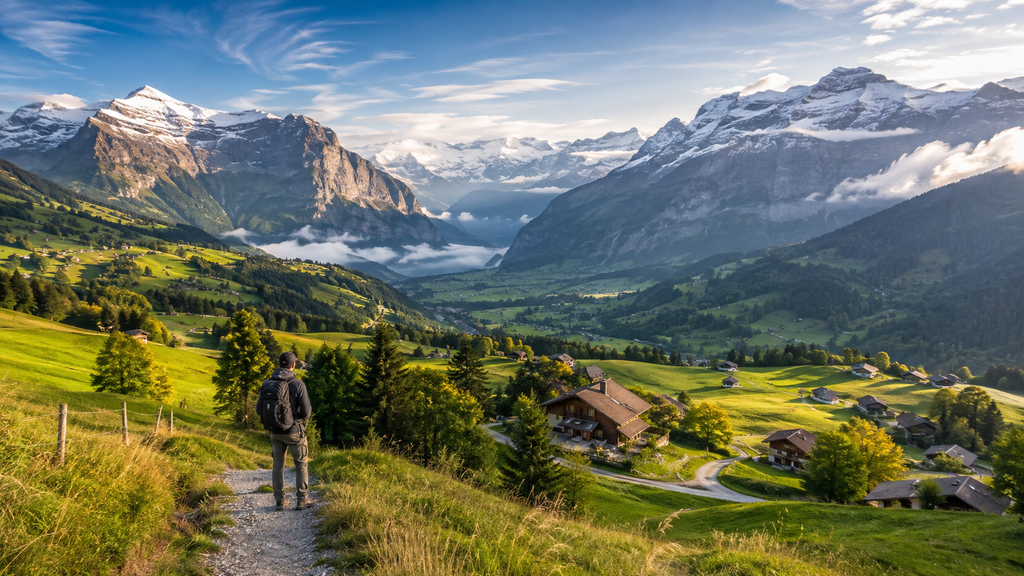
Interlaken, Lauterbrunnen, Wengen and Grindelwald all look close to one another. And they are. But once you arrive, you realize that getting from one place to another is part of the experience.
You are not simply moving between towns.
One train follows a turquoise river into a valley. Another climbs slowly above waterfalls and wooden chalets. A cable car disappears toward a mountain ridge. Then you step off at a tiny station and suddenly find yourself looking directly at snow-covered peaks.
That is why I would not rush this part of Switzerland.
Three days is enough to experience the area without turning the trip into a race. Four days is even better, particularly if hiking is important to you.
For a first visit, I would base myself around Interlaken or Lauterbrunnen and explore from there.
Here is how I would plan the journey after understanding how the region actually works.
Day 1: Arriving in Interlaken
Interlaken is often described as the gateway to the Bernese Oberland, and that is probably the best way to think about it.
The town sits between Lake Thun and Lake Brienz, with mountains rising around it and railway lines heading toward some of Switzerland’s most famous Alpine villages.
If you arrive by train from Zurich, Bern or Lucerne, the transition happens gradually.
City buildings disappear.
Fields become greener.
The mountains get closer.
Then suddenly you are standing outside Interlaken Ost station with peaks visible beyond the town.
Interlaken itself is easy to navigate. There are two main railway stations, Interlaken Ost and Interlaken West, connected by the town center.
For trips toward Lauterbrunnen and Grindelwald, Interlaken Ost is the station that matters most.
If I were choosing accommodation primarily for mountain day trips, I would stay within comfortable walking distance of Interlaken Ost rather than choosing a hotel simply because it looks attractive on a booking site.
That small decision saves time every morning.
Do Not Fill the First Afternoon
It is tempting to arrive in Interlaken and immediately start heading into the mountains.
I would resist that unless you arrive early.
Use the first afternoon to understand the area.
Walk through town.
Check where your train leaves the following morning.
Buy groceries or snacks.
Look at the weather forecast.
Sit somewhere near the river or walk toward one of the lakes.
Interlaken is particularly pleasant in the evening when day-trippers begin leaving and the pace slows down.
You may also see paragliders descending toward the large open field of Höhematte in the center of town.
That scene becomes surprisingly normal after a day or two.
Someone is drinking coffee on a terrace while another person is floating down from a mountain.
That is Interlaken.
Where Should You Stay?
This question matters more than it initially appears.
Interlaken has the largest choice of hotels, restaurants and shops. It is also the easiest base if your itinerary includes several different valleys.
Lauterbrunnen is much smaller and more atmospheric.
If your idea of Switzerland is waking up surrounded by cliffs and waterfalls, Lauterbrunnen is difficult to beat.
Grindelwald feels more like a mountain resort and works extremely well if most of your plans involve the Grindelwald side of the region.
Personally, for a first visit covering several places, I would choose either Interlaken or Lauterbrunnen.
Interlaken gives you convenience.
Lauterbrunnen gives you atmosphere.
There is no perfect answer. It depends on whether you value transportation flexibility or waking up directly inside the mountains.
Day 2: Interlaken to Lauterbrunnen
This is where the trip really begins.
From Interlaken Ost, trains run toward Lauterbrunnen through a landscape that becomes more dramatic almost immediately.
The journey is not long, which is why many people treat Lauterbrunnen as a quick stop.
I think that is a mistake.
When the train enters the valley, steep cliffs begin rising on both sides.
Waterfalls appear against dark rock.
Traditional houses sit between green fields.
The scale changes completely.
Then you step outside Lauterbrunnen station and realize that the photographs did not exaggerate very much.
The valley really does look like that.
The First View of Staubbach Falls
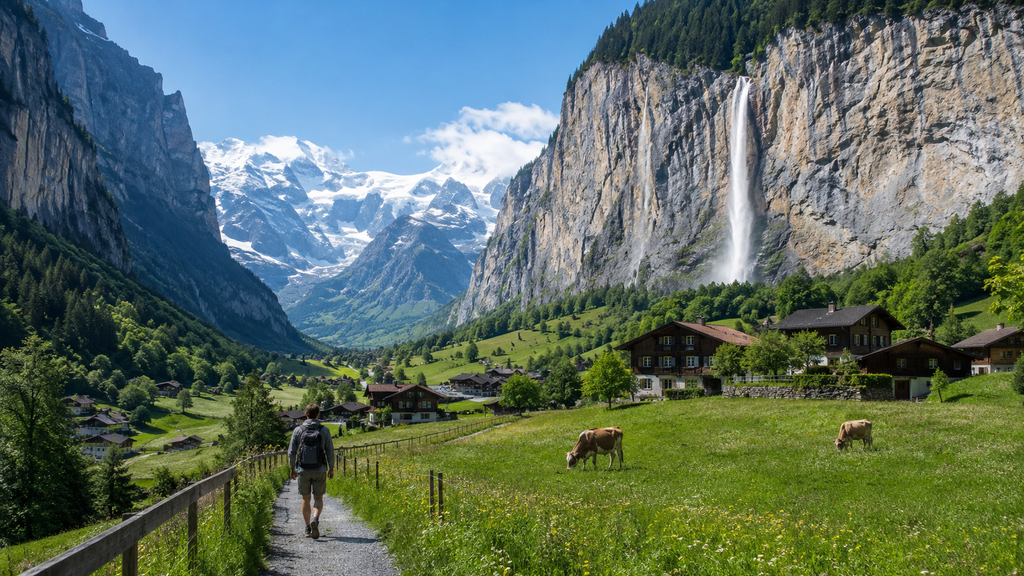
Staubbach Falls is visible from much of Lauterbrunnen.
Water drops almost 300 meters from the cliff above the village, and depending on the wind, the lower part sometimes seems to disappear into mist before reaching the ground.
You do not need to rush directly toward it.
Walk through the village slowly.
The main road is lined with hotels, cafés, shops and traditional houses, but the cliffs dominate everything.
Every few minutes you look up again.
That is something photographs rarely communicate.
The waterfall is not simply an attraction you visit.
It is part of the background while you walk around town.
Walk Into the Valley
One of the simplest things you can do in Lauterbrunnen is also one of the best.
Keep walking beyond the village.
The valley floor is relatively gentle compared with many mountain hikes, making it accessible even if you are not planning a serious hiking day.
Once you leave the busiest part of Lauterbrunnen, the atmosphere becomes quieter.
You pass farms, wooden barns, small houses and fields beneath enormous cliffs.
Waterfalls appear on both sides of the valley.
Cyclists pass occasionally.
Cowbells carry surprisingly far through the open landscape.
This is the point where I stopped thinking about Lauterbrunnen as somewhere to “see” and started enjoying simply being there.
You do not always need another viewpoint.
Sometimes walking through the valley is enough.
Trümmelbach Falls Is Worth Considering
Farther into the valley are the Trümmelbach Falls, a series of powerful glacial waterfalls running through the mountain itself.
The experience is completely different from Staubbach Falls.
Instead of standing in an open valley looking at water falling from above, you enter a rocky interior where enormous quantities of water rush through narrow channels.
It is loud.
Wet.
And much more dramatic than I expected.
Opening periods depend on the season and conditions, so this is one place I would check before building the day around it.
If it is open during your visit, it fits naturally into a Lauterbrunnen valley day.
Lauterbrunnen Is Better After the Day-Trippers Leave
This is one reason staying overnight here is appealing.
During the middle of the day, Lauterbrunnen can become busy.
Tour buses arrive.
Trains bring visitors from Interlaken.
The small center fills quickly.
Later in the afternoon, things change.
The streets become quieter.
The light begins moving across the cliffs.
Restaurants prepare for dinner.
The sound of the waterfalls becomes more noticeable once traffic and crowds decrease.
If you are staying in Interlaken, consider remaining in Lauterbrunnen until early evening rather than immediately returning after the main attractions.
The valley feels different when it becomes quiet.
Going Up to Wengen
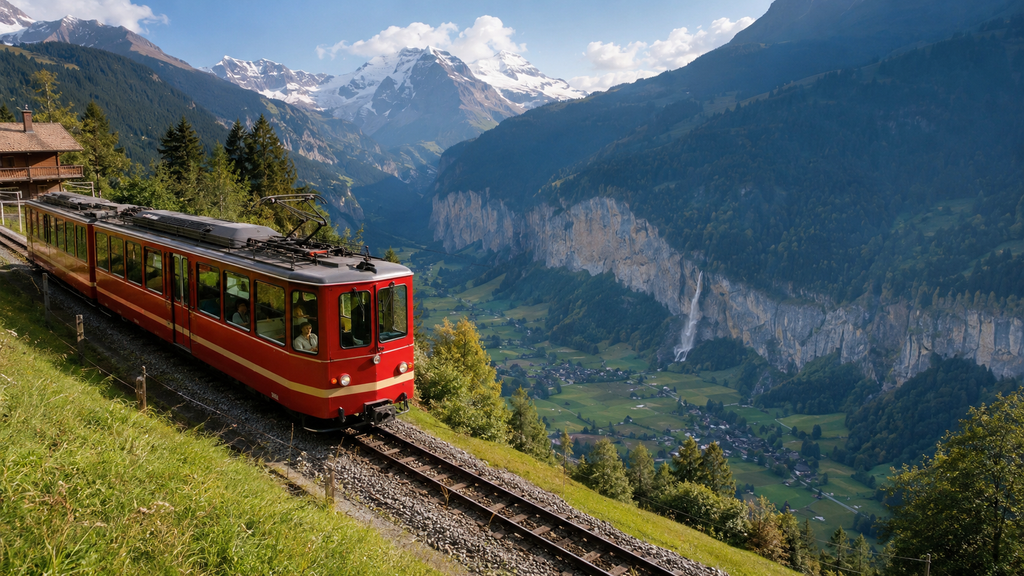
From Lauterbrunnen, a mountain railway climbs toward Wengen.
The journey itself is worth paying attention to.
Sit near a window.
As the train climbs, the valley gradually opens beneath you.
Lauterbrunnen becomes smaller.
The waterfall appears from a completely different angle.
Then the train reaches Wengen.
Wengen is car-free in the traditional sense, so the village immediately feels calmer than many road-accessible destinations.
You arrive by train and start walking.
Hotels and wooden chalets spread across the hillside while mountains dominate the horizon.
This is where I would slow down again.
You do not need a complicated itinerary in Wengen.
Walk through the village.
Find a viewpoint.
Have coffee.
Look back toward the Lauterbrunnen Valley.
Sometimes the best part of a Swiss Alps trip is having enough time to do nothing for twenty minutes.
Do Not Trust the Mountain Weather Too Much
This became one of the most important lessons of the trip.
Weather forecasts in the mountains are useful.
They are not guarantees.
A morning can begin under perfect blue skies and become cloudy surprisingly quickly.
A valley may be sunny while a nearby summit is completely covered in cloud.
This matters because many expensive mountain excursions are primarily about views.
If you are considering Jungfraujoch, First, Schilthorn or another high-altitude excursion, check webcams before buying or activating expensive tickets whenever possible.
A mountain covered in cloud from bottom to top is unlikely to become magically clear simply because your itinerary says you are supposed to go there at 10:30.
Stay flexible.
In this region, weather should influence your itinerary more than your spreadsheet.
Should You Go to Jungfraujoch?
This is one of the questions nearly every first-time visitor asks.
Jungfraujoch is famous, spectacular and expensive.
The railway journey takes you high into the Alps to a station at more than 3,400 meters above sea level, surrounded by snow, glaciers and high peaks.
On a clear day, it can be extraordinary.
On a cloudy day, you can spend a significant amount of money looking at white fog.
That is why I would not automatically book Jungfraujoch for a fixed day far in advance unless necessary.
If your schedule has some flexibility, watch the weather.
If the forecast is excellent and visibility looks good, go.
If the mountain is buried in cloud, consider spending the day lower in the valleys and trying again if you have another opportunity.
The mountain is not going anywhere.
Day 3: Grindelwald Feels Completely Different
Lauterbrunnen is a narrow valley enclosed by cliffs.
Grindelwald feels more open.
The village spreads across green slopes beneath enormous mountains, with the north face of the Eiger dominating the landscape.
Even the train journey there feels different.
From Interlaken, modern trains climb gradually toward the village while fields, forests and mountain houses pass outside.
When you step out at Grindelwald station, the Eiger immediately becomes the reference point for almost everything around you.
You can see it while walking through town.
You see it from cafés.
You see it from hotel balconies.
Eventually, you stop taking a photograph every time you notice it.
Almost.
Grindelwald First
For many visitors, Grindelwald First is one of the main reasons to come here.
A gondola carries you from the village to the mountain station high above Grindelwald.
The ride itself takes long enough that you can watch the landscape transform beneath you.
Houses become smaller.
Forests pass below.
The valley gradually opens.
At the top, the mountains feel much closer.
One of the best-known attractions is the First Cliff Walk, a metal walkway built along the side of the mountain.
It sounds more frightening than it actually feels for most people, although anyone uncomfortable with heights may disagree.
The main reward is the view.
On a clear day, the panorama across the Bernese Alps is exceptional.
But again, weather decides everything.
Walk to Bachalpsee If Conditions Are Good

If you have decent weather and comfortable shoes, the walk from First to Bachalpsee is one of the most approachable Alpine hikes in the area.
It is not completely flat.
This is Switzerland.
But you do not need technical hiking skills.
The trail crosses open mountain terrain with wide views across surrounding peaks.
Eventually, Bachalpsee appears ahead.
On calm days, the lake can reflect the mountains.
That is the photograph everyone wants.
Reality may include wind, clouds and twenty other people trying to take the same photograph.
It does not matter.
The walk itself is the experience.
I enjoyed the trail more than the few minutes spent taking photographs at the lake.
Bring More Water Than You Think
Swiss mountain infrastructure is excellent.
That can create a false sense that everything is always nearby.
Once you are walking away from stations and villages, you still need normal hiking preparation.
Carry water.
Bring sunscreen.
Take a light jacket even if the valley is warm.
Mountain temperatures can be considerably lower than conditions in Interlaken.
Weather can also change quickly.
I would keep a small snack in my bag rather than assuming a restaurant will appear exactly when I become hungry.
And wear actual walking shoes.
You do not need heavy hiking boots for every trail, but this is not the place for shoes chosen mainly because they look good in photographs.
The Price of Eating in the Mountains
Switzerland is expensive.
There is no useful way to pretend otherwise.
Restaurants in popular mountain areas can make the reality especially clear.
A simple lunch can cost considerably more than travelers from many countries expect.
My approach was not to avoid restaurants completely.
Food is part of travel.
But I did not need every meal to be a restaurant meal.
Breakfast from the hotel or bakery.
A supermarket lunch or picnic some days.
Dinner at a local restaurant when I actually wanted to sit down and enjoy the evening.
This balance kept costs under control without turning the trip into an exercise in avoiding everything.
Swiss supermarkets are extremely useful for travelers.
Bread, cheese, fruit, yogurt, sandwiches and prepared food can create an easy picnic.
And eating outside while looking at the Alps is not exactly a disappointing lunch.
Try Rösti After a Long Day Outside
Rösti is one of those foods that makes complete sense after spending a day walking in cool mountain air.
At its simplest, it consists of grated potatoes cooked until crisp and golden.
Different versions may include cheese, egg, bacon or other ingredients.
It is not delicate.
That is the point.
After hiking for several hours, a hot plate of potatoes and cheese feels exactly right.
Fondue is the more internationally famous Swiss mountain meal, and it is worth trying, especially in cooler weather.
But I would not force myself to eat fondue on a hot summer afternoon simply because I happened to be in Switzerland.
Eat what fits the day.
Grindelwald Village Deserves Some Time Too
It is easy to treat Grindelwald as nothing more than the lower station for mountain excursions.
Give the village some time.
Walk beyond the busiest commercial streets.
Follow smaller roads toward residential areas.
Traditional wooden houses appear between newer hotels and chalets.
Gardens sit beneath enormous mountain walls.
The further you move away from the center, the quieter it becomes.
I enjoyed this part especially in late afternoon when many visitors had already descended from First and were heading back toward Interlaken.
The mountain does not become less impressive simply because the cable car has closed.
Interlaken or Grindelwald at Night?
If you prefer restaurants, shops and a little more evening activity, Interlaken is easier.
If you want to open your hotel window and see mountains filling most of the view, Grindelwald wins.
That is why I would not necessarily recommend the same base to everyone.
Couples wanting a quieter mountain stay may prefer Grindelwald or Wengen.
First-time visitors trying to explore several different areas may appreciate Interlaken’s connections.
Travelers focused primarily on Lauterbrunnen Valley may want to sleep in Lauterbrunnen itself.
Think about where you want to be at 8 a.m., not only where you want to be at 2 p.m.
That usually produces a better accommodation decision.
Swiss Trains Make This Trip Much Easier
One reason the region works so well without a car is the public transportation system.
Trains, mountain railways, buses, cable cars and boats are integrated remarkably well.
Connections that look complicated on paper often become straightforward once you are there.
You get off one train.
Follow the signs.
Walk to another platform.
The next service arrives.
This does not mean you should leave zero connection time.
But the system generally feels designed for people actually making these journeys.
Google Maps is useful, but I would also use the official Swiss public transport information when checking schedules.
Services can change seasonally, particularly mountain transport.
Do You Need a Swiss Travel Pass?
Maybe.
That is not a satisfying answer, but it is the accurate one.
The value depends heavily on your itinerary.
If you are traveling extensively around Switzerland by train over several days, a pass can be convenient and potentially worthwhile.
If you are staying mostly in one mountain region, regional passes or individual tickets may make more sense.
Some mountain railways are fully included in certain passes.
Others receive only a discount.
Some are not covered in the way first-time visitors expect.
Before buying anything, write down your likely journeys and compare the costs.
Do not buy the most expensive transport pass simply because it sounds easier.
Five minutes of calculation can save a meaningful amount of money in Switzerland.
One More Day? Choose Based on the Weather
If you have a fourth day, I would avoid deciding exactly what to do before arriving.
Keep it flexible.
If the weather is clear, use the day for a major mountain excursion.
Jungfraujoch could fit here.
So could Schilthorn.
If the mountain tops are cloudy but the valleys are clear, spend more time around Lauterbrunnen, Mürren or the lakes.
If it rains heavily, consider visiting a town such as Bern or taking a lower-elevation excursion.
This flexibility is more valuable than squeezing another attraction into the itinerary.
You have already traveled far enough to see the Alps.
Give yourself the best chance of actually seeing them.
Mürren Is an Excellent Alternative
If you have extra time around Lauterbrunnen, Mürren deserves serious consideration.
The village sits high above the valley and is reached through mountain transport rather than ordinary road traffic.
The journey up already feels like part of the day.
Once you arrive, the view across toward peaks such as Eiger, Mönch and Jungfrau can be extraordinary in clear weather.
Mürren has a quieter feel than some of the most famous stops.
Wooden chalets line narrow lanes.
The mountains appear almost impossibly close.
You can walk without constantly thinking about traffic.
If Wengen and Grindelwald feel busy during peak season, Mürren can provide a slightly different experience.
Do Not Try to See Every Village
This was probably the biggest planning mistake I almost made.
Lauterbrunnen.
Wengen.
Mürren.
Grindelwald.
Interlaken.
Jungfraujoch.
First.
Schilthorn.
Lake Brienz.
Lake Thun.
All of them look close together.
Technically, you can move between many of them efficiently.
That does not mean you should visit all of them in three days.
Constant transportation eventually turns the Alps into something you see through train windows while checking the time.
Choose fewer places.
Stay longer.
Walk.
Sit down.
Have lunch without calculating the next departure.
The scenery is not improved by rushing through it.
When Is the Best Time to Visit?
For green valleys and hiking, roughly late spring through early autumn is the obvious period, although exact trail and mountain conditions vary by altitude and year.
June can be beautiful as the landscape becomes intensely green.
July and August offer long days and broad access to mountain activities but also attract the largest summer crowds.
September can be particularly pleasant, with cooler temperatures and potentially fewer visitors.
Winter changes the region completely.
Grindelwald and Wengen become major winter destinations, and the green hiking landscape transforms into a skiing environment.
The trip described here is primarily a warm-season itinerary.
If visiting outside the main summer period, check which cable cars, trails and attractions are operating.
Mountain infrastructure often has seasonal maintenance periods.
What I Would Pack for Three Days in the Alps
I would pack less clothing and more layers.
Conditions can vary dramatically between Interlaken and high mountain stations.
A warm day in the valley does not mean you will be comfortable in a T-shirt several thousand meters higher.
Bring a waterproof outer layer.
Comfortable walking shoes.
Sunscreen.
Sunglasses.
A reusable water bottle.
A small backpack.
A power bank is useful because your phone spends the day working as a camera, map, ticket wallet and timetable.
I would also keep some space in the bag.
There is a high probability that Switzerland will convince you to buy chocolate.
What Surprised Me Most
I expected the big views to be the memorable part.
They were.
But some of the smaller moments stayed with me just as much.
Waiting alone for a train at a tiny station while clouds moved across the mountain.
Hearing cowbells from a field long before seeing the cows.
Watching the Lauterbrunnen cliffs change color toward evening.
Sitting beside a train window and realizing that nobody in the carriage seemed particularly impressed by scenery that would stop traffic almost anywhere else.
Buying bread and cheese from a supermarket and eating lunch outside because the restaurant view could not possibly have been better.
The Swiss Alps are full of famous viewpoints.
You do not have to turn every one of them into an appointment.
A Three-Day Itinerary I Would Actually Recommend
If I were planning this trip again, I would keep it simple.
Day 1: Interlaken
Arrive, check into the hotel and keep the afternoon relaxed. Explore Interlaken, walk toward the lakes if you have time, organize transport and check the mountain weather for the following days.
Day 2: Lauterbrunnen and Wengen
Take an early train to Lauterbrunnen. Walk through the valley, visit Staubbach Falls and consider Trümmelbach Falls if open. Later, take the mountain railway to Wengen and spend time enjoying the views rather than rushing onward.
Day 3: Grindelwald and First
Travel to Grindelwald in the morning. Take the gondola to First if visibility is good. Walk toward Bachalpsee if conditions and fitness allow, then return to Grindelwald and spend some time exploring the village before heading back.
If you have Day 4, keep it open for Jungfraujoch, Mürren, Schilthorn or whichever excursion has the best weather.
That final flexible day can completely change the quality of the trip.
Final Thoughts
The Swiss Alps are easy to overplan because everything looks spectacular.
You see a photograph of Lauterbrunnen and add it to the itinerary.
Then Grindelwald.
Then Wengen.
Then Jungfraujoch.
Then another lake.
Soon you have created a trip where every hour belongs to a train, gondola or reservation.
I would do the opposite.
Use Switzerland’s excellent transportation to make the trip easier, not busier.
Spend a morning walking through Lauterbrunnen Valley without worrying about how many waterfalls you have photographed.
Take the train up to Wengen and stay long enough to have coffee.
Go to Grindelwald when the mountains are actually visible.
Walk to Bachalpsee if the weather is good.
Skip an expensive summit if all you are going to see is cloud.
And leave some time for the moments that do not have names on Google Maps.
That is what I remember most clearly.
Not simply standing at famous viewpoints, but moving through the landscape between them.
A train climbing above a valley.
A path disappearing between green fields.
Snow appearing through a break in the clouds.
A small village becoming quiet in the evening.
The Swiss Alps do not need much help impressing you.
The best thing you can do is give them enough time.