

There are famous places that reveal themselves immediately.
The Forbidden City is not one of them.
You can stand outside its enormous red walls in central Beijing, recognize the portrait above Tiananmen Gate, see streams of visitors moving toward the entrance, and still have very little sense of what is waiting behind those walls.
Then you begin walking.
One gate leads to a courtyard. The courtyard leads to another gate. Beyond it stands another palace, followed by another enormous open space. Red walls continue in every direction. Golden roofs appear above stone terraces. Smaller passages disappear between buildings that most visitors walk straight past.
And after an hour, you realize you are nowhere near finished.
That was the biggest surprise of visiting the Forbidden City.
I expected a palace.
What I found felt more like an entire city built for an emperor.
For almost five centuries, this vast complex stood at the center of imperial power in China. Today it is officially the Palace Museum and one of Beijing’s essential historical sites.
But visiting it is very different from simply reading about it.
The Forbidden City requires time, comfortable shoes, some preparation and a willingness to occasionally leave the main stream of visitors.
If you do that, it becomes much more than another famous landmark.
It becomes one of the best places in Beijing to understand the extraordinary scale of imperial China.
The Morning Starts at Tiananmen
The experience begins before you enter the Forbidden City itself.
Tiananmen Square and the surrounding monumental buildings immediately establish the scale of central Beijing.
Everything feels enormous.
The roads are wide. The square stretches across a vast open area. Security procedures and controlled entrances mean you cannot always move through the district as casually as you might around historic centers in other cities.
This is one reason I would never plan to arrive at the Forbidden City at the exact time I wanted to enter.
Give yourself extra time.
Depending on current access arrangements, security checks and visitor numbers can take time, and regulations around Tiananmen Square and the Forbidden City can change.
Check official information before your visit.
Once you approach Tiananmen Gate, however, there is no mistaking where you are.
The enormous red walls and traditional roofline form one of the most recognizable scenes in China.
Most people stop for photographs.
I did too.
But the interesting part is still ahead.
Walking Through the Meridian Gate
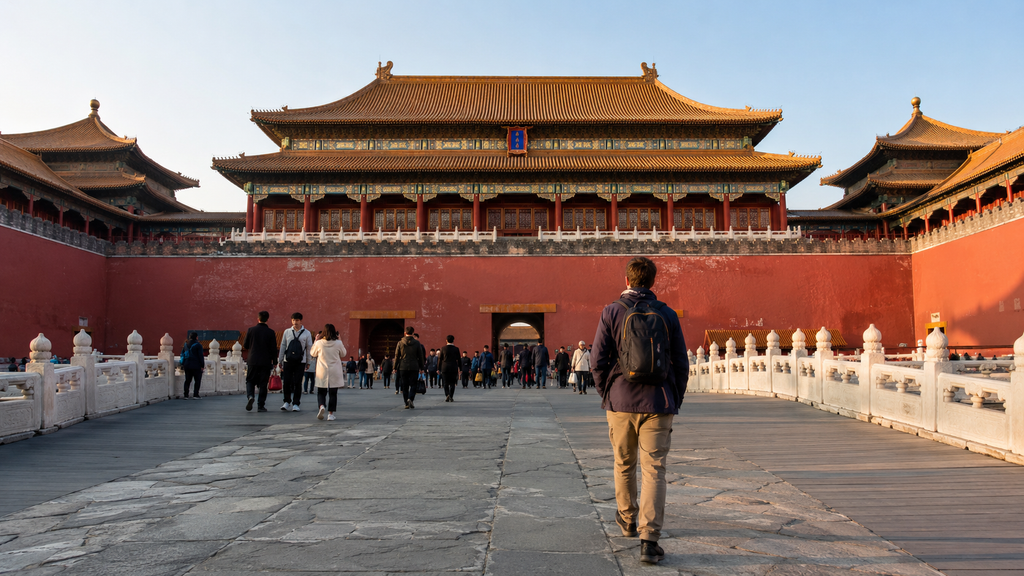
The Meridian Gate, or Wumen, is the monumental southern entrance to the Forbidden City.
Passing through it feels like crossing a boundary.
Modern Beijing suddenly disappears behind you.
Ahead is a huge imperial courtyard crossed by the Inner Golden Water River and its stone bridges.
Beyond that stands another gate.
And this is where the scale of the Forbidden City begins to become clear.
Photographs often compress the complex.
Standing inside does the opposite.
The courtyards are much larger than they appear in pictures, and the buildings sit on monumental stone platforms designed to make them feel even more imposing.
It is worth stopping here instead of immediately following everyone toward the next building.
Look behind you.
Look toward the corners.
Notice the rooflines appearing beyond the walls.
The Forbidden City was designed around procession, hierarchy and controlled movement.
You begin to feel that almost immediately.
Why Is It Called the Forbidden City?
The English name sounds mysterious, but it describes something very practical.
For centuries, this was not a public monument.
It was the imperial palace.
Construction began during the Ming dynasty in the early 15th century, and the complex subsequently served as the political and ceremonial heart of Chinese imperial government through the Ming and Qing dynasties.
Emperors lived here.
Their families lived here.
Officials entered according to rank and responsibility.
Access to different areas was strictly controlled.
Ordinary people could not simply walk through the gates.
That history changes the way the courtyards feel.
The enormous spaces were not designed primarily for tourists to admire.
Architecture communicated authority.
Where someone could walk, where they could stand, which gate they could use and how close they could approach the emperor were connected to status.
Once you understand that, the repetitive sequence of gates and courtyards begins making more sense.
The Hall of Supreme Harmony
Eventually you reach the most imposing section of the Outer Court.
The Hall of Supreme Harmony stands above a huge stone terrace and dominates the space around it.
This was the ceremonial heart of the imperial palace.
Important state ceremonies took place here, including events associated with imperial authority and major celebrations.
Even with large crowds, the architecture remains impressive.
The golden roof contrasts sharply with the red columns and pale stone terraces.
Decorative details appear everywhere.
But what struck me most was the space in front of the hall.
It is enormous.
Imagine arriving here centuries ago as an official participating in an imperial ceremony.
The distance, elevation and architecture would constantly remind you who occupied the highest position in this world.
That was intentional.
The Forbidden City is architecture being used as political language.
Look Up at the Roofs
It is easy to become focused on doors, halls and crowds and forget to look upward.
Do not.
The roofs are among the most beautiful parts of the Forbidden City.
Yellow glazed tiles dominate many of the major buildings because yellow was closely associated with imperial authority.
Along roof ridges you can see small decorative figures.
The number and arrangement of these figures were connected to the importance of a building.
You do not need to understand every architectural rule to appreciate the details.
Stand back occasionally.
Look at how the rooflines overlap.
From certain positions, several layers of golden roofs rise behind red walls, giving you a much better impression of the density of the complex.
These quieter architectural moments became some of my favorite parts of the visit.
The Forbidden City Is Bigger Than You Think
This deserves its own warning.
You will walk a lot.
The Forbidden City covers an enormous area and contains hundreds of historic structures within its walls.
Most first-time visitors naturally follow the central north–south axis.
That route takes you past the major ceremonial halls and eventually toward the Inner Court and Imperial Garden.
It is the logical route.
But if you only walk straight through the middle, you see only part of the complex.
Side courtyards contain exhibitions, smaller halls, residential spaces and quieter passages.
The problem is energy.
If you spend the first hour rushing around every side courtyard, you may be exhausted before reaching the northern half.
I found it better to explore selectively.
See the major central buildings, then choose a few side areas that genuinely interest you.
You do not need to enter every open room simply because it is there.
Leaving the Main Route Changes Everything
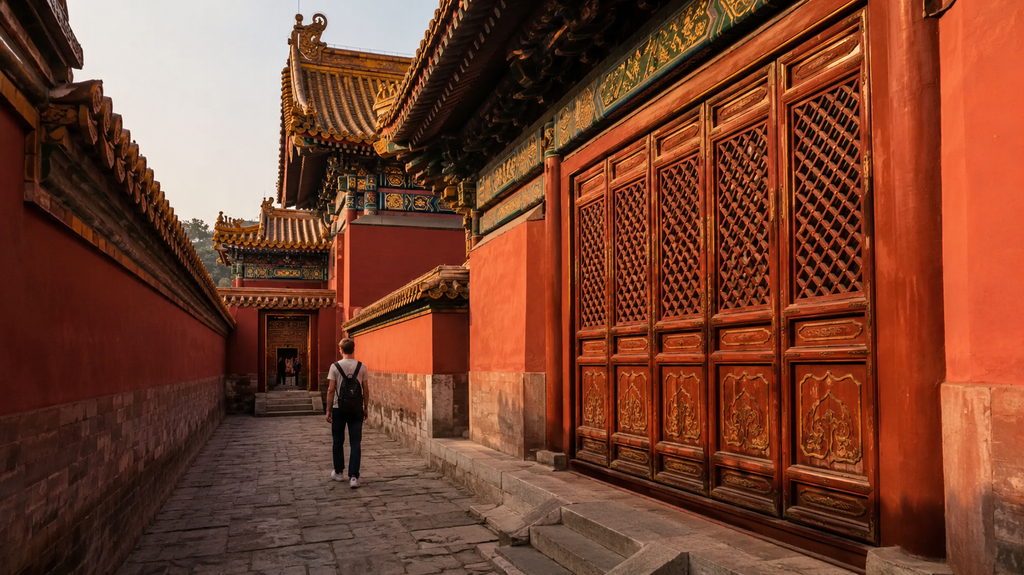
One of the strange things about the Forbidden City is how quickly the atmosphere can change.
The central route can be extremely crowded.
Tour groups gather around major halls. People compete for views through doorways. Everyone seems to move in the same direction.
Then you turn into a side passage.
Suddenly there are fewer people.
The architecture becomes more intimate.
You notice old stone paving beneath your feet, faded details on doors, small courtyards and narrow corridors between red walls.
These areas gave me a stronger feeling of being inside a historic palace than some of the enormous ceremonial spaces.
The famous halls show imperial power.
The quieter courtyards help you imagine people actually living here.
Both are necessary to understand the place.
The Inner Court Feels Different
As you move north, the purpose of the palace gradually changes.
The grand ceremonial spaces of the Outer Court give way to areas more closely associated with the emperor, imperial family and life inside the palace.
The scale remains impressive, but the atmosphere becomes slightly more intimate.
This distinction is important.
The Forbidden City was not simply a collection of ceremonial halls.
It was also home.
Of course, “home” means something very different when that home contains enormous numbers of rooms, servants, officials, guards, family members and complex rules governing imperial life.
Still, imagining daily life here creates a different connection to the buildings.
Who waited in these courtyards?
Who walked through these corridors at night?
What did winter feel like inside these enormous walls?
History becomes more interesting when you stop seeing buildings as empty objects.
Details Are Easy to Miss
By the second or third hour, palace fatigue can begin.
Another red wall.
Another golden roof.
Another courtyard.
This is when slowing down becomes useful.
Look at the enormous bronze vessels placed around important buildings.
Notice carved stone ramps.
Look at door decorations.
Study the stone animals and guardian figures.
Notice how frequently architectural symmetry appears.
Even the paving beneath your feet has a story.
The Forbidden City was constructed not only to look impressive but also to function as a highly controlled imperial environment.
The more details you notice, the less repetitive the complex becomes.
The Imperial Garden Is a Welcome Change
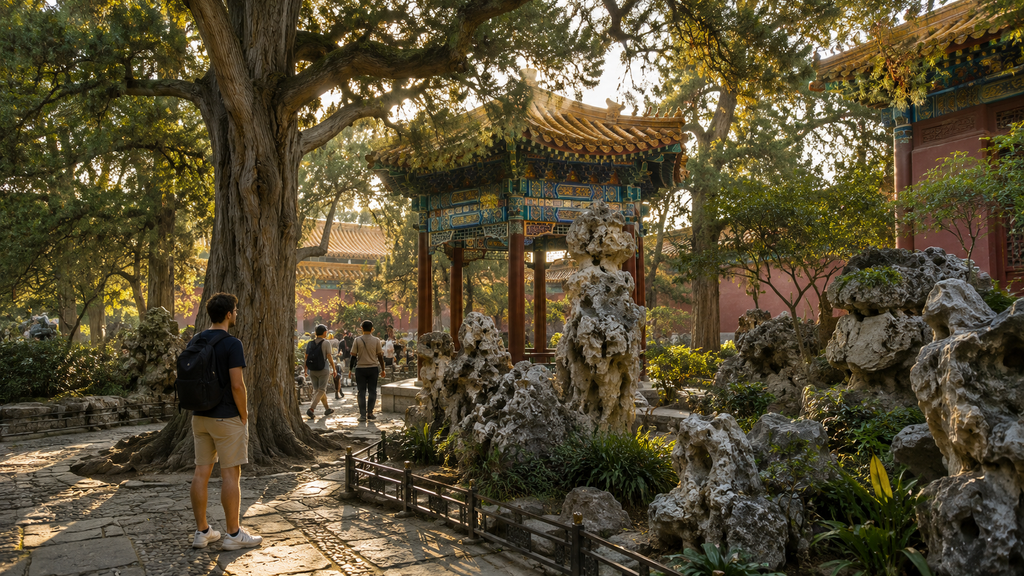
After hours of monumental courtyards, the Imperial Garden feels almost surprising.
Trees appear.
Rock formations interrupt the symmetry.
Pavilions stand among landscaped spaces.
The environment becomes more organic.
It is not a huge garden compared with some imperial landscapes elsewhere in Beijing, but arriving here after walking through the palace creates a welcome change of pace.
By this point, your feet may also be reminding you how large the Forbidden City is.
Take your time.
Sit when permitted.
Drink some water.
There is no prize for reaching the exit ten minutes earlier.
The North Gate Is Not the End
Most visitors eventually leave through the northern Gate of Divine Prowess, or Shenwumen.
You step outside.
Modern traffic returns.
And directly across the road is one of the best things you can do after visiting the Forbidden City.
Jingshan Park.
If you still have enough energy, go.
The climb is not particularly long, although after several hours inside the palace it can feel longer than it actually is.
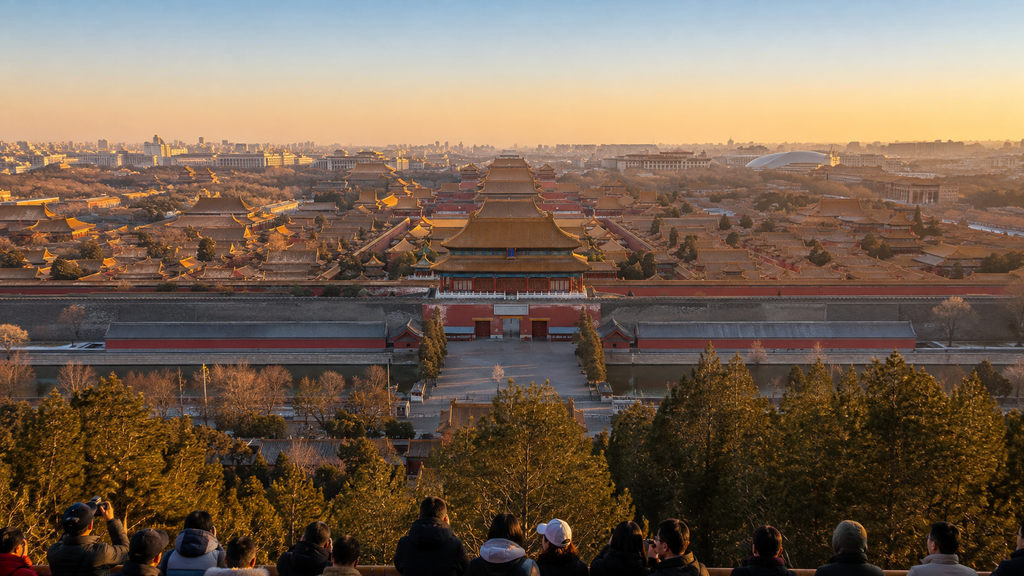
At the top, you get the view that finally explains everything you have just walked through.
The Forbidden City spreads out below you.
Golden roofs form layer after layer along the central axis.
The enormous rectangular complex becomes visible as a whole.
From inside, it is difficult to understand the layout because walls constantly interrupt your view.
From Jingshan Hill, the organization suddenly becomes obvious.
This was probably my favorite view of the entire visit.
Go to Jingshan Even If Your Feet Disagree
Your feet will probably tell you not to.
Ignore them this once.
The elevated view from Jingshan is especially beautiful when visibility is good and the light is softer.
Late afternoon can be excellent.
You can see how the Forbidden City sits directly along Beijing’s historic central axis.
The rooftops that seemed enormous while standing underneath them now form a remarkably ordered pattern.
It also gives you a sense of how dramatically Beijing has grown around the old imperial center.
Historic palace roofs occupy the foreground.
Modern Beijing stretches far beyond them.
It is one of those viewpoints that makes the day’s walking feel worthwhile.
When Should You Visit?
For most travelers, morning is the best time to begin.
The Forbidden City is not somewhere I would deliberately save for the final couple of hours of the day.
There is too much to see.
Starting early gives you more flexibility and allows you to slow down when something interests you.
Spring and autumn can offer comfortable conditions for exploring Beijing, although popular periods can also bring significant visitor numbers.
Summer can be hot, and much of the Forbidden City involves walking across exposed courtyards.
Bring sun protection and water.
Beijing winters can be very cold, but winter also gives the palace a completely different atmosphere.
If you ever have the chance to see the red walls and golden roofs after snow, the visual experience is extraordinary.
Whatever season you choose, check current opening days, reservation requirements and entry rules before traveling to the site.
Booking Ahead Is Important
This is not an attraction where I would recommend simply appearing at the entrance and hoping everything works out.
The Palace Museum controls visitor access and tickets can be limited.
Reservation procedures, ticket-release schedules and requirements for international visitors may change over time.
Use official Palace Museum information when planning your visit.
Do not rely entirely on an old blog post or travel video for current ticket procedures.
Bring the identification or travel document associated with your reservation.
For international travelers, this commonly means having your passport available.
The practical details are not the exciting part of visiting the Forbidden City.
But discovering that you cannot enter after traveling across Beijing would be much less exciting.
How Long Should You Spend Inside?
Three hours is enough to see the main route at a reasonably steady pace.
I would prefer four to five hours.
Someone genuinely interested in Chinese history, architecture or museum collections could spend much longer.
The mistake is assuming that because the Forbidden City is one attraction, it needs the same amount of time as one museum or temple.
It does not.
Think of it as a historic district enclosed by walls.
Once you approach it that way, dedicating half a day feels completely reasonable.
Add Tiananmen and Jingshan Park, and the experience can easily occupy most of a day.
Food and Water
Eat before entering if you are starting early.
You do not want hunger to dictate how quickly you move through the palace.
There may be places to obtain drinks and simple refreshments within or around the visitor areas, but options and operations can change.
Carry water, particularly in warm weather.
I would also keep a small snack in my bag if current security regulations permit it.
After leaving through the north, you can look for a proper meal elsewhere in central Beijing.
By that point, you will have earned it.
Wear the Right Shoes
This sounds obvious.
It is still worth saying.
Do not visit the Forbidden City in shoes that are only comfortable for photographs.
Stone surfaces, large courtyards and several hours of walking are unforgiving.
Comfortable walking shoes make an enormous difference.
Beijing travel often involves more walking than visitors expect anyway, and combining the Forbidden City with Tiananmen and Jingshan makes this a particularly active day.
Your feet should not become the main thing you remember about imperial China.
Photography Without Missing the Experience
The Forbidden City is extremely photogenic.
Red walls.
Golden roofs.
Stone lions.
Decorated gates.
Long corridors.
Perfectly aligned courtyards.
The problem is that everyone notices this.
At the major halls, finding completely empty photographs can be difficult.
Instead of becoming frustrated by crowds, use them occasionally to show scale.
Then explore side areas for quieter compositions.
Early light can create beautiful shadows along red walls, while later afternoon light often brings warmer tones to the roofs.
And sometimes put the camera away.
The sensation of standing alone for a moment in a narrow passage between enormous red walls is difficult to capture in a photograph anyway.
What Surprised Me Most
Before visiting, I expected the Hall of Supreme Harmony to be the highlight.
It was impressive.
But it was not what stayed with me most.
I remember the transitions.
Walking from an enormous courtyard into a narrow side passage.
Looking through one gate and seeing another perfectly aligned in the distance.
Finding a quiet courtyard only a few minutes away from hundreds of visitors.
Looking upward and realizing there were golden roofs behind golden roofs behind golden roofs.
And finally climbing Jingshan Hill and seeing the entire palace spread below.
That was the moment the Forbidden City finally made sense.
Inside, you experience it piece by piece.
From above, you understand the whole.
Do Not Combine Too Much With This Day
Beijing has enough attractions to encourage terrible itinerary decisions.
Forbidden City in the morning.
Temple of Heaven at lunch.
Summer Palace in the afternoon.
Night market in the evening.
Technically possible?
Perhaps.
Enjoyable?
Not for me.
The Forbidden City deserves enough time that you do not constantly check the clock.
Combining it with Tiananmen and Jingshan Park creates a full historical day without unnecessary travel across Beijing.
If you still have energy in the evening, find dinner and take a relaxed walk through another neighborhood.
You do not need to conquer Beijing in 24 hours.
Understanding the Forbidden City Changes Beijing
Before visiting the palace, Beijing can feel overwhelmingly modern.
Wide roads, subway stations, towers, shopping centers and enormous urban distances dominate your first impression.
The Forbidden City reveals another structure underneath the modern capital.
Beijing developed around an imperial center and a powerful north–south axis.
Once you have walked through the palace and viewed it from Jingshan, other historic sites around the city begin to fit into a larger picture.
That makes the Forbidden City more than an isolated attraction.
It provides context for Beijing itself.
Final Thoughts
I expected the Forbidden City to feel like a museum.
Instead, it felt like a journey.
You enter from the south with modern Beijing behind you.
You cross bridges and enormous courtyards.
You pass through gates that once separated different levels of imperial life.
You stand beneath halls designed to communicate power on a scale that still works centuries later.
Then you wander into quieter corners where the palace suddenly feels less monumental and more human.
Eventually, after several hours, you leave through the northern gate.
And if you climb Jingshan Hill afterward, you finally turn around and see what you have just crossed.
Thousands of golden roof tiles spread beneath you.
Red walls divide courtyards you were walking through only minutes earlier.
The entire Forbidden City sits along Beijing’s historic axis with the modern capital surrounding it.
That view changed the experience for me.
The Forbidden City is impressive because of its history, but you do not need to memorize dynasties and emperors to appreciate it.
Walk slowly.
Look beyond the main halls.
Pay attention to the details.
Leave enough time to get tired.
And climb the hill afterward.
Only then do you begin to understand why this enormous palace remained at the center of imperial China for nearly five centuries.