

The first time I looked into Thailand’s entry requirements, I expected a simple answer.
Do I need a visa or not?
It turned out that this was the wrong question to ask first.
Thailand has several ways a foreign visitor may be allowed to enter. Depending on your passport, purpose of travel and the rules in force when you travel, you might qualify for visa exemption, you might be eligible for Visa on Arrival, or you might need to obtain a Tourist Visa before departure.
And there is now another step that almost every foreign visitor needs to know about:
The Thailand Digital Arrival Card, or TDAC.
That is separate from a visa.
Once I separated these different requirements, planning the trip became much easier.
If I were preparing for Thailand today, this is the order I would follow.
Start With Your Passport, Not With a Visa Application
Before filling out anything, I would take out my passport.
Check the expiry date.
Check the condition.
Make sure the personal information is correct.
For a standard Thai Tourist Visa application, official guidance requires a passport or travel document with at least six months of validity.
Even if you expect to enter under a visa exemption or another arrangement, checking passport validity early is one of the easiest ways to avoid an unnecessary problem later.
I would never leave this until the week before departure.
If your passport is close to expiring, renew it first.
Flights and hotels can wait.
The Most Important Question: Does Your Passport Need a Visa?
Thailand does not have one immigration rule for every traveler.
Your passport matters.
Some nationalities can enter under a visa-exemption arrangement.
Some may qualify for Visa on Arrival.
Others need to obtain a visa before traveling.
This is where I would be particularly careful with old travel blogs and social-media posts.
Thailand has changed its visa policies several times in recent years, and further revisions were approved in 2026.
A post saying that a nationality receives a particular number of visa-free days may have been completely accurate when it was published and still be wrong when you travel.
So I would use a travel guide like this to understand the process.
For the final answer about my own passport, I would check the current Thai government rules immediately before booking and again before departure.
Thailand’s Visa Rules Changed Again in 2026
This deserves attention because it affects how you should use online travel information.
In May 2026, the Thai government approved a major revision of its visa-exemption and Visa on Arrival schemes.
Among the approved changes was the removal of the broad 60-day visa-exemption arrangement that had covered 93 countries and territories, alongside a restructuring of shorter visa-exemption schemes and the Visa on Arrival list.
The important practical lesson is not to memorize an old number.
It is to check what applies to your passport at the time you travel.
Thailand is still making international tourism relatively accessible, but the exact route into the country can change.
That makes official information particularly important.
Visa Exemption, Visa on Arrival and Tourist Visa Are Different
These three terms are often mixed together.
They should not be.
Visa Exemption
Visa exemption means an eligible traveler can enter Thailand for an allowed purpose without obtaining a normal visa before the trip.
There will still be immigration clearance.
You still need to satisfy entry conditions.
And the period you are allowed to remain depends on the rules that apply at the time of entry.
Visa-free does not mean immigration-free.
Visa on Arrival
Visa on Arrival, usually shortened to VOA, is another specific immigration arrangement for eligible passport holders.
It is not the same thing as visa exemption.
Eligibility, permitted stay, required documents and fees can differ.
Do not see the words “Visa on Arrival” and assume every tourist can simply fly to Bangkok and buy a visa at the airport.
You must actually qualify.
Tourist Visa
If you do not qualify for an appropriate exemption or VOA arrangement, or if your travel plans require a visa, a Tourist Visa may be the correct route.
Thailand’s Tourist Visa is designed for travelers visiting the country for tourism.
This is the option I will focus on throughout much of this guide.
Thailand e-Visa Has Made the Process Much Easier
One major improvement is Thailand’s electronic visa system.
Since January 2025, foreign nationals have been able to apply for Thai e-Visas from locations worldwide outside Thailand, subject to the applicable eligibility and application procedures.
That last part matters.
You cannot simply be physically inside Thailand and decide to apply for a Thai e-Visa as though you were applying from abroad.
The official system states that applicants must be outside Thailand.
For a normal traveler preparing at home, however, the online system makes the process considerably easier than the old model of physically delivering a passport and paperwork to a consulate.
How the Thai e-Visa Application Works
The overall process is straightforward.
Create an account.
Complete the application.
Upload the supporting documents.
Pay the applicable visa fee.
Wait for processing.
If approved, the e-Visa confirmation is sent electronically.
That sounds simple because structurally it is.
The part that requires attention is the information you enter and the documents you upload.
An online visa is still a visa application.
Moving the form from a consulate desk to a website does not make accuracy less important.
Use Only the Official Thai e-Visa Website
Visa applications contain some of your most sensitive travel information.
Passport details.
Date of birth.
Travel history.
Photographs.
Accommodation.
Possibly financial documents.
I would not upload those casually to the first website that appears in a search result.
Thailand has an official e-Visa platform operated under the Ministry of Foreign Affairs.
Start there.
Third-party visa companies may provide legitimate services, but you should know when you are using a private company and when you are dealing directly with the Thai government.
A website looking official is not the same thing as being official.
Check Whether You Need a Tourist Visa Before Creating an Application
The official Thai e-Visa system provides tools for checking visa needs based on details such as passport/travel-document country and intended stay.
Use them.
This is much better than reading a list copied into a travel article two years ago.
If the system and current government guidance indicate that you do not need a Tourist Visa for your planned trip, there is no benefit in creating unnecessary paperwork.
If you do need one, then move to the next step.
Tourist Visa Documents
The exact documents required can depend on your nationality, location, travel circumstances and the Thai embassy or consular authority handling the application.
That is why I would always follow the checklist generated for my actual application.
For a typical tourism application, however, expect to deal with documents relating to:
- Your passport or travel document.
- A recent photograph.
- Your intended travel to and from Thailand.
- Accommodation or your intended place of stay.
- Evidence related to your financial ability where required.
- Information establishing your current location or residence where requested.
- Other supporting documents required for your particular application.
Consular officers can ask for additional information.
Do not assume that because someone online submitted five documents, your application will require exactly the same five.
Passport Details Must Match Exactly
This sounds obvious until you realize how easy it is to make a mistake.
A zero looks like an O.
A middle name gets omitted.
The date format is misunderstood.
An old passport number is copied from a previous booking.
When completing a visa application, I would put the passport beside the computer and copy information directly from it.
Then I would check everything again before submitting.
Do not rely on memory for passport numbers.
Your Photograph Should Be Recent
Visa photographs are administrative documents, not profile pictures.
Use a recent photograph that complies with the requirements shown in the application system.
Do not upload a heavily edited selfie.
Do not crop yourself out of a holiday photograph.
Do not assume an old visa photo is still suitable simply because you like how you look in it.
Follow the specification.
It is one of the easiest parts of the application to get right.
Travel Plans Should Make Sense
If I say I am visiting Thailand for tourism, the rest of my application should look like a tourism trip.
Dates should make sense.
Accommodation should correspond reasonably with the itinerary.
Onward or return travel should be consistent with the intended stay where such evidence is requested.
Nothing needs to be elaborate.
In fact, simple is better.
Bangkok for four nights.
Chiang Mai for three.
Phuket for four.
Flight home.
That is easier to understand than an application full of contradictory dates and unexplained plans.
Proof of Onward Travel
Thailand may require evidence showing that you intend to leave after your visit, depending on the visa or entry arrangement involved.
For a Tourist Visa, official guidance includes evidence of travel from Thailand among the supporting requirements.
This might be a return flight or onward journey to another country.
The exact evidence you need should follow the current application checklist.
My approach would be conservative.
I want my travel plans to show clearly that I am a temporary visitor.
Should You Buy a Non-Refundable Flight Before Visa Approval?
I would avoid taking unnecessary financial risks.
There is a difference between providing the travel evidence required by an application and spending a large amount on bookings that cannot be changed before you know whether you can travel.
Where possible, flexible arrangements make visa planning less stressful.
If your specific application requires particular booking evidence, provide what is requested.
But do not assume that buying the most expensive non-refundable ticket somehow improves your chances.
A visa application is assessed on the relevant requirements, not on how much money you were willing to risk on airfare.
Accommodation Evidence
Know where you are staying.
For many tourists, this is simple.
Hotel confirmation.
Hostel reservation.
Resort booking.
If staying with another person, different supporting information may be relevant.
Again, follow your actual checklist.
What I would avoid is creating fake hotel reservations purely to fill a field.
If your plans change legitimately later, that is one thing.
Submitting invented information from the beginning is another.
Financial Evidence
Thailand’s Tourist Visa rules can include financial requirements.
The official Ministry of Foreign Affairs information has historically specified minimum financial amounts for Tourist Visa applicants, while individual e-Visa applications or missions may require particular evidence.
I would not rely solely on a number copied from an old article.
Look at what your current application asks you to demonstrate.
If bank evidence is required, provide genuine evidence.
Do not temporarily manipulate statements.
Do not edit balances.
Do not borrow a document from someone else and pretend it is yours.
Visa applications are much easier when everything is real.
Tourist Visa Validity Is Not the Same as Your Permitted Stay
This distinction causes confusion in many countries.
Visa validity tells you the period during which the visa can be used according to its conditions.
The period of stay tells you how long immigration permits you to remain after entry.
Those are not necessarily the same thing.
Thailand’s standard Tourist Visa framework provides its own validity and stay conditions, but your actual immigration permission is what matters once you enter.
Always check the entry information granted to you.
Do not look only at the visa and calculate your departure date from the wrong number.
Single Entry or Multiple Entry?
Thailand offers different Tourist Visa arrangements, including single-entry and multiple-entry options where applicable.
Which one you need depends on your trip.
If you are flying into Bangkok, spending two weeks in Thailand and flying home, a multiple-entry visa may provide no practical benefit.
If your itinerary involves leaving Thailand and returning during the visa’s validity, the situation is different.
Do not pay for complexity you do not need.
Choose based on your real itinerary.
Visa Fees Can Vary by Application Location
Thailand publishes visa fee structures, but the amount you actually pay through a mission or e-Visa application can depend on the visa category and local processing arrangements.
The official e-Visa system shows the applicable payment during the application process.
One important point is clear:
Visa fees are generally non-refundable.
Submitting an application does not guarantee approval.
If an application is refused, do not assume you will automatically receive the fee back.
That is another reason to check everything before clicking submit.
How Long Does Thailand e-Visa Processing Take?
This is an area where I would avoid promising a universal number.
Processing can vary between embassies and consulates and may be affected by:
- Nationality.
- Application location.
- Visa category.
- Document completeness.
- Requests for additional information.
- Public holidays.
- Application volume.
- Individual assessment.
The safest approach is to check the estimated processing guidance of the Thai mission responsible for your application and apply with enough time to handle delays.
Do not submit on Monday for a flight on Friday and assume technology makes everything instant.
Electronic application does not mean automatic approval.
You May Be Asked for More Documents
The official Thai e-Visa system explicitly notes that an embassy or consulate can request additional documents or an interview.
That does not necessarily mean the application is going badly.
Sometimes the officer simply needs clarification.
If you receive a legitimate request through the official process, respond carefully.
Read exactly what is requested.
Provide the document.
Do not send ten unrelated files in the hope that more paperwork looks more convincing.
Clear beats complicated.
An e-Visa Is Still Subject to Approval
Completing every field does not create a right to a visa.
Paying the fee does not create a right to a visa.
Uploading the documents does not create a right to a visa.
The application must still be assessed and approved.
This is stated clearly by Thailand’s official e-Visa system.
Treat approval as approval only after you actually receive it.
After Approval, Check Everything
When the e-Visa confirmation arrives, do not simply celebrate and close the email.
Open it.
Check your name.
Passport information.
Visa category.
Validity.
Entries.
Any conditions.
Make sure the visa corresponds to the passport you will use for travel.
Save the confirmation somewhere accessible.
I would keep a copy on my phone and another in cloud storage or email.
Printing a copy is also sensible when traveling internationally.
You may never need the paper.
That is fine.
Then Comes TDAC
Now we reach the requirement that applies much more broadly to foreign visitors:
The Thailand Digital Arrival Card.
TDAC replaced the old paper arrival-card process.
It is an online pre-arrival form used by Thai immigration.
And this point is important:
TDAC is not a visa.
Having a Tourist Visa does not turn TDAC into a visa.
Being visa-exempt does not mean TDAC becomes your visa.
They serve different purposes.
Who Needs the Thailand Digital Arrival Card?
Thailand’s Immigration Bureau states that non-Thai nationals entering Thailand generally need to submit their arrival information through TDAC.
This includes entry by air, land and sea.
There are exceptions in specific circumstances, particularly travelers who remain in transit without passing through Thai immigration.
But for an ordinary international tourist flying into Bangkok, Phuket or another Thai entry point and actually entering the country, TDAC should be part of your pre-departure checklist.
Children are also covered by the requirement.
Do not assume only adults need it.
When Should You Submit TDAC?
Do not complete it a month before the trip.
TDAC is designed for the period immediately before arrival.
Thailand’s Immigration Bureau allows travelers to submit it within the three days before arrival, including the arrival date.
That makes it easy to remember.
I would do it one or two days before my flight.
By then I know:
My flight.
Arrival date.
Hotel.
Address in Thailand.
Passport details.
Everything needed should be easy to find.
What Information Does TDAC Ask For?
Prepare the basic trip information before starting.
You can expect information such as:
- Passport details.
- Flight or travel information.
- Arrival date.
- Address in Thailand.
- Purpose of travel.
- Health declaration information.
- Email address.
It should not take long when you already have everything in front of you.
The biggest mistake would be completing it carelessly because it feels simpler than a visa application.
It is still immigration information.
Check the passport number.
Use the Official TDAC Website
This is another place where travelers need to pay attention.
Use Thailand Immigration Bureau’s official TDAC platform.
Do not assume every website with “Thailand Arrival Card” in its name is the government system.
Commercial companies may offer assistance with forms.
That does not make them the Thai Immigration Bureau.
Whenever I enter passport information online, I want to know exactly who is receiving it.
Do You Need to Print TDAC?
Thailand’s official TDAC guidance says you do not necessarily need to print the document.
After submission, you can keep the document or QR code electronically.
Personally, I would save it on my phone.
I would also make sure it is accessible without relying on airport Wi-Fi.
A screenshot or downloaded copy takes seconds.
If you prefer paper, printing a backup is fine.
Travel is easier when one dead phone battery does not become a crisis.
What If You Make a Mistake on TDAC?
Some information can be updated through the TDAC system.
However, important identity details such as your name, passport number, nationality and date of birth cannot simply be edited in the same way.
If one of those critical details is wrong, official guidance allows a new submission with the correct information, with the latest valid submission used.
This is why checking before submission is easier.
Passport beside you.
Type.
Check.
Submit.
What If Your Hotel Changes?
Travel plans change.
That is normal.
TDAC information should be accurate when you enter Thailand.
If something changes before arrival, use the available update function where appropriate or submit corrected information according to the official guidance.
Do not panic because you changed hotels.
Just correct the information.
Transit Passengers Need to Think About Immigration Clearance
Suppose you are connecting through Bangkok to another international flight.
Do you need TDAC?
The key question is whether you pass through Thai immigration.
If you remain in international transit without immigration clearance, the TDAC requirement does not apply in the same way.
If you leave the transit area and enter Thailand, it does.
This becomes especially important with separate tickets, baggage collection or an overnight stop where you plan to leave the airport.
Check your actual connection.
Do not assume “transit” means the same thing for every itinerary.
Arriving at Bangkok Airport
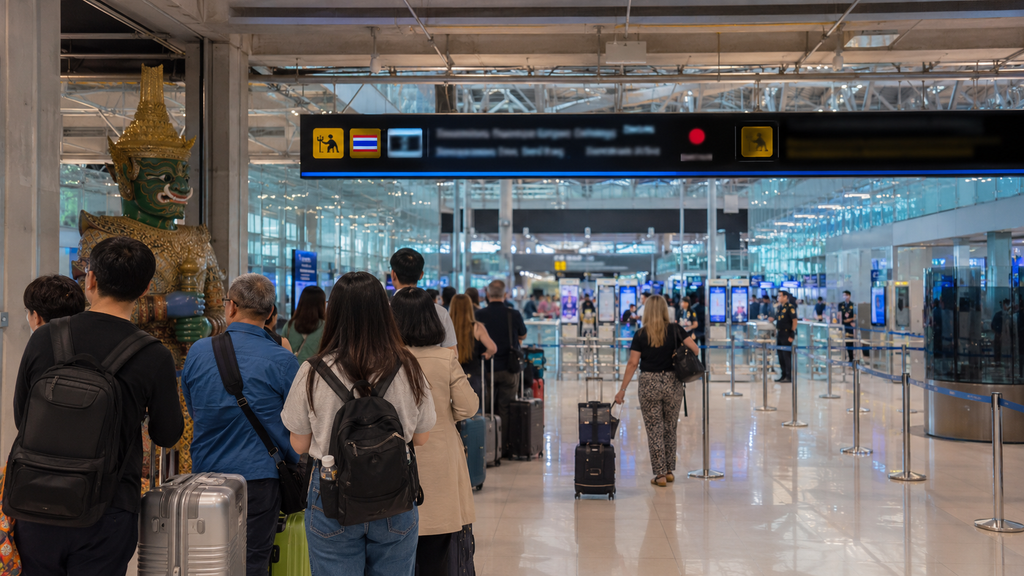
After a long flight, immigration is the last place I want to discover a missing requirement.
So before landing I want four things clear:
My passport is valid.
My visa situation is correct.
My TDAC has been submitted.
I know where I am staying.
Then the arrival process becomes much less stressful.
Follow the signs to immigration.
Have your passport ready.
Follow the lane instructions.
If an officer asks about your trip, answer clearly.
You are visiting Thailand for tourism.
You are staying at a particular hotel.
You intend to leave on a particular date.
There is no need to turn a simple holiday into a complicated story.
A Visa Does Not Guarantee Entry
This is true in Thailand just as it is in many countries.
A visa allows you to travel under that visa and request entry.
Immigration officers retain authority at the border.
Visa exemption also does not mean unconditional entry.
Neither does Visa on Arrival.
Every traveler still goes through immigration control.
That is why genuine travel plans and correct documents matter even after the visa has been issued.
Immigration May Ask About Your Trip
Most tourists want immigration to be uneventful.
That is exactly what I want too.
But be prepared to answer normal questions.
Where are you staying?
How long will you be in Thailand?
Why are you visiting?
Where are you going afterward?
You do not need rehearsed answers.
You need real answers.
Know your own itinerary.
Keep Your Hotel Address Accessible
I always keep the first accommodation address somewhere easy to reach.
Not buried inside an email from six months ago.
Screenshot it.
Save it in your notes.
Have the booking available offline.
You may need the address for TDAC.
You may need it for transportation.
You may need it when speaking with immigration.
And you will definitely appreciate having it when trying to explain your destination after a long overnight flight.
Carry Evidence of Onward Travel
Even if nobody asks to see it, I like having my onward or return booking accessible.
It helps demonstrate that my visit is temporary and gives me one less thing to worry about.
Save the booking confirmation offline.
Do not depend entirely on an airline app that suddenly decides you need to log in again while standing at immigration.
Keep Some Financial Backup
Thailand can be inexpensive compared with many destinations, but you still need to support yourself during the trip.
Carry appropriate access to money.
A working international card.
A backup payment method.
Some cash when useful.
And if your visa or entry category has specific financial requirements, make sure you comply with them.
Do not treat financial requirements as decorative numbers on a website.
What Happens After Immigration?
Once admitted, check the immigration permission associated with your entry.
This matters more than what you assumed before departure.
Make sure you understand how long you are permitted to stay.
If anything looks wrong or unclear, deal with it immediately rather than discovering the problem when you are trying to leave the country.
Then you can stop thinking about immigration.
Collect your luggage.
Get some Thai baht if needed.
Find the Airport Rail Link, taxi or other transport.
Go eat.
That is the moment the trip actually begins.
Do Not Overstay in Thailand
This is simple.
Know the last day you are legally permitted to remain.
Leave before that date unless you have legitimately obtained an extension or another appropriate immigration permission.
Do not build an itinerary that intentionally depends on overstaying because someone online told you the fine is manageable.
Immigration violations can create consequences far beyond the immediate financial penalty.
It is not worth it.
Can You Extend a Tourist Stay?
Thailand has mechanisms through which some travelers may request extensions of stay, depending on their entry category and circumstances.
Approval is at the discretion of immigration authorities.
I would treat an extension as an application, not a guarantee.
If you already know before traveling that you want a longer stay than your entry arrangement permits, investigate the correct visa before departure.
Choosing the right visa is usually cleaner than entering under one arrangement and immediately trying to change the plan.
Do Not Use Visa Exemption as a Long-Term Living Strategy
Visa exemption is designed around qualifying short visits.
It is not automatically a substitute for the appropriate long-term visa.
Thailand has other visa categories for different purposes, including work, study, family, retirement and longer-term arrangements.
If your actual intention is to live in Thailand, work remotely for an extended period, study or take employment, research the category designed for that purpose.
Trying to make a tourist entry fit a completely different lifestyle creates unnecessary immigration risk.
What About the Destination Thailand Visa?
Thailand also offers the Destination Thailand Visa, commonly called the DTV, for qualifying activities and applicants.
It is separate from the ordinary Tourist Visa discussed here.
For someone planning a normal two-week holiday in Bangkok, Chiang Mai and Phuket, there is no reason to turn the trip into a DTV research project.
But if your circumstances involve longer stays or activities covered by that visa category, it may be worth investigating separately.
Use the visa designed for what you actually intend to do.
Common Mistake 1: Reading an Old Visa-Exemption List
This is especially dangerous now because Thailand has recently revised its policies.
Always check the current rule for your passport.
A 2024 screenshot is not an immigration policy.
Common Mistake 2: Thinking Visa on Arrival Means Everyone
It does not.
VOA is an eligibility-based scheme.
If your nationality is not covered under the current arrangement, arriving at the airport does not magically make you eligible.
Common Mistake 3: Confusing TDAC With a Visa
TDAC is an arrival card.
It does not replace a visa.
If you need a Tourist Visa, completing TDAC does not solve that requirement.
Common Mistake 4: Applying for e-Visa While Inside Thailand
Thailand’s official e-Visa system specifies that applicants use it while outside Thailand.
Do not enter Thailand and assume you can simply submit a normal e-Visa application from your hotel.
Common Mistake 5: Applying at the Last Minute
Online does not mean instant.
Applications can require additional documents or review.
Give yourself time.
Common Mistake 6: Using an Unofficial Website Without Realizing It
This happens with both visas and arrival cards.
Check the website carefully before entering passport information or paying.
Common Mistake 7: Passport Information Does Not Match
One wrong digit can create a problem that was completely avoidable.
Copy directly from the passport.
Common Mistake 8: Fake Hotel or Flight Documents
Do not manufacture travel evidence.
If your itinerary is not finalized, use legitimate flexible arrangements where appropriate.
Common Mistake 9: Assuming Visa Validity Equals Length of Stay
It does not necessarily.
Pay attention to the immigration permission granted when you enter.
Common Mistake 10: Ignoring Rule Changes Between Booking and Departure
Check again before flying.
You might book Thailand months ahead.
Immigration policy can change during that period.
My Practical Thailand Entry Timeline
If I were organizing the trip from scratch, I would do it this way.
Two or Three Months Before the Trip
Check passport validity.
Look up the current entry arrangement for my nationality.
Determine whether I need a Tourist Visa.
Understand whether I am using visa exemption, VOA or a visa obtained before travel.
Several Weeks Before the Trip
If I need a Tourist Visa, begin the e-Visa process with enough time for processing.
Prepare genuine supporting documents.
Check the requirements of the responsible Thai embassy or consulate.
Avoid leaving everything until the final week.
After Visa Approval
Download and save the confirmation.
Check the details against my passport.
Keep an electronic copy accessible.
Print a backup if useful.
Three Days Before Arrival
Complete TDAC through the official Thai Immigration system.
Use my actual passport and travel details.
Save the resulting document or QR code.
The Day Before Flying
Check:
Passport.
Visa confirmation if required.
TDAC.
Flight booking.
Hotel address.
Onward or return ticket.
Payment methods.
Any additional documents required for my particular entry category.
Then stop reading visa forums.
Pack your bag.
A Simple Checklist Before Flying to Thailand
For a normal tourism trip, my final checklist would look like this:
Passport
Valid and in good physical condition.
Correct visa status
Visa exemption, VOA eligibility or approved Tourist Visa depending on my passport and current rules.
Thai e-Visa confirmation
Saved and accessible if I required an e-Visa.
TDAC
Submitted within the permitted pre-arrival window.
Accommodation
First hotel address and booking accessible.
Onward travel
Return or onward booking available.
Money
Working payment method plus appropriate backup.
Travel insurance
Not a substitute for immigration requirements, but something I personally consider sensible for an international trip.
That is enough for most ordinary travelers.
You do not need a folder containing every document you have owned since birth unless your specific application tells you otherwise.
Is Getting Into Thailand Difficult?
For most genuine tourists with straightforward circumstances, the process is manageable.
The confusing part is that different travelers can legitimately follow different routes.
The person sitting beside you on the flight may enter visa-free.
You may have an e-Visa.
Someone else may qualify for another arrangement.
All three can be traveling to Thailand for the same holiday.
That is why asking another traveler, “Did you need a visa?” is not enough.
The missing question is:
“What passport were you using, and when did you travel?”
Why I Prefer Official Sources for Visa Information
Travel blogs are useful for explaining what a process feels like.
Government websites are better for deciding whether you are legally allowed to enter a country.
The distinction matters.
I can tell you to prepare your documents early.
I can explain why TDAC should not be confused with a visa.
I can warn you not to rely on a five-year-old screenshot.
But the final decision about whether your specific passport qualifies for an exemption comes from Thailand.
Use official information for that decision.
Final Thoughts
Getting ready for Thailand becomes much easier once you separate the process into stages.
First, check your passport.
Then determine which immigration route applies to you:
Visa exemption.
Visa on Arrival.
Or a visa obtained before travel.
If you need a Tourist Visa, Thailand’s e-Visa system now allows the application process to be handled online from outside the country.
Prepare the requested documents carefully.
Use genuine information.
Apply with enough time.
And remember that submitting an application never guarantees approval.
Then, shortly before the trip, complete the Thailand Digital Arrival Card if the requirement applies to you.
TDAC is not your visa.
It is a separate arrival requirement.
When you finally land in Bangkok, Phuket, Chiang Mai or another Thai entry point, immigration still makes the decision on admission and determines your permitted stay.
Check that permission.
Know when you need to leave.
And do not overstay.
The paperwork can look complicated when everything is mixed together.
It becomes much simpler when handled in the right order:
Passport.
Visa status.
Visa application if needed.
TDAC.
Immigration.
Then Thailand.
Once that final immigration gate is behind you, the part you actually came for can begin.