

Bangkok was one of those cities I thought I understood before I arrived.
I had seen the photographs: golden temples, tuk-tuks, rooftop bars, crowded markets and bowls of noodles served beside busy streets.
On a map, the city also looked surprisingly manageable.
Grand Palace in the morning. Wat Arun after lunch. Siam in the afternoon. Chinatown for dinner.
Easy.
By the end of my first day, I had already changed the way I planned the rest of the trip.
Bangkok is not difficult to travel around, but it has its own rhythm.
The heat slows you down.
Traffic makes short distances unpredictable.
A temple that looks close on Google Maps can feel much farther away when you are walking under the afternoon sun.
And sometimes the best part of the day is not another attraction at all.
It is sitting at a small table with an iced Thai tea while the city moves around you.
Three days is not enough to know Bangkok.
But it is enough for a first visit.
If I had exactly three days again, this is how I would spend them.
Before Day 1: Where I Would Stay in Bangkok
The first decision I would make differently is choosing accommodation based on transportation rather than photographs.
Bangkok is enormous.
A hotel can look centrally located on a map and still be inconvenient if you need a taxi every time you leave.
For a three-day trip, I would strongly prefer somewhere within easy walking distance of a BTS or MRT station.
Sukhumvit is convenient if you want restaurants, nightlife and easy transport.
Siam works well if shopping and central connections matter.
Silom is another practical option with good transport and plenty happening nearby.
The Old Town puts you closer to the Grand Palace and several famous temples, but rail connections are not as convenient everywhere.
There is no single perfect neighborhood.
For me, the important question is simple:
How quickly can I reach public transport in the morning?
After spending an entire day outside in Bangkok’s heat, a ten-minute walk from the station to the hotel feels much longer than it did when looking at Booking.com from home.
Getting From the Airport Into Bangkok
Bangkok has two major airports, so check which one is printed on your ticket before planning transportation.
If arriving at Suvarnabhumi Airport, the Airport Rail Link can be a very useful way to get toward central Bangkok without sitting in traffic.
If I were traveling alone with manageable luggage and arriving during normal operating hours, I would seriously consider it.
After a long flight with several suitcases, a taxi or ride-hailing option can be more comfortable.
This became a recurring lesson in Bangkok:
The cheapest option is not automatically the best option.
Sometimes spending a little more saves enough time and energy to be worth it.
Day 1: The River, Wat Arun and My First Night in Chinatown
I would keep the first morning relatively flexible.
Flights arrive at different times.
Immigration can take longer than expected.
Hotel rooms may not be ready.
And if you have crossed several time zones, your body may have completely different ideas about the itinerary.
My first rule for Day 1 is therefore:
Do not book an exhausting morning.
Get into the city.
Leave your luggage.
Take a shower if possible.
Eat something.
Then begin.
My First Real Bangkok Meal Wasn’t Somewhere Famous
One of the easiest mistakes on a short Bangkok trip is trying to make every meal famous.
I initially had restaurant names saved all over my phone.
Then hunger won.
I stopped at a small casual place near where I was staying and ordered pad kra pao with rice and a fried egg.
It was simple.
Hot.
Spicy enough to wake me up after traveling.
And much better than spending another forty minutes crossing Bangkok to reach a restaurant I had seen online.
That first meal changed my approach to food for the rest of the trip.
Bangkok rewards planning.
It also rewards eating when something smells good.
Head Toward the Chao Phraya River
For the first afternoon, I would head toward the river.
The Chao Phraya gives Bangkok a completely different atmosphere from the roads around Sukhumvit or Siam.
Boats move between piers.
Old buildings sit beside modern hotels.
Temples appear along the water.
High-rise towers rise behind traditional neighborhoods.
And most importantly, traveling by boat gives you a break from Bangkok traffic.
The river is not just something to photograph.
It is transportation.
My First Boat Ride Made Bangkok Make More Sense
From the road, Bangkok initially felt difficult to understand.
Elevated trains.
Expressways.
Side streets.
Shopping malls.
Traffic going everywhere.
Then I got onto the river.
Suddenly the city opened up.
You could see how neighborhoods had developed along the water.
Temple roofs appeared between buildings.
Boats crossed in every direction.
The breeze also felt wonderful after walking outside.
I would recommend taking at least one public river boat rather than experiencing the Chao Phraya only from an expensive dinner cruise.
The ordinary boat feels more connected to Bangkok.
You are traveling with commuters, local residents and other visitors.
Just pay attention to which boat you are taking and where it stops.
Wat Arun in the Late Afternoon
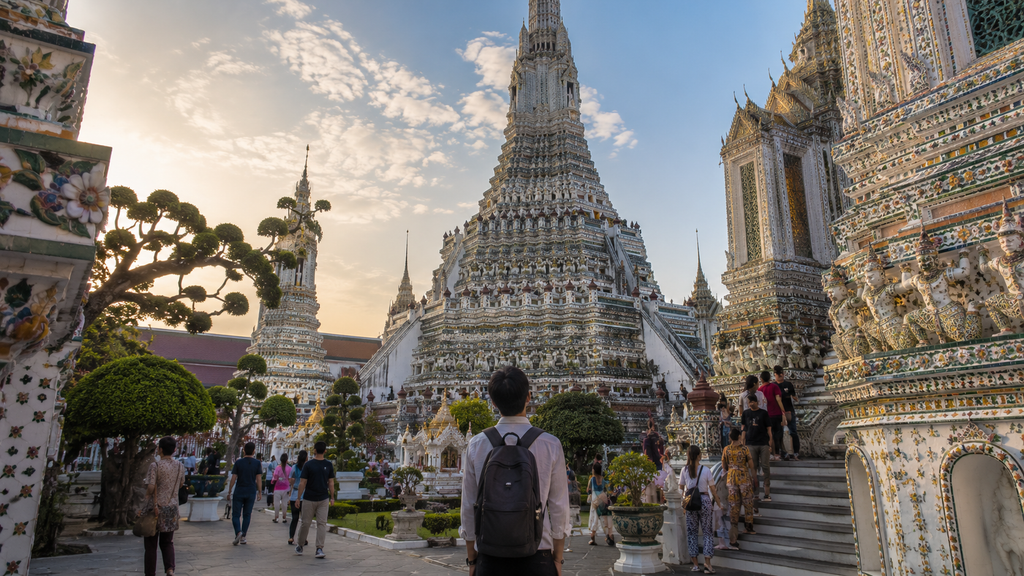
Wat Arun was one of the places I most wanted to see.
I deliberately saved it for later in the afternoon.
Bangkok temples can become extremely hot during the middle of the day, and the light becomes much nicer as afternoon progresses.
Wat Arun rises beside the Chao Phraya and looks completely different up close than it does from across the river.
From a distance, the central prang appears almost white.
Closer inspection reveals detailed pieces of porcelain and decoration covering the structure.
This is where I stopped trying to move quickly.
Walk around.
Look at the details.
Climb where access is permitted.
Then step back and look at the entire complex again.
Bangkok’s famous temples deserve more than fifteen minutes between taxi rides.
Dress for the Temple, Not Just the Weather
Bangkok’s heat makes shorts and light clothing tempting.
But when visiting temples, you need to respect the dress requirements.
I found it easier to plan my temple days around appropriate lightweight clothing rather than trying to solve the problem at every entrance.
Cover shoulders and knees where required.
Wear something breathable.
Shoes that are easy to remove can also be useful because footwear rules apply in certain temple areas.
Most importantly, remember that these are religious sites.
People are not only there for photographs.
Cross the River Toward Wat Pho
Depending on your pace and arrival time, you can combine Wat Arun with the Wat Pho area.
But I would not force it.
This is where realistic itineraries differ from perfect itineraries.
If you arrived late.
If you are tired.
If Wat Arun took longer than expected.
Save Wat Pho for tomorrow.
There is no prize for completing three temples before sunset.
I would rather enjoy one properly than rush through three.
Sunset Beside the River
One of my favorite moments of the first day required no ticket.
After visiting Wat Arun, I crossed toward the opposite side of the river and waited as the light changed.
Wat Arun becomes particularly beautiful from across the Chao Phraya.
The sky darkens.
Boats continue moving.
Lights begin appearing.
The temple slowly becomes illuminated.
This is exactly the kind of moment that disappears when an itinerary is too full.
If I had scheduled another attraction at 6 p.m., I probably would have left.
Instead, I stayed.
I am glad I did.
Then Go to Chinatown Hungry

Do not eat a large dinner before Yaowarat.
Bangkok’s Chinatown deserves an appetite.
By evening, Yaowarat Road feels completely different from the temple areas you explored during the afternoon.
Traffic.
Lights.
People.
Street-food stalls.
Restaurants.
Smoke rising from grills.
Tables packed onto sidewalks.
Queues appearing in front of particular vendors.
It is noisy and slightly overwhelming.
That is part of the experience.
I Gave Up Trying to Find the “Best” Street Food
Before visiting Chinatown, I had saved lists of famous stalls.
Once there, I realized how ridiculous my plan was.
I was standing in one of Bangkok’s great food neighborhoods surrounded by hundreds of things to eat while staring at my phone trying to locate one specific bowl of noodles.
So I stopped.
I walked.
I looked for busy stalls.
I watched what people were ordering.
Then I ate.
Grilled seafood.
Noodles.
Something sweet.
Fresh fruit.
A cold drink.
Not everything needs to be the most famous version in Bangkok.
Sometimes travel becomes much more enjoyable when you stop trying to optimize dinner.
How Spicy Is Thai Food Really?
The answer is:
It depends.
Some dishes were milder than I expected.
Others reminded me very quickly that my definition of spicy was not necessarily the cook’s definition.
If you do not handle chili well, say so.
But understand that “not spicy” can mean different things to different people.
I would not avoid Thai food because of this.
Just start carefully.
There are countless dishes that are not aggressively spicy.
And even when I accidentally ordered something hotter than intended, an iced drink usually helped me recover my dignity.
Getting Back to the Hotel
By the end of the first night, I would not add another attraction.
This is where many three-day itineraries become unrealistic.
They suggest Chinatown until 10 p.m., then a rooftop bar, then a night market.
You can do that.
I did not want to.
After walking, temples, boats, heat and street food, I was ready for the hotel.
Bangkok will still be awake tomorrow.
Day 2: Grand Palace, Wat Pho and Modern Bangkok
Day 2 is the biggest sightseeing day.
Start early.
I mean actually early.
Not “leave the hotel at 10:30 after breakfast” early.
Bangkok becomes hotter as the day progresses, and major attractions become busier.
The Grand Palace is exactly the kind of place where arriving earlier improves the experience.
Breakfast First
I would eat before heading out.
Nothing elaborate.
Jok.
Rice.
Noodles.
Moo ping.
Coffee.
Whatever is convenient near the hotel.
I have learned that visiting a major attraction hungry makes me impatient.
And the Grand Palace is not somewhere I want to rush because I skipped breakfast.
Arrive at the Grand Palace Early
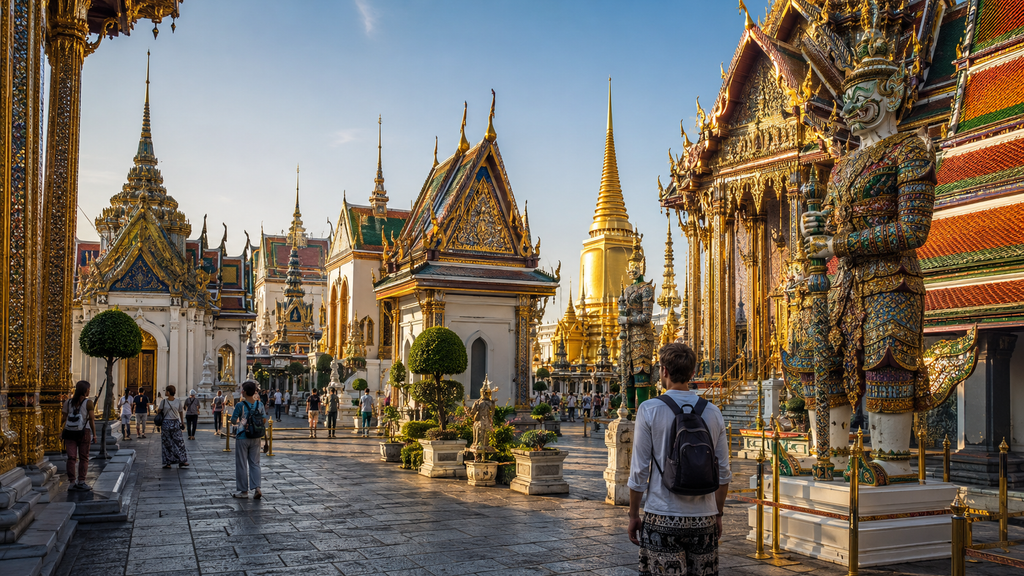
The Grand Palace is one of Bangkok’s biggest attractions for a reason.
The first thing that struck me was not one particular building.
It was the amount of detail.
Gold surfaces.
Decorated roofs.
Murals.
Guardians.
Courtyards.
Structures competing for your attention.
It can almost feel visually overwhelming.
This is another reason to arrive before you are exhausted.
Wat Phra Kaew Deserves Time
Inside the Grand Palace complex is Wat Phra Kaew, the Temple of the Emerald Buddha.
This is one of Thailand’s most important religious sites.
The atmosphere changes when you enter the temple area.
Visitors naturally become quieter.
Shoes come off where required.
Photography restrictions need to be respected.
This is not simply another ornate building.
Even if you know very little about Thai Buddhism, you can feel that the site carries a different significance.
I would spend some time observing rather than immediately reaching for the camera.
Be Careful With the “Grand Palace Is Closed” Story
Bangkok has long had scams targeting visitors around major attractions.
One classic version involves someone telling you the Grand Palace or another site is closed and offering an alternative tour, tuk-tuk ride or shopping stop.
Do not automatically believe someone simply because they sound helpful.
Check official opening information yourself.
Walk to the proper entrance.
Bangkok has many genuinely helpful people.
It also has people who understand exactly how confused a first-time tourist can look.
A little skepticism is useful.
Walk to Wat Pho
Wat Pho is close enough to combine naturally with the Grand Palace.
By the time I arrived, however, the heat had started becoming noticeable.
This is where I began understanding that Bangkok distances should not be measured only in kilometers.
Shade matters.
Temperature matters.
Crowds matter.
A short walk at 8 a.m. and the same walk at 1 p.m. are completely different experiences.
The Reclining Buddha Is Bigger Than Photographs Suggest
Wat Pho is famous for the enormous Reclining Buddha.
I had seen photographs before arriving.
The scale still surprised me.
The figure fills the space so completely that finding a single viewpoint becomes difficult.
You move along the side of the Buddha rather than standing back and seeing everything at once.
But Wat Pho is more than one statue.
Take time to walk through the wider temple complex.
The courtyards are beautiful.
Details appear everywhere.
If you rush directly to the Reclining Buddha and leave, you miss much of the atmosphere.
By Lunch, I Was Done With Temples
This is something many itineraries do not admit.
Temple fatigue is real.
The Grand Palace is spectacular.
Wat Pho is beautiful.
Wat Arun is unforgettable.
But after several hours of ornate religious architecture in Bangkok heat, I no longer needed another temple.
I needed lunch.
And air conditioning.
So that is exactly what I would recommend.
Do not schedule another major historic site immediately afterward.
Change the environment.
Lunch and a Proper Break
Find somewhere comfortable.
Eat.
Sit down.
Drink water.
Stay inside for a while.
This is not wasted travel time.
Bangkok in the middle of the afternoon can be brutally hot, particularly when you have already spent hours outside.
I initially felt guilty about sitting inside for nearly an hour.
Then I realized I was on holiday.
Nobody was scoring the efficiency of my itinerary.
That break made the rest of the day much better.
Afternoon: Go to Siam
After the historic center, I liked moving into modern Bangkok.
The contrast is enormous.
A few hours earlier, I had been standing inside temple courtyards.
Now I was surrounded by huge shopping centers, BTS tracks, digital screens, traffic and crowds.
Siam is not the reason I traveled to Thailand.
But it is part of Bangkok.
Ignoring modern Bangkok because temples look better in photographs gives you an incomplete picture of the city.
Bangkok’s Shopping Malls Make More Sense Once You Feel the Heat
I am not usually excited about visiting malls while traveling.
Bangkok changed my opinion slightly.
Shopping centers here function as more than places to buy things.
They are meeting places.
Restaurants.
Cafés.
Cinemas.
Food courts.
And, critically, air-conditioned refuges.
After several hours around the Grand Palace, stepping into a cool building felt magnificent.
You do not need to spend half a day shopping.
But I would not dismiss the mall culture either.
It is part of contemporary Bangkok life.
Try a Food Court
One useful thing about Bangkok’s malls is that they give nervous first-time visitors an easy introduction to Thai food.
Menus can be easier to understand.
The environment is comfortable.
There are many choices.
Prices vary depending on the mall, but you do not need to eat at an expensive restaurant.
I still prefer street food for atmosphere.
But there is no rule saying every meal in Thailand must be eaten on a plastic stool beside traffic.
Get a Thai Massage
By the second afternoon, my feet were ready.
Bangkok involves more walking than I expected.
BTS stations can be large.
Temple complexes involve walking.
Markets involve walking.
You walk because traffic makes a destination look close.
Then you discover it was not close.
A Thai massage suddenly begins to make sense.
There are massage shops across the city at very different price and quality levels.
I would choose somewhere reputable and professional rather than automatically picking the cheapest sign I saw.
After an hour, I felt considerably more prepared for the evening.
Bangkok From Above
For the second evening, I would choose one elevated view.
Bangkok has countless rooftop bars and observation points.
You do not need to visit several.
Pick one that fits your budget and style.
Watching the city from above helps you finally understand its scale.
Bangkok seems endless.
Buildings stretch toward the horizon.
Traffic becomes lines of light.
The BTS looks tiny.
The Chao Phraya curves through the city in the distance.
After spending two days moving through Bangkok at street level, seeing it from above gives the city a completely different shape.
Rooftop Bars Can Get Expensive Quickly
This is worth knowing before you arrive.
The view may be spectacular.
The drink prices can also be spectacular.
Check menus, dress codes and reservation requirements before going.
You do not need an expensive rooftop cocktail to experience Bangkok at night.
There are observation decks and more casual alternatives.
If you do choose a rooftop bar, think of the price partly as paying for the view.
Then enjoy it rather than complaining about the bill for the next two hours.
Dinner Somewhere Away From the Tourist Checklist
For the second night’s dinner, I would deliberately avoid another famous food destination.
Find somewhere near your hotel.
Walk around.
Look for a busy restaurant.
Eat what looks good.
This is how Bangkok begins feeling slightly less overwhelming.
By the second night, you recognize the BTS station.
You know which convenience store is near the hotel.
You know where to buy water.
You have already figured out that Google Maps sometimes suggests a walking route that makes no emotional sense in Bangkok heat.
The city is still unfamiliar.
But it is becoming manageable.
Day 3: Markets, Local Bangkok and a Slower Final Day
I would not spend the third day racing through every attraction I had missed.
Instead, I would use it to see a more ordinary side of Bangkok.
This is where the trip began feeling more personal to me.
The first two days were full of places I had seen in photographs.
The third day contained more moments I had not planned.
Start With a Local Breakfast

Skip the hotel buffet if you feel comfortable exploring.
Walk outside.
Find breakfast.
Thai cities come alive early because the heat makes mornings valuable.
Food stalls are already operating.
People are going to work.
Motorbikes move through side streets.
Monks may be visible collecting alms in some areas.
Bangkok in the morning feels different from Bangkok at midnight.
I liked seeing both.
What About Chatuchak Weekend Market?
If your third day falls on a weekend, Chatuchak can be a good choice.
The market is enormous.
Clothes.
Souvenirs.
Home goods.
Art.
Plants.
Food.
Things I could not identify.
And enough narrow lanes to destroy any confidence I had in my sense of direction.
I stopped trying to follow a perfect route after about twenty minutes.
That was the right decision.
Walk.
Browse.
Eat something.
Get lost.
Eventually find your way out.
That is basically the Chatuchak experience.
Go Early to Chatuchak
This is important.
Bangkok gets hot.
Markets get crowded.
Go earlier rather than arriving at the hottest part of the day.
Wear comfortable shoes.
Carry water.
And do not expect to see the entire market.
You will not.
You do not need to.
If It Is Not the Weekend
I would not redesign the entire trip just because Chatuchak is not operating in its full weekend form.
Bangkok has plenty of alternatives.
Explore a neighborhood.
Visit a local market.
Spend time around Talat Noi.
Walk through older streets near Chinatown.
Visit a museum.
Find a café.
The goal of Day 3 is not one particular attraction.
It is allowing Bangkok to become more than a checklist.
Talat Noi Was the Kind of Bangkok I Wanted More Of
One area I would happily spend time walking through is Talat Noi.
The neighborhood sits near Chinatown but feels different from the main Yaowarat experience.
Old buildings.
Small lanes.
Chinese heritage.
Workshops.
Street art.
Cafés hidden inside older structures.
Motorcycle parts and machinery.
It feels slightly rougher around the edges than Bangkok’s polished shopping districts.
That is exactly why I liked it.
You can walk without needing a major destination every ten minutes.
Sit in a Café Without Feeling Guilty
By Day 3, I was comfortable doing this.
Find somewhere interesting.
Order coffee.
Sit down.
Watch Bangkok.
Travel itineraries rarely include “do nothing for forty minutes.”
They should.
Some of my clearest memories of cities come from moments when I was not visiting anything.
Bangkok is especially good for this because street life constantly gives you something to observe.
Take the BTS Somewhere Just Because You Can
By the third day, public transport no longer felt intimidating.
I knew how the BTS worked.
The MRT made sense.
I stopped checking every station three times.
That confidence makes Bangkok much easier.
This is why staying near rail transport matters so much.
Instead of asking whether a destination is too far away, you start thinking in stations.
That changes the scale of the city.
BTS, MRT or Grab?
After three days, my rule became fairly simple.
If BTS or MRT gets reasonably close, use it.
If the destination is awkward by rail, consider Grab or a taxi.
If traffic is terrible, reconsider the car.
Bangkok road traffic can turn a short journey into a very long one.
Rail gives you predictability.
Cars give you door-to-door convenience.
Use whichever makes sense at that moment.
Do not become loyal to one form of transport.
And What About Tuk-Tuks?
You should probably ride one at least once if you want the experience.
They are part of Bangkok’s visual identity.
The ride can be fun.
The open sides make the city feel incredibly close.
Traffic, smells, noise and heat all arrive at once.
But I would not use tuk-tuks as my primary transportation.
Agree on the fare before leaving.
Be cautious with suspiciously cheap rides tied to shopping stops or tours.
Treat it as an experience rather than Bangkok’s most efficient transport system.
My Final Afternoon: Stop Trying to Complete Bangkok
This was the moment I accepted that three days would never be enough.
There were still temples I had not seen.
Markets I had missed.
Museums.
Neighborhoods.
Restaurants.
Rooftop bars.
Day trips.
I could have spent the final afternoon frantically crossing things off the list.
Instead, I returned to places I actually wanted to experience.
I ate.
Walked.
Bought a few things.
Sat down when I was tired.
Bangkok became much more enjoyable once I accepted that I would leave without seeing everything.
What I Would Eat Before Leaving Bangkok
For a final meal, I would choose something I had enjoyed enough to want again.
Maybe pad kra pao.
Maybe boat noodles.
Maybe som tam.
Maybe grilled pork with sticky rice.
Maybe one final mango sticky rice.
Travel does not always need another new experience.
Sometimes repeating a favorite is the better ending.
By the third day, I had started developing preferences.
That is when a destination begins feeling slightly familiar.
How Much Cash Would I Carry?
Bangkok has become increasingly convenient for electronic payments, but cash remains useful for visitors.
Street-food stalls.
Markets.
Small shops.
Tuk-tuks.
Certain local businesses.
I would not carry my entire travel budget in cash.
I would carry enough Thai baht for normal daily spending and keep cards as another payment option.
ATMs are widely available, although withdrawal and foreign-bank fees can add up.
Check your own card before traveling.
And always have a backup.
A payment card failing abroad is annoying.
A payment card failing when you are hungry is somehow much worse.
Bangkok Is Cheap Until It Isn’t
You can eat extremely well without spending much.
Public transport is affordable.
Local massage can be reasonable.
Street food can keep meal costs low.
Then you walk into a luxury rooftop bar.
Or a high-end shopping mall.
Or an international hotel.
Bangkok can suddenly become expensive.
That is one of the interesting things about the city.
Budget Bangkok and luxury Bangkok exist almost on top of each other.
You decide which version you want.
The Heat Changed My Itinerary More Than Anything Else
I cannot emphasize this enough.
Bangkok is hot.
Depending on the season, it can be extremely hot and humid.
This affects everything.
How far you want to walk.
How many temples you want to visit.
How long you stay at a market.
How much water you drink.
Whether that “quick 20-minute walk” is actually a good idea.
My strategy became:
Do outdoor attractions earlier.
Take a real break around midday.
Use air-conditioned transport where practical.
Continue again later in the afternoon.
This made Bangkok much more enjoyable.
Carry Water
Simple.
Obvious.
Easy to forget.
You will find convenience stores everywhere, so buying water is not difficult.
Still, I prefer having some with me.
Especially around temples and markets.
Carry Something for Rain
Bangkok’s tropical weather can change quickly.
A small umbrella is useful.
It can help with rain.
It can also help with the sun.
If heavy rain arrives, do not assume the day is ruined.
Go eat.
Find a café.
Enter a mall.
Wait.
Then continue.
Three days is short, but there is still enough flexibility to move things around.
Temple Etiquette Matters
Bangkok’s temples are not theme parks.
Dress appropriately.
Remove shoes where required.
Follow photography rules.
Keep your voice reasonable.
Do not climb or sit somewhere simply because it would make a good photograph.
Observe what local visitors are doing.
If you are uncertain, ask.
Respect does not require understanding every aspect of Buddhism.
It requires remembering that the place matters to people beyond tourism.
Scams Exist, but Bangkok Is Not One Giant Scam
Reading travel warnings before Thailand can make Bangkok sound terrifying.
Closed attraction scams.
Tuk-tuk scams.
Taxi problems.
Gem shops.
Overcharging.
Yes, tourists should be aware.
But I would not spend the trip assuming everyone who speaks to me is trying to steal something.
Most interactions were completely normal.
Use common sense.
Check official information.
Know roughly where you are going.
Do not accept obviously strange offers.
And walk away when something feels wrong.
Awareness is useful.
Paranoia is exhausting.
Where I Would Stay Next Time
For another short Bangkok visit, I would still choose somewhere near BTS or MRT.
That requirement would remain non-negotiable.
I would probably choose based on what I wanted from the trip.
Sukhumvit for convenience, restaurants and nightlife.
Siam for shopping and excellent transport connections.
Silom for a useful balance of food, nightlife and transport.
Riverside for atmosphere and views if the budget allowed.
Old Town if temples and historic Bangkok were the main focus.
The best area depends on the traveler.
The worst choice for a three-day trip is somewhere that makes every journey unnecessarily difficult.
What I Would Skip With Only Three Days
I would skip most day trips.
Ayutthaya is worth visiting.
Floating markets can interest some travelers.
There are plenty of destinations outside Bangkok.
But with only three days on a first visit, I would stay in Bangkok.
You already have more than enough to see.
Save the day trips for a longer itinerary.
I would also avoid trying to visit every major shopping mall.
One or two is enough unless shopping is a major reason for the trip.
And I would not visit ten temples.
Three memorable temples are better than ten temples I can no longer distinguish in photographs.
Is Three Days in Bangkok Enough?
Enough for everything?
Not remotely.
Enough for a first experience?
Yes.
Three days allowed me to see several different Bangkoks.
The historic Bangkok of the Grand Palace and Wat Pho.
The riverside Bangkok around Wat Arun.
The food chaos of Chinatown.
The modern city around Siam.
The neighborhood streets around Talat Noi.
The markets.
The BTS.
The traffic.
The heat.
The late-night food.
By the end, I understood the city much better than I had on arrival.
I also understood how much I had not seen.
That is usually a good reason to return.
My Realistic 3-Day Bangkok Itinerary
If you want the simplified version, this is how I would actually organize it.
Day 1: Chao Phraya River, Wat Arun and Chinatown
Keep the morning flexible for arrival. Have a local lunch, head toward the Chao Phraya River, use the boat, visit Wat Arun in the afternoon and stay around the river toward sunset. Finish the evening eating your way through Yaowarat Chinatown.
Day 2: Grand Palace, Wat Pho and Modern Bangkok
Start early at the Grand Palace and Wat Phra Kaew. Walk to Wat Pho afterward. Have lunch and take a proper midday break. Spend the afternoon around Siam or central Bangkok, get a Thai massage and choose one rooftop or elevated city view for the evening.
Day 3: Market, Neighborhoods and Local Bangkok
If it is the weekend, visit Chatuchak early. Otherwise choose a local market or neighborhood. Spend time around Talat Noi or another area away from the biggest attractions, stop at a café, eat somewhere local and keep the final afternoon flexible.
That is enough.
You will still be busy.
But you should not feel as though you are racing Bangkok.
What I Would Change If I Returned
I would wake up earlier.
Bangkok mornings are valuable.
I would spend more time around the river.
I would explore more residential neighborhoods.
I would plan fewer famous restaurants and simply eat where I happened to be.
I would probably add several days and take a trip to Ayutthaya.
And I would never again look at a map at 1 p.m. and say:
“It’s only two kilometers. Let’s walk.”
Bangkok taught me that lesson quickly.
Final Thoughts
Three days in Bangkok went much faster than I expected.
Before arriving, I thought the challenge would be deciding what to see.
It wasn’t.
The real challenge was knowing when to stop.
Bangkok constantly gives you another option.
Another temple.
Another market.
Another food stall.
Another rooftop.
Another neighborhood.
Another night out.
If you try to experience all of it in 72 hours, the city becomes exhausting.
When I slowed down, Bangkok became much better.
I remember the Grand Palace, but I also remember sitting in the shade afterward because I was completely overheated.
I remember Wat Arun, but I remember the boat ride across the river just as clearly.
I remember Chinatown, but not the names of every stall where I ate.
I remember the skyline from above, but I also remember ordinary mornings walking past people buying breakfast on their way to work.
Those small moments made Bangkok feel like somewhere people actually live rather than a collection of attractions.
That is why I would keep a first trip simple.
Three days.
A few important landmarks.
One or two neighborhoods each day.
Plenty of Thai food.
BTS and MRT whenever possible.
A boat ride on the Chao Phraya.
A tuk-tuk once for the experience.
And enough empty time to sit down when Bangkok inevitably becomes hotter, louder and more tiring than you expected.
You will leave without seeing everything.
That is fine.
Bangkok is not a city you complete.
It is a city that gives you a reason to come back.