

Before traveling to India, I thought I knew Indian food reasonably well.
I knew naan.
I knew butter chicken.
I had eaten samosas, biryani and several kinds of curry. I knew Indian food could be spicy, and I expected to eat a lot of rice.
Then I arrived in India and realized how little of the country’s food I had actually experienced.
The first surprise was not a particular dish.
It was how quickly the food changed.
A breakfast that seemed completely normal in Delhi could disappear from the menu as you traveled south. Bread gradually gave way to rice. Coconut became more noticeable. The spices changed. Even something as simple as a cup of chai could taste different from one place to another.
And the word “curry” became increasingly useless.
India does not really have one national cuisine in the way many visitors imagine. It has an enormous collection of regional cuisines shaped by climate, religion, agriculture, history and local traditions.
You could travel around India for months and still encounter dishes you had never heard of.
That is part of the pleasure.
The best way to approach Indian food is not to arrive with a checklist of famous dishes.
Arrive hungry.
Ask questions.
Order things you cannot pronounce.
And accept that at some point you will probably confidently bite into something much hotter than you expected.
Your First Indian Breakfast
Breakfast was where I first noticed that eating in India was going to be different from eating Indian food back home.
In Delhi, a morning meal might involve paratha served hot from a griddle, sometimes stuffed with potato, paneer or vegetables.
Add yogurt, pickle and perhaps a cup of chai, and breakfast suddenly becomes substantial enough to keep you walking for hours.
Another morning might begin with poori and a spiced potato dish.
Or chole bhature: chickpeas served with large pieces of fried bread.
None of this feels particularly light.
That took some adjustment.
I was used to treating breakfast as preparation for lunch. In northern India, breakfast occasionally felt like an event of its own.
The easiest strategy is to watch where local people are eating.
A small restaurant filled with office workers or families in the morning is usually more interesting than a hotel buffet designed to satisfy every nationality at once.
Chai Becomes Part of the Journey
I expected to drink chai in India.
I did not expect to drink quite so much of it.
Tea appears everywhere.
Railway platforms.
Street corners.
Markets.
Restaurants.
Bus stops.
Small roadside stalls.
Sometimes you hear a chai seller before you see him.
A typical masala chai combines strong black tea with milk, sugar and spices, although recipes vary considerably.
It usually arrives in a much smaller serving than the enormous café versions common in other countries.
At first, I kept thinking the cup was too small.
Then another chai opportunity appeared twenty minutes later.
Eventually, the size made perfect sense.
Some of my favorite food memories from India involve nothing more complicated than standing beside a street stall with a small hot cup in my hand while traffic moved past.
Not every memorable meal needs a table.
Delhi: Where Street Food Becomes Difficult to Resist
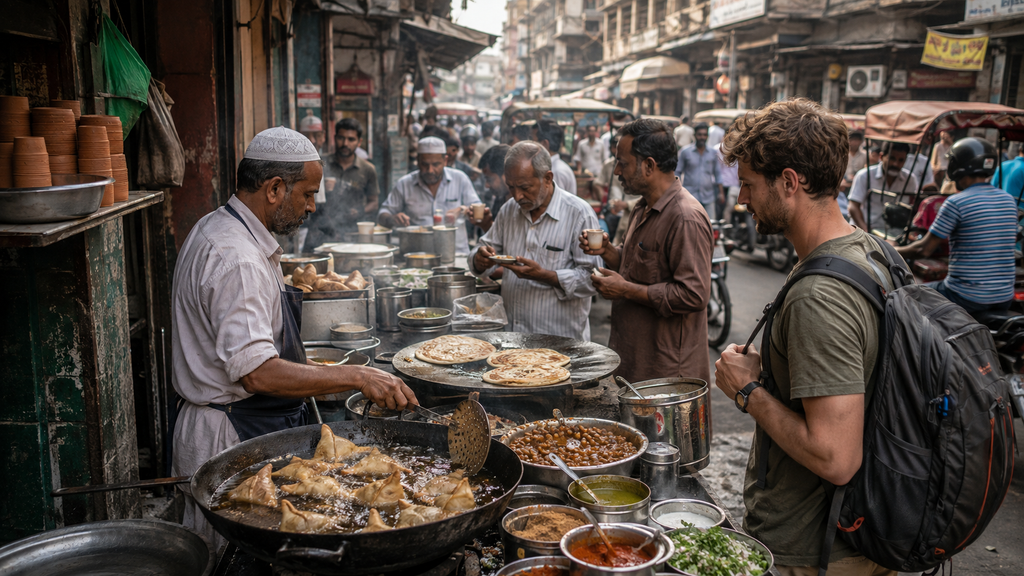
Old Delhi is a dangerous place to visit when hungry.
Every few meters, something smells good.
Oil bubbles around samosas.
Bread cooks on hot metal surfaces.
Kebabs smoke over grills.
Vendors assemble snacks so quickly that you barely understand what went into them before someone is already eating.
Around Chandni Chowk, eating becomes part of exploring the neighborhood.
One of the most famous local experiences is paratha.
A freshly cooked stuffed paratha is crisp in places, soft in others and considerably heavier than it looks.
Then there is chaat.
Chaat is not one dish but a broad family of snacks combining contrasting flavors and textures.
Something can be crispy, soft, sweet, sour, spicy and cooling almost simultaneously.
Potato, chickpeas, yogurt, chutneys, fried dough, spices and herbs appear in different combinations depending on the dish.
It can look chaotic on the plate.
Then you take a bite and understand that the chaos is organized.
The Pani Puri Problem
Sooner or later, someone will tell you to try pani puri.
Small hollow crispy shells are filled with ingredients such as potato or chickpeas and flavored water, then eaten whole.
Watching an experienced vendor serve them is almost a performance.
One arrives.
You eat it.
Another appears immediately.
Then another.
The problem for international travelers is the water.
If you are uncertain about hygiene, this is one street-food experience where caution is sensible. Look for busy, reputable places with good hygiene practices, or try it at an established restaurant.
I do not believe travelers need to prove anything by eating at the most questionable stall they can find.
The goal is to experience Indian food.
Not to spend the following 48 hours memorizing the ceiling of a hotel room.
North Indian Food Is More Than Butter Chicken
Butter chicken is famous internationally for good reason.
When prepared well, the sauce is rich, smooth and deeply flavored without simply being hot.
It is also only one small corner of northern Indian cooking.
Dal is everywhere in different forms.
Paneer appears in countless vegetarian dishes.
Chickpeas become chana masala.
Kidney beans become rajma.
Tandoori cooking produces smoky meats and breads from intensely hot clay ovens.
Roti and naan accompany meals, but even the world of Indian bread is much larger than those two names suggest.
One of the pleasures of eating in northern India is discovering that foods you thought you understood have multiple regional and local versions.
Even dal can become an entirely different experience from one restaurant to another.
The Thali Solves the Problem of Ordering
A menu in India can be intimidating when half the dishes are unfamiliar.
This is why I quickly became a fan of thali.
A thali brings several dishes together on one plate or tray.
Depending on the region and restaurant, you might receive dal, vegetables, curries, rice, bread, yogurt, pickle, chutney and something sweet.
Sometimes the servings are fixed.
In other places, servers return with more food.
The first time this happened, I assumed they were offering something extra that would appear on the bill.
Then they refilled almost everything.
A thali is one of the best ways to understand how an Indian meal works because you are not eating each dish in isolation.
You combine things.
A little dal with rice.
A piece of bread with vegetables.
Something spicy followed by yogurt.
Pickle in tiny amounts.
The meal becomes interactive.
And if you do not know what half the bowls contain, that is fine.
Pointing and asking is part of the experience.
Rajasthan: Food Shaped by the Desert
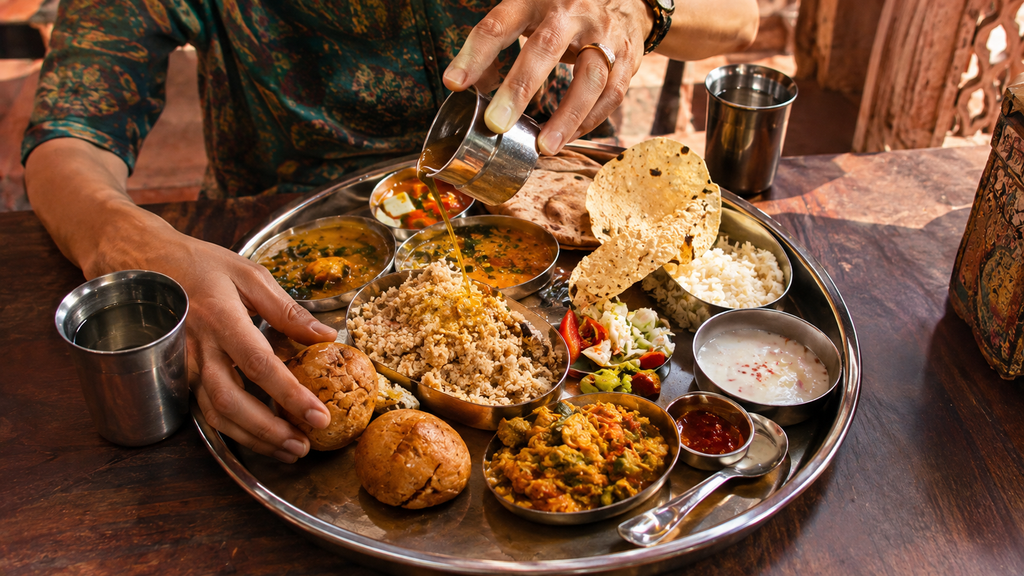
Travel from Delhi toward Jaipur and the food begins telling you something about geography.
Rajasthan developed in a dry environment where water and fresh ingredients were historically less reliable than in many other parts of India.
The cuisine reflects that.
One of the most famous meals is dal baati churma.
Baati are firm baked wheat balls, often broken open and eaten with dal and ghee. Churma provides a sweeter element.
It is filling.
Very filling.
The kind of lunch that makes ambitious afternoon sightseeing suddenly seem unnecessary.
I had seen photographs before trying it and expected the baati to resemble ordinary bread.
It does not.
The texture and the way it absorbs dal and ghee are part of the experience.
This is exactly why reading a menu rarely tells you enough about Indian food.
Laal Maas and the Question Everyone Asks
“Is it spicy?”
This may be the most common question international travelers ask in India.
Unfortunately, the answer is complicated.
Something described as “not spicy” by one person may still be extremely hot to someone who did not grow up eating chili regularly.
Rajasthan’s laal maas illustrates this problem beautifully.
Traditionally a meat dish associated with strong red chili flavor, it can be seriously hot.
Not every restaurant prepares it at the same intensity, but this is not the dish I would order while confidently announcing that I can handle anything.
Indian food taught me to stop treating spice tolerance as a competition.
If something is too hot, eat slowly.
Use rice, bread or yogurt.
And accept defeat when necessary.
There is always another meal.
Vegetarian Food Never Feels Like a Compromise
India is an extraordinary destination for vegetarian travelers.
In many countries, the vegetarian section of a menu feels like an alternative.
In India, vegetarian cooking is central to enormous culinary traditions.
You can eat for days without meat and never feel like you are repeatedly ordering the same vegetables.
Paneer alone appears in countless forms.
Then there are lentils, chickpeas, potatoes, cauliflower, okra, peas, eggplant and ingredients that may be completely unfamiliar to a visitor.
Religious traditions have also shaped food practices across the country.
Some restaurants are entirely vegetarian.
Others may identify themselves as “pure veg,” generally indicating that meat, fish and eggs are not prepared there, although definitions and practices can vary.
For a traveler, the interesting part is how little you miss meat when the vegetarian food is this developed.
Mumbai: Eating While Standing Up
Mumbai has its own rhythm.
So does its food.
One of the city’s most famous snacks is vada pav.
It is sometimes casually described as an Indian burger, which is convenient but does not really explain it.
A spiced potato fritter is placed inside a bread roll and served with chutneys and often chili.
It is simple, cheap, portable and deeply connected to Mumbai’s street-food culture.
Then there is pav bhaji.
A rich mashed vegetable mixture is served with buttered bread rolls.
The amount of butter involved can be impressive.
Mumbai also has bhel puri, sev puri and numerous other chaat-style snacks.
This is food designed for a city that rarely seems to stop moving.
You eat quickly.
Sometimes standing.
Sometimes beside a road.
Then you continue with your day.
Coastal India Changes the Menu Again
One of the biggest mistakes a food-focused traveler can make is spending an entire India trip inland.
Reach the coast and another version of Indian cuisine appears.
Fish and seafood become much more prominent.
Coconut appears in different forms.
Regional spices combine with ingredients from the Arabian Sea and Indian Ocean.
Goa is perhaps the most internationally familiar example.
Its cuisine reflects local Konkani traditions alongside centuries of Portuguese influence.
Vindaloo is probably the dish visitors recognize most easily, although versions outside India can be very different from what you encounter locally.
Goan fish curry, seafood dishes, rice and breads reveal a cuisine that feels far removed from the rich gravies many travelers associate with northern India.
Again, the idea of one “Indian cuisine” begins to collapse.
Arriving in South India
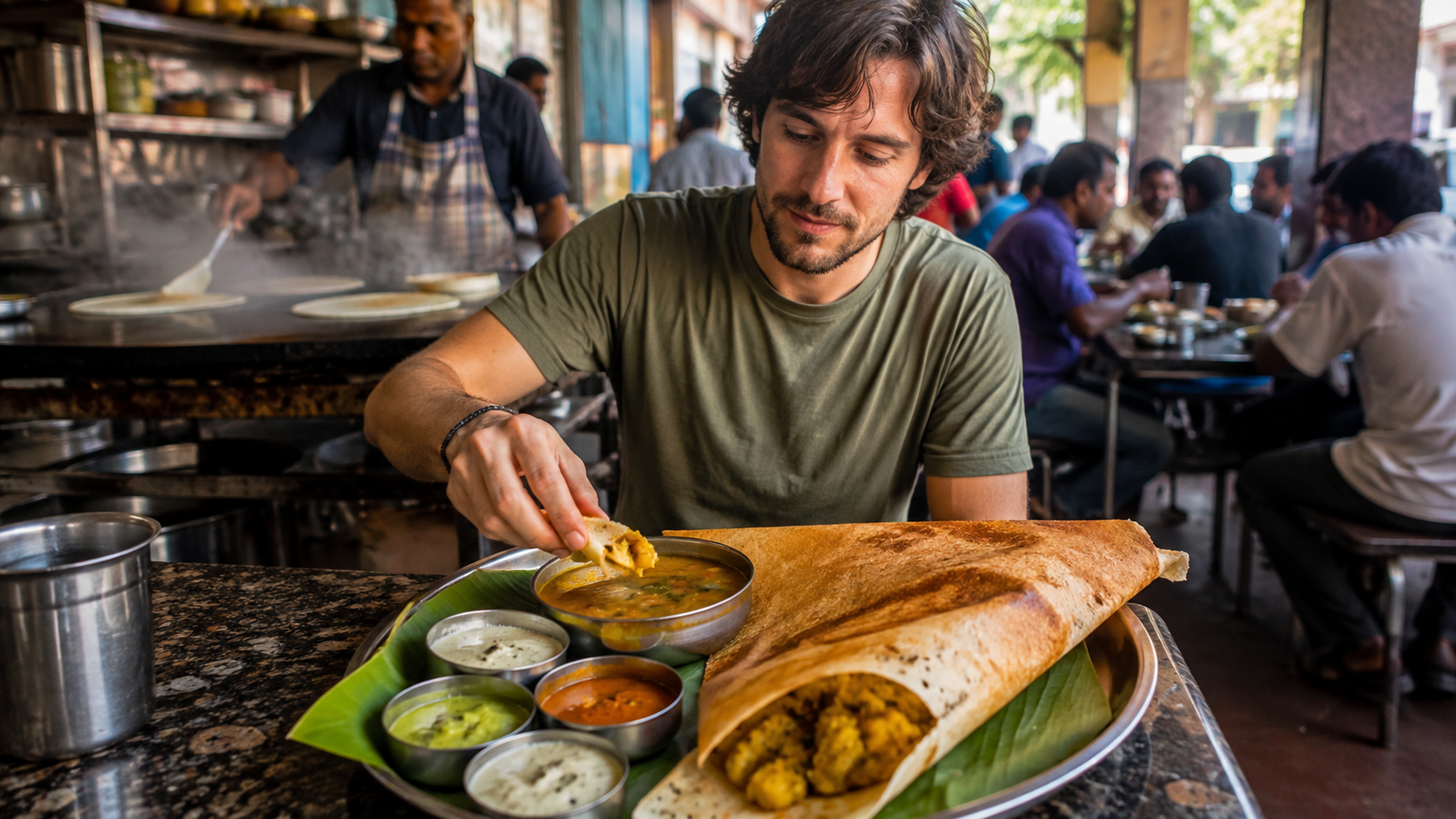
The first dosa made me reconsider breakfast.
It arrived much larger than expected.
A thin, crisp fermented crepe stretched across the plate, accompanied by sambar and several chutneys.
A masala dosa adds a spiced potato filling.
You tear off pieces with your hand and combine them with the accompaniments.
The crisp edges are particularly satisfying.
Then you discover idli.
Soft steamed cakes made from fermented rice and lentil batter, usually served with sambar and chutney.
After some of northern India’s heavier breakfasts, idli can feel almost gentle.
South Indian food makes extensive use of rice, lentils, coconut, tamarind, curry leaves and other regional ingredients, but cuisine varies enormously between states.
Tamil Nadu does not eat exactly like Kerala.
Kerala does not eat exactly like Karnataka.
And none of them can be summarized by dosa alone.
Eating With Your Hands
At some point, you may find yourself looking around a restaurant and realizing that everyone except you is eating with their hands.
Eating with the hand is normal in many Indian food traditions.
Usually, the right hand is used.
There is a technique to mixing rice with sauces and bringing it neatly to your mouth.
My first attempts were not elegant.
That is fine.
Nobody expects a visitor to instantly understand something they have practiced since childhood.
Wash your hands before eating.
Watch how local diners handle the food.
Start with small amounts.
You do not have to abandon cutlery if you are uncomfortable, but trying the local eating style can change how you experience certain meals.
Food is not only about ingredients.
It is also about how people eat them.
Kerala: Coconut, Seafood and Banana Leaves
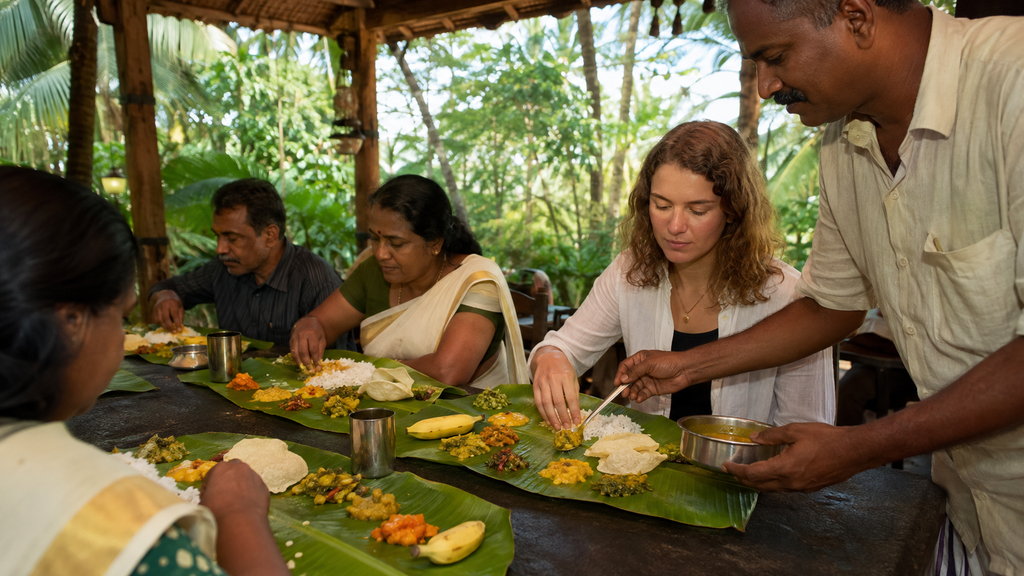
Kerala feels different before you even sit down to eat.
The landscape is greener.
Palm trees appear everywhere.
The climate is tropical.
The food reflects the environment.
Coconut milk, grated coconut, curry leaves, rice and seafood feature prominently in many dishes.
One memorable Kerala meal may arrive not on a plate but on a banana leaf.
A traditional sadya consists of numerous vegetarian preparations arranged across the leaf, usually served with rice and eaten by hand.
It is especially associated with celebrations such as Onam, although restaurants may offer versions at other times.
The first time you see a full sadya, it can be difficult to understand where to begin.
That is another good moment to watch everyone else.
Kerala also has excellent fish dishes.
Karimeen, often translated as pearl spot fish, is closely associated with the region.
Different preparations may grill, fry or cook fish with spices and coconut-based ingredients.
If northern India introduced me to the depth of vegetarian cooking, Kerala demonstrated how dramatically Indian food changes near the coast.
Hyderabad and the Biryani Question
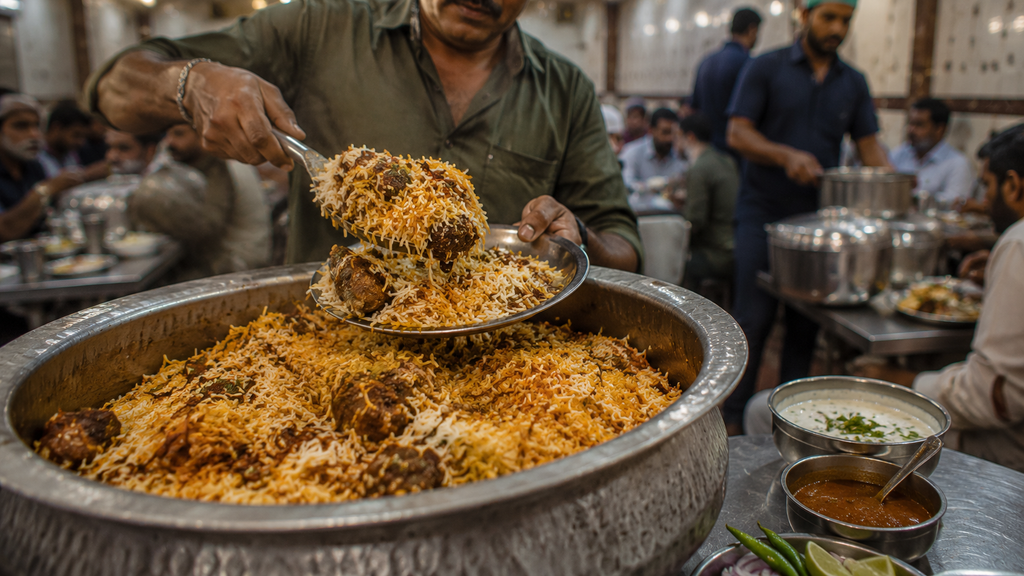
Mention biryani in India and conversations become serious.
Different cities and regions have their own styles, and people have strong opinions about which is best.
Hyderabad is one of the names most closely associated with the dish.
Hyderabadi biryani combines fragrant basmati rice, spices and usually meat in layers, traditionally using cooking techniques designed to trap steam and flavor.
A good biryani does not taste like rice with curry poured over it.
The rice itself carries aroma and flavor.
Some grains remain pale while others absorb color and spices.
Pieces of meat appear between layers.
Raita or other accompaniments may come alongside.
The dangerous part is portion size.
A plate can look manageable when you begin.
Halfway through, you realize you have made a serious commitment.
Kolkata and a Different Kind of Indian Food
Eastern India adds another layer.
Kolkata has a food identity shaped by Bengali traditions as well as the city’s long and complicated history.
Fish plays an important role in Bengali cuisine.
Mustard appears frequently.
Rice is central to many meals.
Then there are sweets.
If you enjoy desserts, Bengal can become a problem.
Rasgulla — soft cheese-based balls soaked in syrup — is one of the best-known examples.
Mishti doi, a sweetened fermented yogurt, is another.
Indian desserts often challenge visitors because sweetness levels can be intense.
A tiny portion can be enough.
This is especially true after a large meal when someone insists that you still need dessert.
In India, there often seems to be space for one more thing.
How to Choose a Good Local Restaurant
I stopped relying entirely on online ratings after a while.
They are useful.
But they are not the only information available.
Look inside.
Are local people eating there?
Is the restaurant busy at normal meal times?
Does food appear to be prepared continuously?
Does the place look reasonably clean?
A simple restaurant with plastic chairs and a short menu can serve an exceptional meal.
Meanwhile, an expensive restaurant designed for tourists can produce something completely forgettable.
I also learned to ask hotel staff specific questions.
Do not ask:
“Where is a good restaurant?”
That often leads to the place they think foreigners will find comfortable.
Ask:
“Where would you go for dosa?”
Or:
“Where do you eat biryani?”
The answer becomes much more interesting.
How Much Does Food Cost in India?
Food can be remarkably affordable if you eat where local people eat.
A simple breakfast or street-food meal may cost very little by international travel standards.
Local restaurants can also offer filling meals at modest prices.
Tourist restaurants, hotel dining rooms and upscale restaurants in major cities are a completely different category.
The important point is that cheap food is not automatically bad food.
Some of India’s most memorable dishes are everyday foods designed to be affordable.
I would spend money occasionally on a high-quality restaurant if there were a particular regional cuisine I wanted to understand.
But I would never build an Indian food trip entirely around expensive dining.
You would miss too much.
Water Matters More Than Spice
Travelers worry about chili.
I worry more about water.
Digestive problems can ruin several days of a trip, so basic caution is worthwhile.
Drink sealed bottled water or properly treated water.
Check bottle seals.
Be careful with ice when you do not know the water source.
Raw vegetables washed in untreated water can also present a risk.
With street food, freshly cooked and piping hot is generally preferable to something that has been sitting around.
None of this means you should become afraid of eating.
It simply means making sensible decisions.
I ate local food throughout India without trying to sterilize the experience.
I just became more selective about where and how I ate.
Do Not Try Everything on Day One
The first day is not the time for a personal street-food championship.
Your body is adjusting to travel, climate, water, spices and a completely different eating schedule.
Start slowly.
Choose cooked food.
Drink plenty of safe water.
See how you feel.
Then become more adventurous.
India is not going to run out of food before you leave.
You have time.
The Best Meals Are Often the Ones You Did Not Plan
Some meals are destinations.
You travel across a city because a restaurant is famous for one particular dish.
Those experiences can be wonderful.
But they are not always the meals you remember.
Sometimes you remember the dosa from the small restaurant beside your hotel because you ate there three mornings in a row.
Or the chai at a railway station because your train was delayed and you had nothing else to do.
Or the thali where the server kept returning with more food until you had to physically cover your plate to convince him you were finished.
Or a snack you bought because everyone around you seemed to be eating it and you still do not know exactly what it was called.
Travel changes food.
The setting becomes part of the flavor.
What I Would Tell Someone Eating Their Way Through India
Do not search only for famous dishes.
Ask what is local.
If you are in Rajasthan, eat Rajasthani food.
If you are in Kerala, do not spend the entire trip ordering butter chicken.
Try breakfast outside your hotel.
Order a thali when the menu becomes overwhelming.
Eat vegetarian meals even if you normally eat meat.
Drink chai from small stalls.
Learn what level of chili you can actually handle rather than what level you think sounds impressive.
Carry tissues and hand sanitizer.
Wash your hands.
Drink safe water.
And occasionally order something simply because you have no idea what it is.
That is how some of the best meals happen.
Final Thoughts
I arrived in India thinking I was going to eat Indian food.
By the end of the trip, that phrase no longer made much sense.
I had eaten Punjabi dishes in the north, Rajasthani food in Jaipur, street snacks in crowded cities, coastal dishes, biryani, dosa, idli, thali and meals served on banana leaves.
Some were fiery.
Some were surprisingly mild.
Some were rich enough that I needed to walk for an hour afterward.
Others cost almost nothing and disappeared in three bites.
And there were still entire regions whose food I had barely touched.
That is the wonderful problem with eating your way through India.
Every answer creates another question.
You discover dosa and then realize there are countless variations.
You try biryani and immediately hear that another city makes it better.
You learn one kind of dal and discover ten more.
You finally understand a thali and then travel to another state where the entire plate changes.
Indian food is not something you finish exploring.
You simply keep going.
And somewhere between the first nervous street-food decision and the moment you are confidently tearing dosa with your fingers or ordering another roadside chai, food stops being one part of the trip.
It becomes one of the main reasons you want to return.