

There is a moment on almost every first trip to India when you realize that the journey you planned on a map is going to feel very different on the ground.
For me, that realization came in Delhi.
I had looked at the Golden Triangle route dozens of times before the trip. Delhi, Agra and Jaipur form a convenient triangle across northern India, and on paper the journey seems straightforward. Spend a few days in Delhi, travel to Agra for the Taj Mahal, continue west into Rajasthan, explore Jaipur, and you have completed one of India’s most famous travel routes.
The distances are manageable. Trains connect the cities. Hotels exist for almost every budget. There are enough famous sights to fill a week easily.
But the Golden Triangle is not memorable because it is convenient.
It is memorable because each city feels completely different from the one before it.
Delhi introduces you to the noise and scale of urban India. Agra gives you one of those rare landmarks that actually lives up to years of photographs. Jaipur slows the journey slightly and replaces Delhi’s intensity with forts, bazaars, sandstone walls and the colors of Rajasthan.
Between them are railway platforms, roadside chai stops, tuk-tuk conversations, unexpected traffic jams, meals you cannot pronounce, wrong turns through old neighborhoods and dozens of ordinary moments that never appear on an itinerary.
If this is your first journey through northern India, seven to nine days is enough to experience the Golden Triangle without turning it into a race.
This is how I would travel it.
Starting in Delhi
Delhi is not a gentle introduction to India.
That is also why I think it is the right place to begin.
The city does not gradually reveal itself. It arrives all at once.
Traffic, horns, people, food stalls, construction, monuments, markets and modern office buildings compete for your attention from the moment you leave the airport.
On my first morning, I made the mistake of looking at the map and thinking several attractions seemed reasonably close together.
They were not.
Distances in Delhi are deceptive because the city is enormous and traffic changes everything.
A journey that appears short can consume much more time than expected. After the first day, I stopped planning Delhi by the number of attractions and started planning it by neighborhoods.
That made everything easier.
Give Delhi at least two full days.
Three is better if you have enough time.
Old Delhi in the Morning

If I had to choose one place to understand Delhi’s energy quickly, I would start around Old Delhi.
Go early.
The streets are already active, but the heat is usually easier and the crowds have not yet reached their afternoon intensity.
Around Chandni Chowk, the city seems to operate on several levels simultaneously.
Shops open their metal shutters. Vendors prepare breakfast. Cycle rickshaws squeeze between pedestrians. Motorcycles somehow find paths through spaces that barely seem wide enough for a person.
Above the street are tangled wires, signs and old buildings that reveal layers of history if you remember to look upward.
At first, I kept trying to avoid everyone.
Eventually, I realized that moving through Old Delhi works better when you stop fighting its rhythm.
Walk steadily. Keep your valuables secure. Accept that you will occasionally need to step aside for a motorcycle, cart, cow or group of people moving faster than you.
And stop for chai.
A small cup of hot tea in the middle of an already warm morning might not sound logical, but somehow it works.
Jama Masjid and the View Over Old Delhi
Jama Masjid is one of the places where Delhi’s pace briefly changes.
After the surrounding streets, stepping into the mosque’s large courtyard feels almost spacious.
Shoes must be removed before entering appropriate areas, and visitors should dress respectfully. Requirements can change, so follow the instructions at the entrance rather than relying entirely on old travel advice.
What stayed with me was not simply the architecture.
It was the contrast.
Outside, Chandni Chowk was moving at full speed.
Inside, people sat quietly around the courtyard while pigeons crossed the open space and the old city stretched beyond the mosque.
Delhi is full of these sudden transitions.
Chaos to calm can happen within a few meters.
Eating in Old Delhi
Old Delhi is dangerous for anyone who arrives hungry.
Not because the food is bad.
Because there is too much of it.
Parathas, kebabs, curries, sweets, lassi, samosas and endless small snacks appear everywhere.
On a first trip, I would resist trying five different street foods in an hour.
Choose busy places where food is being prepared continuously and served hot.
One good meal is better than spending the following day discovering the limits of your stomach.
The lanes around Old Delhi contain famous restaurants as well as tiny places that have served local customers for generations.
You do not always need to find the restaurant with the most online reviews.
A crowded room full of local diners is often useful information.
A Completely Different Side of Delhi
Spend the following day exploring New Delhi and you begin to understand how many versions of the city exist.
The broad avenues and government districts feel worlds away from Old Delhi.
Humayun’s Tomb is one of my favorite places to visit during this part of the journey.
Its symmetrical gardens and red sandstone architecture provide a much calmer experience than the markets, and the Mughal design also gives useful historical context before traveling to Agra.
Then there is India Gate, Lodhi Garden, Qutub Minar and numerous museums and neighborhoods.
You cannot see all of Delhi properly in two days.
Do not try.
Choose a few places and leave room for meals, transportation and simply walking around.
The Golden Triangle becomes much more enjoyable when you stop treating every day like an exam.
Leaving Delhi for Agra
The Delhi-to-Agra journey is where the trip begins to feel like a journey rather than a city break.
You have several transportation options.
Trains are popular and can be very convenient. Private cars provide more flexibility but cost more. Buses are another possibility.
For a first trip, I like the train.
There is something satisfying about arriving at a busy Delhi station early in the morning, finding your carriage, putting your bag away and watching the city gradually disappear outside the window.
Indian railway stations can be confusing if you have never used them.
Arrive with extra time.
Check the train number and platform carefully.
Keep a screenshot of your ticket.
Do not assume every person offering assistance is an official railway employee.
Once you are sitting in the correct carriage, the difficult part is over.
Then you can watch northern India pass outside the window.
Arriving in Agra
Agra is an interesting city because almost everyone arrives thinking about one building.
The Taj Mahal dominates expectations so completely that the city itself can become invisible.
The streets around Agra are busy and sometimes dusty. Traffic is intense in places. Shops and hotels constantly remind you that you are near one of the world’s most famous tourist attractions.
It is not necessarily the romantic city travelers imagine before arriving.
That does not matter.
You are here because of the Taj Mahal.
And yes, it is worth it.
Seeing the Taj Mahal for the First Time

Some landmarks suffer from being too famous.
You have seen them so many times in photographs that the real thing feels strangely familiar.
I wondered whether the Taj Mahal would be like that.
It wasn’t.
Walking through the entrance and seeing the white marble structure appear in the distance is still extraordinary.
The symmetry is almost unreal.
What photographs often fail to communicate is the scale of the entire complex: the gardens, reflecting pools, gateways, surrounding structures and the enormous amount of space around the mausoleum.
Go early.
Sunrise is popular for a reason.
The temperature is usually more comfortable, the light is softer, and although you will certainly not have the Taj Mahal to yourself, the experience can feel calmer than later in the day.
I would not rush immediately toward the main building.
Stop after entering.
Look at it from a distance.
The Taj Mahal changes as you walk closer.
Details that disappear in wide photographs gradually become visible in the marble.
This is one of those rare travel experiences where taking your time genuinely matters.
Put the Camera Down Occasionally
Everyone photographs the Taj Mahal.
Of course they do.
I did too.
But there is a point where taking another twenty photographs of almost exactly the same view stops improving the experience.
Find somewhere to stand or sit for a few minutes.
Watch the light change across the marble.
Watch families taking photographs together.
Notice the workers maintaining the gardens.
Look back toward the entrance rather than always facing the mausoleum.
The Taj Mahal is not difficult to photograph.
It is surprisingly easy to forget to actually look at it.
Agra Fort Deserves More Attention
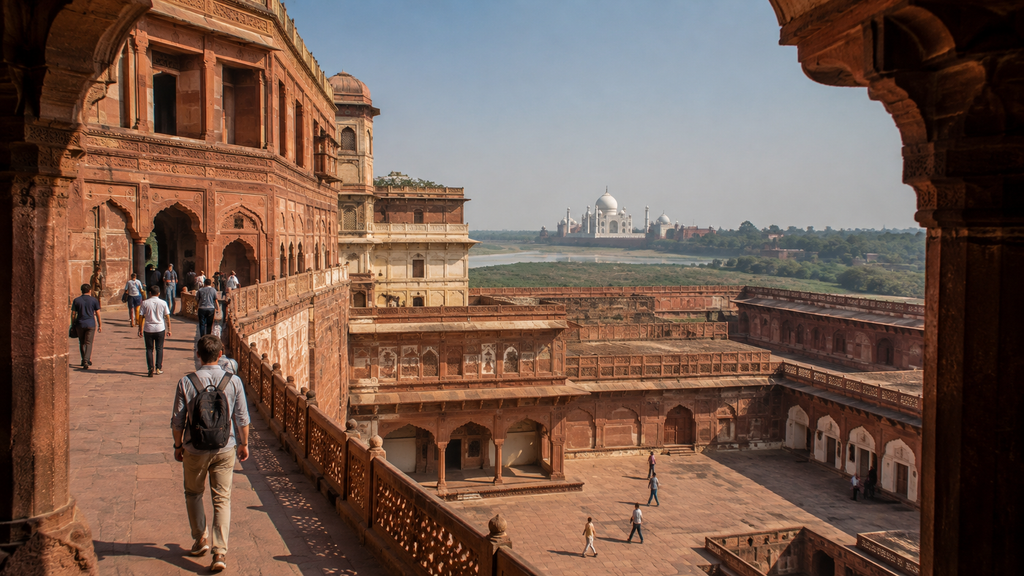
After the Taj Mahal, many travelers leave Agra immediately.
If your schedule allows, stay long enough to visit Agra Fort.
The massive red sandstone walls are impressive before you even enter.
Inside, the fort becomes much more complex, with courtyards, palaces, audience halls and views toward the Taj Mahal.
Understanding some of the Mughal history connecting the two places makes the experience considerably richer.
The fort also tends to feel less emotionally overwhelming than the Taj Mahal.
You can walk slowly, notice architectural details and spend time looking across the Yamuna River.
Agra deserves at least one night.
Two nights make the pace much more comfortable.
From Agra to Jaipur
The journey from Agra to Jaipur is longer and feels different from the Delhi–Agra leg.
You are moving toward Rajasthan.
The landscape gradually changes, and Jaipur announces itself through color, architecture and increasingly visible traces of Rajasthan’s identity.
You can travel by train, bus or private car.
A private car allows you to stop at Fatehpur Sikri along the way, which is one reason many travelers choose this option.
Fatehpur Sikri was once an important Mughal capital and is now an impressive complex of palaces, courtyards and religious buildings.
If you enjoy history, the stop is worthwhile.
Just remember that adding attractions to a travel day makes the day longer.
Sometimes getting to Jaipur, checking into the hotel and having a relaxed evening is the better decision.
First Evening in Jaipur
Jaipur felt easier to me after Delhi and Agra.
Not quiet.
Jaipur is definitely not quiet.
But by this point, I had adjusted to the rhythm of northern India.
Tuk-tuks no longer seemed intimidating.
Crossing busy streets had become slightly less terrifying.
I knew how much small rides should approximately cost and had become better at politely refusing sales pitches.
That adjustment changes the experience.
On the first evening, I would not schedule a major monument.
Walk.
Find dinner.
Explore a nearby market.
Watch the buildings turn warmer as the sun drops.
Jaipur is particularly beautiful in late afternoon when its pink and terracotta facades catch the softer light.
The Hawa Mahal Is Not Quite What You Expect
Hawa Mahal is one of Jaipur’s most recognizable buildings.
Most photographs show its elaborate pink facade facing the street.
What surprised me was how integrated it is into the city.
It is not standing alone in a large ceremonial square.
Traffic passes outside. Shops operate nearby. Tuk-tuks stop and start. Pedestrians cross the road.
The famous facade rises directly above ordinary city life.
For the classic view, many visitors head to one of the cafés or rooftops opposite the building.
Go early if photography matters to you.
Later, the road becomes much busier.
But do not only photograph Hawa Mahal from across the street.
Going inside gives you a better understanding of why the building was designed with so many small windows and openings.
Amber Fort in the Morning

If there is one place in Jaipur where I would make the effort to arrive early, it is Amber Fort.
The fort sits outside the central city, rising above the surrounding landscape.
Approaching it in the morning is impressive.
Massive defensive walls follow the hills while the palace complex appears above Maota Lake.
Inside are courtyards, gates, halls and decorated rooms that reveal how much more sophisticated the fort is than its defensive exterior suggests.
The Sheesh Mahal, with its intricate mirror work, receives much of the attention.
But I enjoyed wandering through quieter passages and looking back across the hills just as much.
Wear comfortable shoes.
There are stairs, uneven surfaces and plenty of walking.
And bring water.
Even during cooler months, Rajasthan’s sun becomes strong surprisingly quickly.
A Note About Elephant Rides
Visitors may encounter elephant rides around Amber Fort.
Animal welfare concerns have been raised for years about tourist elephant riding.
Personally, I would skip it.
You do not need an elephant ride to experience Amber Fort.
Walking gives you more time to appreciate the approach anyway, and vehicles are also available for travelers who need transportation.
Travel traditions change.
Something being offered to tourists does not automatically mean we need to participate.
Jaipur’s Bazaars
This is where I would deliberately leave several hours without a strict plan.
Jaipur’s markets are not just places to buy souvenirs.
They are part of the city.
Johari Bazaar is particularly associated with jewelry, while other market areas sell textiles, shoes, handicrafts, clothing, spices and everyday household items.
The colors are difficult to ignore.
Stacks of fabrics spill from shops. Bangles reflect light from display cases. Vendors sit surrounded by goods that appear to occupy every centimeter of available space.
Negotiation is common.
I learned quickly that bargaining works better when it feels like a conversation rather than a battle.
Ask the price.
Offer something reasonable.
Smile.
Walk away if it is too expensive.
Sometimes the price changes.
Sometimes it does not.
There will always be another shop.
What to Eat in Jaipur
Rajasthan’s food deserves time.
Dal baati churma is probably one of the regional dishes most visitors encounter.
The combination is filling, rich and very different from the simplified idea of Indian food many international travelers arrive with.
Laal maas is another famous Rajasthani dish for meat eaters, traditionally known for its intense chili and spice.
Then there are kachori, sweets, lassi and countless snacks.
One of my favorite ways to eat in India is still the thali.
It removes the pressure of choosing one unfamiliar dish from a long menu and lets you taste several things at once.
The first few minutes often involve trying to remember what the server said each bowl contained.
Eventually, you stop worrying about the names and just eat.
How Many Days Do You Need for the Golden Triangle?
You can technically complete the Golden Triangle very quickly.
I would not.
A comfortable first itinerary looks something like this:
Days 1–3: Delhi
Use the arrival day to settle in and explore lightly. Spend one day around Old Delhi and another exploring major sites in New Delhi.
Days 4–5: Agra
Travel to Agra, visit Agra Fort and other sites, then see the Taj Mahal early the following morning.
Days 6–8: Jaipur
Travel to Jaipur and spend two or three nights exploring Amber Fort, the old city, Hawa Mahal, markets and local food.
With nine or ten days, the itinerary becomes even more relaxed.
The extra time is rarely wasted.
India has a way of filling it.
Train, Driver or Bus?
There is no single correct way to travel the Golden Triangle.
Trains give you a more distinctly Indian travel experience and can be fast between major cities.
A private driver provides flexibility, door-to-door transportation and easier stops between destinations.
Buses can be economical but may require more patience and planning.
You can also combine them.
Take a train from Delhi to Agra.
Hire a car from Agra to Jaipur if you want to visit Fatehpur Sikri.
There is no reason to force the entire trip into one transportation style.
Choose what makes sense for each section.
Where I Would Spend More Money
I would not spend heavily on luxury transportation or expensive restaurants throughout the entire trip.
I would spend more on location.
A well-located hotel can save hours in traffic.
In Delhi especially, choosing accommodation simply because it is cheaper can become a false economy if you spend large parts of every day traveling across the city.
I would also pay for reliable transportation when arriving late at night or leaving early for a train.
Saving a small amount of money is not worth creating unnecessary stress at 5 a.m.
And occasionally, I would pay for a knowledgeable local guide.
The Taj Mahal, Agra Fort and Jaipur’s major historical sites become more interesting when someone can explain what you are looking at rather than simply telling you when the building was constructed.
What I Would Pack Differently
Pack lighter than you think.
Moving through railway stations, hotel staircases and crowded streets with a large suitcase becomes tiring quickly.
A lightweight day bag is extremely useful.
Carry water, sunscreen, tissues, hand sanitizer, a power bank and a scarf or lightweight layer.
Good walking shoes matter more than fashionable ones.
I would also keep small amounts of cash somewhere easily accessible so I was not opening my main wallet every time I needed to pay for chai, a tuk-tuk or a small purchase.
And keep your phone charged.
Between maps, tickets, translation, transportation apps and photographs, it works surprisingly hard on this route.
The Golden Triangle Is Popular for a Reason
Some travelers avoid the Golden Triangle because it is India’s most famous tourist route.
I understand the instinct.
Nobody wants their trip to feel like they are simply following everyone else.
But popular routes become popular for reasons.
Delhi, Agra and Jaipur contain an extraordinary concentration of history, architecture, food and everyday street life within a relatively manageable distance.
More importantly, they are different enough to make the journey feel like progression rather than repetition.
Delhi challenges you.
Agra gives you the Taj Mahal.
Jaipur gives you Rajasthan.
And the roads and railway lines between them give you glimpses of the enormous country beyond the tourist itinerary.
Final Thoughts
By the time I reached Jaipur, something had changed.
India was still noisy.
Traffic was still unpredictable.
People still approached me in markets.
I still occasionally had no idea what I was ordering for dinner.
But none of it felt quite as overwhelming anymore.
That may be the real reason the Golden Triangle works so well as a first journey through India.
You do not simply visit three cities.
You gradually learn how to travel here.
In Delhi, everything feels new.
In Agra, you begin to understand the rhythm.
By Jaipur, you are negotiating tuk-tuk fares, drinking chai beside the road and walking into crowded bazaars with much more confidence than you had a week earlier.
The monuments are extraordinary.
The Taj Mahal alone would justify the journey.
But years later, you may find yourself remembering something much smaller: a train pulling out of Delhi in the morning, the smell of food from a Jaipur market, a conversation with a driver, or the moment the Taj Mahal first appeared through the entrance gate.
Those are the parts of the Golden Triangle that do not fit neatly onto an itinerary.
And they are usually the parts worth traveling for.