
Few landmarks create a sense of scale quite like the Great Wall of China.
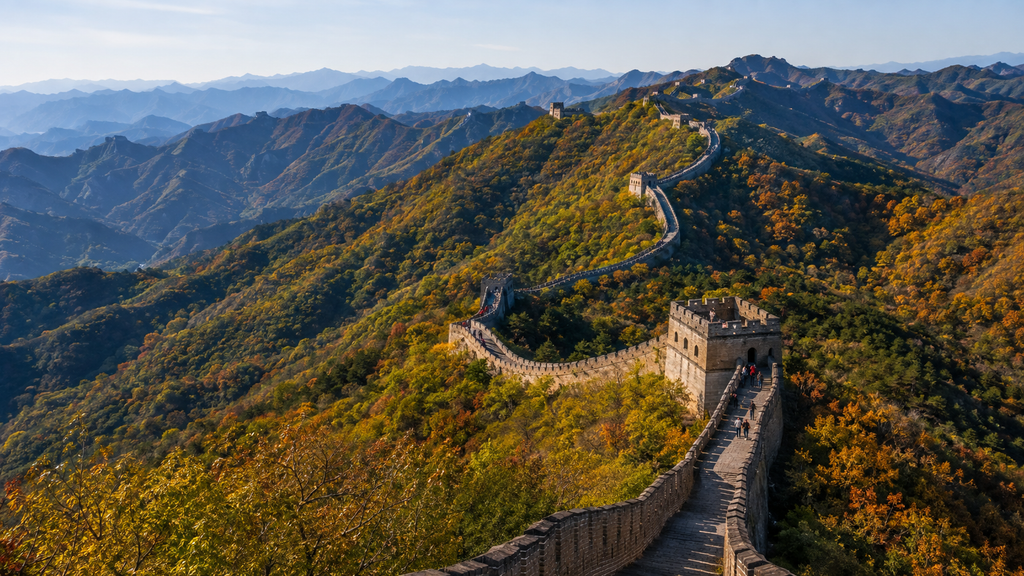
Photographs usually show the same familiar scene: a stone wall following the ridge of a mountain, watchtowers appearing one after another in the distance, and steep green hills stretching toward the horizon. Seeing those images makes the Great Wall look impressive. Standing on it reveals something photographs struggle to capture.
The wall does not simply cross the landscape. It follows it.
It climbs steep ridges, drops into valleys and disappears behind mountains before appearing again somewhere far away. From a high watchtower, you can sometimes follow its route until the structure becomes little more than a thin line across the horizon.
That enormous scale is only one reason the Great Wall remains extraordinary.
Its real story is much larger. The Great Wall represents centuries of construction, military strategy, political change and human effort. Different sections were built and rebuilt by different Chinese states and dynasties, using materials and techniques adapted to the landscapes they crossed.
Understanding that history changes the experience of visiting it.
The Great Wall stops feeling like a single monument and begins to feel like a physical timeline stretching across northern China.
The Great Wall Is Not One Continuous Wall
One of the biggest misconceptions about the Great Wall is that it is a single uninterrupted structure built during one period.
The reality is far more interesting.
Fortifications existed across northern China long before China became a unified empire. Different states constructed defensive walls to protect territory and control important routes.
After Qin Shi Huang unified China in the third century BC, earlier fortifications were connected and expanded as part of a larger defensive system.
Construction did not end there.
Successive dynasties continued building, repairing and modifying defensive structures according to changing political and military needs. The process continued for centuries, eventually producing a vast network of walls, passes, watchtowers and fortresses.
UNESCO describes the complete Great Wall system as extending for more than 20,000 kilometers.
That figure helps explain why different parts of the wall can look surprisingly different.
Some sections consist of the familiar stone and brick fortifications seen around Beijing. Elsewhere, particularly in drier regions, older sections were constructed using rammed earth and locally available materials.
The Great Wall is therefore better understood as an enormous defensive network created across many generations rather than a single wall built according to one master plan.
The Ming Dynasty Created the Wall Most Travelers Recognize
When travelers imagine the Great Wall, they are usually imagining sections associated with the Ming dynasty.
The Ming ruled China from 1368 to 1644 and carried out extensive construction and reinforcement along the northern frontier.
Many surviving sections near Beijing belong to this period.
Here, builders made extensive use of stone and brick. Watchtowers were positioned along mountain ridges, fortified passes controlled important routes and walls were adapted carefully to difficult terrain.
Walking along a restored Ming section makes the engineering achievement immediately visible.
The path is rarely flat.
One moment you may be walking comfortably along a broad section of wall. A few minutes later, the route becomes a steep staircase climbing directly toward another watchtower.
Looking back reveals how dramatically the wall follows the mountains.
This is what makes the structure so visually powerful.
Rather than cutting through the landscape in a straight line, the builders used ridges and high ground as part of the defensive system itself.
Mountains became natural barriers.
The wall strengthened them.
It Was More Than a Physical Barrier
It is tempting to imagine the Great Wall simply as an enormous obstacle designed to stop invading armies.
Its military role was more sophisticated than that.
A wall alone cannot defend thousands of kilometers of frontier.
The larger system included watchtowers, beacon towers, passes, fortresses and routes that allowed soldiers and information to move across strategic areas.
Watchtowers are particularly important to understanding how the system worked.
From elevated positions, soldiers could observe surrounding territory and communicate warnings along the frontier. Signals could travel between towers, allowing information about approaching threats to move much faster than a messenger traveling the entire distance.
Major passes served another purpose.
They controlled routes through difficult terrain and became strategically important locations where movement could be monitored and defended.
The Great Wall was therefore not simply a barrier.
It was infrastructure.
It helped organize defense across an enormous frontier and connected soldiers, forts and communication points into a much larger military network.
The Landscape Makes the Achievement Even More Remarkable
The size of the Great Wall is impressive on paper.
The terrain makes it astonishing.
Northern China contains mountains, valleys, grasslands and desert environments. Constructing defensive works across these landscapes required builders to adapt constantly.
Near Beijing, some sections climb steep mountain ridges where even walking can be exhausting.
It is difficult to stand on one of these slopes without wondering how workers transported stone, brick, timber, food and tools into such difficult locations centuries ago.
Farther west, conditions changed completely.
Builders working in arid landscapes could not simply use the same materials and methods found around Beijing. Local resources influenced construction, producing sections made from compacted earth and other available materials.
This variation is one of the most fascinating parts of the Great Wall.
There was no universal solution.
Construction had to respond to geography.
That ability to adapt a defensive system across such different environments is a major part of the wall’s engineering significance.
Walking the Great Wall Changes Your Sense of Scale
The best way to understand the Great Wall is to walk along it.
From a distance, the structure can appear almost smooth.
Once you are standing on it, the experience is very different.
The stone beneath your feet is uneven. Staircases can become unexpectedly steep. Watchtowers that look close may require a tiring climb to reach.
Then you arrive at the top.
The view suddenly opens across the mountains.
Behind you, the wall follows the ridge you have just crossed. Ahead, another section climbs toward a distant tower before disappearing over the next mountain.
That is usually the moment when the scale becomes real.
You are seeing only a tiny fraction of the entire system.
Even after walking for an hour, you have covered almost nothing compared with the distances across which Great Wall fortifications once extended.
It creates an unusual combination of achievement and perspective.
The structure feels enormous.
The individual visitor feels very small.
Badaling: The Most Accessible Experience
For many first-time visitors staying in Beijing, Badaling is the easiest introduction to the Great Wall.
Located roughly 60 kilometers northwest of central Beijing, Badaling is one of the most developed and heavily restored sections.
Its accessibility has obvious advantages.
Transportation is relatively straightforward, facilities are well established and the restored wall provides the classic experience many travelers expect.
The scenery is also impressive.
The wall rises across mountain ridges with large watchtowers positioned along the route.
The disadvantage is popularity.
Badaling can become crowded, particularly during weekends, holidays and peak travel periods.
If Badaling is your only opportunity to see the Great Wall, it is still worth visiting. Arriving early can make a significant difference to the experience.
But travelers looking for something quieter may prefer another section.
Mutianyu: A Good Balance for First-Time Visitors
Mutianyu is often a better choice for travelers who want beautiful scenery without the intensity of Badaling’s largest crowds.
The restored wall stretches across forested mountains and includes numerous watchtowers.
The surrounding landscape is one of its strongest features.
Spring brings fresh green vegetation, summer covers the mountains in dense forest and autumn can transform the hills with changing colors.
The section is restored enough to make walking relatively comfortable while still providing dramatic mountain views.
There are steep sections, however, and distances between towers can feel longer than expected.
This is not necessarily a disadvantage.
Walking slowly is part of the experience.
Stopping at a tower, looking back across the route and watching the wall disappear into the mountains is often more memorable than trying to cover as much distance as possible.
Jinshanling: For Travelers Who Want a Quieter Wall
Jinshanling offers a different atmosphere.
It is farther from central Beijing and generally requires more effort to reach, which naturally reduces visitor numbers.
For some travelers, that is exactly the appeal.
Parts of the wall feel quieter and less urbanized than the busiest sections closer to Beijing. Long mountain views make it possible to appreciate how the defensive line follows the natural terrain.
Jinshanling is particularly attractive to travelers interested in hiking and photography.
The landscape feels larger here.
Instead of focusing only on individual towers, you begin to notice the relationship between the wall and the mountains surrounding it.
That relationship is one of the most important things to understand about the Great Wall.
The landscape was never merely scenery.
It was part of the defense.
Restored and Unrestored Sections Tell Different Stories
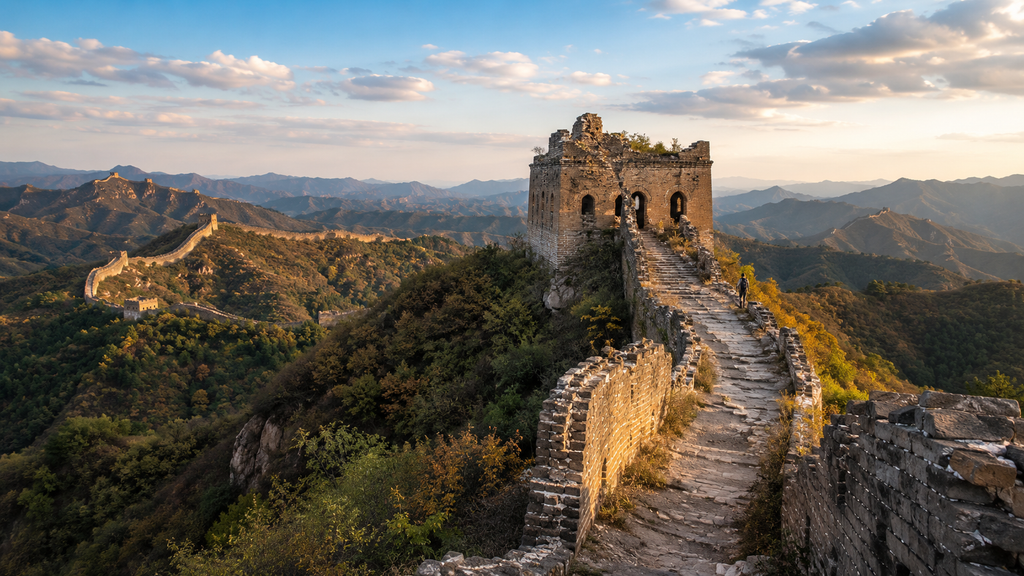
A perfectly restored section is often the easiest place to appreciate the architectural design of the Great Wall.
But damaged sections tell another part of the story.
Centuries of weather, erosion, vegetation and human activity have affected many parts of the structure.
Some walls have partially collapsed.
Some towers survive only as ruins.
In certain areas, old fortifications can be difficult to distinguish from the surrounding landscape.
These sections remind visitors that the Great Wall is not a modern reconstruction stretching endlessly across China.
It is an ancient structure that has survived in different conditions.
Preservation is therefore extremely important.
Travelers should remain on permitted routes, avoid climbing closed or unstable sections and never remove stones or other material from historic areas.
The Great Wall has survived for centuries.
Tourism should help people appreciate it rather than accelerate its deterioration.
The Human Story Behind the Wall
The engineering achievements of the Great Wall are easy to admire.
The human cost is harder to see.
Construction across centuries required enormous amounts of labor.
Soldiers, workers and other groups participated in building and maintaining defensive structures, often in remote environments and difficult conditions.
Moving materials through mountains and deserts was physically demanding. Workers also had to deal with extreme temperatures, limited transportation and the logistical challenge of supplying construction sites far from major settlements.
This human dimension matters.
Without it, the Great Wall can become nothing more than an impressive background for photographs.
Remembering the generations involved in its construction gives the monument greater depth.
Every staircase, tower and defensive pass represents not only imperial ambition but also human labor.
The Great Wall Became Larger Than Its Military Purpose
Military technology eventually changed.
The political conditions that had made large frontier walls strategically important changed as well.
Yet the Great Wall did not disappear from Chinese culture.
Instead, its meaning evolved.
Today it is one of China’s most recognizable cultural landmarks and one of the world’s best-known historical structures.
UNESCO inscribed the Great Wall on the World Heritage List in 1987, recognizing its exceptional historical, strategic and architectural significance.
Its importance extends beyond military history.
The wall represents the relationship between political power, geography, engineering and the societies that developed across China’s northern frontier.
It also demonstrates how a structure can acquire meanings very different from the purpose for which it was originally built.
A defensive system eventually became a global cultural symbol.
When Is the Best Time to Visit?
Spring and autumn are generally the most comfortable seasons for walking the Great Wall.
Temperatures tend to be easier for hiking, and the surrounding mountains can be especially attractive.
Autumn is particularly beautiful around forested sections near Beijing as leaves change color.
Summer brings greener landscapes but also hotter temperatures and larger crowds.
Winter creates an entirely different atmosphere.
Snow can make the mountains spectacular, and visitor numbers may be lower, but cold temperatures and slippery steps can make walking more difficult.
Regardless of season, comfortable shoes are essential.
The Great Wall may look like a paved walkway in photographs, but many sections involve substantial climbing.
Carry water, allow more time than you think you need and avoid turning the visit into a race between watchtowers.
Why the Great Wall Still Deserves Its Reputation
The Great Wall of China is extraordinary not because of one statistic or one famous photograph.
Its significance comes from the combination of everything it represents.
It stretches across an enormous landscape.
It developed over many centuries.
Its builders adapted construction techniques to mountains, plains and deserts.
Its towers and passes formed parts of sophisticated defensive systems.
And long after its original military role faded, the wall remained deeply connected to Chinese history and identity.
But perhaps the most convincing explanation comes from simply standing there.
Climb to a quiet watchtower and look along the ridge.
The wall rises over one mountain, drops into a valley and climbs toward another peak until distance finally hides it from view.
For a moment, the numbers no longer matter.
You can see the ambition for yourself.
That is why, thousands of years after the earliest frontier walls were constructed, the Great Wall remains one of the most remarkable human-made landscapes in the world.
Final Thoughts
Visiting the Great Wall is often described as one of the essential experiences of traveling in China, but its value goes far beyond checking a famous landmark off an itinerary.
Take time to walk.
Stop inside the watchtowers.
Look at how the wall follows the mountains instead of focusing only on photographs.
Think about the different dynasties that expanded and rebuilt the system, the soldiers who once watched the frontier and the generations of workers who constructed defenses across terrain that remains difficult to cross even today.
The Great Wall becomes much more impressive when you understand what you are looking at.
It is not simply a long stone wall.
It is the surviving evidence of centuries of engineering, strategy, political ambition and human effort written directly across the landscape of northern China.