
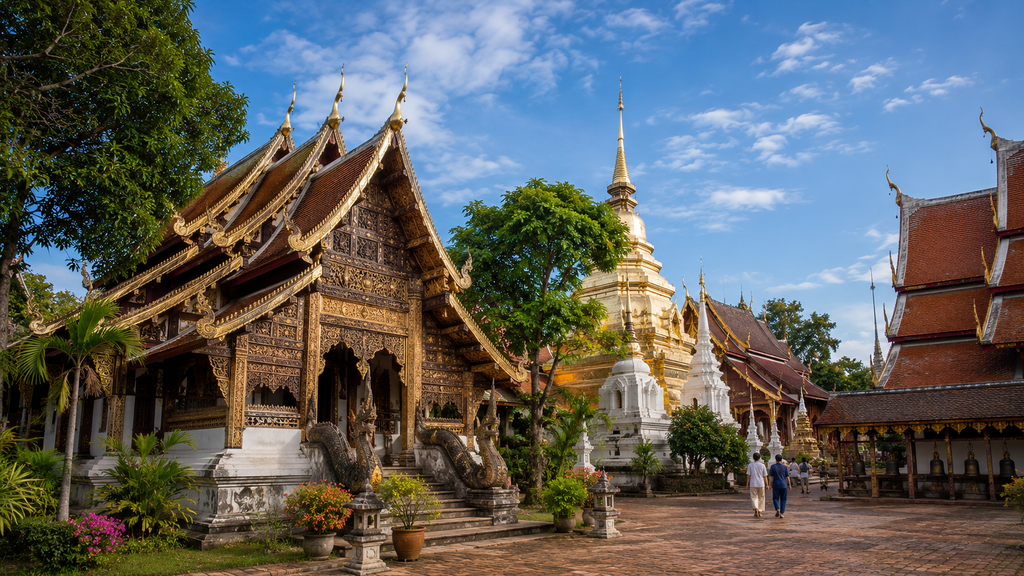
On my first morning in Thailand, I saw something that made me realize temples were only one part of the country’s Buddhist culture.
The streets were barely awake.
Shops were beginning to open, motorcycles occasionally passed along the road, and the tropical heat had not yet settled over the city.
Then several Buddhist monks appeared.
They walked quietly through the neighborhood in saffron robes while local residents waited with small bags of food.
One by one, people stepped forward and placed their offerings into the monks’ alms bowls.
There were no tour buses.
No guides holding flags.
No entrance tickets.
Nobody seemed to consider what was happening unusual.
It was simply part of the morning.
Until that moment, I had mostly thought about Buddhism in Thailand through its temples.
The Grand Palace.
Wat Pho.
Wat Arun.
Golden Buddha statues.
Ornate rooftops.
Places I had seen hundreds of times in photographs.
But the longer I traveled through Thailand, the more I realized that Buddhist culture does not begin and end at the entrance to a famous temple.
It appears in neighborhoods.
In family routines.
In festivals.
In offerings placed beside a shrine.
In the quiet presence of monks walking through a city that is otherwise rushing toward another busy day.
Visiting temples is still one of the most rewarding parts of traveling through Thailand.
But understanding what is happening around them makes the experience much more meaningful.
My First Morning Seeing Monks Receiving Alms
I had not planned to see the morning alms-giving tradition.
That probably made the experience more memorable.
I was simply awake early.
Thailand feels different before breakfast.
Bangkok’s traffic has not reached full intensity.
The sidewalks are cooler.
Food vendors are preparing their first customers’ meals.
And in some neighborhoods, monks can be seen making their morning alms rounds.
The practice is commonly known as tak bat.
Local residents offer food and other appropriate items to monks, traditionally as a way of making merit.
What surprised me was how ordinary the moment felt.
I had imagined something more ceremonial.
Instead, the interactions were often brief and quiet.
A person waited.
The monk approached.
Food was offered.
The monk continued walking.
Then everyday life resumed.
It made me understand something important.
I was not watching a cultural performance.
I was watching part of someone’s normal morning.
I Kept My Distance
My first instinct as a traveler was predictable.
Take a photograph.
Then I hesitated.
The people around me were not doing this for my camera.
It was a religious practice.
So I stayed farther away.
I watched for a while before taking any photographs, and when I did, I avoided pushing into the interaction.
That became a rule I tried to follow throughout Thailand.
Not every beautiful moment needs a close-up.
Sometimes the most respectful way to experience something is to remain outside it.
Why Do Thai People Give Food to Monks?
I initially assumed the food was simply charity.
The meaning is broader than that.
Giving alms is connected to the Buddhist practice of making merit, or tham bun in Thai.
Merit-making can take many forms.
Giving food to monks.
Donating to temples.
Supporting charitable activities.
Participating in religious observances.
Doing good deeds.
For many Thai Buddhists, these practices form part of religious and everyday life.
As a traveler, I did not need to understand every theological detail to appreciate what I was seeing.
But knowing even the basic meaning changed the experience.
A bag of rice was no longer simply breakfast being handed to a monk.
There was an entire belief system behind that small interaction.
Buddhism Is Deeply Connected to Thai Life
Thailand is predominantly Buddhist, particularly within the Theravada Buddhist tradition.
You can see that influence almost everywhere while traveling.
Temples occupy important spaces in cities and villages.
Monks are visible in everyday life.
Buddhist holidays affect the calendar.
Religious images appear in homes and businesses.
Families visit temples to make merit.
Ceremonies mark important moments in life.
Even if you spend most of your trip visiting beaches and eating street food, it is difficult to travel through Thailand without encountering Buddhism in some form.
But I would be careful about assuming that every Thai person practices religion in exactly the same way.
People differ.
Some are deeply religious.
Others may participate mainly in family or cultural traditions.
Thailand also has Muslim, Christian, Hindu, Sikh and other religious communities.
The farther I traveled, the more important those distinctions became.
My First Thai Temple Was Almost Overwhelming
Photographs do not completely prepare you for a major Thai temple.
There is so much detail.
Golden surfaces.
Colored roof tiles.
Naga figures.
Murals.
Flowers.
Incense.
Buddha images.
Courtyards.
Monks moving between buildings.
Visitors trying to understand where they are allowed to go.
At first, I concentrated on the architecture.
It was difficult not to.
Thai Buddhist temples can be extraordinarily beautiful.
But eventually I noticed the people who were not behaving like tourists.
Someone kneeling quietly.
A family making an offering.
A person lighting incense.
Someone sitting in silence before a Buddha image.
That changed the atmosphere.
The building stopped feeling like a museum.
It became a religious space again.
Wat Pho Taught Me to Slow Down
Bangkok’s Wat Pho is famous for the enormous Reclining Buddha.
Like most first-time visitors, I wanted to see it.
And it is impressive.
But what I remember almost as clearly are the quieter areas of the temple complex.
Once I moved away from the busiest parts, I started noticing smaller details.
Decorative stupas.
Courtyards.
Monks.
People praying.
The sound of bells.
Shoes lined outside certain entrances.
I realized that rushing directly from one famous object to another was probably the least interesting way to experience the temple.
So I slowed down.
That became my approach to temples afterward.
See the famous thing.
Then keep walking.
Wat Arun Felt Completely Different
Across the Chao Phraya River, Wat Arun created another impression.
Its towering central prang dominates the riverfront.
From a distance, it is one of Bangkok’s most recognizable landmarks.
Up close, the decorative details become much more obvious.
This was another reminder that “Thai temple” is an enormous category.
Temples do not all look the same.
They were built in different periods.
They have different histories.
They serve different communities.
And they create very different experiences.
After visiting several, I stopped treating temples as interchangeable stops on an itinerary.
Then I Visited Smaller Temples
This was where things became more interesting.
Famous Bangkok temples are extraordinary, but they also receive enormous numbers of visitors.
Smaller neighborhood temples can feel completely different.
There may be no ticket office.
No large tourist groups.
No line for photographs.
Maybe only a few local residents and monks are present.
Without crowds, I became more aware of the temple as part of a community.
People were not arriving because a guidebook told them to.
The temple belonged to the neighborhood.
That made even modest temple complexes interesting.
What Exactly Is a Wat?
Travel around Thailand for a few days and you will see the word wat constantly.
Wat Pho.
Wat Arun.
Wat Saket.
Wat Chedi Luang.
Wat Phra Singh.
In simple terms, a wat is a Buddhist temple or monastery complex.
But it is useful to imagine more than one building.
A temple complex can contain different structures used for worship, ordination, ceremonies, teaching and monastic life.
There may be stupas or chedis containing relics or commemorating important figures.
There may be living quarters for monks.
There may be courtyards and other community spaces.
Once I understood this, I stopped walking into a temple expecting one main building and nothing else.
The entire complex mattered.
I Learned to Look for Shoes
One of the easiest cultural lessons in Thailand is sitting directly in front of many temple doors.
Shoes.
If everyone else’s shoes are outside, yours probably belong there too.
After the first few temple visits, checking footwear became automatic.
I also started choosing sandals or shoes that were easy to remove.
This sounds trivial until your itinerary includes several temples in tropical heat.
Then it becomes excellent travel planning.
Removing shoes is not unique to temples either.
You may encounter the practice in homes and certain businesses.
As always, observe the people around you.
Dressing for Temples Became Part of Planning the Day
Thailand can be extremely hot.
Naturally, travelers want lightweight clothing.
That can create problems if the day’s itinerary includes religious sites.
At important temples, visitors may be expected to cover shoulders and knees or otherwise dress modestly.
Exact requirements can vary.
Rather than trying to negotiate with dress codes at every entrance, I found it easier to prepare before leaving the hotel.
If I knew temples were part of the day, I dressed appropriately from the beginning.
Lightweight trousers.
A suitable shirt.
Comfortable footwear.
Something that handled the heat without being disrespectful.
It removed unnecessary stress.
The Dress Code Is About More Than Getting Inside
It is easy to think about temple clothing as another tourism rule.
Wear this or security will not let you enter.
But that misses the point.
You are entering a religious space.
People may be praying beside you.
Monks may live there.
Ceremonies may be happening.
Appropriate clothing is simply one way of recognizing the nature of the place.
Thinking about it that way made the rules feel much less annoying.
Sitting Inside a Temple Required More Awareness
Inside temple buildings, I became conscious of where my feet were pointing.
In Thai culture, feet are generally regarded as the lowest and less respectful part of the body.
Pointing the soles of your feet directly toward a Buddha image, monk or another person can therefore be inappropriate.
I watched how local visitors sat.
That helped.
Again, nobody expected me to suddenly become an expert in Thai Buddhist etiquette.
I simply needed to pay attention and behave respectfully.
Buddha Images Are Not Props
This sounds obvious.
Unfortunately, travel behavior sometimes suggests otherwise.
Buddha images have religious significance.
They should not be climbed on, touched casually or used as amusing backgrounds for inappropriate poses.
I saw plenty of travelers behaving respectfully.
Most people do.
But social media creates a strange temptation to turn every beautiful location into a personal photoshoot.
A temple is one place where I think the photograph should come second.
If getting the shot requires disrespecting the place, the shot is not worth having.
Photography Rules Are Not the Same Everywhere
Some temple areas allow photography.
Others restrict it.
Flash photography may be prohibited.
Certain sacred spaces may have specific rules.
I learned not to assume.
Look for signs.
Watch what other visitors are doing.
Ask when uncertain.
And even when photography is technically allowed, I still tried to consider whether taking a photograph was appropriate.
Someone praying does not automatically become part of my travel photograph because they happen to be in a public temple.
Monks Became a Normal Part of the Landscape
During my first days in Thailand, seeing monks immediately caught my attention.
After a while, their presence became part of everyday life.
Monks walking beside a road.
Monks on public transportation.
Monks inside temple grounds.
Monks receiving food.
Monks talking to local residents.
That shift was interesting.
I stopped thinking of monks as people who existed only inside monasteries.
They are members of Thai society.
And like anyone else, they deserve personal space rather than constant cameras.
I Became More Careful Around Monks
There are particular etiquette considerations when interacting with Buddhist monks.
One important point for travelers is that women should avoid physical contact with monks.
There can also be particular customs around handing objects, seating and interactions.
I did not attempt to memorize every possible rule.
My approach was simpler.
Give monks space.
Do not initiate unnecessary physical contact.
Observe local behavior.
Follow instructions at religious sites.
If uncertain, ask.
That was enough for ordinary travel situations.
Temporary Ordination Surprised Me
One aspect of Thai Buddhist culture I had known little about before traveling was temporary monastic ordination.
Some Thai men spend a period of time as monks, sometimes connected to family tradition, merit-making or personal spiritual reasons.
The duration can vary.
This helped me understand that monastic life and family life are not necessarily as separate as I had imagined.
For some families, ordination can be an important event.
It is another example of how Buddhism connects with social and family traditions rather than existing only inside temple walls.
Merit-Making Appeared Again and Again
Once I understood the basic idea of merit-making, I started recognizing it in different contexts.
Food offered to monks.
Donations.
Temple visits.
Offerings.
Religious ceremonies.
Acts of generosity.
I would not pretend that a short trip gave me a deep understanding of Buddhist philosophy.
It did not.
But learning the concept helped connect things I had previously seen as unrelated activities.
Suddenly, patterns appeared.
Flowers, Incense and Offerings Became More Meaningful
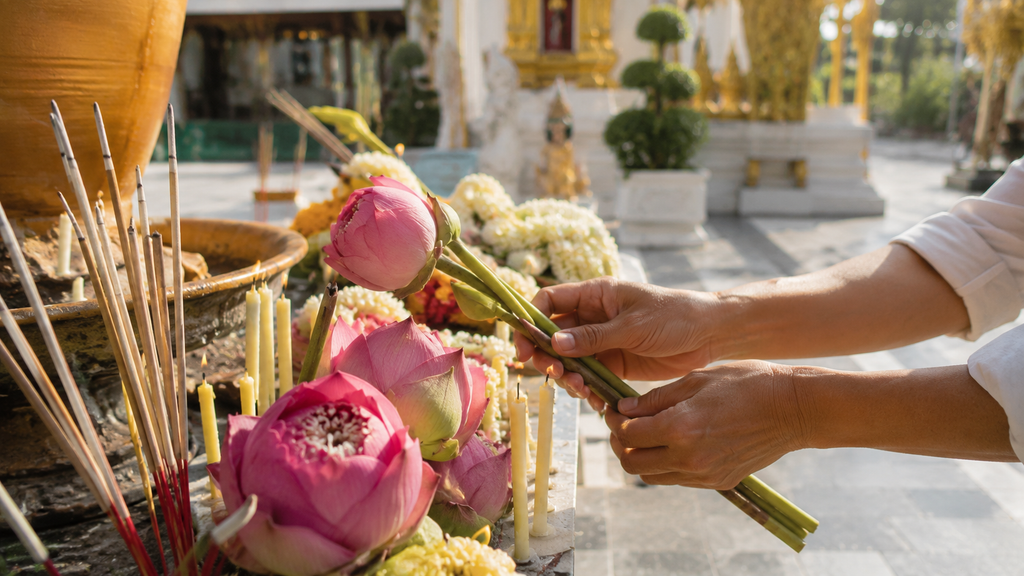
Temple entrances and nearby markets often sell flowers, incense and other offerings.
At first, I saw them mostly as colorful details.
Then I watched how people used them.
Lotus flowers.
Garlands.
Candles.
Incense.
Small offerings placed carefully in front of religious images.
The visual beauty was still there.
But now there was meaning behind it.
That is one of my favorite things about learning while traveling.
The physical scene does not change.
Your understanding of it does.
The Smell of Incense Became Part of My Memory of Thailand
Travel memories are often surprisingly sensory.
For Thailand, one of those memories is incense.
You walk from a noisy street into a temple.
Traffic becomes quieter.
Shoes come off.
The air changes.
You smell incense.
Maybe flowers.
Maybe the rain has just cooled the stone courtyard.
Those moments are difficult to communicate in photographs.
But they are often what returns to me when I think about the trip.
Spirit Houses Made Thailand More Complicated in an Interesting Way
Buddhism is extremely influential in Thailand, but Thai spiritual life cannot be explained through Buddhism alone.
Spirit houses are a good example.
Small shrines can be found outside homes, businesses, hotels and large office buildings.
Offerings may include flowers, fruit, drinks or food.
These practices reflect traditions and beliefs that coexist with Buddhism.
There are also Hindu influences visible in some Thai religious practices and sacred spaces.
The more I noticed, the less useful it became to imagine Thai spirituality as one perfectly separated religious system.
Different traditions have interacted for centuries.
The Erawan Shrine Was a Perfect Example
Bangkok’s Erawan Shrine is particularly interesting because it sits within one of the city’s most modern commercial districts.
Traffic.
Shopping centers.
Hotels.
Elevated trains.
Modern towers.
Then, in the middle of all that, people stop to make offerings and pray at a shrine associated with the Hindu deity Brahma.
The contrast is striking.
But after spending more time in Thailand, it stopped feeling contradictory.
Modern life and spiritual traditions simply occupied the same city.
Chiang Mai Changed My Temple Experience
Bangkok introduced me to monumental temples surrounded by an enormous modern city.
Chiang Mai felt different.
The Old City contains temples almost everywhere.
Sometimes I would walk toward one destination and accidentally pass several others along the way.
Some were famous.
Others were nearly empty.
The pace also felt slower.
I had more time to wander without feeling as though I needed to move immediately to another attraction.
For travelers interested in Buddhist architecture and culture, Chiang Mai deserves more than a quick stop.
Wat Chedi Luang Felt Different From Bangkok

Wat Chedi Luang, with its enormous historic chedi, created a very different atmosphere from the polished grandeur of some Bangkok temples.
The partially ruined structure carries the visible weight of history.
Standing nearby reminded me that temples are not frozen in one period.
Buildings are constructed.
Damaged.
Restored.
Expanded.
Reused.
Religious sites continue evolving with the communities around them.
That historical dimension made temple visits more interesting.
Temple Conversations Can Be Valuable
Some temples and Buddhist institutions offer opportunities for visitors to speak with monks, sometimes known informally as monk chats.
When conducted through appropriate programs, these conversations can provide a much better understanding of monastic life and Buddhism than simply reading signs.
They can also give monks an opportunity to practice languages and interact with international visitors.
I would approach such conversations respectfully.
This is not an interrogation.
You are speaking to another person.
Ask genuine questions.
Listen.
And do not expect one monk to explain every aspect of Buddhism or Thai society.
Temples Can Also Be Community Spaces
Something I had not appreciated before traveling was how temples can serve roles beyond worship.
Depending on the community, temple grounds may be connected with education, festivals, charitable activities, funerals and community gatherings.
This helped explain why temples appeared so deeply embedded in local neighborhoods.
They were not isolated monuments.
They were part of social infrastructure.
That perspective changed the way I looked at smaller local temples in particular.
Buddhist Holidays Can Change Your Trip
Thailand observes important Buddhist holidays throughout the year.
On some occasions, temples become especially active.
People may make merit, attend ceremonies or participate in candlelight processions.
There can also be restrictions on alcohol sales during certain religious holidays.
If your trip overlaps with an important Buddhist date, I would research it beforehand.
Not simply because it may affect travel plans.
Because it can offer an opportunity to understand something you would otherwise miss.
Makha Bucha, Visakha Bucha and Asalha Bucha
Several Buddhist observances are particularly important in Thailand.
Makha Bucha commemorates an important gathering associated with the Buddha and his disciples.
Visakha Bucha marks key events traditionally associated with the Buddha’s birth, enlightenment and passing.
Asalha Bucha commemorates the Buddha’s first sermon.
The exact calendar dates vary because they are connected to the lunar calendar.
For travelers, the important thing is to check current dates rather than assuming they remain fixed from year to year.
Temple activities may be particularly meaningful during these periods.
I Would Never Plan a Religious Festival Only for Photos
Candlelight processions can be beautiful.
Temples illuminated at night can be beautiful.
People carrying flowers and incense can be beautiful.
But beauty does not remove religious meaning.
If I attended a Buddhist ceremony, I would want to understand at least a little about what was happening.
Why are people walking around the temple?
What does the day commemorate?
What behavior is expected?
Five minutes of reading can completely change an experience.
The Quietest Temple Was One of My Favorites
It did not have the biggest Buddha.
It was not the most famous.
I do not remember seeing it on a list of Bangkok’s essential attractions.
There were almost no visitors.
I walked inside.
Removed my shoes.
Sat for a while.
Outside, the city continued making noise.
Inside, everything felt slower.
That experience taught me something I would recommend to anyone visiting Thailand.
Visit the famous temples.
They are famous for good reasons.
But also enter one you did not plan to visit.
Sometimes the place without a checklist is the place where you finally stop rushing.
Don’t Try to Visit Ten Temples in One Day
I understand the temptation.
Bangkok and Chiang Mai have so many temples that you can create an enormous list.
But after the fourth or fifth temple, details begin blending together.
Another Buddha image.
Another roof.
Another courtyard.
Another photograph.
I would rather visit two or three properly.
Spend time.
Read about them.
Sit down.
Notice differences.
Then go eat lunch.
Temple fatigue is real.
And rushing through sacred places just to complete a list defeats the purpose.
The Heat Changes Everything
Temple itineraries look easy on maps.
Then Thailand’s midday heat arrives.
Walking between temples.
Removing shoes.
Climbing steps where permitted.
Standing in courtyards.
It becomes tiring.
I would start early whenever possible.
Carry water.
Take breaks.
Find shade.
And avoid turning cultural exploration into an endurance test.
There is no prize for seeing the most temples before lunch.
Rain Can Make a Temple Visit Better
One afternoon, tropical rain changed the atmosphere completely.
People moved under covered walkways.
The courtyard emptied.
Rain hit tiled roofs.
The temperature dropped.
Instead of immediately trying to escape, I stayed.
When the rain slowed, everything looked different.
Wet stone.
Reflections.
Darker roof tiles.
Cooler air.
Travel itineraries often treat rain as a failure.
Sometimes it creates the memory.
Don’t Forget That Monks Have Daily Routines
Travelers often visit temples at whatever time is convenient for sightseeing.
But monasteries operate according to their own schedules.
Monks study.
Meditate.
Eat.
Perform ceremonies.
Complete daily responsibilities.
A temple is not an attraction that exists exclusively during opening hours for visitors.
Remembering that made me less demanding.
If an area was unavailable, I accepted it.
If a ceremony was happening, I stayed out of the way.
Being a visitor means adapting to the place, not expecting the place to adapt to you.
What About Women Visiting Thai Temples?
Women can visit Buddhist temples throughout Thailand, but particular etiquette should be respected.
As mentioned earlier, physical contact between women and monks should be avoided.
Some specific sacred areas may have additional access rules.
Dress requirements also apply regardless of gender.
The easiest approach is to read posted instructions and follow local guidance.
Do not assume every temple has identical rules.
And do not take a restriction personally.
You are entering an established religious environment.
Children Should Learn the Rules Too
Families traveling with children can absolutely visit temples.
But I would explain a few things beforehand.
Speak quietly inside sacred buildings.
Do not climb on religious structures.
Do not run around people who are praying.
Remove shoes where required.
Do not touch objects simply because they are interesting.
Children are naturally curious.
That curiosity can make temple visits educational rather than difficult if adults provide context.
I Stopped Thinking of Buddhism as Something I Needed to “See”
This was probably the biggest change.
At the beginning of the trip, Buddhism existed on my sightseeing list.
Visit Wat Pho.
Visit Wat Arun.
See monks.
See Buddha statues.
After a while, that approach felt strange.
Buddhist culture was already around me.
A monk walking down the street.
A taxi driver with a small religious image.
A family visiting a temple.
Flowers beside a shrine.
A business owner making an offering.
A religious holiday changing the rhythm of the city.
I did not need to chase Buddhism.
I needed to notice it.
Tourism Can Distort Religious Experiences
Popular temples have to manage huge numbers of visitors.
That creates complicated situations.
Ticketing.
Crowd control.
Photography.
Dress enforcement.
Souvenir businesses.
Guided tours.
None of those automatically destroy the spiritual significance of a place.
But they can make it harder for visitors to recognize it.
When hundreds of people are moving through the same space, it is easy to behave as though you are inside a tourist attraction.
That is when I tried to remind myself:
Somebody beside me may be here to pray.
Don’t Participate in Exploitative “Monk Experiences”
I became cautious whenever a cultural experience seemed designed primarily to create photographs for tourists.
Authentic religious life does not need to be staged.
If an activity involves monks, ceremonies or sacred practices, I would research who organizes it and whether participation is appropriate.
There are legitimate opportunities to learn.
There are also experiences that simplify or commercialize religion for visitors.
Not everything labeled “authentic” is authentic.
How I Would Visit a Thai Temple Now
My routine became simple.
First, I would check the basic information.
Opening hours.
Dress requirements.
Photography rules.
Then I would arrive, preferably before the hottest part of the day.
At the entrance, I would look around.
Shoes?
Signs?
Restricted areas?
Then I would slow down.
Walk through the complex.
Read enough to understand what I was seeing.
Take photographs where appropriate.
Put the camera away occasionally.
Sit quietly.
Watch without interfering.
Then leave before I became exhausted enough to stop appreciating the place.
It sounds simple.
It worked.
What I Would Tell a First-Time Visitor
You do not need to understand Buddhism deeply before entering a Thai temple.
But you should understand that you are entering somewhere meaningful to other people.
Dress appropriately.
Remove your shoes where required.
Keep your voice down.
Treat Buddha images respectfully.
Give monks space.
Do not interrupt people who are praying.
Follow photography rules.
Avoid pointing your feet toward sacred images or people.
And if you are unsure what to do, watch.
Thai temples receive international visitors constantly.
Nobody expects you to arrive knowing every custom.
Respect and willingness to learn matter much more.
My Favorite Moments Happened Between the Famous Sights
I remember the Reclining Buddha.
Of course I do.
I remember Wat Arun across the river.
I remember the ancient chedi in Chiang Mai.
But some of my strongest memories are smaller.
Saffron robes moving along a quiet street early in the morning.
A woman placing food into an alms bowl.
Shoes lined neatly outside a temple entrance.
Incense smoke moving through sunlight.
A family sitting together after making an offering.
Rain falling over an almost empty courtyard.
A monk walking past a convenience store.
These moments did not appear on my itinerary.
That may be why I remember them.
Buddhism Helped Me Understand Thailand Differently
Before the trip, temples were architecture to me.
Beautiful architecture.
Historic architecture.
Architecture I wanted to photograph.
By the end, they represented much more.
Community.
Family traditions.
Religious practice.
Education.
Merit-making.
Ceremonies.
Monastic life.
History.
And everyday routines that continue regardless of whether travelers are watching.
Understanding even a small part of that made every temple more interesting.
Final Thoughts
If you travel through Thailand, you will almost certainly visit a Buddhist temple.
You should.
Some are among the most extraordinary places in the country.
But do not let the golden roofs become the entire story.
Wake up early one morning.
Walk through a neighborhood.
You may see monks receiving alms.
Notice the flowers and offerings people carry into temples.
Watch how local visitors behave before entering.
Sit quietly for a few minutes instead of immediately taking another photograph.
Look for the small shrine outside a modern building.
Pay attention to the ways old beliefs and modern Thai life exist side by side.
You do not need to become Buddhist.
You do not need to understand every ritual.
And you certainly do not need to pretend you understand a religion after spending two weeks in Thailand.
You only need to recognize that what you are seeing matters to the people around you.
That realization changed the way I experienced Thailand.
The temples became more than beautiful buildings.
Monks became more than figures in saffron robes.
Offerings became more than colorful objects.
And those quiet morning scenes began to make sense.
Thailand’s Buddhist culture is certainly visible in its grand temples.
But some of its most meaningful expressions happen outside them.
On sidewalks.
At neighborhood markets.
Inside family routines.
During ordinary mornings.
And in small moments that continue whether a traveler happens to be there or not.
Those were the moments that taught me the most.