
Before traveling to Thailand, most of what I knew about Thai culture came from travel guides.

The Wai Was More Subtle Than I Expected
Dress respectfully at temples.
Take your shoes off when required.
Learn how to say hello.
Don’t touch people’s heads.
Be respectful around monks.
Useful advice, certainly.
But after spending time in Thailand, I realized that knowing a list of rules and actually understanding a culture are two very different things.
The things I remember most were rarely dramatic.
They happened in restaurants.
At hotel entrances.
On quiet streets early in the morning.
Inside crowded markets.
While trying to communicate with someone who spoke very little English.
Or when I noticed everyone around me behaving in a certain way and realized that I should probably pay attention.
Thailand became much more interesting once I stopped seeing culture as something that existed only inside temples.
It was everywhere.
In the way people greeted each other.
In how food was shared.
In the importance of staying calm.
In the respect shown toward religion.
In the small spirit houses standing beside enormous modern buildings.
And in the simple act of removing your shoes before entering someone’s space.
If you are visiting Thailand for the first time, you do not need to understand every tradition before you arrive.
I certainly didn’t.
But learning to notice these small things can completely change the way you experience the country.
My First Lesson: Watch Before You Act
This became one of my most useful habits in Thailand.
When I entered somewhere unfamiliar, I watched what other people were doing.
Were they removing their shoes?
Were people speaking quietly?
Was photography appropriate?
How were people greeting each other?
Where were they sitting?
Travel guides can prepare you for common situations, but they cannot explain every doorway you will walk through.
Observing local behavior often gives you the answer faster.
I learned this particularly quickly around temples.
There might be signs explaining what to do.
Sometimes there aren’t.
But a row of shoes outside an entrance is a fairly good clue.
So is seeing everyone else lower their voice.
You do not need to understand every cultural reason immediately.
Sometimes respect begins with simply paying attention.
The Wai Was More Subtle Than I Expected

Before arriving, I knew about the wai.
Hands together.
A small bow.
Thai greeting.
Simple.
Then I arrived and realized it was not quite as simple as copying the gesture every time somebody looked at me.
The wai can communicate greeting, thanks and respect, and the way it is used depends on context and social relationships.
As a visitor, I found that I did not need to become an expert in all of its subtleties.
I just needed to be respectful.
When someone greeted me with a wai in an appropriate situation, returning it politely felt natural.
At other times, a smile and a spoken thank you were enough.
What I stopped doing was treating the wai like a tourist performance.
It is not something to repeatedly exaggerate for photographs.
It belongs to an actual system of social etiquette.
That distinction matters.
I Started Saying Sawasdee and Khop Khun
You can travel through major Thai destinations using English surprisingly often.
But learning a few Thai expressions changed interactions.
Not dramatically.
Nobody suddenly believed I spoke Thai.
My pronunciation was certainly not perfect.
But attempting a greeting or thank you showed that I was making an effort.
“Sawasdee” became familiar quickly.
So did “khop khun” for thank you.
Thai speech also uses polite particles, commonly “khrap” for male speakers and “kha” for female speakers.
I did not always remember them.
Sometimes I said things awkwardly.
That was fine.
People generally understood that I was trying.
Travel becomes much easier when you stop worrying about sounding perfect.
The Famous Thai Smile Is More Complicated Than a Travel Slogan
Thailand has long been promoted as the “Land of Smiles.”
You certainly see plenty of smiles.
But I became careful about interpreting every smile in exactly the same way.
A smile can express friendliness.
It can also soften an awkward situation.
It may appear during embarrassment or uncertainty.
Sometimes it simply keeps an interaction pleasant.
That was useful for me to understand because communication while traveling is not always perfect.
Maybe I did not understand the price.
Maybe the other person did not understand my question.
Maybe neither of us knew what the other was trying to say.
Getting visibly frustrated rarely helped.
A smile, some patience and another attempt usually worked better.
Staying Calm Got Me Further Than Getting Angry
This may have been one of the most useful cultural lessons of the trip.
Things do not always go according to plan.
A taxi takes longer than expected.
A restaurant misunderstands an order.
A hotel room is not ready.
A tour changes because of weather.
Someone gives you directions you cannot understand.
My instinct, especially when tired, could be to become visibly frustrated.
Thailand reminded me that raising my voice rarely improves a situation.
Calm communication usually worked better.
This is connected to a broader social preference for maintaining harmony and avoiding unnecessary public confrontation.
You do not need to understand every concept behind it to recognize the practical lesson.
Losing your temper in public is unlikely to make you look more convincing.
It usually just makes the situation uncomfortable for everyone.
Saving Face Became Something I Could Actually Notice
Before Thailand, I had heard the phrase “saving face” used in discussions of Asian cultures.
It sounded abstract.
Travel made it easier to understand.
Public embarrassment can be particularly uncomfortable.
Aggressively pointing out someone’s mistake in front of other people may turn a small problem into a much bigger social situation.
This does not mean you should accept bad service or never complain.
It means how you handle the problem matters.
If something was wrong, I found it more productive to explain calmly and privately when possible.
That approach is useful almost anywhere in the world.
In Thailand, I became much more conscious of it.
Respect for Older People Appears in Small Ways
Age and social position can influence how people interact.
You may notice younger people showing particular respect toward older relatives, teachers or senior figures.
As a foreign visitor, you are not expected to understand every social hierarchy.
But basic courtesy goes a long way.
This was another situation where watching people around me helped.
Culture often reveals itself through small gestures rather than formal explanations.
Who speaks first.
Who is served first.
How someone is addressed.
Where someone sits.
I began noticing details I would probably have ignored during the first few days.
Shoes Became Something I Paid Attention To
Thailand made me look at floors and doorways more often than any trip I can remember.
Shoes come off in many temples.
They may also come off before entering homes and certain businesses, guesthouses, massage rooms or other spaces.
The easiest solution?
Look.
If there is a collection of shoes outside, that is usually your answer.
If you are uncertain, ask.
I started wearing footwear that was easy to remove on days involving temples.
It sounds like an insignificant travel decision.
After taking shoes on and off repeatedly in tropical heat, it no longer felt insignificant.
The Head and Feet Matter
One of the cultural etiquette points many visitors hear before arriving is that the head is traditionally regarded as an important part of the body, while feet are considered lower and can carry negative associations.
The practical version is straightforward.
Do not casually touch someone’s head.
Do not point your feet toward people or sacred objects when sitting.
Do not put your feet on furniture in situations where it would be disrespectful.
And definitely do not use your foot to move or indicate something in a way that could offend someone.
I never felt as though I needed to walk around anxiously monitoring every movement.
Basic awareness was enough.
My First Temple Visit Changed How I Dressed for the Day
Thailand’s heat encourages you to wear as little as socially acceptable.
Then you arrive at a temple.
Suddenly the shorts and sleeveless top that made sense on the street may not be appropriate.
After the first few temple visits, I stopped treating appropriate clothing as something I would solve at the entrance.
If temples were part of the day, I dressed for them from the beginning.
Lightweight clothing that covered shoulders and knees where required made everything easier.
I also carried something that could provide additional coverage when useful.
The important point is not simply avoiding being refused entry.
Temples are religious spaces.
Dressing appropriately is part of recognizing that.
A Temple Is Not Just Another Tourist Attraction
This became particularly obvious at famous temples in Bangkok.
I was there because I was traveling.
The person beside me might have been there to pray.
That difference matters.
Beautiful architecture can make temples feel like museums to visitors.
Gold.
Murals.
Statues.
Elaborate roofs.
Photographs everywhere.
But people continue to use these places religiously.
Once I started noticing that, I became much more careful about how I moved through them.
I lowered my voice.
I checked photography rules.
I avoided standing in someone’s way just to take a picture.
And sometimes I simply sat quietly.
Those moments often became more memorable than taking another photograph.
Buddha Images Deserve Respect
Buddha images appear throughout Thailand.
In temples.
Shrines.
Homes.
Shops.
Public spaces.
For visitors, it can be tempting to treat them primarily as beautiful cultural objects.
That misses their religious significance.
I avoided climbing onto religious structures, posing disrespectfully with Buddha images or treating sacred objects as props.
Again, none of this made travel difficult.
Respect usually requires less effort than people imagine.
Monks Are Part of Everyday Thailand

I had expected to see monks at temples.
What I had not fully expected was how naturally monastic life appeared within ordinary daily routines.
You may see monks walking through neighborhoods.
Using public transportation.
Entering temples.
Receiving offerings.
Going about activities that are completely normal within Thai society.
Early mornings can be particularly interesting because Buddhist monks may receive alms from local residents.
This is not a performance organized for travelers.
That distinction is important.
If you encounter such a moment, observe respectfully rather than immediately turning it into a photo session.
There Are Etiquette Considerations Around Monks
Visitors should be aware that interaction with Buddhist monks has particular etiquette.
One important consideration involves physical contact between monks and women.
Rather than trying to memorize complicated rules, I found the safest approach was to give monks appropriate space and follow local cues.
On public transportation or inside temples, be aware of designated seating and customs.
If you are uncertain, do not be embarrassed to wait and observe.
Being a respectful visitor does not require pretending you already know everything.
Spirit Houses Were Everywhere Once I Started Looking
At first, I barely noticed them.
Then suddenly I saw them everywhere.
Small spirit houses can stand outside homes, hotels, businesses and enormous modern buildings.
Some are simple.
Others are beautifully decorated.
You may see flowers, drinks, fruit or other offerings placed nearby.
What fascinated me was the contrast.
A modern shopping center could have a spirit house outside.
An office building could have one.
A luxury hotel could have one.
Traditional beliefs and modern urban life were not necessarily separated.
They existed beside each other.
Once I started noticing these shrines, Bangkok looked slightly different.
Thai Culture Doesn’t Stop Being Traditional When the Skyline Appears
This was one of the most interesting things about traveling through Bangkok.
The city can feel intensely modern.
Huge shopping centers.
Skyscrapers.
Digital payment.
Modern trains.
Luxury hotels.
Then you turn a corner and encounter a shrine covered with offerings.
Or monks walking down a street.
Or a small traditional market operating beneath a modern railway line.
I liked that contrast.
Thailand does not fit neatly into “traditional” or “modern.”
Both exist simultaneously.
That became even clearer the longer I stayed.
Eating Together Taught Me More Than I Expected
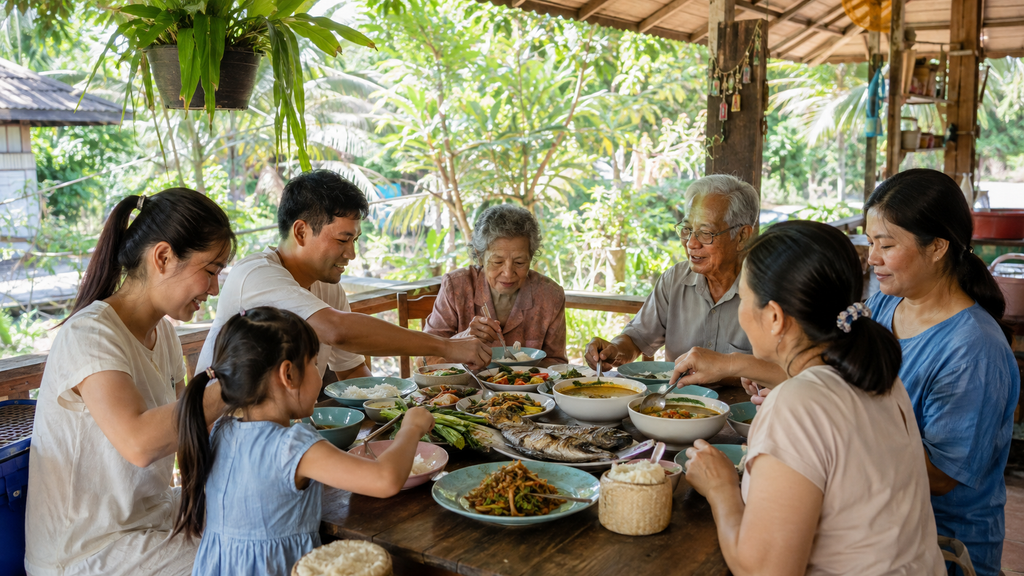
Food is one of the easiest ways to experience Thai culture.
Not just because Thai food is excellent.
Because of how meals can be shared.
At many meals, several dishes arrive for the table rather than everyone treating one large plate as completely their own.
Rice forms the base.
Then everyone shares curries, vegetables, meat, soup or other dishes.
I liked this immediately.
It made dinner feel social.
It also allowed me to try much more food.
Instead of choosing between three things I wanted, we could order several and share.
That is excellent travel logic.
I Stopped Expecting Courses
I grew up with the idea that meals often follow an order.
Starter.
Main.
Dessert.
That structure is not always useful in Thailand.
Dishes may arrive when they are ready.
One appears.
Then another.
Then the rice.
Then something else.
At first I waited for everything to reach the table before eating.
Eventually I realized I was letting perfectly good hot food become cold.
So I adapted.
When food arrives, start eating.
The rest will come.
The Spoon Became My Main Tool
Another small adjustment.
In many everyday Thai meals, the spoon does most of the work.
The fork helps move food onto the spoon.
Then the spoon goes to your mouth.
Chopsticks appear with certain noodle dishes and foods influenced by Chinese culinary traditions, but they are not the universal Thai eating utensil some visitors expect.
Nobody gave me a lesson.
I simply looked around the restaurant.
Again:
Watch first.
Then copy.
It solves an impressive number of travel problems.
Markets Showed Me a Different Side of Daily Life
I enjoyed Thailand’s famous night markets.
But morning and neighborhood markets taught me more about everyday routines.
These were places where people actually bought ingredients.
Vegetables.
Herbs.
Fruit.
Meat.
Seafood.
Prepared meals.
Breakfast.
The atmosphere was less about entertainment and more about getting things done.
I liked arriving early enough to see vendors setting up and customers buying food before the heat became intense.
Markets also made Thai cuisine easier to understand.
Ingredients I had only seen inside finished dishes were suddenly sitting in piles in front of me.
Chilies.
Limes.
Basil.
Galangal.
Lemongrass.
Coconut.
Everything began connecting.
Family Felt Very Visible
Traveling through Thailand, I frequently noticed several generations together.
At restaurants.
Markets.
Businesses.
Temples.
Family plays an important role in Thai society, although obviously no two families are identical.
What interested me as a traveler was how often family and business seemed to overlap.
A small restaurant might feel like several members of one family were involved.
Someone cooks.
Someone takes orders.
Someone clears tables.
A child sits nearby doing something completely unrelated.
It can make small businesses feel personal in a way that large restaurants rarely do.
Sanuk Helped Me Understand Something About Thailand
One Thai concept travelers often hear about is sanuk.
It is commonly translated in relation to fun or enjoyment, although a single English word does not capture every nuance.
I began thinking about it when I noticed how often ordinary activities seemed to include an element of sociability or enjoyment.
Work and seriousness do not necessarily exclude laughter.
A meal is not simply about consuming calories.
A market can be practical and social.
A festival can transform an entire neighborhood.
I would be careful about reducing an entire culture to one word.
But sanuk did help me notice that enjoyment can have an important place in everyday interactions.
Mai Pen Rai Is Easy to Misunderstand
Another phrase visitors quickly encounter is mai pen rai.
Depending on context, it can communicate something like “it’s okay,” “never mind” or “don’t worry about it.”
It is tempting to turn this into a stereotype that Thai people simply do not worry about anything.
That would obviously be wrong.
But the phrase did make me notice a tendency in many everyday situations to avoid turning small inconveniences into major confrontations.
Something minor goes wrong.
It gets resolved.
Life continues.
As a traveler, I found that attitude useful.
Especially when plans changed.
Thailand Taught Me to Be More Flexible
Travel rarely goes perfectly.
Thailand is no exception.
Tropical rain arrives.
Traffic becomes terrible.
A boat trip changes.
A restaurant is closed.
A market is quieter than expected.
Your body decides that 35°C is hotter than the itinerary anticipated.
The more rigidly I planned, the more frustrating those moments became.
When I left room for changes, everything improved.
This is not uniquely Thai culture.
But traveling through Thailand certainly taught me the value of going with the situation rather than fighting every inconvenience.
Public Displays of Anger Made Me Uncomfortable Too
After spending enough time adjusting to calmer interactions, I began noticing loud tourists more than before.
Someone arguing aggressively over a small bill.
Someone shouting at hotel staff.
Someone becoming angry because a taxi ride took too long.
Seeing it from the outside made me understand how disruptive it looked.
You can be firm without shouting.
You can disagree without humiliating someone.
You can solve a problem without making everyone nearby part of it.
That is advice I would take beyond Thailand.
Respect for the Thai Monarchy Is Important
This is an area where visitors should be particularly careful.
The monarchy holds an important position in Thailand, and the country has strict laws concerning insults or defamatory remarks about the monarchy.
As a visitor, I would not treat this as a topic for jokes, provocative comments or careless social-media content.
You may see portraits and symbols connected with the royal family in public places.
Treat them respectfully.
You do not need to involve yourself in Thai politics to understand that local laws and cultural sensitivities deserve attention while you are in the country.
The National Anthem May Catch You by Surprise
Depending on where you are, you may encounter the Thai national anthem being played publicly.
The first time something like this happens, it can be confusing if you do not know what everyone around you is doing.
This is another perfect situation for my favorite Thailand rule:
Look around.
Follow respectful local behavior.
Do not turn every unfamiliar cultural moment into something funny for social media.
Sometimes you simply participate respectfully and learn about it afterward.
Public Affection Felt More Reserved
Thailand welcomes enormous numbers of international visitors and tourist areas can feel very relaxed.
Still, I found it useful to remember that public behavior may be more reserved in certain contexts than visitors expect.
Normal affection between couples is not automatically a problem.
But very intimate behavior in temples, traditional environments or ordinary public spaces can be inappropriate.
Context matters.
The behavior that feels normal at a beach club may not feel equally appropriate inside a temple courtyard.
This is mostly common sense.
Dress Codes Depend on Where You Are
On Phuket beach?
Swimwear makes sense.
Walking through a shopping center?
Normal casual clothing.
Entering a temple?
Different expectations.
This sounds obvious, but beach destinations sometimes blur those boundaries for travelers.
I would not walk through a temple complex dressed as though I had just stepped out of the sea.
Thailand’s tourist infrastructure can feel extremely relaxed.
That does not mean every environment follows the same standards.
Pack clothing that gives you options.
Don’t Assume Bangkok Represents All of Thailand
Bangkok was my introduction to Thailand.
It would have been easy to assume the rest of the country worked exactly the same way.
Then I traveled farther.
Chiang Mai felt different.
Phuket felt different.
Smaller communities felt different again.
Food changed.
Pace changed.
Architecture changed.
Local traditions became more visible in different ways.
Thailand has regional identities, histories and cultural influences that cannot be reduced to one Bangkok experience.
The more places I visited, the less comfortable I became saying, “Thai culture is…”
There was almost always an exception.
Northern Thailand Felt Different
In Chiang Mai and other parts of Northern Thailand, the pace often felt calmer than central Bangkok.
Northern food introduced different flavors.
Lanna cultural influences appeared in architecture, temples, festivals and crafts.
The physical environment changed too.
Mountains replaced Bangkok’s enormous urban horizon.
I began understanding why travelers who spend only two nights in Bangkok and then fly to an island leave with a very different impression of Thailand from someone who also visits the north.
Neither experience is fake.
They are simply incomplete in different ways.
Southern Thailand Had Its Own Identity
Phuket showed me another side.
The beaches get most of the attention, but the island also carries Chinese, Malay, Muslim and Southern Thai cultural influences.
Phuket Old Town in particular challenged the simple image I had of the island as nothing more than resorts and beaches.
Architecture told part of the story.
Food told another.
Traveling through different regions made Thailand feel much larger culturally than it looked on my itinerary.
Festivals Can Completely Change the Experience
Thailand has many festivals and religious celebrations throughout the year.
Some are nationally famous.
Others are more regional.
If your trip overlaps with one, it can become a highlight.
But festivals are not simply entertainment staged for tourists.
They may have religious, community or historical significance.
That means I would research what I was attending rather than showing up only for photographs.
Understanding even a little of the meaning behind an event makes it much more interesting.
Songkran Is More Than a Giant Water Fight
Songkran is probably the Thai festival most international visitors recognize.
Photographs often show enormous water fights.
And yes, modern Songkran celebrations can involve a lot of water and fun.
But the Thai New Year has deeper cultural and religious traditions as well.
Family.
Merit-making.
Temple visits.
Respect for elders.
Cleansing and renewal.
If I traveled during Songkran, I would want to experience both sides.
The celebration.
And the meaning behind it.
Reducing the entire festival to tourists shooting water guns at each other misses much of the story.
Loy Krathong Made More Sense Once I Understood the Meaning
Images of floating krathongs illuminated by candles are beautiful.
But again, the visual spectacle is only part of the experience.
Traditions associated with water, gratitude, reflection and letting go give the festival meaning beyond photography.
Celebrations and local practices vary.
That is another reason I prefer learning about a festival before participating.
You become less of a spectator collecting images and more aware of what people around you are actually doing.
Tourism Changes Culture Too
It would be unrealistic to talk about modern Thailand without acknowledging tourism.
Bangkok, Phuket, Chiang Mai and the islands receive enormous numbers of visitors.
Tourism creates jobs.
It changes neighborhoods.
It influences restaurants.
It creates businesses specifically for foreigners.
It can preserve some traditions while commercializing others.
Sometimes what looks “traditional” has been packaged specifically for visitors.
That does not automatically make it worthless.
But I became more interested in asking questions.
Who is this experience for?
Is this something local people actually do?
Is this a cultural tradition, a tourist adaptation or some combination of both?
Travel becomes more interesting when you stop expecting perfectly clear answers.
Don’t Turn Local People Into Scenery
This is one rule I wish more travelers considered.
A market vendor is not a prop.
A monk is not a prop.
A child is not a prop.
Someone wearing traditional clothing is not automatically inviting you to photograph them.
If I wanted a close photograph of a person, I tried to ask.
Sometimes the answer was yes.
Sometimes it was no.
That is fine.
There are countless things to photograph in Thailand without making someone uncomfortable.
Respecting people matters more than getting one more travel picture.
Learning a Few Customs Made Me More Comfortable, Not Less
Before visiting, cultural etiquette guides can make Thailand sound intimidating.
Don’t do this.
Don’t point that way.
Don’t touch this.
Wear this.
Remove that.
The reality felt much easier.
You do not need to spend the trip terrified of making a mistake.
Be observant.
Be polite.
Respect religious spaces.
Control your temper.
Dress appropriately when the situation requires it.
Ask when you are uncertain.
Most importantly, remember that you are the visitor.
That covers a surprising amount.
I Still Made Mistakes
Of course I did.
Sometimes I forgot to remove my shoes until I noticed everyone else’s.
Sometimes I pronounced Thai words badly.
Sometimes I did not know how to behave until I watched someone else.
Sometimes I misunderstood what a person was trying to tell me.
Nobody handed me a cultural exam.
Most small mistakes were easily corrected.
What mattered was being willing to notice and adjust.
There is a huge difference between accidentally doing something wrong and refusing to respect a custom after you understand it.
What I Wish I Had Known Before My First Trip
I wish I had spent less time memorizing rules and more time understanding the principles behind them.
Respect religious spaces.
Avoid unnecessary confrontation.
Observe before acting.
Remember that local customs do not exist for tourists.
Do not assume that friendliness means every social interaction works exactly as it does at home.
And leave room to learn while you are there.
That would have been enough.
Ten Simple Things I Would Remember as a First-Time Visitor
If I had to reduce everything I learned into a practical set of reminders, these would be mine.
Dress respectfully at temples.
Cover appropriately and remember that religious sites remain places of worship.
Remove your shoes when required.
Look at what people around you are doing.
Be respectful toward Buddha images and religious objects.
They are not photography props.
Give monks appropriate space.
Be aware that particular etiquette can apply to interactions with monks.
Avoid touching people’s heads.
Especially do not do it casually with someone you do not know.
Be aware of where your feet are pointing.
Particularly around people and sacred objects.
Keep disagreements calm.
Being loud rarely improves the outcome.
Treat the monarchy respectfully.
Understand that Thailand has serious laws and cultural sensitivities in this area.
Ask before taking close photographs of people.
Being in a public market does not remove someone’s right to privacy and dignity.
Watch what locals are doing.
This may be the most useful rule of all.
What Thai Culture Added to My Trip
Without paying attention to culture, I still would have enjoyed Thailand.
The beaches would still have been beautiful.
The food would still have tasted good.
The temples would still have looked spectacular.
Bangkok would still have been exciting.
But I would have understood much less of what I was seeing.
Culture gave those places context.
A temple became more than architecture.
A market became more than somewhere to buy food.
A shared meal became more than several plates on a table.
A small spirit house became something I actually noticed.
A wai became more than a gesture I had seen in travel advertisements.
Those small pieces gradually connected.
That was when Thailand stopped feeling like a collection of attractions.
It started feeling like a place with its own rhythm.
Final Thoughts
I arrived in Thailand thinking cultural preparation meant learning what not to do.
I left thinking it was much more about learning how to notice.
Notice when people remove their shoes.
Notice how quietly someone enters a temple.
Notice the morning offerings.
Notice how food moves around a shared table.
Notice the spirit house beside a skyscraper.
Notice how people handle a small misunderstanding without turning it into an argument.
None of those moments are as famous as the Grand Palace or a Phuket beach.
But they changed the trip.
You do not need to become an expert on Thai culture before visiting Thailand.
You probably could not, even if you tried.
Culture is too complicated to fit into a travel checklist.
Learn the important etiquette.
Understand the major sensitivities.
Then arrive with curiosity.
Watch.
Listen.
Ask questions when appropriate.
And be willing to change your behavior when you realize you have misunderstood something.
The longer I traveled through Thailand, the less interested I became in trying to “experience authentic Thai culture” as though it were an attraction I could book.
Instead, I started seeing it in ordinary moments.
Breakfast beside a road.
Shoes outside a doorway.
Families eating together.
Monks walking through a neighborhood in the morning.
A shrine covered with flowers outside a modern building.
Someone smiling while we both tried to understand what the other person was saying.
Those are the moments I remember.
And they are the reason I would tell any first-time visitor to Thailand:
See the temples.
Eat the food.
Go to the islands.
Explore Bangkok.
But pay attention to everything happening in between.
That is where you begin to understand the country.