

Before my first trip to Thailand, I thought I already knew Thai food.
Pad Thai, tom yum, green curry and mango sticky rice were familiar names. I had eaten versions of them at Thai restaurants before, so I assumed the food would be one of the easier parts of the trip.
That changed very quickly after arriving.
Thai food in Thailand is not just about dishes. It is about where you eat them, when you eat them and what is happening around you.
A bowl of noodles eaten beside a busy Bangkok street feels completely different from the same dish served in a quiet restaurant back home.
Breakfast might come from a charcoal grill on the sidewalk. Lunch can be a plate of rice and basil cooked in less time than it takes to choose a restaurant. Dinner might begin with one dish at a night market and somehow turn into six different things shared between two people.
And then there is the chili.
I learned fairly early that my understanding of “a little spicy” and a Thai cook’s understanding of “a little spicy” were not always the same.
But that was part of the fun.
The more I ate, the more I realized that some of Thailand’s best food is also its simplest.
These are the Thai foods I would tell a first-time visitor to try at least once.
1. Pad Kra Pao – The Dish I Ended Up Eating More Than Pad Thai
Before Thailand, I expected Pad Thai to become my default meal.
It didn’t.
Pad kra pao did.
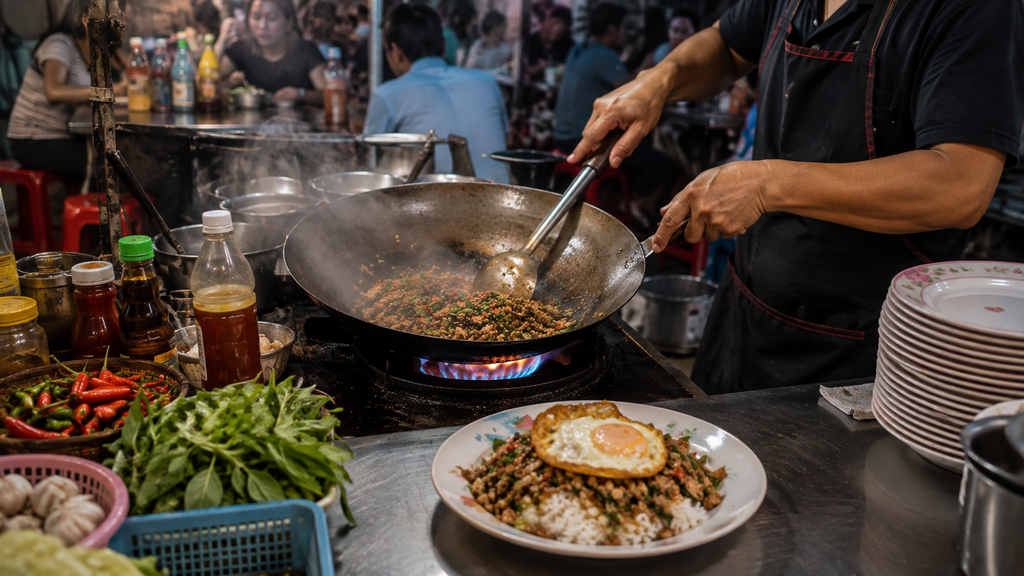
Pad kra pao is one of those dishes that does not necessarily look spectacular in photographs. It is usually a simple plate of rice topped with minced or chopped meat stir-fried with holy basil, garlic, chili and savory seasoning.
Add a crispy-edged fried egg on top and it becomes one of the most satisfying quick meals in Thailand.
The first thing I noticed was the smell.
Garlic and basil hit you before the plate even reaches the table.
Then comes the chili.
A proper pad kra pao can be seriously spicy, especially when it has not been adjusted for foreign visitors.
But underneath that heat is a salty, fragrant and slightly sweet combination that works perfectly with plain jasmine rice.
Break the fried egg.
Let the yolk run into the rice.
Mix everything together.
That was when I understood why this is such an everyday favorite.
It is fast.
It is filling.
It is inexpensive at ordinary local restaurants.
And you can find it almost everywhere.
If I were in Bangkok and had no idea what to eat for lunch, pad kra pao would probably be my answer.
Is It Good for First-Time Visitors?
Absolutely, but be careful with the chili.
If you are sensitive to spicy food, ask for it less spicy.
Even then, “less spicy” may still contain more chili than you expect.
That became a recurring lesson in Thailand.
2. Tom Yum Goong – Thailand in One Bowl
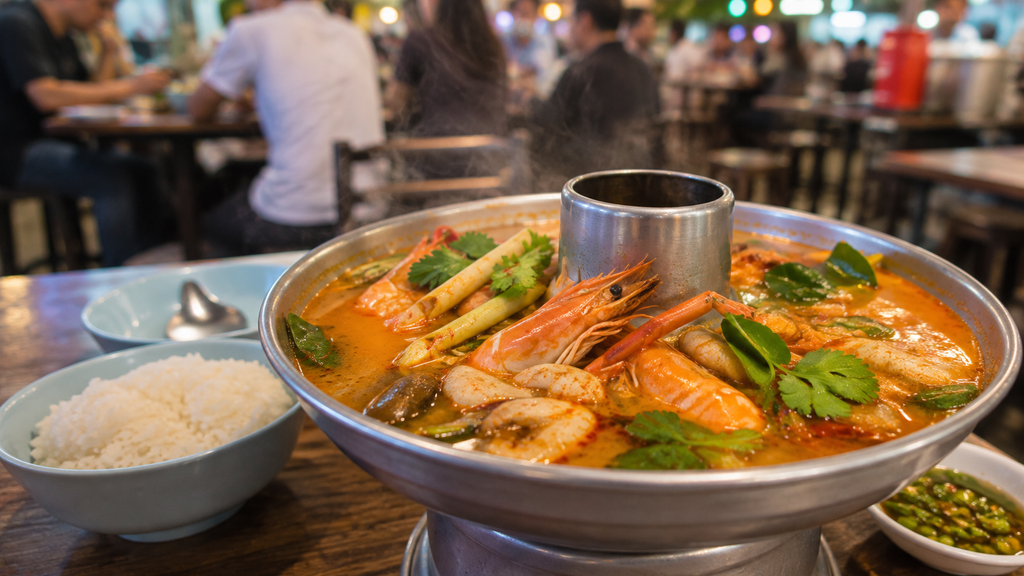
If I had to choose one dish that captures the flavors people associate with Thailand, tom yum goong would be near the top.
The first spoonful can be confusing.
It is sour.
Then spicy.
Then salty.
Then aromatic.
Lemongrass, galangal and kaffir lime leaves create a fragrance that is difficult to mistake for anything else.
Add prawns and mushrooms, and suddenly you have a soup that feels both refreshing and intense.
I had eaten tom yum outside Thailand before.
The version I tried in Thailand tasted brighter.
The lime seemed sharper.
The herbs seemed more obvious.
And the heat arrived more aggressively.
There are different styles of tom yum, including clearer broths and creamier versions.
I enjoyed both, but the important thing for a first-time visitor is not to expect a mild soup.
Tom yum is supposed to have personality.
One Thing I Learned Quickly
You are not necessarily supposed to eat every piece of herb floating in the bowl.
Large pieces of lemongrass, galangal and lime leaves are often there primarily to flavor the broth.
My first bowl became considerably easier once I understood that.
3. Pad Thai – Famous for a Reason
Pad Thai might be the most internationally recognizable Thai dish.
That popularity sometimes works against it.
People dismiss it as “tourist food” because it appears on menus everywhere.
I think that is unfair.
A well-made Pad Thai is genuinely delicious.
Rice noodles are stir-fried quickly with egg, tofu or shrimp, bean sprouts, seasonings and a balance of sweet, salty and sour flavors.
Then you adjust it yourself.
A squeeze of lime.
Crushed peanuts.
Maybe chili flakes.
That final adjustment is part of what makes the dish enjoyable.
What surprised me in Thailand was that Pad Thai was often less sweet than versions I had eaten abroad.
It also tasted fresher when cooked quickly in a hot wok and eaten immediately.
The noodles still had texture.
The bean sprouts added crunch.
The lime made everything brighter.
Street Stall or Restaurant?
Try both if you have time.
But eating Pad Thai from a busy street stall is one of those classic Thailand experiences that is still worth having.
Watch the cook work over the wok.
The entire dish can come together remarkably quickly.
Then eat it while it is hot.
4. Som Tam – The Salad That Nearly Defeated Me
Som tam looks innocent.
Green papaya.
Tomatoes.
Long beans.
Peanuts.
Lime.
What could go wrong?
Then the chili arrives.
Som tam, or green papaya salad, was one of the dishes that taught me to take Thai spice levels seriously.
The ingredients are pounded together in a mortar, allowing the lime juice, fish sauce, palm sugar and chili to coat the shredded papaya.
The result is crunchy, sour, salty, sweet and often extremely spicy.
When it is balanced properly, it is fantastic.
It also feels refreshing in Thailand’s heat.
But if you are not accustomed to chili, do not be brave for no reason.
Ask for fewer chilies.
You can always eat something hotter next time.
You cannot remove chili after it has been pounded throughout the salad.
What to Eat With Som Tam
Som tam works beautifully with sticky rice and grilled meat.
That combination became one of my favorite ways to eat it.
A little spicy salad.
A little sticky rice.
A piece of grilled chicken or pork.
Then repeat.
5. Khao Soi – The Dish That Made Chiang Mai Worth the Journey
If you visit Northern Thailand and only try one regional dish, I would make it khao soi.
My first proper bowl in Chiang Mai looked almost too rich for the hot weather.
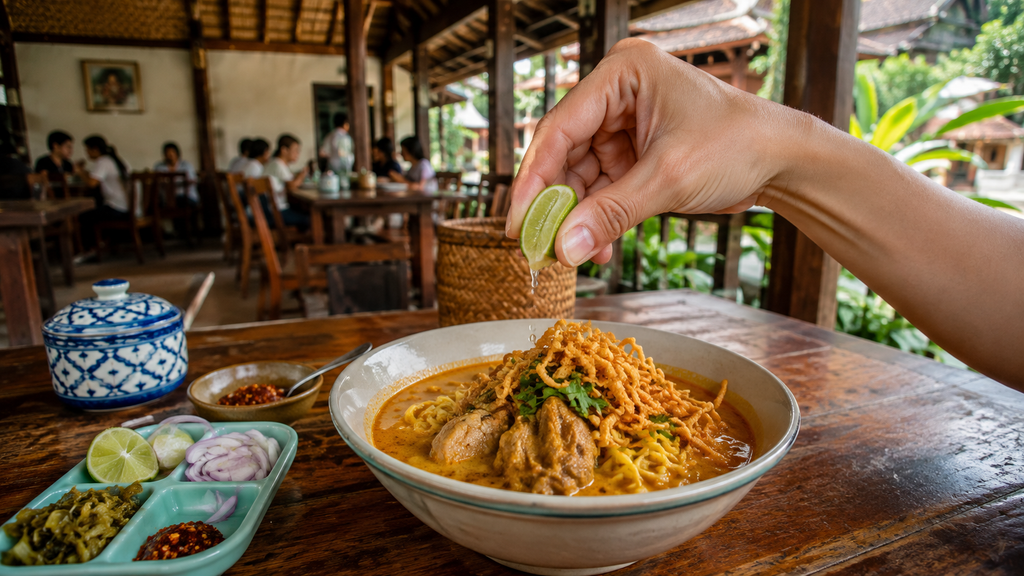
Golden curry broth.
Soft egg noodles underneath.
Crispy noodles piled on top.
Meat slowly cooked in the curry.
Lime, pickled mustard greens and shallots served alongside.
Then I tasted it.
The broth was creamy from coconut milk but still deeply savory and aromatic.
The crispy noodles added texture.
The lime cut through the richness.
The pickled greens made every few bites taste slightly different.
This is one of those dishes where the condiments are not decoration.
Use them.
Add some lime.
Try the pickled greens.
Adjust the chili gradually.
The bowl changes as you eat it.
Why I Would Wait Until Chiang Mai
You can find khao soi elsewhere in Thailand.
But eating it in Northern Thailand gives the dish context.
Food becomes more interesting when it connects to the place you are visiting.
If Chiang Mai is part of your itinerary, save at least one meal for khao soi.
I would probably save two.
6. Moo Ping With Sticky Rice – One of the Best Simple Breakfasts
Some of my favorite Thai food did not require a restaurant.
Moo ping is a perfect example.
These are skewers of marinated pork grilled over charcoal.
You often smell them before you see the stall.
Sweet marinade caramelizes around the edges of the meat while smoke from the charcoal adds another layer of flavor.
Buy a few skewers.
Add a small bag of sticky rice.
That is breakfast.
Or a snack.
Or something you eat because you walked past a grill and suddenly became hungry despite having eaten thirty minutes earlier.
There is nothing complicated about moo ping.
That is exactly why I like it.
Eat It Hot
This is one street food I particularly enjoy straight from the grill.
When the meat is still hot and slightly smoky, it is hard to beat.
Look for a stall that is actively cooking and has regular customer turnover.
7. Khao Man Gai – When You Need Something Simple
Not every Thai meal needs to attack every taste bud at once.
Sometimes I wanted something simple.
Khao man gai became one of my choices on those days.
It is Thailand’s version of chicken rice: tender chicken served over fragrant rice, usually accompanied by sauce, cucumber and broth.
The rice matters as much as the chicken.
It absorbs flavor from the cooking process and should not taste like ordinary plain steamed rice.
The sauce then brings the dish alive.
Compared with som tam or tom yum, khao man gai is gentle.
That makes it a great choice when you need a break from very spicy food.
It is also useful for travelers who are still adjusting to Thai flavors.
Simple does not mean boring.
8. Green Curry – Gaeng Keow Wan
Thai green curry is another dish I thought I knew.
Then I ate it in Thailand.
The color can range from pale green to a much deeper shade depending on the curry paste and ingredients.
Coconut milk gives the sauce richness while green chili, herbs and spices create the heat and aroma.
Depending on where you eat it, the curry may contain chicken, meat or other ingredients along with vegetables and Thai basil.
The first thing to understand is that green curry is not necessarily mild because coconut milk is involved.
It can be hot.
Sometimes very hot.
The coconut milk softens the edges of the chili but does not remove it.
Eat it with rice.
The rice is not an afterthought.
It helps balance the intensity of the curry.
9. Massaman Curry – A Great Choice If You Don’t Love Spicy Food
Massaman curry feels different from many other Thai curries.
It is richer, warmer and often less aggressively spicy.
The flavors can include spices such as cinnamon and cardamom alongside coconut milk, potatoes, peanuts and meat.
The result is almost comforting.
If green curry feels too intense, massaman is a good place to go next.
I particularly liked the contrast between the soft potatoes, rich sauce and crunchy peanuts.
This is also a dish that demonstrates how Thai cuisine has absorbed influences from different cultures and turned them into something distinctly its own.
Who Should Try It?
Almost everyone.
But I would especially recommend it to travelers who want to explore Thai curry without immediately jumping into the hottest options.
10. Boat Noodles – Small Bowls, Big Flavor
Boat noodles were one of the Bangkok foods I was most curious about.
Traditionally associated with vendors who sold noodles from boats along Bangkok’s canals, the dish is now commonly eaten in restaurants.
The bowls are often small.
Do not let that fool you.
The broth can be incredibly concentrated.
Dark.
Rich.
Savory.
Aromatic.
Depending on the shop, you choose noodles and meat, then season the bowl to your preference.
The small portions also make it dangerously easy to order another.
And another.
At some places, the growing stack of empty bowls becomes part of the experience.
Why Try Them in Bangkok?
Because the dish is connected to the city’s waterways and history.
You are not just eating another bowl of noodles.
You are eating something tied to an older Bangkok built around canals and river transport.
11. Grilled Seafood – Save This for the Coast
Once you reach Southern Thailand, seafood becomes difficult to ignore.
Phuket.
Krabi.
The islands.
Coastal towns.
Fish and shellfish appear everywhere.
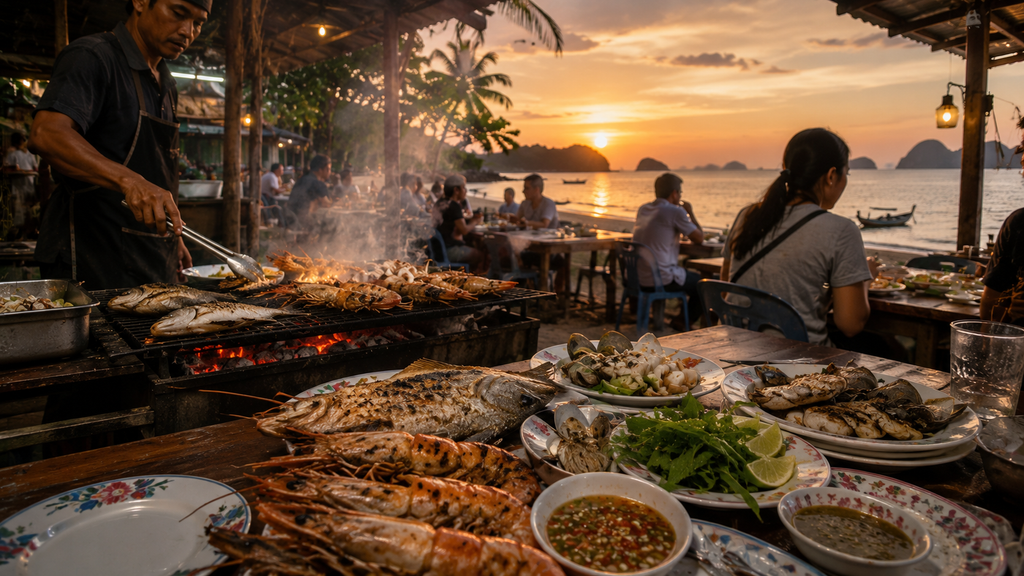
Grilled prawns were one of my favorites because they needed very little.
Fresh seafood.
Hot grill.
Smoke.
Thai seafood dipping sauce.
Done.
The dipping sauce is often where things become unmistakably Thai.
Lime.
Garlic.
Chili.
Fish sauce.
Bright, sharp flavors cutting through the sweetness of grilled seafood.
If you are traveling with other people, order several things and share.
Prawns.
Squid.
Fish.
Shellfish.
A seafood dinner near the coast is one of those Thailand experiences I would happily repeat.
12. Thai Fried Rice – The Reliable Meal Nobody Talks About
Thai fried rice rarely appears near the top of “foods you must eat before you die” lists.
That is probably why I like mentioning it.
You will encounter fried rice everywhere.
Chicken.
Pork.
Shrimp.
Crab.
Vegetables.
A good plate is quick, comforting and satisfying without being overwhelming.
Add lime.
Use some fish sauce with chili if provided.
Suddenly something very simple becomes much more interesting.
This is the kind of meal I would order after a long travel day when I did not want to study a menu for twenty minutes.
Not every meal needs to become a culinary event.
Sometimes you just need dinner.
13. Mango Sticky Rice – Yes, It Really Is That Good
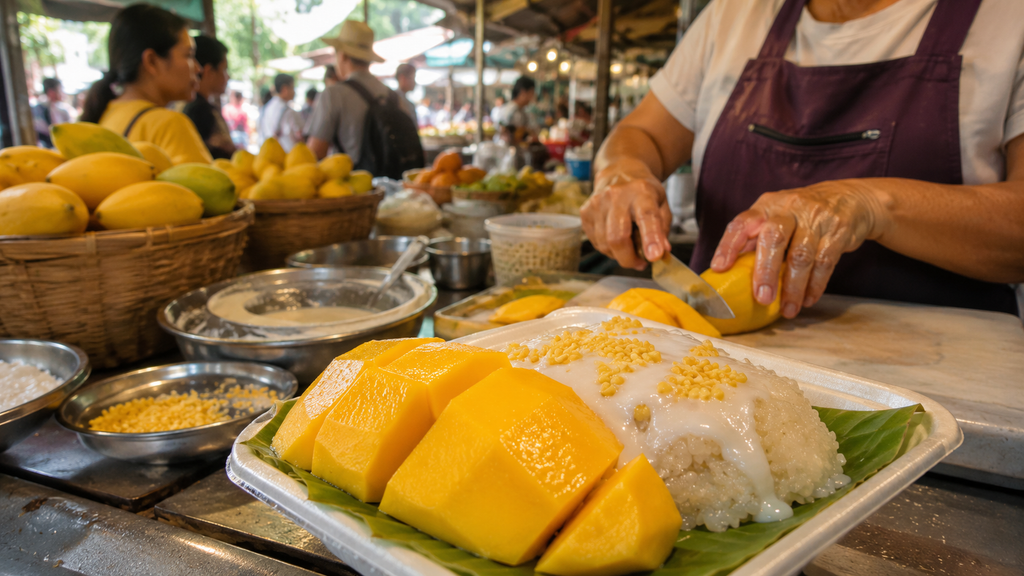
I expected mango sticky rice to be overrated.
It appears everywhere in Thailand travel content.
Beautiful yellow mango.
White sticky rice.
Coconut sauce.
Photogenic plate.
Surely it could not be that exciting.
I was wrong.
When the mango is properly ripe, the combination makes complete sense.
The fruit is sweet and slightly tangy.
The sticky rice is dense and comforting.
Coconut milk adds richness and a little salt balances the sweetness.
It is simple.
That simplicity depends heavily on good ingredients.
A great mango sticky rice does not need anything else.
When Should You Eat It?
Whenever you find a good one.
Dessert.
Afternoon snack.
After a night-market dinner.
I stopped trying to create rules.
14. Roti – The Dessert I Didn’t Plan to Eat So Often
Walk through enough Thai night markets and eventually you will hear the sound of roti being prepared on a hot griddle.
The dough is stretched thin.
Cooked until crisp.
Folded around fillings.
Then cut into small pieces.
Banana is common.
Condensed milk is common.
Chocolate appears frequently in tourist areas.
Is it subtle?
Not particularly.
Is it delicious late at night?
Absolutely.
The combination of crispy dough, banana and condensed milk is difficult to dislike.
It is also the kind of food that smells so good while being cooked that saying “I’m full” becomes surprisingly difficult.
15. Coconut Ice Cream – Thailand’s Heat Makes It Better
There are foods that become better because of where you eat them.
Coconut ice cream in Thailand is one of them.
After walking around a market in humid heat, something cold suddenly becomes far more exciting than it has any right to be.
Coconut ice cream is creamy but refreshing, and depending on the vendor it may come with toppings such as peanuts, sticky rice or pieces of coconut.
I would not travel across Bangkok specifically to find one particular coconut ice cream stall.
I would simply eat it when I found it.
That is how many of my favorite food moments in Thailand happened.
And Don’t Forget Thai Milk Tea
Thai milk tea is not a meal, but it deserves a place here.
It is sweet.
Very sweet, sometimes.
Strong tea is mixed with milk and poured over plenty of ice.
On a hot afternoon, that cold cup can disappear frighteningly quickly.
I would not pretend it is a health drink.
It is a treat.
And after spending several hours walking through Bangkok in tropical heat, I was perfectly happy treating it like one.
Where I Actually Found the Best Food in Thailand
I stopped believing that the best food always had to come from a famous restaurant.
Some excellent meals came from places I could probably never find again.
A small shop near the hotel.
A crowded stall at a market.
A restaurant where I pointed at a picture because I could not pronounce the name.
A grill beside a road.
That does not mean famous restaurants are bad.
Some are famous for good reason.
But I would not build an entire Thailand food experience around social-media recommendations.
Look around.
Is the stall busy?
Are people actually eating there?
Is food being cooked fresh?
Does the turnover look good?
Those clues often mattered more to me than an online ranking.
Is Thai Street Food Safe?
This is one of the most common questions first-time visitors ask.
No one can guarantee that every street-food stall is safe.
The same is true of every restaurant.
I generally looked for places with steady customer turnover and food being prepared fresh.
If raw ingredients had been sitting around in questionable conditions, I moved on.
If a stall was busy with local customers and food was constantly going onto and coming off a hot grill, I felt more comfortable.
I also used basic judgment with seafood, ice and raw ingredients.
Street food is a huge part of experiencing Thailand.
You do not need to be reckless to enjoy it.
How Much Does Thai Street Food Cost?
One reason eating in Thailand is so enjoyable is the range.
A simple local meal can be inexpensive.
Street snacks can cost very little.
At the same time, Thailand has luxury restaurants where dinner costs more than several days of street food.
Bangkok in particular offers both extremes.
I would not obsess over finding the absolute cheapest food.
A small difference in price is often meaningless compared with the total cost of an international trip.
Eat where you feel comfortable.
Try local places.
Spend more occasionally when something interests you.
Food is one of the best parts of traveling in Thailand, so I would actually budget enough to enjoy it.
How I Ordered Food Without Speaking Thai
Most of the time, it was easier than I expected.
Some places had English menus.
Some had photographs.
At others, I pointed.
Sometimes I watched what another customer ordered and asked for the same thing.
A few Thai words can help, but you do not need to speak fluent Thai to eat well.
The more important skill is patience.
Smile.
Do not get frustrated because communication takes twenty seconds longer.
And when you are not sure how spicy something is, ask before the first bite.
A Warning About Thai Spice Levels
If you genuinely love spicy food, Thailand will make you happy.
If you only think you love spicy food, Thailand may provide an educational experience.
I learned not to prove anything.
If a cook asked how spicy I wanted the dish, I answered realistically.
There is no prize for suffering through dinner.
Thai cuisine is about balance, not simply maximum chili.
Sourness.
Sweetness.
Saltiness.
Heat.
Fresh herbs.
Rich coconut.
Charred meat.
Crunchy vegetables.
The chili is only one part of the experience.
Bangkok, Chiang Mai and Southern Thailand Taste Different
One of the reasons I would avoid reducing Thai cuisine to Pad Thai and tom yum is that food changes as you travel.
Bangkok gives you almost everything.
Street noodles.
Chinese-Thai influences.
Curries.
Stir-fries.
Modern restaurants.
Old family-run shops.
In Northern Thailand, dishes such as khao soi introduce different flavors and traditions.
The food can feel earthier and more connected to sticky rice, herbs and Northern regional cooking.
Travel south and seafood becomes increasingly prominent.
Curries can become intense.
Coconut appears frequently.
Malay and Muslim culinary influences become more visible in certain areas.
You could travel through Thailand largely by following its food.
I would happily do exactly that.
Markets Are Where Thai Food Becomes Most Fun
Restaurants are easier.
Markets are more entertaining.
A night market lets you try a little of everything.
One skewer.
A small bowl.
Some fruit.
Something fried.
Something you cannot identify.
Dessert.
Then another dessert because you forgot the first dessert was supposed to be the last thing you ate.
This is my favorite way to explore unfamiliar food.
Instead of committing to one large dish, you can keep trying small things.
Go with another person if possible.
Sharing means you can taste twice as much.
That is excellent travel mathematics.
Don’t Spend the Entire Trip Eating Only “Must-Try” Foods
This sounds strange in an article about foods you should try.
But it matters.
Food lists can become another form of travel checklist.
Pad Thai. Done.
Tom yum. Done.
Som tam. Done.
Mango sticky rice. Done.
That misses the point.
Some days, eat whatever is nearby.
Order something because the table beside you has it.
Return to a dish you already loved.
Eat the same breakfast twice.
Thailand has far too much food to “complete.”
Enjoying it is more important than collecting it.
If I Could Only Choose Five Thai Foods
This is difficult.
But imagine someone told me:
“You only get five dishes on your first trip to Thailand. Choose.”
I would go with these.
1. Tom Yum Goong
Because it captures that Thai balance of sour, spicy, salty and aromatic flavors better than almost anything else.
2. Pad Kra Pao
Because I want a first-time visitor to experience the kind of simple everyday Thai meal I actually wanted to eat repeatedly.
3. Khao Soi
Because Northern Thai food deserves a place in the experience, and a great bowl of khao soi is unforgettable.
4. Som Tam
Because Thai food without that combination of fresh crunch, lime, fish sauce and chili would feel incomplete.
Just be sensible with the spice level.
5. Mango Sticky Rice
Because after all the chili, herbs, grilled meat and curry, finishing with ripe mango, coconut and sticky rice feels exactly right.
I would still be sad about losing moo ping.
What I Would Eat on My First Day Back in Thailand
This question is easier.
Breakfast would be moo ping with sticky rice.
Lunch would be pad kra pao with a fried egg.
In the afternoon, I would probably get Thai milk tea despite knowing how sweet it is.
Dinner would be tom yum and several shared dishes.
Then mango sticky rice.
And if I walked past a roti stall later that night?
Apparently I would still have room.
Thailand has that effect.
Final Thoughts
Thai food was one of the things I looked forward to most before the trip.
It still surprised me.
Not because every meal was extraordinary.
They weren’t.
I had average meals.
I ordered things that were too spicy.
I occasionally had no idea what I was eating.
I chose places because they were convenient rather than famous.
And sometimes I ordered the same dish again because I was tired and knew I liked it.
That is what made the food experience feel real.
Thailand’s cuisine is not something you experience by visiting one restaurant and ordering Pad Thai.
It happens gradually.
You smell pork grilling while walking in the morning.
You discover that pad kra pao is the perfect quick lunch.
You underestimate som tam.
You sit down in Chiang Mai with a bowl of khao soi.
You eat seafood near the coast.
You buy mango sticky rice even though you said you were full.
And eventually you stop asking what the most famous Thai food is.
You simply start asking:
What looks good right now?
That is when eating in Thailand becomes one of the best parts of the trip.
If it is your first visit, try the famous dishes.
They are famous for a reason.
But leave some meals unplanned.
The dish you remember most might not be the one you traveled across Bangkok to find.
It might be the one you ordered from a small stall because you were hungry, it smelled incredible, and there was an empty plastic stool waiting beside it.