
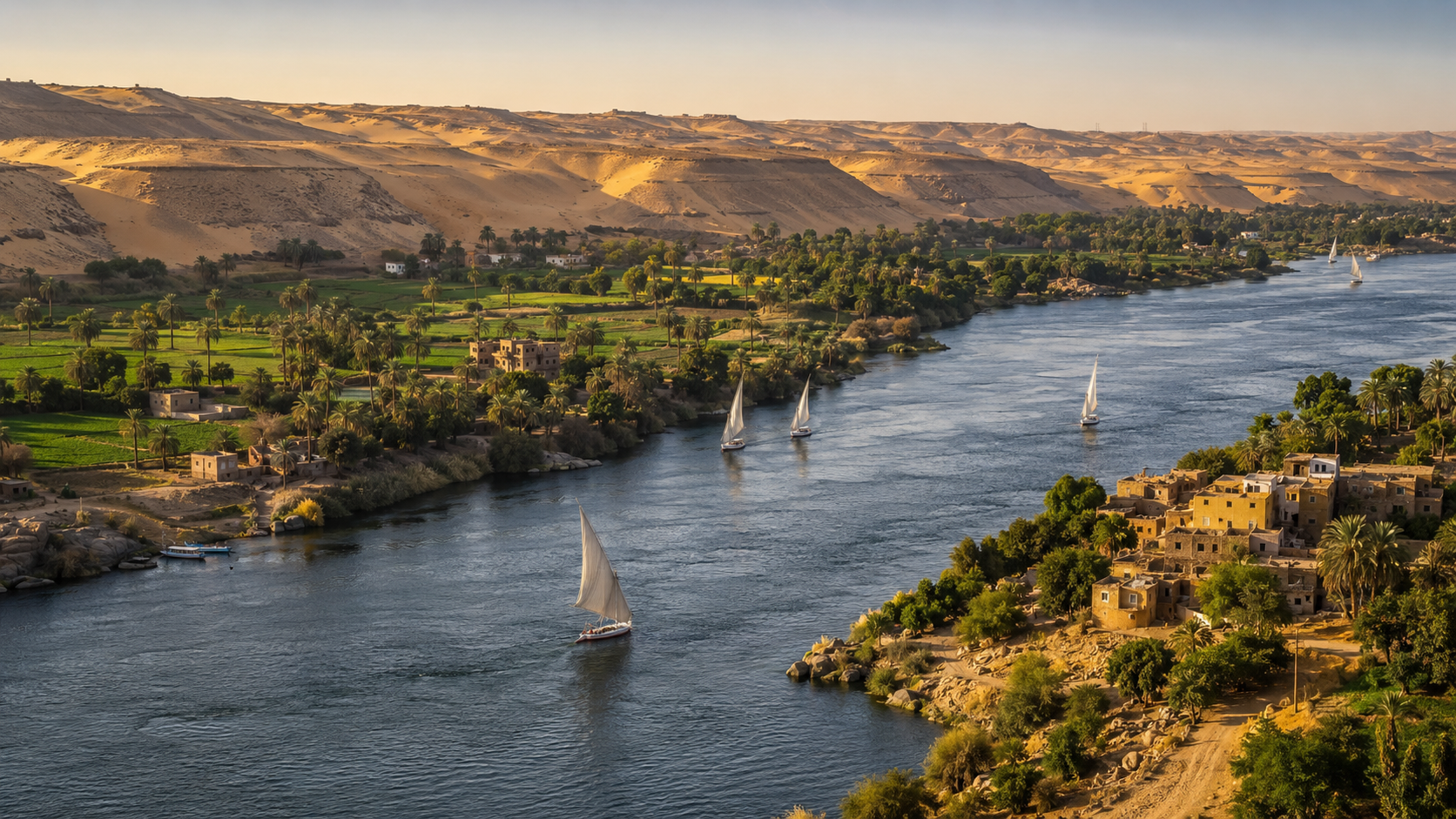
Mention Egypt and one image usually appears first: the pyramids rising from the desert outside Cairo.
They deserve that reputation. Few ancient monuments anywhere in the world are as recognizable, and seeing the scale of the Giza complex is one of the great reasons to travel to Egypt.
But the pyramids can also overshadow almost everything else.
Egypt stretches from the Mediterranean coast to the deserts of North Africa, following the Nile through cities, farmland, temples, villages and archaeological landscapes before reaching the border with Sudan. To the east, the Red Sea opens onto coral reefs and mountain-backed coastlines. Far to the west, isolated oases appear among vast desert landscapes.
Even Cairo cannot be understood only through its ancient monuments. It is a huge modern city filled with neighborhoods, markets, mosques, cafés, apartment blocks and streets that rarely resemble the quiet archaeological image used to advertise Egypt.
A trip that goes beyond Giza reveals a country with far more variety than many first-time visitors expect.
These ten places show just how different Egypt can become once the pyramids are no longer the entire itinerary.
1. Cairo: The City Beyond Giza
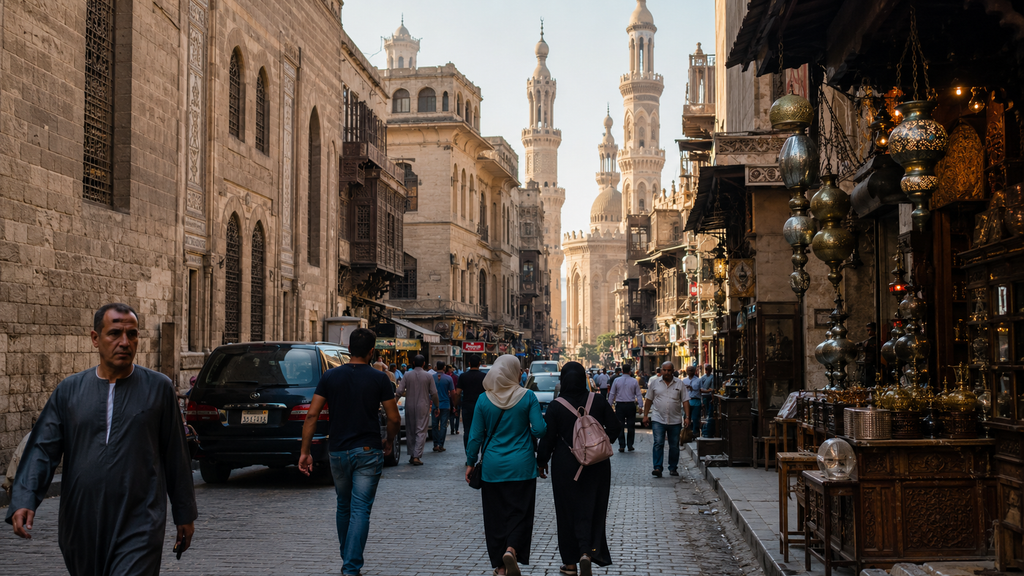
Cairo is often treated as the place where travelers sleep before visiting the pyramids.
That misses most of the city.
Modern Cairo is enormous, crowded and constantly moving. Traffic fills major roads, vendors occupy sidewalks, cafés stay busy late into the evening and the Nile divides districts that can feel very different from one another.
Historic Cairo reveals another layer.
The area contains an extraordinary concentration of Islamic architecture, including mosques, madrasas, gates and buildings created during different periods of the city’s history.
Walking around Al-Muizz Street brings you close to some of that architecture without separating it completely from modern urban life. Historic façades stand beside shops and streets still used by residents every day.
Nearby Khan el-Khalili is much more commercial and heavily visited, but it remains worth exploring for the density of its lanes, shops and surrounding historic buildings.
Cairo can be exhausting. Noise, traffic and crowds are part of the experience.
But that intensity is also why the city matters.
Giza introduces ancient Egypt. Cairo introduces the country people live in today.
2. Alexandria: Egypt Facing the Mediterranean
Travel north from Cairo and Egypt begins to feel different.
Alexandria stretches along the Mediterranean, giving the city a coastal atmosphere unlike the desert landscapes many visitors associate with the country.
The sea is constantly present.
The Corniche follows the waterfront for kilometers, with waves on one side and dense urban neighborhoods on the other. Fishing boats, cafés and seafood restaurants reinforce the city’s connection with the Mediterranean.
Alexandria was founded by Alexander the Great in 331 BC and later became one of the most important intellectual and commercial centers of the ancient Mediterranean world.
Much of that ancient city has disappeared or lies beneath the modern one, so Alexandria does not provide the same monumental experience as Luxor.
Its appeal comes from layers.
Greco-Roman history, Mediterranean architecture, modern Egyptian life and the waterfront overlap in the same city.
The Bibliotheca Alexandrina provides a contemporary connection to the legendary ancient Library of Alexandria, while the Citadel of Qaitbay occupies a dramatic position beside the sea.
Alexandria works especially well for travelers who want to see an Egypt that does not fit the usual desert image.
3. Luxor: Where Ancient Egypt Becomes Difficult to Ignore
If Giza is dominated by a handful of enormous monuments, Luxor feels surrounded by history.
The modern city occupies part of ancient Thebes, once one of the great centers of pharaonic Egypt.
On the east bank of the Nile stand Luxor Temple and the enormous Karnak complex.
Karnak is not a single temple. It developed over centuries as successive rulers added gateways, courtyards, sanctuaries, statues and monumental columns.
The Great Hypostyle Hall provides one of its most memorable spaces.
Massive stone columns rise overhead in dense rows, making human visitors appear almost insignificant beside them.
Cross the Nile and the landscape changes.
The west bank contains archaeological sites spread beneath dry mountains, including the Valley of the Kings, where numerous pharaohs were buried in rock-cut tombs.
The contrast between both sides of Luxor is striking.
Green fields follow the river while barren desert begins surprisingly close to cultivated land.
Temples and tombs appear within that transition.
For anyone genuinely interested in ancient Egypt, Luxor deserves several days rather than a rushed excursion.
4. Aswan: A Slower Side of the Nile
Continue south and the Nile around Aswan develops another character.
The river flows between rocky islands and stretches of desert, with vegetation creating narrow green edges beside the water.
The pace can feel noticeably slower than Cairo.
One of the simplest ways to experience Aswan is from the Nile itself.
Traditional sailing boats known as feluccas still move across the water, their triangular sails standing out against the river and surrounding landscape.
A short sailing trip does not need a complicated itinerary.
The appeal is the movement of the boat, the changing riverbanks and the sudden quiet that appears once the city’s traffic fades behind you.
Aswan is also an important center for understanding Nubian culture.
Nubian communities have a long history connected with southern Egypt and northern Sudan, with their own cultural traditions and languages.
The construction of the Aswan High Dam and the creation of Lake Nasser transformed the region dramatically, including the displacement of many Nubian communities.
That history gives Aswan a cultural dimension very different from simply visiting another collection of temples.
5. Abu Simbel: Monumental Architecture at the Edge of Lake Nasser
Abu Simbel requires effort to reach, but few archaeological sites demonstrate the ambition of ancient Egyptian rulers more clearly.
The temples were constructed during the reign of Ramesses II in the 13th century BC near Egypt’s southern frontier.
Four enormous seated statues of the pharaoh dominate the façade of the Great Temple.
Their scale is impressive enough.
The modern history of the temples makes the site even more remarkable.
During the construction of the Aswan High Dam, rising water threatened to submerge Abu Simbel.
An international preservation campaign dismantled the temples into large blocks and reconstructed them on higher ground during the 1960s.
The relocation saved the monuments from the waters of the newly created Lake Nasser.
Knowing that story changes the way the site looks.
You are not only seeing an extraordinary ancient structure.
You are also seeing one of the most ambitious archaeological preservation projects of the twentieth century.
6. Siwa Oasis: Egypt Far From the Nile
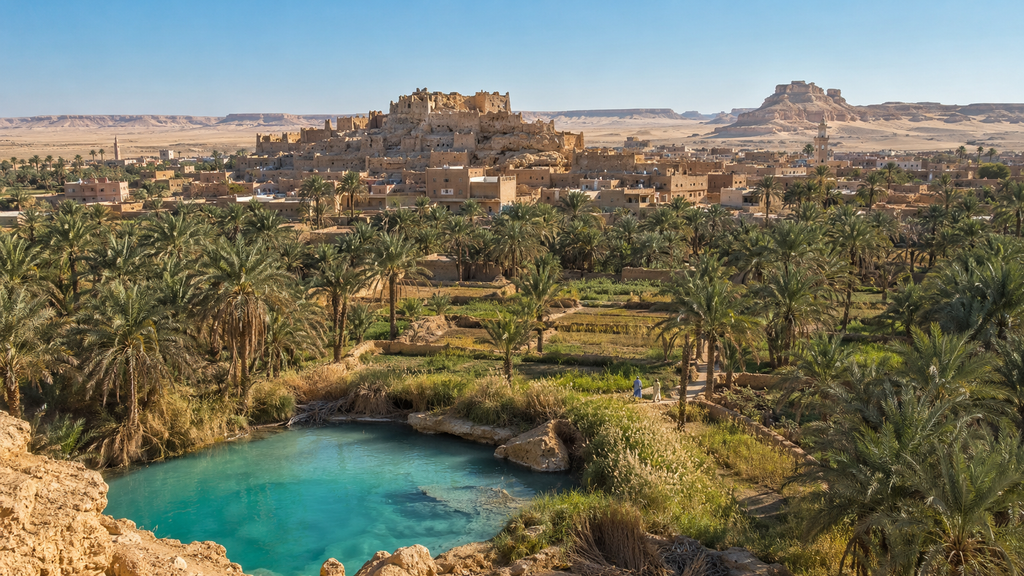
Most of Egypt’s population lives close to the Nile and its delta.
Siwa shows what happens when you travel far away from that corridor.
Located in Egypt’s Western Desert near the Libyan border, the oasis is geographically and culturally distinct from the country’s major Nile cities.
Palm groves and freshwater springs interrupt a vast desert environment.
Traditional mud-brick architecture appears alongside salt lakes and cultivated land.
Siwa also has a strong Amazigh cultural identity, adding another dimension to Egypt’s diversity.
The ruins of the ancient Oracle Temple of Amun connect the oasis with the ancient Mediterranean world. Alexander the Great is traditionally associated with a journey to the oracle after entering Egypt.
But Siwa is not interesting only because of archaeology.
Its isolation is part of the experience.
Reaching the oasis takes time, and that distance has helped preserve a character very different from Cairo, Luxor or the Red Sea resorts.
For travelers with a longer itinerary, Siwa demonstrates just how dramatically the Egyptian landscape can change.
7. The White Desert: A Landscape That Barely Looks Real
Southwest of Cairo, the Western Desert contains one of Egypt’s strangest natural environments.
The White Desert is famous for pale chalk formations shaped by wind and erosion.
Some rise like enormous mushrooms. Others resemble towers, animals or abstract sculptures depending on the angle from which they are viewed.
Against the surrounding desert, their white surfaces create a landscape that looks almost artificial.
There are no temples required to make this place extraordinary.
That is precisely why it belongs on a broader Egyptian itinerary.
Egypt’s international image is so strongly associated with archaeology that its natural landscapes can become secondary.
The White Desert reverses that expectation.
The attraction is geology, silence and open space.
Travel here generally requires appropriate desert transportation and experienced local arrangements rather than treating the area as an ordinary self-guided road trip.
The environment is remote and should be approached accordingly.
8. The Red Sea: An Entirely Different Egypt Underwater

Drive east toward the Red Sea and another version of Egypt appears.
Destinations along the coast are known for warm water, coral reefs, diving and snorkeling.
Underwater, the landscape has almost nothing in common with the archaeological sites of the Nile Valley.
Reef systems support colorful fish and other marine life, making the Egyptian Red Sea one of the country’s major attractions in its own right.
Hurghada is among the best-known resort centers and provides easy access to marine activities.
Farther south, areas around Marsa Alam appeal particularly to travelers interested in diving and less urbanized stretches of coastline.
The contrast can be surprising.
A single Egyptian itinerary can involve walking through a 3,000-year-old temple one day and swimming above a coral reef shortly afterward.
That combination of archaeology and natural environment is one of the country’s strongest travel advantages.
9. Dahab: Mountains, Desert and the Gulf of Aqaba
On the Sinai Peninsula, Dahab offers another interpretation of Egypt’s Red Sea coast.
The town sits beside the Gulf of Aqaba with the mountains of Sinai rising behind it.
Diving is a major reason people come here, but Dahab has developed a more relaxed identity than some of Egypt’s larger resort destinations.
Restaurants and small hotels line parts of the waterfront, while desert excursions and mountain landscapes begin surprisingly close to the coast.
The surrounding region also has deep connections with Bedouin communities, whose history and culture form an important part of Sinai.
This combination gives Dahab an unusual geography.
Look in one direction and you see clear blue water.
Turn around and dry mountains dominate the horizon.
For travelers whose image of Egypt consists mainly of the Nile and pyramids, Sinai can feel like another country entirely.
10. The Villages and Farmland Along the Nile
Not every place worth seeing in Egypt needs a famous name.
Travel between Luxor and Aswan and watch the riverbanks.
Here, another Egypt appears between the major archaeological sites.
Fields extend away from the water. Date palms rise above small settlements. Farmers work narrow areas of fertile land while boats move along the river.
The transition from green farmland to desert can be remarkably abrupt.
This narrow fertile corridor helps explain something fundamental about Egypt.
For thousands of years, the Nile made large-scale settlement and agriculture possible within an otherwise extremely dry region.
Ancient temples make that history spectacular.
The ordinary landscape makes it understandable.
Seeing agricultural life along the Nile provides context that a museum cannot reproduce.
The river is not simply a scenic backdrop for ancient monuments.
It remains part of everyday life.
How to Build an Egypt Trip Beyond the Pyramids
Trying to combine all ten places into one short holiday would defeat the purpose.
Egypt is larger than it appears when looking only at the main tourist route.
For a first trip of roughly one week, Cairo, Giza and Luxor already provide a strong introduction.
With additional time, Aswan fits naturally after Luxor.
Abu Simbel can then be added from southern Egypt.
Alexandria works in the opposite direction and can be combined with time in Cairo.
Siwa requires a larger commitment because of its remote western location.
The White Desert is another journey into the Western Desert rather than a simple addition between Nile destinations.
For travelers focused on diving or relaxation, adding the Red Sea makes more sense than trying to collect another archaeological site.
The important thing is not to see everything.
It is to choose two or three different sides of Egypt.
Combine a city with an archaeological region.
Add the Nile or desert.
Finish at the coast if time allows.
The contrasts are what make the country interesting.
Egypt Is Much More Than Its Ancient Monuments
Ancient Egypt will always dominate the country’s international image.
That is understandable.
The pyramids, royal tombs and monumental temples represent one of the most extraordinary archaeological legacies anywhere in the world.
But modern Egypt did not stop developing when the pharaohs disappeared.
Cairo became a vast contemporary capital.
Alexandria retained its Mediterranean identity.
Nubian communities continued traditions in southern Egypt.
Bedouin communities remained connected to desert regions and Sinai.
Millions of people still depend on the Nile corridor, while coastal cities developed around tourism, trade and marine environments.
Traveling beyond the pyramids does not make ancient Egypt less impressive.
It does the opposite.
Once you have seen the Nile, desert, agricultural land and different communities surrounding these monuments, the ancient civilization begins to exist within a real landscape rather than as an isolated chapter in a history book.
Final Thoughts
The pyramids may be the reason many people first dream about Egypt.
They should not be the only thing they remember.
Cairo shows the intensity of modern Egyptian city life. Alexandria opens toward the Mediterranean. Luxor contains an extraordinary concentration of ancient architecture, while Aswan introduces the landscapes and cultures of southern Egypt.
Farther away, Siwa interrupts the Western Desert with palms and springs. The White Desert replaces temples with strange geological formations. The Red Sea reveals coral reefs beneath clear water, and Sinai places mountains beside the coast.
Between all of them runs the Nile, supporting the narrow green corridor where much of Egyptian life has existed for thousands of years.
That variety is the real surprise.
Egypt is famous for looking backward into one of humanity’s great ancient civilizations.
Travel through enough of the country, however, and you discover that its geography, communities and everyday life are just as important to understanding the place as the monuments left behind.