
The Nile is more than a river running through Egypt. For thousands of years, it has shaped where people live, where food is grown, and where some of the country’s most remarkable temples and cities were built.
You understand this much more clearly when you travel south from Luxor toward Aswan.
On one side of the river, there are green fields, date palms, villages, and farmers working close to the water. Just beyond them, the landscape can suddenly turn into dry desert. Ancient temples appear along the route, sometimes only a short distance from ordinary towns where daily life continues around them.
This stretch of the Nile is also very different from Cairo.
There is less traffic, the landscape feels more open, and traveling by boat gives you time to notice things you would probably miss from a car or plane.
For a first trip to Egypt, the journey between Luxor and Aswan is one of the best ways to combine ancient history with a slower look at life along the Nile.
Here is what to expect, where to stop, and how to make the most of the journey.
Starting in Luxor
Luxor is the natural starting point for many journeys through southern Egypt.
The city stands on both sides of the Nile, surrounded by archaeological sites connected to ancient Thebes. You could easily spend several days here before traveling farther south.
On the east bank, Karnak Temple is the site that usually makes the strongest first impression.
The complex is enormous.
Its Great Hypostyle Hall contains rows of massive stone columns covered in hieroglyphs. Walking between them in the early morning, before the heat becomes intense, gives you a much better sense of their scale than any photograph can.
Luxor Temple is closer to the center of the modern city. It is particularly enjoyable later in the day, when the light softens and the temple begins to glow against the evening sky.
The west bank offers an entirely different experience.
This is where you will find the Valley of the Kings, the Temple of Hatshepsut, and the Colossi of Memnon.
Visiting the Valley of the Kings early is worth the effort. Temperatures rise quickly, and exploring several tombs in the middle of the day can become exhausting.
But Luxor is not only about archaeological sites.
Walk near the Nile in the late afternoon and the city takes on another personality. Feluccas cross the water, local boats move between the banks, and cafés begin filling as the strongest heat disappears.
Spending a quiet evening beside the river is a good introduction to the journey ahead.
Choosing How to Travel From Luxor to Aswan
There is no single way to travel between Luxor and Aswan.
The most famous option is a Nile cruise. Most conventional cruises take several days and stop at important archaeological sites along the river.
This is convenient because accommodation, transportation, and much of the sightseeing are combined into one trip.
But larger cruise ships are not the only choice.
A dahabiya offers a slower and more intimate experience. These traditional-style sailing boats usually carry far fewer passengers and can sometimes stop at smaller villages or quieter sections of the river.
For travelers who value the journey as much as the destinations, this can be an appealing option.
Independent travel is also possible.
Trains connect Luxor and Aswan, while cars or private drivers can be arranged for certain routes and excursions.
Each method creates a different experience.
A train gets you between the two cities efficiently. A cruise makes the river itself part of your trip. A dahabiya slows everything down.
If you have enough time, one of the river options gives you the best opportunity to appreciate the landscape between the two cities.
Watching Life Along the Nile
Some of the most interesting moments happen when there is no famous monument in sight.
From the river, you see a side of Egypt that can be difficult to notice on a fast itinerary.
Farmers work in narrow green fields beside the water. Children walk along village roads. Cattle graze near the riverbank. Small fishing boats drift past palms and reeds.
Then, sometimes only a short distance behind the fields, the desert begins.
The contrast between fertile farmland and dry desert is incredibly sharp.
It also explains why the Nile has been so important throughout Egyptian history. In many areas, almost everything green is concentrated around the river.
Early morning is particularly beautiful.
The water can be almost completely calm, and the light is softer than later in the day. Villages slowly become active while boats begin moving along the river.
Sunset offers another experience.
The heat fades, palms become silhouettes against the sky, and the surface of the Nile reflects the last light of the day.
These are simple moments, but they often become some of the strongest memories of the journey.
Visiting Edfu Temple
One of the major stops between Luxor and Aswan is Edfu.
The town is home to the Temple of Horus, one of the best-preserved ancient temples in Egypt.
The entrance alone is impressive.
A huge pylon rises above the courtyard, covered with carved scenes. Once inside, you move through courtyards, halls, and increasingly enclosed spaces leading toward the sanctuary.
Because so much of the structure survives, Edfu makes it easier to imagine how an ancient Egyptian temple may have functioned.
The walls are filled with inscriptions and reliefs depicting religious ceremonies, deities, and rulers.
If you arrive as part of a cruise itinerary, the site can become busy when several boats reach the area around the same time.
Try not to rush through it.
Look beyond the largest carvings and spend time examining the smaller details on the walls and columns.
The scale is impressive, but the details are what make the temple fascinating.
Kom Ombo: A Temple Beside the River
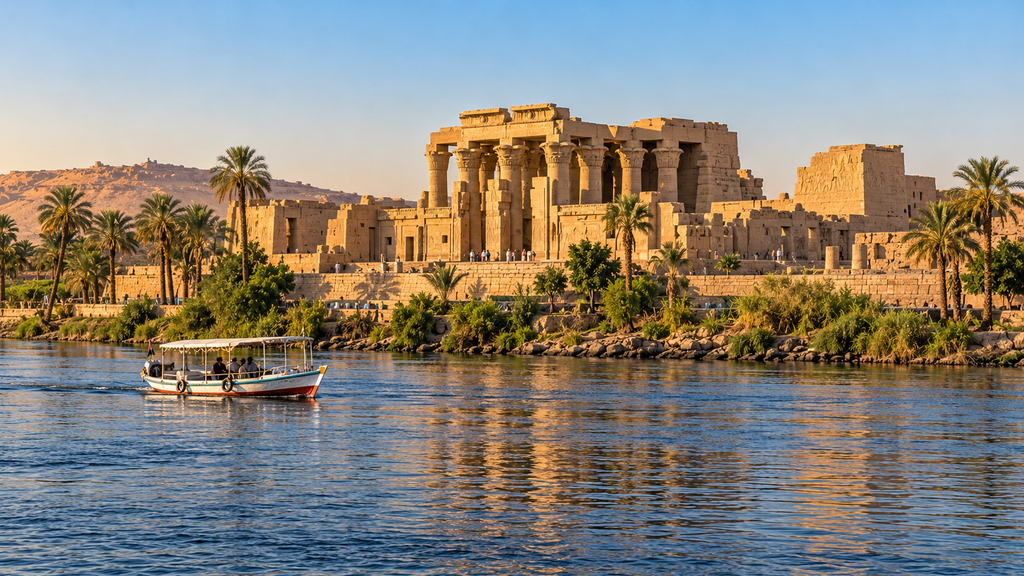
Continue south and you reach Kom Ombo.
Its location is one of the things that makes it memorable.
The temple stands on elevated ground beside the Nile, making it particularly atmospheric in the late afternoon.
Kom Ombo is unusual because the complex was dedicated principally to two deities: Sobek, associated with the crocodile, and the falcon-headed Haroeris.
This dual arrangement is reflected in parts of the temple’s design.
You will find reliefs, columns, courtyards, and carved scenes throughout the complex. Some details are especially interesting because they offer glimpses into religious practices and ancient ideas about medicine.
Nearby, the Crocodile Museum provides additional context about the importance of crocodiles in the area’s ancient religious traditions.
Kom Ombo does not require as much time as Karnak or the major sites around Luxor.
But its riverside location makes it an excellent stop on the journey south.
If your timing is right, leaving as the sun begins to set over the Nile can be one of the best views of the trip.
Arriving in Aswan
Aswan feels noticeably different from Luxor.
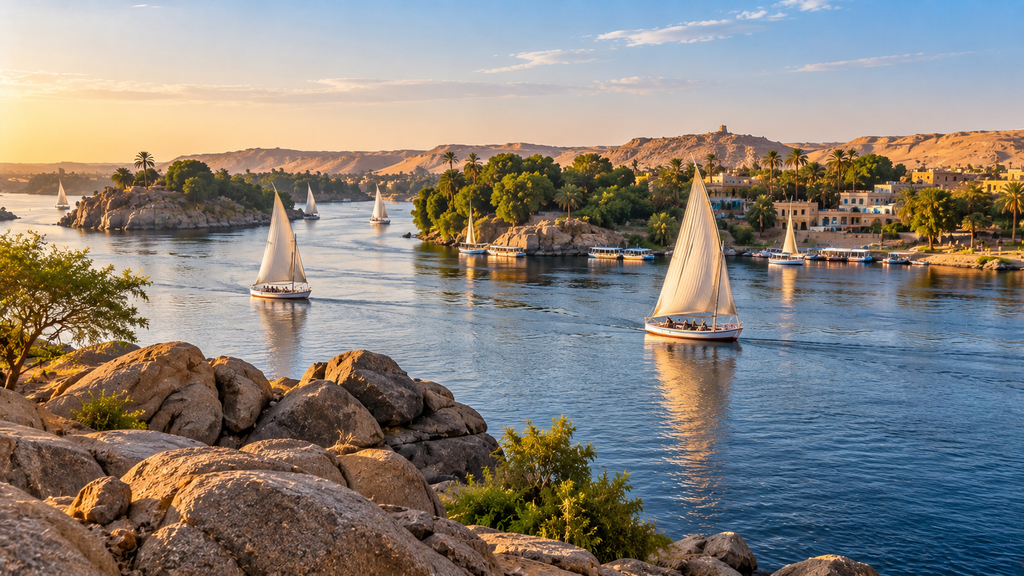
The Nile becomes dotted with islands, granite rocks, and small boats with white sails. The pace feels slower, and the surrounding landscape has a quieter character.
One of the simplest pleasures in Aswan is taking a felucca onto the Nile.
These traditional sailing boats depend on the wind rather than engines, so the experience can be wonderfully quiet. You hear the water against the boat, the movement of the sail, and sounds drifting from the riverbanks.
Elephantine Island sits in the Nile opposite central Aswan and is worth exploring if you have time.
The island has archaeological remains as well as residential areas, giving you a mixture of history and everyday life.
Another important stop is the Nubian Museum.
If you want to understand southern Egypt beyond its pharaonic monuments, this is one of the most valuable places to visit. The museum introduces the history and culture of Nubia, a region extending through southern Egypt and northern Sudan.
It also provides useful context before visiting Nubian communities around Aswan.
Experiencing Nubian Culture

A journey through southern Egypt is incomplete if you only focus on ancient temples.
Nubian culture remains an important part of the region’s identity.
Some Nubian villages around Aswan are known for brightly painted houses decorated with colorful patterns. Visitors can reach several communities by boat.
However, it is worth approaching these places as living communities rather than simply photo locations.
Take time to walk around, try local food, browse handmade products, and speak with residents when appropriate.
The experience can provide a completely different perspective on southern Egypt.
Traditional Nubian food, music, architecture, and language all reflect a cultural history distinct from what many first-time visitors associate with Egypt.
This is also one of the reasons Aswan deserves more than a rushed overnight stay.
The archaeological attractions are important, but the city’s atmosphere and living culture are equally rewarding.
Taking a Felucca on the Nile

If large cruise ships are one way of experiencing the Nile, a felucca is almost the opposite.
These traditional sailing boats are much smaller and simpler.
There is no large dining room, swimming pool, or air-conditioned cabin. Instead, the experience revolves around the river itself.
A short sunset trip is easy to arrange in Aswan and is suitable even if you have limited time.
Longer felucca journeys are also possible.
They move slowly and depend on wind conditions, so they are not ideal for travelers who want a tightly controlled schedule.
But that unpredictability is also part of the appeal.
You begin to travel according to the rhythm of the river rather than a sightseeing timetable.
For many travelers, a few quiet hours under sail become more memorable than another afternoon spent rushing between monuments.
Should You Visit Abu Simbel From Aswan?
Once you reach Aswan, one major question remains: should you continue to Abu Simbel?
For most first-time visitors, the answer is yes if the itinerary allows it.
Abu Simbel lies much farther south, close to the Sudanese border, so it is not technically part of the Luxor–Aswan river journey. However, Aswan is the main base used by travelers visiting the temples.
The Great Temple of Ramesses II is one of Egypt’s most recognizable ancient monuments.
Four enormous seated statues dominate the façade, creating an extraordinary first impression when you approach the site.
The temples are also famous for their modern preservation story.
During the construction of the Aswan High Dam, the monuments were threatened by rising water. An international campaign led by UNESCO helped dismantle and relocate the temples to higher ground during the 1960s.
Today, it is difficult to imagine that the enormous complex was moved.
Many tours leave Aswan very early in the morning.
The journey can make for a long day, but Abu Simbel is one of the few excursions where the scale of the destination makes the effort feel worthwhile.
How Many Days Do You Need?
A rushed Luxor-to-Aswan trip can be completed in only a few days, but slowing down improves the experience considerably.
For Luxor alone, two to three days is a sensible minimum if you want to explore both sides of the Nile without trying to fit everything into a single exhausting day.
A typical Nile cruise between Luxor and Aswan usually takes several days depending on the itinerary and direction of travel.
Once in Aswan, allow at least two days if possible.
That gives you time for the city, a felucca ride, Nubian culture, and perhaps a separate day trip to Abu Simbel.
Altogether, around six to eight days works well for a journey focused on Luxor, the Nile, and Aswan.
Travelers with more time can slow down further or combine the route with Cairo, the Red Sea, or another part of Egypt.
When Is the Best Time to Travel the Nile?
Weather can make a major difference to your experience in southern Egypt.
The cooler months are generally the most comfortable for sightseeing because many archaeological sites provide limited shade.
During hotter periods, temperatures can make walking around large temple complexes challenging, especially around midday.
Whatever time of year you visit, starting early is useful.
Morning light is beautiful along the Nile, archaeological sites can be quieter, and temperatures are often more comfortable.
A hat, sunscreen, comfortable shoes, and plenty of water are essential for days spent exploring outdoor sites.
Even when traveling by cruise ship, much of your sightseeing will involve walking in exposed areas.
Practical Tips for the Luxor to Aswan Journey
Do not try to fit every archaeological site into your itinerary.
After several days, temples can begin to blur together if you rush through too many of them.
Choose the places that interest you most and leave enough time to actually look around.
Carry some Egyptian cash for smaller purchases, tips, cafés, and situations where cards are not practical.
When arranging private transportation, tours, or boat trips, confirm the price and exactly what is included before leaving.
If you travel by cruise, check the itinerary carefully before booking. Different boats may include different stops, schedules, meals, and excursions.
It is also useful to pack light clothing for hot days while keeping something warmer for evenings, particularly during cooler months.
Most importantly, leave some unscheduled time.
One of the pleasures of traveling along the Nile is simply sitting somewhere and watching the river.
You do not need a monument in front of you every hour.
Why the Nile Journey Is Different From the Rest of Egypt
Cairo is energetic and often overwhelming.
Giza is monumental.
The Red Sea is about water, reefs, and relaxation.
But the Nile between Luxor and Aswan offers something different.
Here, ancient monuments and everyday life exist side by side.
You might spend the morning inside a temple built thousands of years ago and the afternoon watching farmers working fields beside the river.
You may pass a large cruise ship and then, minutes later, see a fisherman alone in a tiny wooden boat.
The landscape constantly moves between green and gold: fertile riverbanks on one side and desert immediately behind them.
Traveling slowly makes these contrasts easier to notice.
And that is perhaps the greatest reason to choose the river instead of simply flying between destinations.
Final Thoughts
Luxor and Aswan contain enough famous attractions to justify a trip on their own.
But traveling between them reveals something that individual monuments cannot.
The Nile connects the entire experience.
It carries you past farmland, villages, palm trees, temples, islands, fishing boats, and stretches of desert. It shows why cities developed where they did and why this river has remained central to life in Egypt for thousands of years.
Karnak may leave you speechless because of its scale. Edfu may impress you with its preservation. Kom Ombo may stay in your memory because of its position beside the water. Aswan may win you over with its slower rhythm.
But somewhere between those places, you may find that the best part of the journey is simply watching Egypt pass by from the river.
If you have enough time on your first trip to Egypt, don’t just visit Luxor and Aswan as two separate destinations.
Travel the Nile between them.
The journey is part of the experience.