
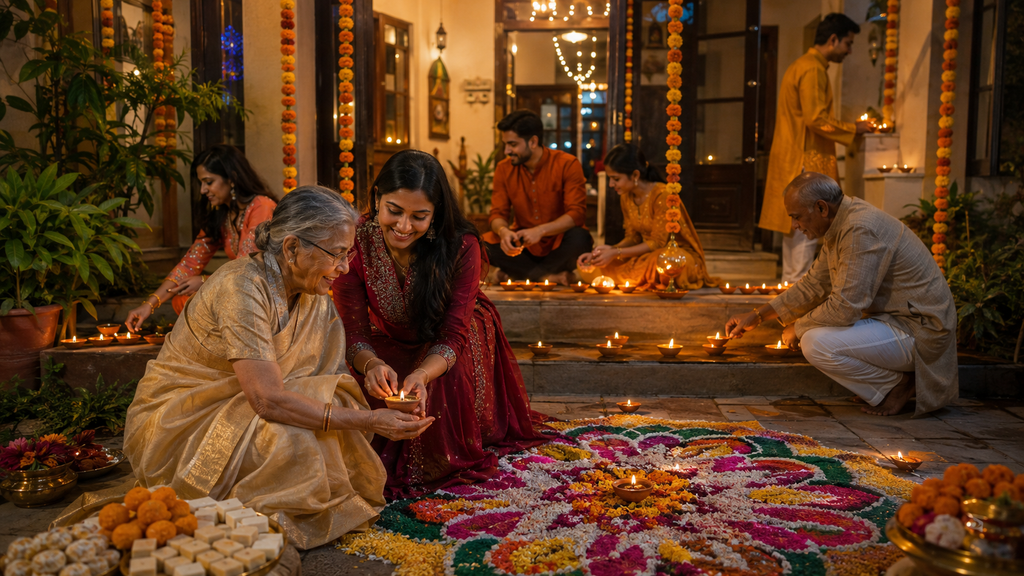
Before traveling through India, I knew the names of several Indian festivals.
Diwali meant lights.
Holi meant colors.
I had seen photographs of temples crowded with worshippers, lamps floating on rivers and streets covered in bright powder.
I thought I understood the basic picture.
Then I arrived in India and realized that I had been looking at festivals mostly as visual events.
Beautiful things to photograph.
What I had not understood was how deeply faith, family, food and community could overlap with everyday life.
Religion was not always hidden behind temple walls.
Sometimes it appeared in a tiny shrine beside a busy road.
Sometimes in flowers placed outside a home.
Sometimes in the sound of bells early in the morning.
Sometimes in a Sikh gurdwara serving free meals to hundreds of people.
Sometimes in a Muslim neighborhood preparing for Eid.
And sometimes in a family quietly lighting a small oil lamp at home.
The more I traveled, the less comfortable I became with the phrase “Indian culture” as though it described one single tradition.
India contains many cultures.
Many languages.
Many religions.
Many ways of celebrating.
Festivals gave me one of the most interesting ways to begin understanding that diversity.
My First Surprise Was How Visible Faith Could Be
In some countries, religion can feel separated from ordinary public life.
India often felt different.
I would leave a hotel in the morning and pass a tiny shrine.
A few minutes later, someone might be placing flowers near an image of a deity.
Further down the street, temple bells could be ringing.
In another neighborhood, I might hear the call to prayer from a mosque.
Elsewhere, I would see a Sikh gurdwara or a Christian church.
None of these experiences alone explains India.
Together, they showed me that faith can be deeply woven into the country’s physical and social landscape.
India Is Not One Religious Story
This is probably the most important thing I learned.
International travel imagery often presents India primarily through Hindu temples, Hindu festivals and Hindu rituals.
Hinduism is enormously important to Indian history and culture.
But it is not the entire story.
India is also home to large Muslim communities and significant Sikh, Christian, Buddhist, Jain and other religious communities.
There are also Indians who are secular, atheist or simply less religious in everyday life.
Even within the same religion, practices can vary enormously by region, community and family.
The longer I traveled, the less interested I became in asking:
“What do Indians believe?”
That question is simply too broad.
My First Temple Visit Made Me Slow Down
Temples had been on my itinerary from the beginning.
Initially, I approached them the same way I approached historical monuments.
Look at the architecture.
Read about the history.
Take photographs.
Move to the next place.
That approach did not always work.
A functioning temple is not simply an architectural attraction.
People are there to worship.
Someone may be praying while you are admiring a carved doorway.
A family may be making an offering while you are trying to find the best camera angle.
A priest may be performing a ritual that has nothing to do with tourism.
Once I understood that, my behavior changed.
I slowed down.
Shoes Were Usually the First Clue
At many religious sites in India, footwear needs to be removed before entering particular areas.
Sometimes the rule is obvious.
Hundreds of shoes are waiting outside.
Sometimes there is a designated place to leave them.
Sometimes the boundary is less clear.
I learned not to guess.
Watch other visitors.
Look for instructions.
Ask someone if necessary.
Removing shoes takes a few seconds.
Walking into a sacred space wearing them because you were too embarrassed to ask is a much worse option.
Clothing Matters Too
India can be extremely hot.
That does not mean every item of hot-weather travel clothing is appropriate inside every religious site.
I began carrying a light scarf or something that could help cover shoulders when necessary.
At some places, additional requirements may apply.
Sikh gurdwaras, for example, generally require visitors to cover their heads.
Different temples, mosques and other religious sites may have their own expectations.
There is no universal dress code for every sacred place in India.
The safest approach is simple:
Check before entering.
I Stopped Assuming Photography Was Allowed
This was another habit I had to change.
India is extraordinarily photogenic.
That can become a problem.
A ritual is happening.
Beautiful light enters a temple.
Someone is praying.
Your instinct says:
Photo.
But worship is not a performance for visitors.
Some religious sites prohibit photography entirely.
Others allow photography in certain areas but not others.
Even where cameras are permitted, photographing an individual during a private religious moment can still feel intrusive.
I started asking myself a different question.
Not:
“Can I get this photograph?”
But:
“Should I?”
Those are not always the same thing.
Morning Rituals Felt Different From Festival Crowds
Some of my strongest memories of faith in India came from ordinary mornings rather than major celebrations.
People arrived quietly.
Flowers were carried.
Incense burned.
Small lamps were lit.
Prayers were performed before work.
Nothing dramatic was happening.
That was exactly why I found it interesting.
Festivals show culture at maximum volume.
Morning rituals show what continues when the festival is over.
Both matter.
Varanasi Changed How I Thought About Sacred Places
Few places made the connection between faith and everyday life as visible to me as Varanasi.
The Ganges is not simply a river passing through the city.
For millions of Hindus, it has profound religious significance.
Early in the morning, I watched people approach the ghats.
Some bathed.
Some prayed.
Some made offerings.
Others simply sat beside the river.
Boats moved through the morning haze.
Tea sellers were already working.
Dogs slept on steps.
Pilgrims arrived.
Tourists watched.
Ordinary life and sacred life occupied the same space.
There was no clean boundary between them.
Sunrise on the Ganges Was Quieter Than I Expected
I had seen photographs of Varanasi before visiting.
Many made the city look permanently dramatic.
Fire.
Smoke.
Crowds.
Ceremonies.
Color.
But early morning could feel surprisingly gentle.
The river changed slowly with the light.
People performed rituals without paying much attention to the cameras around them.
From a boat, I could watch without standing directly inside someone’s personal space.
That distance helped.
I felt less like I was consuming a ritual and more like I was observing a city beginning its day.
The Evening Aarti Was Completely Different
If morning on the river felt intimate, evening could feel theatrical in scale.
At major ghats, the Ganga Aarti draws large crowds.
Priests perform coordinated rituals using lamps, incense and other ceremonial objects.
People watch from the steps and from boats on the river.
The atmosphere can be intense.
Sound.
Fire.
Movement.
Prayer.
Crowds.
Phones.
Cameras.
Devotion and tourism exist side by side.
That combination made me uncomfortable at first.
Then I realized that modern pilgrimage sites often contain both.
The challenge as a visitor is to remember which one matters more.
Then I Began Understanding Diwali Beyond the Lights
Before visiting India, Diwali was probably the Indian festival I recognized most easily.
Rows of lamps.
Decorated homes.
Fireworks.
Bright clothing.
Sweets.
The visual side is spectacular.
But describing Diwali only as the “Festival of Lights” barely begins the story.
Its meanings and traditions vary between regions and religious communities.
For many Hindu families, Diwali carries religious, family and cultural significance connected with different traditions and stories.
Jains and Sikhs also observe important occasions around the broader Diwali period, though with distinct meanings.
The details matter.
What Interested Me Most Was What Happened at Home
Large public celebrations are easy to photograph.
Homes were more interesting.
Cleaning.
Decorating.
Preparing sweets.
Buying gifts.
Lighting diyas.
Creating rangoli designs.
Visiting relatives.
Putting on special clothing.
Sharing food.
The festival entered everyday domestic spaces.
That made Diwali feel less like an event people attended and more like something families created around themselves.
The preparation was part of the celebration.
A Diya Looks Different When Someone Explains Why It Is There
A small oil lamp is visually simple.
Flame.
Oil.
A small clay container.
Photographed alone, it is beautiful.
But when someone explains why lamps are being lit, when they are placed, who participates and what the occasion means to their family, the object changes.
Travel taught me this repeatedly.
Context makes ordinary objects more interesting.
Without context, I was collecting photographs.
With context, I was learning.
The Sweets Were Dangerous
Every major celebration seems to create a socially acceptable reason to eat enormous amounts of food.
India does this extremely well.
During festive periods, sweets appear everywhere.
Laddu.
Barfi.
Jalebi.
Kaju katli.
Gulab jamun.
And countless regional specialties.
Someone offers you one.
You eat it.
Someone else offers another.
You explain that you already had one.
Apparently, that information has no legal significance.
You eat another.
Festival hospitality can destroy even the strongest intention to “just try a little.”
I eventually stopped resisting.
Holi Looked Like Chaos From a Distance
My understanding of Holi came almost entirely from photographs.
People covered in bright powder.
Crowded streets.
Everyone laughing.
Color exploding through the air.
It looked like one enormous national party.
Reality is more complicated.
Holi has religious and cultural meanings, and celebrations vary significantly across India.
Some places are famous for large public celebrations.
Elsewhere, the festival may be more local or family-oriented.
The experience can change dramatically depending on where you are.
That matters for travelers.
Holi Is Not Permission to Forget Personal Boundaries
This is important.
A festival involving color does not mean every person automatically wants strangers touching them or throwing powder at them.
Consent still matters.
Local conditions matter.
Crowd behavior matters.
Travelers should not assume that because they saw a photograph of Holi online, every street in India becomes an unrestricted color fight.
I preferred organized or well-understood celebrations where I knew what kind of environment I was entering.
That made the experience much more enjoyable.
Protecting My Camera Became a Serious Mission
Color powder and expensive camera equipment are not natural friends.
Neither are water and phones.
If you attend a Holi celebration, bring only what you are prepared to protect.
A waterproof phone pouch can be useful.
A cheap protective covering for a camera is better than optimism.
Wear clothing you do not mind staining.
And understand that “I will just stand at the edge and stay clean” is an ambitious theory.
Holi has excellent range.
The Festival Made More Sense After I Learned the Stories Behind It
Holi is often described internationally as a celebration of spring, color and joy.
Those descriptions are not wrong.
But religious stories and regional traditions add much more depth.
Different communities may emphasize different narratives and customs.
This was another moment when I realized how travel marketing simplifies festivals.
“Come throw colors!”
is easy to advertise.
Understanding why a festival exists requires more effort.
That effort is worth it.
A Sikh Gurdwara Gave Me One of My Strongest Memories
Some of the most powerful religious experiences I had in India did not involve a festival at all.
Visiting a Sikh gurdwara was one of them.
Before entering, I covered my head and removed my shoes according to the site’s customs.
The atmosphere felt welcoming but disciplined.
People came to pray.
Visitors moved quietly.
Volunteers worked.
Then I encountered one of the traditions that stayed with me most strongly:
Langar.
Langar Changed My Understanding of Hospitality
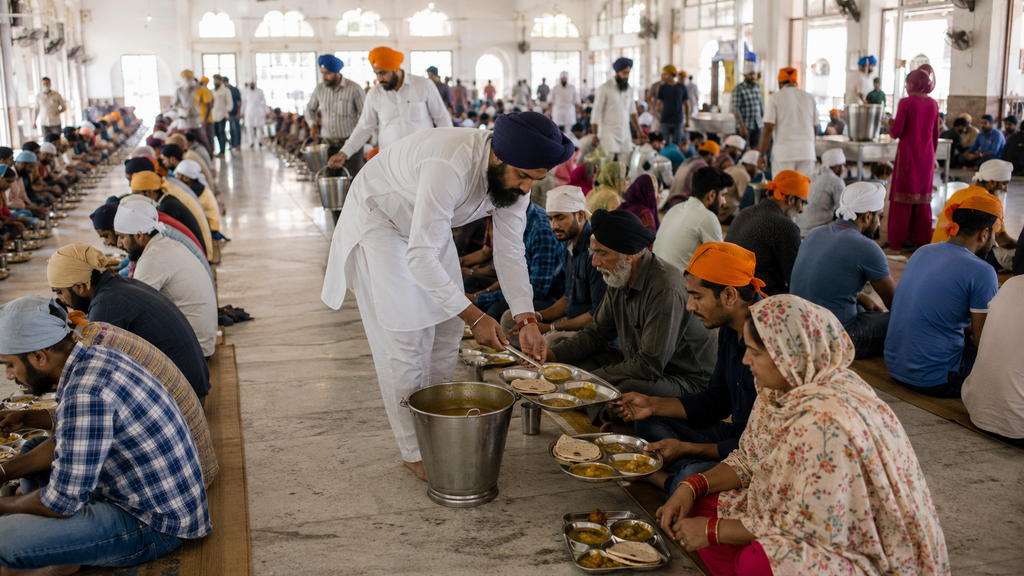
Langar is the community kitchen tradition associated with Sikh gurdwaras.
Meals are served without distinction of wealth, social status or background.
At major gurdwaras, the scale can be extraordinary.
People prepare vegetables.
Cook.
Wash dishes.
Serve food.
Clean floors.
Everything depends on volunteers.
Then people sit together and eat.
I had experienced hospitality in Indian homes.
Langar showed hospitality operating at community scale.
The idea was not simply:
“We will feed our guests.”
It was closer to:
“Everyone can eat.”
That is powerful.
Sitting Together Was Part of the Meaning
The food itself could be simple.
Dal.
Vegetables.
Rice.
Roti.
The point was not luxury.
The experience came from sharing the same space.
People from different backgrounds sitting together.
Volunteers moving along the rows.
Food being served efficiently.
More arriving when needed.
Nobody asking whether you could afford the meal.
I had eaten far more elaborate food elsewhere in India.
Few meals taught me as much.
The Golden Temple Made the Idea Even More Visible
Amritsar’s Golden Temple is one of the most recognizable religious sites in India and the spiritual center of Sikhism.
Its beauty is immediately obvious.
The golden structure reflected in the surrounding water.
Pilgrims moving around the complex.
Music and prayer.
But focusing only on the architecture would miss part of what makes the place remarkable.
The enormous langar operation nearby turns principles of service and equality into something physical.
People actually have to chop the vegetables.
Cook the food.
Carry the plates.
Wash everything.
Belief becomes work.
I found that deeply memorable.
Service Was Another Form of Faith
Before visiting Sikh religious spaces, I tended to think of religious practice primarily as prayer or ceremony.
Seva, or selfless service, expanded that understanding.
Volunteering can itself become an expression of faith.
Cooking.
Cleaning.
Helping.
Serving.
The concept appeared simple.
Watching it happen at scale made it much more meaningful.
Religion was not only something people believed.
It was something people did.
India’s Muslim Culture Added Another Layer
Traveling through India also meant encountering the country’s enormous Muslim heritage and living Muslim communities.
Delhi alone makes this impossible to ignore.
Mosques.
Markets.
Architecture.
Food.
Neighborhood traditions.
Centuries of history.
Places such as Old Delhi felt completely different when I stopped seeing Islamic architecture only as historical monuments and started paying attention to the communities still living around them.
Jama Masjid Was Not Just a Landmark
Delhi’s Jama Masjid is visually impressive.
Large courtyard.
Red sandstone.
Domes.
Minarets.
It would be easy to visit only for architecture.
But it remains an active mosque.
People come to pray.
Religious life continues around the same structure tourists come to photograph.
That required the same adjustment I had learned at Hindu temples.
I was not entering an abandoned historical site.
I was entering someone else’s place of worship.
The difference matters.
Ramadan Changed the Rhythm of Some Neighborhoods
If you visit Muslim areas during Ramadan, the daily rhythm can change.
Fasting takes place from dawn until sunset for observant Muslims.
Then comes iftar.
Food appears.
Families and communities gather.
Markets may become particularly lively in the evening.
For a traveler, the atmosphere can be fascinating.
But again, it is important not to reduce a religious month to a food-tour opportunity.
The meals are connected to worship, discipline and community.
Understanding that makes the experience richer.
Eid Was About More Than Special Food
Food is one of the easiest parts of a celebration for a traveler to notice.
Special dishes.
Sweets.
Busy markets.
Families eating together.
But Eid also involves prayer, charity, family visits and community.
The exact traditions vary.
The more festivals I encountered, the more I noticed the same mistake in my own thinking.
I focused first on what I could see.
Color.
Food.
Clothing.
Decoration.
The deeper meaning often required conversation.
Then Bengal Completely Changed the Scale Again
Durga Puja showed me another version of festival culture.
Particularly associated with West Bengal and especially Kolkata, Durga Puja can transform entire neighborhoods.
Temporary structures known as pandals are created.
Images of Goddess Durga become central to worship and celebration.
Crowds move between different sites.
Art.
Religion.
Community organization.
Food.
Nightlife.
Everything overlaps.
It can feel like an entire city has become part gallery, part religious celebration and part social gathering.
The Pandals Were More Creative Than I Expected
I assumed they would all look traditionally religious.
Many did.
Others were astonishingly imaginative.
Themes.
Materials.
Architecture.
Artistic concepts.
Social messages.
Every year can bring new designs.
People travel around the city specifically to see different pandals.
This showed me another side of religious culture in India.
Tradition does not necessarily mean repeating the exact same visual form forever.
Creativity can become part of the tradition.
Southern India Gave Me Completely Different Festivals
By this point, I had learned not to expect one national pattern.
Kerala reinforced that lesson.
Onam, for example, is deeply associated with Kerala and includes traditions that may involve floral decorations, family gatherings, cultural performances and elaborate meals.
The famous Onam sadya can include a large variety of vegetarian dishes traditionally served on a banana leaf.
Again, food becomes part of cultural memory.
But the festival cannot be reduced to the meal.
Its stories, regional identity and community traditions matter too.
A Banana Leaf Meal Was Its Own Education
The first time I faced a large traditional meal served on a banana leaf, I realized there was an order to things I did not understand.
Different dishes occupied different positions.
More food arrived.
Rice became the center.
People mixed different combinations.
I watched.
That became my strategy throughout India.
Instead of asking for a ten-minute lecture before eating, I watched the people around me.
Then copied them badly.
Then improved.
Cultural learning does not always need to be formal.
Sometimes you learn by being hungry and paying attention.
Festivals Change From Region to Region
This became one of the most important lessons of the trip.
Diwali is not celebrated identically everywhere.
Holi is not experienced the same way in every city.
Harvest festivals vary.
New Year traditions vary.
Religious calendars vary.
Regional identities matter.
Language matters.
Local history matters.
If you are planning a trip specifically around a festival, research the particular destination rather than reading only a generic “India festival guide.”
The city can completely change the experience.
Even the Same Festival Can Feel Different Between Families
One family may celebrate extensively.
Another may keep things quiet.
Someone may be deeply religious.
Another person may enjoy the cultural side more than the religious side.
Young people may reinterpret traditions.
Families living abroad may celebrate differently from relatives in India.
This is normal.
Culture is lived by individuals.
It is not enforced by a tourism brochure.
Festivals Can Be Wonderful and Exhausting
Travel photographs rarely communicate heat.
Noise.
Crowds.
Waiting.
Traffic.
Long walks.
Blocked roads.
Limited transportation.
Festival travel can be extraordinary.
It can also be tiring.
Major celebrations may dramatically increase demand for hotels and transportation.
Streets can become packed.
Some attractions may close or operate differently.
If a festival is central to your trip, plan around it.
Do not simply arrive and assume everything will function normally.
Crowds Require More Awareness
Large festivals can create extremely dense crowds.
Keep valuables secure.
Carry minimal belongings.
Know where you are going.
Agree on a meeting point if traveling with others.
Do not depend entirely on mobile service in a packed area.
Follow local instructions and crowd-control measures.
And if a situation feels too dense or uncomfortable, leave.
You do not need to stand at the absolute center of a crowd to have a meaningful experience.
I Learned to Stop Chasing the “Perfect” Photograph
Festivals are visually irresistible.
A person holding a lamp.
Colored powder in the air.
A child in festive clothing.
A prayer ceremony.
Flowers.
Fire.
Beautiful architecture.
It is easy to experience the entire event through a screen.
I did that sometimes.
Then I would realize I had watched something extraordinary through a three-inch display.
Eventually, I began taking a few photographs and putting the camera away.
Memory deserves some storage space too.
Asking Permission Changed My Photographs
When I wanted a closer photograph of someone, asking often created a better interaction.
Sometimes the answer was yes.
Sometimes no.
Both were fine.
When someone agreed, the photograph had context.
Maybe we talked afterward.
Maybe they explained what they were carrying.
Maybe I learned why they were dressed a certain way.
The photograph became part of an encounter instead of something I took from a stranger.
Not Every Sacred Moment Needs to Become Content
This lesson feels increasingly important in modern travel.
A ritual does not exist because I need material for an article.
A funeral ceremony is not “great content.”
Someone praying is not a prop.
A religious leader is not part of a theme park.
There are moments when the respectful choice is to put the phone away.
Travel becomes better when you accept that you do not need to document everything.
Food Helped Me Understand Festivals
Again and again, food became the easiest doorway into cultural understanding.
Why is this sweet prepared now?
Why is this dish vegetarian?
Why is this ingredient important?
Who makes it?
Is it prepared at home?
Do you eat it every year?
Suddenly the conversation moved from food into religion, agriculture, family history and regional identity.
A plate could explain a festival better than a paragraph on a sign.
Family Was Never Far Away
Even though this journey taught me about faith, it also kept returning to family.
Festivals often meant going home.
Visiting relatives.
Cooking together.
Buying gifts.
Calling family members who lived elsewhere.
Children learning traditions from parents and grandparents.
Religious festivals were also social structures connecting generations.
That connection helped me understand why traditions can remain powerful even as cities modernize.
Modern India and Religious Tradition Exist Together
I could leave an ancient temple and see someone ordering a ride on a smartphone.
A family might perform a ritual and then take selfies.
A gurdwara could coordinate volunteers at enormous scale using modern systems.
Festival decorations could incorporate new technology.
Young people could wear traditional clothing while posting everything online.
None of this seemed contradictory after a while.
Tradition does not require pretending the modern world does not exist.
Young People Are Reinterpreting Festivals Too
Some younger Indians I met were deeply enthusiastic about religious traditions.
Others were more interested in the social and family side.
Some cared about environmental issues related to celebrations.
Others questioned particular customs.
Many combined modern lifestyles with traditions that still mattered to them.
This is another reason I avoid writing that “Indians believe” or “Indians celebrate” something in one fixed way.
Cultures contain disagreement.
That is part of being alive.
Environmental Questions Are Becoming Part of Festivals
Large celebrations can create environmental challenges.
Fireworks affect air quality.
Plastic decorations create waste.
Chemical colors can cause problems.
Large temporary structures require materials.
Religious offerings can affect waterways if handled irresponsibly.
These concerns have encouraged conversations about cleaner and more sustainable forms of celebration.
Natural colors.
Reusable materials.
Reduced waste.
Alternative decorations.
Traditions can adapt without losing all meaning.
What I Learned About Visiting Religious Sites
After many visits, my approach became simple.
I checked the rules.
Removed shoes when required.
Covered my head when required.
Dressed respectfully.
Avoided interrupting worship.
Asked before taking sensitive photographs.
Stayed out of restricted areas.
Accepted that some places were not accessible to everyone.
And tried not to make myself the center of the experience.
It is surprisingly easy.
Most cultural respect is not complicated.
It requires attention.
You Do Not Need to Participate in Everything
Sometimes visitors feel pressure to join every ritual.
You do not.
Observation can be respectful.
If someone invites you to participate and you understand what is happening, you can decide whether you feel comfortable.
But participation should not become performance.
I did not need to imitate worship to prove that I appreciated it.
Sometimes standing quietly was enough.
Ask Before Making Assumptions
If you do not understand something, ask respectfully.
Why are people doing this?
Can visitors enter?
Should I cover my head?
Can I take photographs here?
Is this food connected to the festival?
Most of my best cultural conversations began with simple questions.
Ignorance is not the problem.
Pretending to understand something you do not understand is usually worse.
India Made Me More Careful With the Word “Tradition”
We often talk about tradition as though it is ancient and unchanged.
But many traditions evolve.
Celebrations change.
Technology changes.
Cities change.
Families change.
Environmental concerns change practices.
Migration spreads traditions to new places.
Commercialization affects festivals.
Tourism affects them too.
A tradition can be old and still changing.
Those ideas are not opposites.
Tourism Can Change Religious Celebrations
This became particularly visible at famous destinations.
Travelers arrive because a ritual or festival looks extraordinary.
Hotels advertise it.
Tours appear.
Photography increases.
Local businesses benefit.
Crowds grow.
The event changes.
This does not automatically destroy authenticity.
Cultures have always adapted to economic and social conditions.
But visitors should recognize that our presence is part of the environment.
We are not invisible observers.
I Became Less Interested in “Authenticity”
Travelers love asking whether something is authentic.
Is this the real festival?
Is this ceremony authentic?
Is this neighborhood too touristy?
I began finding those questions less useful.
A festival can be ancient and commercial at the same time.
A religious site can serve worshippers and tourists simultaneously.
A young person can celebrate a traditional festival and post it on social media.
Reality is messy.
That does not make it fake.
The Quiet Moments Stayed With Me Most
Strangely, after seeing large ceremonies and colorful festivals, some of my strongest memories remained small.
A person arranging flowers.
Someone washing the floor of a religious space.
A volunteer serving another plate of dal.
A family lighting lamps outside their home.
An elderly man sitting quietly after prayer.
Children helping decorate.
A woman carrying an offering early in the morning.
These moments did not look spectacular.
They felt human.
What First-Time Visitors Should Remember
You do not need to understand every Indian religion before traveling.
That would be impossible.
Start with respect.
Learn about the places you plan to visit.
Remember that temples, mosques, gurdwaras, churches and other sacred spaces may have different rules.
Dress appropriately.
Watch what others do.
Ask before photographing people.
Do not assume every Indian celebrates every festival.
Do not reduce religious traditions to colorful entertainment.
And remain curious.
India will give you plenty to ask about.
If You Want to Experience a Festival, Plan Early
Major festival periods can dramatically affect travel.
Transportation may become busy.
Hotels can fill.
Prices may rise.
Opening hours can change.
Roads may close.
Crowds may be intense.
Exact festival dates can also vary from year to year because many celebrations follow religious or lunar calendars.
Always verify current dates before booking a trip specifically around a festival.
Planning matters.
But Leave Space for Unexpected Moments
Some of my best experiences were not scheduled.
A small neighborhood celebration.
Music I heard while walking.
A temple ceremony I did not know was happening.
A conversation over festival sweets.
A family explaining decorations.
These moments happened because I had enough time to stop.
A packed itinerary can prevent that.
India rewards curiosity, but curiosity needs time.
What Traveling in India Changed for Me
Before the trip, I saw festivals as events.
Now I think of them more as intersections.
Faith meets family.
Food meets memory.
Religion meets community.
Art meets tradition.
History meets modern life.
Private belief meets public celebration.
That is why a photograph of colored powder or rows of lamps can never explain the whole experience.
The visible part is only the surface.
Final Thoughts
India gave me some of the most visually spectacular cultural experiences I have encountered while traveling.
Diwali lights.
Holi colors.
Temple architecture.
The Ganges at sunrise.
The Golden Temple reflected in water.
Festival decorations filling entire neighborhoods.
But the longer I traveled, the less important spectacle became.
I began paying attention to smaller things.
The person removing their shoes before entering a sacred space.
A family preparing food together.
A volunteer serving a stranger.
A lamp being lit quietly at home.
A child learning what to do by watching a grandparent.
A traveler lowering their camera because a moment did not belong to them.
Those details changed how I understood Indian festivals and culture.
India does not have one faith.
It does not have one festival tradition.
It does not have one cultural identity.
Its Hindu, Muslim, Sikh, Christian, Buddhist, Jain and other communities have shaped the country in different ways, while regional identities add even more layers.
Trying to simplify all of that into one definition of “Indian culture” misses the point.
The diversity is the point.
If you travel through India during a festival, enjoy the colors.
Eat the food.
Admire the decorations.
Listen to the music.
Take photographs when appropriate.
But also ask why people are celebrating.
Notice what happens away from the biggest crowds.
Watch how families participate.
Learn what the occasion means in that particular place.
And occasionally put the camera away.
Because some of the most important things you learn about India are not the things you photograph.
They are the things you finally stop long enough to notice.