
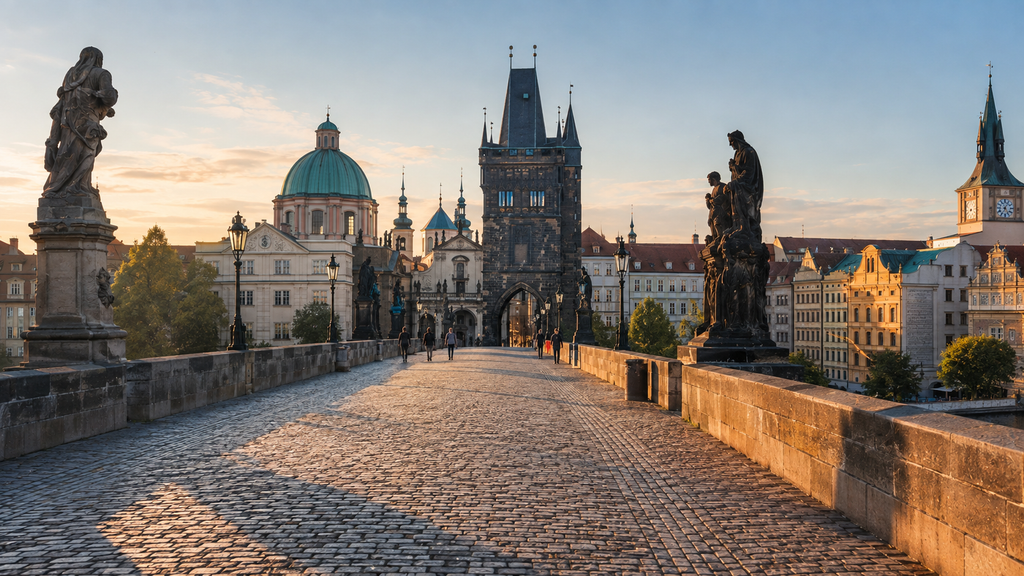
Prague is one of those cities that can look almost too perfect in photographs.
Church towers rise above red rooftops, old trams move between historic buildings, and the Vltava River divides neighborhoods connected by beautiful stone bridges. Prague Castle dominates the skyline from one side of the river, while the narrow streets of the Old Town seem to lead toward another church, courtyard, café, or hidden passage every few minutes.
But Prague is much more enjoyable when you stop treating it as a checklist of famous landmarks.
The city is compact enough that walking becomes part of the experience. Between the major attractions, you pass quiet residential streets, small squares, local bakeries, traditional pubs, parks, and viewpoints that are easy to miss when following a strict itinerary.
For a first visit, I would give Prague at least three full days.
That is enough time to explore the Old Town, cross the river into Malá Strana, spend several hours around Prague Castle, and still have time to experience the city after the busiest sightseeing hours.
Four days is even better if you prefer traveling slowly.
Here are the places I would prioritize on a first trip to Prague.
1. Charles Bridge Early in the Morning
Charles Bridge is probably the most recognizable landmark in Prague.
It is also one of the places where timing can completely change your experience.
Visit around the middle of the day and the bridge can become extremely busy. Tour groups, street artists, photographers, and visitors stopping for pictures fill much of the walkway.
Come early in the morning and it feels like a different place.
The city is quieter, the light over the Vltava River is softer, and there is enough space to notice the bridge itself rather than constantly navigating around other people.
Walking toward Malá Strana gives you one of the classic views of Prague Castle rising above the surrounding rooftops.
But don’t rush across.
Stop occasionally and look back toward the towers of the Old Town. Boats move slowly along the river below, while church domes and historic buildings create layers across the skyline.
Charles Bridge is not a place that needs a long list of activities.
Walking slowly is enough.
If photography matters to you, early morning is easily the best time to visit.
2. Prague Castle
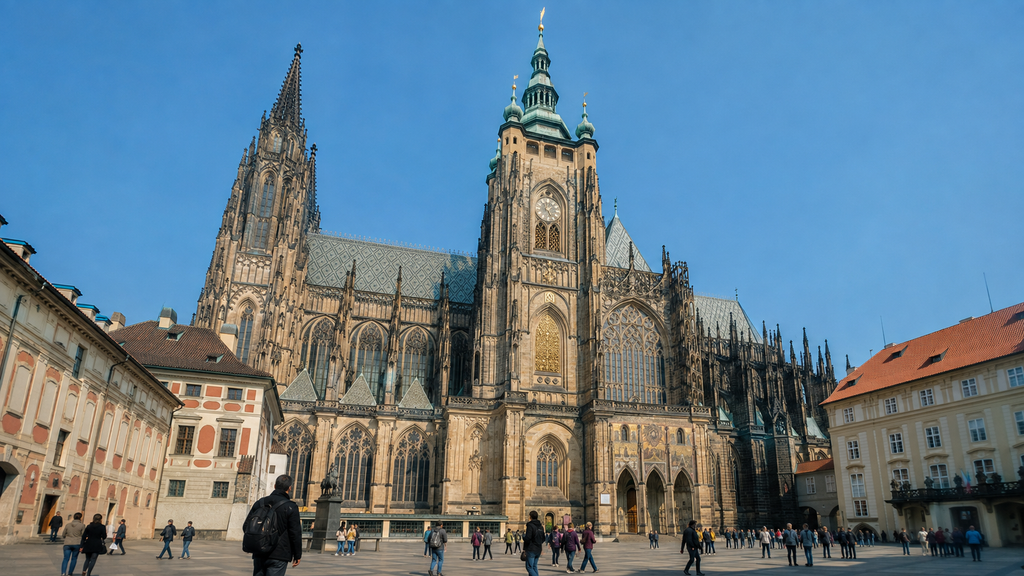
Prague Castle looks like a single attraction from a distance.
Once you arrive, you realize it is an enormous complex containing churches, courtyards, historic buildings, gardens, and viewpoints.
Give yourself several hours here.
Trying to squeeze Prague Castle into a short stop between other attractions usually means spending more time watching the clock than looking around.
The dominant landmark is St. Vitus Cathedral.
Its Gothic towers are visible from many parts of Prague, but standing directly beneath the cathedral reveals how much architectural detail disappears when viewed from across the river.
Inside, the scale changes again.
High vaulted ceilings, stained glass, chapels, stone carvings, and centuries of religious and royal history make the cathedral one of the most impressive interiors in the city.
Elsewhere in the castle complex, you can explore historic courtyards and buildings associated with generations of Czech rulers.
The location is equally important.
Because the castle occupies elevated ground above Malá Strana, several areas provide excellent views across Prague.
On a clear day, the red rooftops of the historic center seem to continue almost endlessly toward the horizon.
3. Golden Lane
Golden Lane is one of the smaller attractions inside the Prague Castle complex, but it provides an interesting contrast to the monumental architecture nearby.
The narrow lane is lined with tiny historic houses built directly against the castle fortifications.
Their scale makes the area feel almost miniature after visiting the enormous cathedral.
Several houses contain displays showing how people lived and worked in earlier periods. The lane is also famously associated with writer Franz Kafka, who used a house here for a period during the early twentieth century.
Golden Lane can become crowded because the street is narrow.
Rather than trying to photograph every doorway, take time to look inside some of the small interiors.
They provide a more personal view of Prague’s history than the grand halls and churches elsewhere in the castle.
4. Malá Strana
After leaving Prague Castle, walk downhill into Malá Strana rather than immediately returning to the Old Town.
This historic district beneath the castle is one of my favorite areas for wandering without a strict plan.
Baroque buildings line narrow streets. Church towers appear unexpectedly between rooftops. Small passages connect courtyards, restaurants, gardens, and residential areas.
The neighborhood still attracts plenty of visitors, particularly along the main route between Prague Castle and Charles Bridge.
Move a few streets away from that route and the atmosphere changes quickly.
This is a good area to stop for lunch or coffee rather than eating directly beside one of Prague’s major landmarks.
Walking through Malá Strana also helps you understand the geography of Prague.
Above you is the castle.
Below is the Vltava.
Across the river, the towers of the Old Town rise above another dense collection of historic streets.
Suddenly the city map begins to make sense.
5. Old Town Square

Eventually almost every first-time visitor reaches Old Town Square.
And despite the crowds, it deserves a visit.
The square is surrounded by architecture from different periods, creating one of the most visually impressive public spaces in Prague.
The Church of Our Lady before Týn dominates one side with its distinctive Gothic towers, while colorful historic façades surround much of the remaining square.
Restaurants and cafés occupy the edges, street performers appear throughout the day, and groups regularly gather near the Old Town Hall.
The square is busiest during the middle of the day.
If possible, return in the early morning or evening.
Without the largest tour groups, it becomes easier to appreciate the buildings rather than seeing the square simply as another crowded tourist attraction.
Old Town Square is also an excellent starting point for exploring the surrounding streets.
Pick almost any direction and walk.
Some of Prague’s most enjoyable corners are only a few minutes away.
6. Prague Astronomical Clock
The Astronomical Clock is attached to Prague’s Old Town Hall and has become one of the city’s most famous attractions.
Every hour, crowds gather below it to watch the short mechanical display.
The performance itself is brief.
That surprises some visitors who have waited a long time expecting something much larger.
The clock is more interesting when you look at it as a historic object rather than simply waiting for the hourly show.
Its astronomical dial, calendar elements, decorative figures, and complicated mechanical design reflect centuries of craftsmanship.
If a large crowd has already formed, there is no need to fight for the perfect position.
You will encounter the clock repeatedly while exploring the Old Town.
Come back later.
One of the advantages of Prague’s compact historic center is that you rarely need to treat a landmark as your only opportunity to see it.
7. Old Town Hall Tower
For one of the easiest panoramic views in central Prague, go up the Old Town Hall Tower.
The elevated position gives you a completely different understanding of the city.
Old Town Square appears directly below, while the towers of Týn Church rise nearby.
Beyond them, red rooftops stretch across the historic center.
Turn toward the river and Prague Castle appears on the opposite side of the Vltava.
This is one of the best places to appreciate how compact Prague actually is.
Many attractions that seem separated when walking at street level are surprisingly close together when viewed from above.
Try visiting when visibility is good.
Late-afternoon light can be beautiful, but sunset periods are naturally popular.
8. Jewish Quarter
Josefov, Prague’s historic Jewish Quarter, deserves more than a quick walk through its streets.
The district contains several historically significant synagogues, the Old Jewish Cemetery, and sites connected with centuries of Jewish life in Prague.
The Old Jewish Cemetery is particularly striking.
Because space was extremely limited, burials occurred within a confined area over generations, creating the dense arrangement of old gravestones visible today.
The experience here is very different from visiting Prague’s castles and panoramic viewpoints.
This is a place where historical context matters.
Allow enough time to read about what you are seeing rather than moving rapidly between buildings.
The neighborhood surrounding the historical sites has changed considerably and today includes elegant streets, shops, and expensive properties.
That contrast between contemporary Prague and the surviving historical sites is noticeable throughout Josefov.
9. Wenceslas Square
Wenceslas Square does not look like a traditional European square.
It feels more like a broad boulevard.
Hotels, restaurants, shops, offices, and commercial buildings line both sides, while the National Museum dominates the upper end.
The area has played an important role in modern Czech history and has been the setting for major demonstrations and public gatherings.
Today it is also one of Prague’s busiest commercial districts.
I would not spend half a day here, but it is worth walking through, particularly if you are interested in seeing the transition between Prague’s historic tourist center and its modern everyday city life.
The National Museum at the top of the square also provides a dramatic architectural endpoint to the walk.
10. Letná Park

After spending hours in narrow historic streets, Letná Park feels wonderfully open.
The park sits above the Vltava River and provides broad views across Prague’s bridges and Old Town skyline.
It is especially enjoyable in the late afternoon.
Locals walk dogs, meet friends, exercise, or simply sit outside when the weather is good.
The atmosphere feels very different from Old Town Square.
You are still looking at famous Prague landmarks, but you are observing them from a neighborhood space used as much by residents as visitors.
One of the classic views from Letná looks along several bridges crossing the Vltava in succession.
It is an excellent photography location, but you do not need a camera to appreciate it.
Bring something to drink, find a comfortable spot, and stay for a while.
Not every hour in Prague needs another attraction.
11. Petrin Hill
Petrin Hill is another place to escape the dense streets of central Prague.
The large green area rises above Malá Strana and contains walking paths, gardens, viewpoints, and the Petrin Lookout Tower.
You can reach the hill on foot, although the climb can be tiring depending on your route.
Once at the top, the surrounding greenery makes it easy to forget how close you are to the center of a major European capital.
The lookout tower provides an even higher perspective across Prague.
On a clear day, you can see Prague Castle, the Vltava River, historic neighborhoods, and modern districts farther away.
Petrin is particularly useful if you have three or four days in Prague.
On a very short visit, I would prioritize the Old Town and castle first.
With additional time, Petrin provides a slower change of pace.
12. Vyšehrad
Vyšehrad is one of the places I would add once you have already seen Prague’s main attractions.
The historic fortress sits above the Vltava south of the Old Town.
Compared with Prague Castle and Charles Bridge, the atmosphere can feel surprisingly peaceful.
Walking paths follow parts of the old fortifications and provide views across the river and surrounding districts.
The complex also includes the Basilica of St. Peter and St. Paul and the Vyšehrad Cemetery, where many notable Czech cultural figures are buried.
What I like most about Vyšehrad is the space.
You can walk without constantly moving through crowds.
It feels more like a historical park than a concentrated tourist attraction.
If you have a fourth day in Prague, this is an excellent place to spend part of the morning.
Don’t Spend the Entire Trip in the Old Town
Prague’s Old Town contains many of the city’s most famous landmarks, but staying there for your entire visit creates a distorted impression of the city.
Walk beyond it.
Neighborhoods such as Vinohrady and parts of Žižkov show a more residential side of Prague.
Instead of souvenir shops and tour groups, you find apartment buildings, neighborhood cafés, parks, bakeries, restaurants, and people going about their normal routines.
You do not necessarily need a list of attractions.
That is the point.
Choose a café, walk through a park, take a tram without turning every stop into a sightseeing objective.
Seeing ordinary Prague makes the historic center more interesting when you return.
Getting Around Prague
Prague is an excellent walking city, particularly within the historic center.
Charles Bridge, Old Town Square, Malá Strana, Josefov, and many other major attractions can easily be connected on foot.
But don’t ignore public transportation.
Trams are particularly useful.
They allow you to move between neighborhoods while still seeing the city outside the window.
The metro is faster for longer distances, while buses are more useful in areas beyond the central districts.
For most first-time visitors, combining walking with trams and the metro is enough.
A rental car is unnecessary for exploring central Prague and can easily become more inconvenient than useful.
Comfortable shoes matter far more.
Cobblestones are beautiful until you have been walking on them for eight hours.
How Many Days Do You Need in Prague?
Two days is possible, but you will need to prioritize heavily.
Three full days is much better.
A simple first visit could look like this:
Day 1: Old Town Square, Astronomical Clock, Jewish Quarter, Charles Bridge, and an evening walk along the Vltava.
Day 2: Prague Castle, St. Vitus Cathedral, Golden Lane, Malá Strana, and Petrin Hill if you still have enough energy.
Day 3: Wenceslas Square, Letná Park, slower neighborhood exploration, and any major attraction you missed.
With a fourth day, add Vyšehrad or spend more time exploring neighborhoods outside the historical center.
Do not underestimate how much walking Prague involves.
Distances on the map may look short, but you will constantly stop to look at buildings, enter churches, take photographs, or wander down interesting side streets.
Leave room for that.
Best Time to Visit Prague
Spring and autumn are excellent periods for exploring Prague on foot.
Temperatures are generally comfortable, and walking around the city is easier than during the hottest parts of summer.
Summer offers long daylight hours and lively streets but also attracts large numbers of visitors.
If you travel during this period, use mornings strategically.
Visit Charles Bridge and Old Town Square early, then spend the busiest middle part of the day exploring less crowded neighborhoods, museums, or parks.
Winter brings colder temperatures and shorter days, but Prague can be especially atmospheric during the festive season.
Regardless of the month, check the weather shortly before traveling.
Prague is a city where you will probably spend much of each day outside.
A Few Practical Tips for Your First Visit
Start earlier than you normally would.
Prague changes dramatically between early morning and midday, especially around Charles Bridge and Old Town Square.
Don’t schedule every hour.
The city rewards wandering, and some of the most memorable streets will not appear on your original itinerary.
Wear comfortable shoes.
You will encounter cobblestones, hills, stairs, and much more walking than you expect.
Use public transportation when your legs need a break.
There is no prize for walking across the entire city when a tram can take you there comfortably.
Be cautious around heavily touristed restaurants immediately beside major landmarks. Walk several streets away and you will often find a calmer atmosphere and more interesting choices.
And finally, see Prague after dark.
Once day visitors disappear and the major buildings are illuminated, walking beside the Vltava or through the Old Town becomes a completely different experience.
Final Thoughts
Prague deserves its reputation as one of Europe’s most beautiful historic cities, but its appeal goes beyond Charles Bridge and Prague Castle.
What makes the city memorable is how easily the major landmarks connect with ordinary moments.
A tram rattles past while you drink coffee.
A narrow street suddenly opens onto a church you were not looking for.
You cross the Vltava for the third time that day and realize the castle looks completely different in the evening light.
You leave a crowded square, turn two corners, and suddenly find yourself almost alone.
See the famous places.
They are famous for good reasons.
But give yourself enough time to walk between them.
Prague is often at its best in the spaces between the attractions.