
Before traveling to Thailand, I had a long list of foods I wanted to try.
Pad Thai.
Tom yum.
Som tam.
Mango sticky rice.
Khao soi.
I had saved restaurants on Google Maps, watched food videos and even made notes about famous stalls in Bangkok.
For the first couple of days, I followed that list.
Whenever I became hungry, I opened my phone and searched for somewhere I had saved.
Sometimes I traveled across the city just to eat one particular dish.
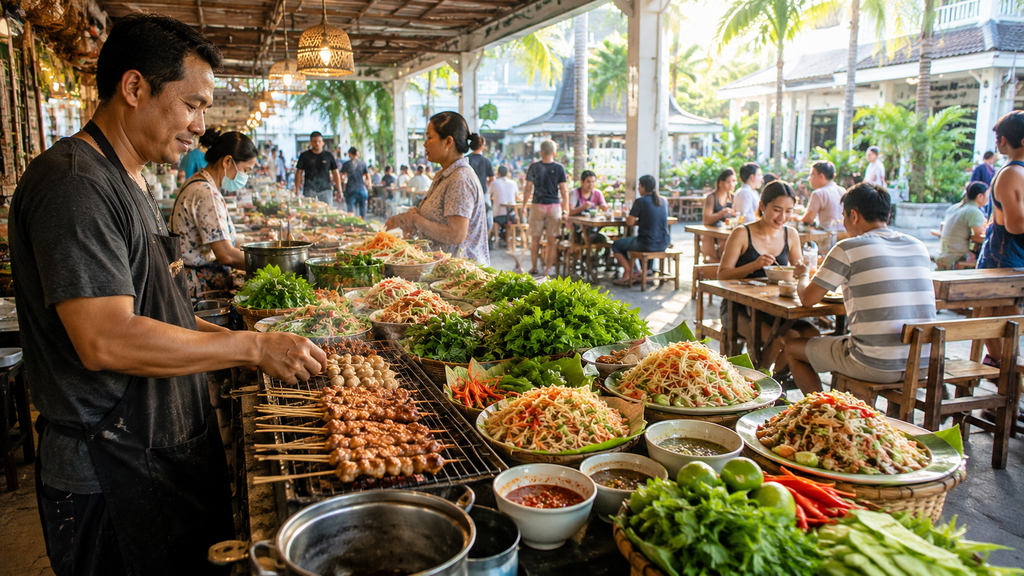
Then one morning, while walking back from a convenience store, I passed a woman grilling pork skewers over charcoal.
There were no tourists taking photographs.
There was no beautiful restaurant.
There were just several people stopping on their way to work, buying small bags of sticky rice and freshly grilled pork.
The smoke smelled incredible.
I joined the queue.
That simple breakfast became one of the moments that changed the way I ate for the rest of my time in Thailand.
I stopped trying to find a famous restaurant for every meal.
Instead, I started paying attention to what was happening around me.
If a small stall was busy, food was being cooked fresh and local customers kept stopping, I became curious.
Some of the meals I remember most clearly came from places whose names I never knew.
That, for me, is where the real Thai street food experience began.
Thai Street Food Is Part of Everyday Life
One thing becomes obvious very quickly in Thailand.
Street food is not only an attraction created for visitors.
People actually use it.
In the morning, workers stop for breakfast.
Around lunchtime, small restaurants and food stalls fill with office workers.
In the evening, grills appear along sidewalks and markets become crowded with people buying dinner.
Food is everywhere.
Sometimes it is a permanent shop with a few tables.
Sometimes it is a cart.
Sometimes there is nothing more than a wok, ingredients, plastic stools and a cook who seems capable of serving ten customers at the same time.
This was different from the way I had imagined “street food” before arriving.
I expected mostly night markets.
Instead, I realized that street food could be breakfast at 7 a.m., lunch beside an office building or a bag of grilled pork bought on the way home.
Once I understood that, eating in Thailand became much easier.
I stopped asking:
“Where is the best street-food market?”
And started asking:
“What are people eating around here?”
Morning: Thailand Starts Eating Early
Some of my favorite street-food experiences happened before the tourist areas became busy.
Thailand is already awake early in the morning.
Walk through a residential neighborhood or near a transport station and you may see people buying breakfast before work.
Grills are smoking.
Rice is being packed into small bags.
Pots of porridge are steaming.
Motorcycles stop for takeaway orders.
This is a very different atmosphere from a night market.
It feels practical.
People are not wandering around deciding what to photograph.
They are getting breakfast.
Moo Ping and Sticky Rice Became My Favorite Quick Breakfast
The smell usually found me first.
Moo ping is marinated pork grilled over charcoal.
The edges become slightly caramelized while the charcoal gives the meat a smoky flavor.
Buy a few skewers with sticky rice and you have a simple breakfast that is surprisingly filling.
I liked it because there was almost nothing complicated about ordering.
Point to how many skewers you want.
Take some sticky rice.
Pay.
Eat.
On mornings when I had a full day of sightseeing ahead, this was much more convenient than sitting through a long hotel breakfast.
It also felt more connected to the city.
You are standing beside people who are buying exactly the same thing before going to work.
That small detail changes the experience.
I Learned to Look for Busy Stalls
At first, choosing between street-food stalls felt random.
There could be five vendors selling similar things within a short walk.
How was I supposed to know which one was good?
Eventually I started using a very simple rule.
Look for customers.
If a stall had a steady flow of people and food was constantly being cooked, I was interested.
High turnover usually meant ingredients were not sitting around for hours.
It also suggested that people had a reason to return.
This does not guarantee an amazing meal.
But it gave me more confidence than choosing a stall because it had the prettiest sign.
Sometimes I simply watched what other customers ordered.
If three people in front of me asked for the same thing, I wanted to know why.
Breakfast Doesn’t Have to Look Like Breakfast
Another adjustment was realizing that my idea of breakfast was irrelevant.
Rice.
Noodles.
Pork.
Soup.
Chicken.
These can all appear in the morning.
There is no requirement for eggs, toast and cereal.
Once I stopped searching for food that looked like breakfast from home, the options became much more interesting.
A bowl of jok, Thai rice porridge, can be comforting early in the day.
Moo ping works perfectly when you are in a hurry.
And sometimes a bowl of noodles at 8 a.m. is exactly what you need.
Travel becomes easier when you stop expecting another country to organize meals according to your habits.
Lunch: Follow the Office Workers
Lunchtime taught me another useful lesson.
If you are near an area with offices, shops or businesses, watch where workers go.
Around midday, ordinary restaurants can suddenly become packed.
These places may not appear on travel blogs.
They may not have carefully designed interiors.
Sometimes the menu is limited.
But people are there because they need lunch that is fast, affordable and good enough to eat regularly.
That is exactly what I wanted.
My Default Lunch Became Pad Kra Pao
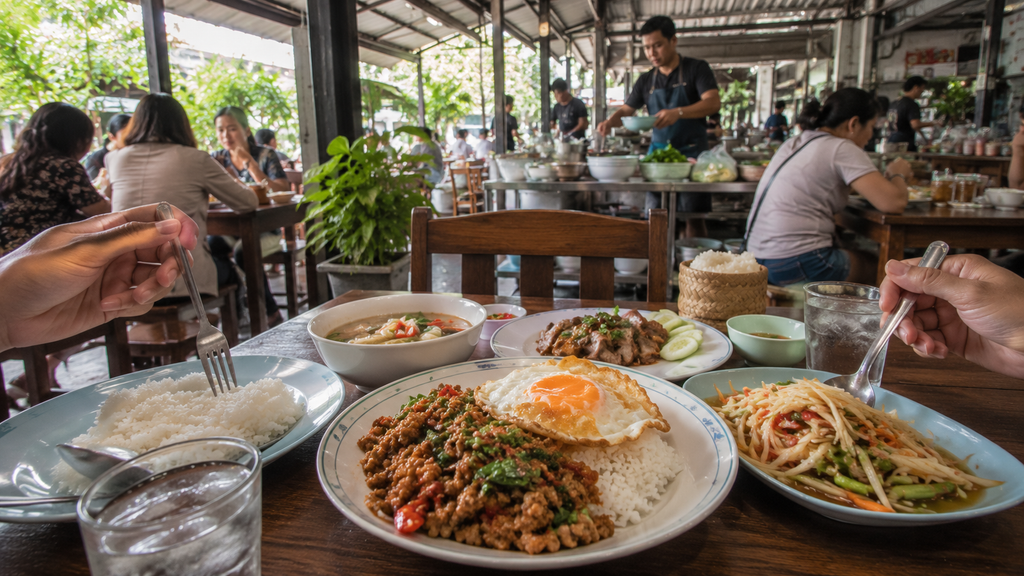
Pad kra pao quickly became my “I don’t know what to order” meal.
Minced or chopped meat.
Holy basil.
Garlic.
Chili.
Rice.
A fried egg on top.
Simple.
Fast.
Excellent.
At a busy local place, you can sometimes watch the entire dish being cooked in front of you.
Oil hits the wok.
Garlic and chili go in.
Then meat.
Sauce.
Basil.
Everything happens quickly.
A few minutes later, lunch is on the table.
The best part for me was the fried egg.
Thai-style fried eggs can have beautifully crispy edges while the yolk remains softer.
Break the yolk into the rice and mix it with the spicy basil meat.
After discovering that combination, I understood why I kept ordering it.
Then I Made the Classic Chili Mistake
At one small restaurant, I was asked how spicy I wanted my food.
I thought I had become accustomed to Thai chili.
I had been in the country for several days.
I was feeling confident.
Too confident.
I indicated that normal spice was fine.
The first few bites were excellent.
Then the heat continued building.
And building.
By halfway through the plate, I was sweating more from lunch than from Bangkok’s weather.
The cook had done nothing wrong.
I had asked for it.
That meal taught me a useful rule:
You do not need to prove anything with chili.
If you prefer mild food, say so.
If you want one chili instead of five, ask.
Thai cuisine has much more going on than heat.
There is no reason to destroy your ability to taste everything else just to demonstrate bravery.
“Not Spicy” Can Still Be Spicy
This is worth remembering if you have very low tolerance for chili.
Different people have different definitions of mild.
A dish adjusted for foreigners may still feel spicy to someone who rarely eats chili.
If spice is a serious concern, ask clearly and choose dishes that are naturally milder rather than expecting every recipe to be completely changed.
Khao man gai, fried rice and certain noodle dishes can be easier starting points.
Then experiment gradually.
There will always be another meal.
How I Ordered When There Was No English Menu
This worried me before traveling.
In reality, it rarely became a major problem.
Some stalls had English menus.
Many had photographs.
At other places, pointing worked.
Sometimes I watched what someone else received and ordered the same thing.
Translation apps can help when communication becomes difficult, but I did not want to spend every meal staring at my phone.
Basic gestures, patience and a smile solved most situations.
If I needed to ask about something important such as an allergy, however, I would not rely on guessing.
That requires clear communication.
For ordinary ordering, things were usually much easier.
Sometimes I Had No Idea What I Had Ordered
And that was fine.
Not every meal needs research.
A few times I pointed at something because it looked good.
The result arrived.
I ate it.
I liked it.
I still could not have told you exactly what it was afterward.
Those moments were surprisingly enjoyable.
There was no expectation.
No comparison with a famous version I had seen online.
Just food.
Travel does not always need documentation.
Afternoon: Markets, Fruit and Something Cold
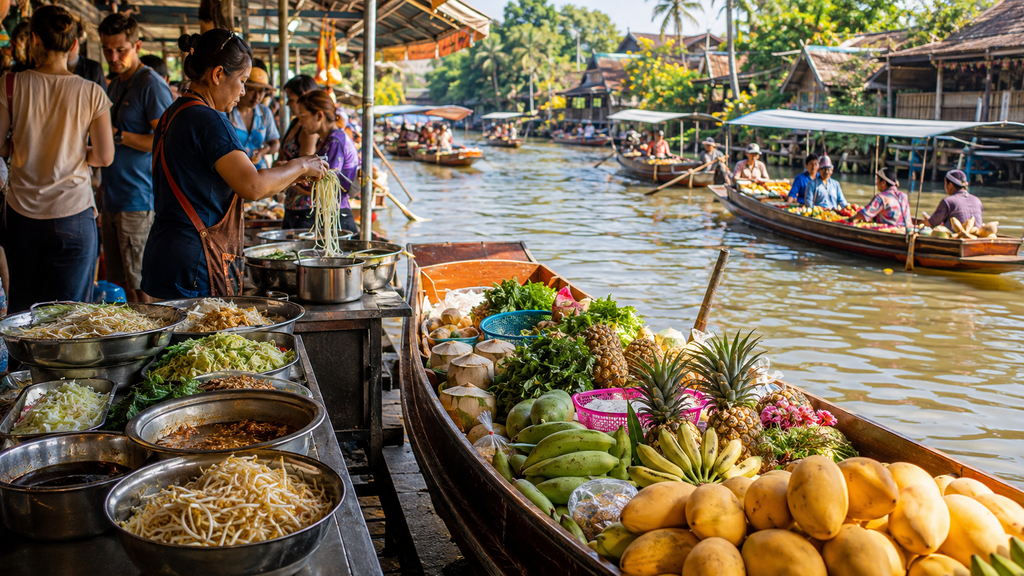
By mid-afternoon, Thailand’s heat changed what I wanted to eat.
Heavy food became less appealing.
Cold drinks and fruit became much more attractive.
This is when markets were particularly enjoyable.
Fresh pineapple.
Watermelon.
Mango.
Coconut.
Fruit shakes.
Thai milk tea.
Small snacks I had never seen before.
I started treating afternoon food less like a formal meal and more like a series of opportunities.
See something interesting?
Try it.
Thai Fruit Deserves More Attention
Thailand’s main dishes get most of the attention, but the fruit can be fantastic.
Mango is an obvious example.
Then there is pineapple, watermelon, rambutan, mangosteen, longan, dragon fruit and, of course, durian.
Some were familiar.
Others were not.
Buying cut fruit from a busy vendor became one of my favorite ways to deal with the afternoon heat.
It was simple, refreshing and easy to share.
And Then There Is Durian
Eventually someone will tell you to try durian.
You will probably see it before you decide whether you are ready.
Durian has an extraordinary reputation because of its smell.
Some people love it.
Some people cannot tolerate being near it.
I think it is worth trying once if you are curious.
But do not buy an enormous portion for your first attempt.
Start small.
The texture and flavor are difficult to compare with ordinary fruit.
Creamy is one word.
Intense is another.
Whether you love it or hate it, you will probably remember the experience.
Also pay attention to rules about where durian is allowed.
Some hotels and forms of transportation restrict it because of the smell.
Thai Milk Tea Became My Afternoon Weakness
Thai milk tea is dangerously easy to drink.
Strong tea.
Milk.
Sugar.
Ice.
A lot of sweetness.
After walking outside in the heat, that cold cup feels wonderful.
I knew it was sweet.
I ordered it anyway.
More than once.
There is a moment on many trips when you stop pretending every decision needs to be sensible.
Thai milk tea was one of those decisions for me.
Convenience Stores Are Part of the Food Experience Too
It would be dishonest to write about eating in Thailand and pretend I never entered a convenience store.
I did.
Frequently.
Sometimes you need water.
Sometimes you need a quick snack.
Sometimes it is late and you are too tired to find another restaurant.
Thailand’s convenience stores can be genuinely useful while traveling.
But I would not allow convenience to replace curiosity.
If there is an interesting local stall beside the convenience store, at least look at what they are cooking before buying another packaged sandwich.
Evening: This Is When Street Food Becomes a Social Experience
Morning street food often felt practical.
Evening street food felt social.
Night markets and busy food streets come alive after sunset.
Tables fill.
Grills start smoking.
People walk around carrying snacks.
Groups share several dishes.
You hear metal spatulas hitting woks and the constant sound of conversations around you.
This was the version of Thai street food I had imagined before arriving.
And yes, it is fun.
But it became more interesting after I had already experienced breakfast and lunch.
I understood that this was only one part of a much larger food culture.
I Stopped Trying to Find the “Best” Night Market
Bangkok alone has enough markets and food areas to overwhelm a short trip.
Add Chiang Mai, Phuket and other destinations and the number becomes ridiculous.
At first, I wanted to know which one was best.
Eventually I stopped caring.
Some markets are touristy.
Some are more local.
Some are primarily about food.
Others mix food with clothing, souvenirs and entertainment.
The better question is:
Which market fits where you already are?
Traveling an hour across Bangkok just because somebody online ranked one market slightly higher does not always make sense.
Sometimes the market twenty minutes away is exactly what you need.
How I Eat at a Thai Night Market
I learned not to buy a full meal immediately.
That defeats the purpose.
Instead, I walk through the market once.
Look at everything.
Then go back.
One skewer here.
A small bowl there.
Something grilled.
Maybe som tam.
Maybe seafood.
Fruit.
Then dessert.
Sharing is even better.
If two people split each dish, both can try more things without becoming full after the first stall.
This is one of the rare situations where being indecisive about dinner becomes an advantage.
Som Tam Is Better When You Can Hear It Being Made
Som tam is green papaya salad, but watching it being prepared adds something to the experience.
The ingredients go into a large mortar.
Garlic.
Chili.
Long beans.
Tomatoes.
Papaya.
Lime.
Fish sauce.
Palm sugar.
Then everything is pounded together.
You hear the preparation before you taste the result.
The salad comes out crunchy, sour, salty, slightly sweet and potentially very spicy.
If you can handle the heat, it is fantastic with grilled chicken and sticky rice.
If you cannot handle the heat, negotiate the number of chilies before the pounding begins.
Once they are in there, it is too late.
Seafood Is Where I Became More Careful
I love seafood.
But this is one area where I paid closer attention to how food was stored and cooked.
Especially in hot weather.
At a busy stall where seafood was properly chilled and being cooked constantly, I felt much more comfortable.
If something looked as though it had been sitting in questionable conditions for a long time, I skipped it.
There is always another stall.
This became my general attitude toward street food.
Curious, but not reckless.
Is Thai Street Food Safe?
There is no honest way to promise that every street-food meal is safe.
Food hygiene varies.
Your own stomach matters.
Ingredients matter.
Storage matters.
Preparation matters.
Instead of trying to find a magical rule, I used basic judgment.
I preferred busy stalls.
I liked seeing food cooked fresh.
I paid attention to raw ingredients.
I was more cautious with seafood and food that had clearly been sitting out.
I washed or sanitized my hands before eating when possible.
And if something looked wrong, I walked away.
Thailand has an enormous amount of street food.
There is no reason to take a chance on one particular stall.
Busy Doesn’t Automatically Mean Perfect
This is also worth saying.
A queue is useful information.
It is not a guarantee.
Sometimes a place is busy because it is famous on social media.
Sometimes it is simply in a convenient location.
Sometimes the food really is excellent.
Use crowds as one clue, not the only clue.
I became much better at choosing places once I combined several things:
Customer turnover.
Fresh cooking.
Ingredient storage.
General cleanliness.
And whether the food actually looked appealing.
How Cheap Is Thai Street Food Really?
Street food can make traveling in Thailand remarkably affordable.
Simple meals are often inexpensive compared with restaurants aimed primarily at international visitors.
But prices vary significantly depending on location.
A local neighborhood in Bangkok is not the same as a major tourist area.
An island is not necessarily priced like Chiang Mai.
A night market designed partly for tourists may charge more than a small daytime stall.
I stopped worrying about whether I was paying the absolute lowest possible price.
Instead, I asked whether the price seemed reasonable for what I was getting.
Traveling across the city to save a tiny amount on lunch makes no sense.
Time has value too.
I Always Carried Some Cash
Electronic payment is increasingly common in Thailand, but many systems are designed primarily for local users.
As an international traveler, cash remained useful.
Especially at smaller food stalls and markets.
I did not carry a huge amount.
Just enough Thai baht for food, transportation and ordinary small purchases.
Larger expenses could be handled differently.
Having small notes was particularly useful.
Paying for a small snack with a very large banknote can create an unnecessary problem for the vendor.
Bangkok Street Food Felt Fast and Constant
Bangkok was where street food felt most overwhelming to me.
There was always something else.
A noodle shop under a building.
A grill beside a sidewalk.
A food court inside a mall.
A night market.
Chinatown.
A tiny restaurant hidden down a side street.
The city made eating incredibly easy.
The difficult part was deciding when to stop.
Bangkok also taught me not to judge food by the surroundings.
Some very ordinary-looking places served excellent meals.
A plastic stool does not tell you anything about the quality of the food.
Chiang Mai Felt Slower
Eating in Chiang Mai felt different.
The city is smaller and the pace felt easier.
Night markets were still busy, but I did not feel the same constant pressure of Bangkok around me.
This was also where Northern Thai food became much more important.
Khao soi was the obvious discovery.
But exploring local markets made it clear that Northern Thai cuisine extends far beyond one famous bowl of noodles.
Sticky rice appears frequently.
Herbs, grilled meats, sausages and regional dishes create a different food identity.
If you visit both Bangkok and Chiang Mai, do not eat exactly the same dishes in both places.
Let the destination change your menu.
Southern Thailand Changed the Menu Again
Travel south and food changes.
Seafood becomes harder to ignore.
Coconut appears frequently.
Curries can become powerful.
Malay and Muslim culinary influences are more noticeable in certain parts of Southern Thailand.
Eating grilled seafood near the coast also feels completely different from ordering seafood in central Bangkok.
This is why I stopped thinking of “Thai food” as one single thing.
The country has regional differences.
Travel farther and those differences become more obvious.
Tourist Markets Aren’t Automatically Bad
Travel advice sometimes becomes obsessed with finding places “where there are no tourists.”
I do not think that is necessary.
Tourist markets can be fun.
Menus may be easier to understand.
There may be more variety in one place.
They can be convenient for first-time visitors.
The problem comes when you experience only places designed for tourists and assume that represents everyday Thai eating.
I enjoyed both.
Famous night markets.
Ordinary neighborhood stalls.
Shopping-mall food courts.
Tiny restaurants.
There is room for all of them in one trip.
Food Courts Surprised Me
I did not travel to Thailand because I wanted to eat inside shopping malls.
Yet food courts became surprisingly useful.
Especially in Bangkok.
After spending hours outside in tropical heat, air conditioning becomes extremely persuasive.
Food courts also offer a huge selection.
You can see what dishes look like.
Ordering can be easier.
Prices at many places remain reasonable, although this depends heavily on the mall.
Street food gives you atmosphere.
Food courts give you convenience.
I stopped treating them as competitors.
Use whichever suits the day.
The Plastic Stool Rule
Some of the places where I felt most uncomfortable at first became the places I enjoyed most later.
Tiny tables.
Plastic stools.
No air conditioning.
Traffic nearby.
A menu I barely understood.
During the first days, these places felt intimidating.
Later, they felt normal.
I realized I did not need every meal to be comfortable in the conventional sense.
If the food was good and the place was busy, I was happy.
Sometimes sitting on a tiny stool while somebody cooks your lunch two meters away is exactly the experience you traveled for.
But You Don’t Need to “Eat Like a Local” Every Meal
This became important too.
Travelers sometimes turn authenticity into another competition.
Never eat Western food.
Never enter a chain.
Never eat at the hotel.
Never go to a tourist restaurant.
That sounds exhausting.
If you want pizza one night, eat pizza.
If you want a familiar breakfast, have one.
If you need an air-conditioned restaurant after walking all day, go inside.
Eating like a local should help you experience Thailand.
It should not become another set of rules.
My Biggest Mistake Was Overplanning Food
Before arriving, I had dozens of restaurants saved.
That sounds useful.
It became a burden.
Every time I became hungry, I started comparing options.
This restaurant has better reviews.
That one appeared in a video.
This stall is famous for noodles.
That place is thirty minutes away.
Eventually I realized something obvious.
I was in Thailand.
Good food was everywhere.
I did not need to optimize every meal.
Once I stopped doing that, food became much more enjoyable.
I still visited a few famous places.
But I left plenty of meals unplanned.
Those were often the meals I remember most.
What I Would Do Differently Next Time
I would explore more morning markets.
Night markets get most of the attention, but mornings showed me a side of Thai food that felt much more connected to everyday routines.
I would also ask more questions when possible.
What is that?
How do you eat it?
What sauce goes with it?
Some of the best discoveries came from simply being curious.
I would eat more regional food instead of repeatedly ordering dishes I already knew.
And I would stop worrying about whether every meal was “the best.”
Good is enough.
Interesting is even better.
A Simple Street Food Day I Would Happily Repeat
If I had one completely unplanned food day in Thailand, I would keep it simple.
In the morning, I would walk through a local neighborhood and buy moo ping with sticky rice from a busy grill.
I would get coffee and continue walking.
At lunchtime, I would find a small restaurant filled with workers and order pad kra pao with a crispy fried egg.
Then I would disappear somewhere air-conditioned during the hottest part of the afternoon.
Later, I would visit a market.
Fresh fruit.
Thai milk tea.
Maybe something I had never tried.
After sunset, I would go somewhere with several food stalls rather than one specific restaurant.
Walk first.
Choose later.
Share several dishes.
Order som tam with a sensible amount of chili.
Eat something grilled.
Try noodles.
Then mango sticky rice or roti.
And when I was completely full, I would probably walk past another stall and buy something anyway.
That is basically how Thailand works.
Final Thoughts
The best thing Thai street food taught me was to pay attention.
Not to rankings.
Not constantly to my phone.
To what was happening around me.
Where were people stopping for breakfast?
Which lunch shop suddenly filled at noon?
What was producing that incredible smell from the charcoal grill?
Why was everyone ordering the same dish?
Once I started noticing those things, food became part of exploring Thailand rather than something scheduled between attractions.
Some meals were memorable.
Others were simply lunch.
Both mattered.
Because eating like a local is not really about discovering a secret stall that no tourist has ever visited.
It is about understanding that food is part of the rhythm of everyday life.
Breakfast bought on the way to work.
A fast plate of pad kra pao at noon.
Fruit when the afternoon becomes too hot.
Something grilled at a night market.
A bowl of noodles when you are still hungry late at night.
That was the Thailand food experience I had not understood before arriving.
The famous dishes are absolutely worth trying.
But eventually, stop searching for them.
Walk outside.
Look around.
Follow the smoke from the grill.
See where people are eating.
And when something looks good, order it.
You may not remember the name of the stall afterward.
You may not even know exactly what you ate.
But there is a good chance you will remember the meal.