
Singapore looked small enough on the map that I initially thought four days might be too much.

That assumption disappeared surprisingly quickly.
The distances are manageable. The MRT is excellent. Many major attractions sit relatively close to one another. But Singapore is not a city I would enjoy by rushing from landmark to landmark.
The heat slows you down.
A sudden tropical shower changes your afternoon.
You walk into a hawker centre for a quick lunch and stay much longer than expected.
You arrive at Marina Bay before sunset and realize there is no reason to leave.
Four days turned out to be a very comfortable amount of time for a first visit.
It was enough to see the famous side of Singapore — Marina Bay, Gardens by the Bay and the skyline — while still having time for Chinatown, Little India, Kampong Glam and some of the ordinary moments that made the city more interesting.
If I were planning my first Singapore trip again, this is roughly how I would do it.
Before Day 1: Do Not Underestimate Changi Airport
Most airports are places I try to leave as quickly as possible.
Changi is different.
If you arrive during the day and are not exhausted after the flight, there is an argument for spending some time around the airport before heading into the city.
Jewel Changi Airport is the obvious reason.
The enormous indoor waterfall, the Rain Vortex, is one of those places that looks slightly unreal in photographs and still manages to be impressive when you see it in person.
But I would not sacrifice half a day of Singapore just to stay at the airport.
Think of Jewel as a bonus.
If your arrival time works, explore it.
If you land late at night, go to your hotel and sleep.
You can always return before your departure.
That is a much better start to the trip than forcing yourself to admire an airport after a long flight simply because every travel guide told you to.
Getting From Changi Airport Into Singapore
Singapore makes the arrival relatively painless.
Depending on where you are staying and the time you arrive, the MRT, taxi or ride-hailing services can all be practical.
If I were traveling alone or with light luggage and arriving at a reasonable hour, I would be comfortable using public transport.
If I had just finished a long international flight with several bags, I would seriously consider taking a taxi.
Sometimes convenience is worth paying for.
The important thing is that Singapore’s airport is not isolated from the city in the way some major international airports are.
Once you leave Changi, the transition into Singapore happens quickly.
The first thing I noticed was greenery.
Trees line roads.
Vegetation appears around buildings.
Even major highways can feel unexpectedly green.
That first impression becomes important later because Singapore’s relationship with nature is much more interesting than its reputation as a city of skyscrapers suggests.
Day 1: Marina Bay and the Singapore Everyone Comes to See
For the first day, I would not try to be clever.
Go to Marina Bay.
Yes, it is the obvious Singapore.
Yes, you have seen it in thousands of photographs.
It is still the right place to begin.
Marina Bay gives you an immediate sense of what modern Singapore is trying to be: organized, ambitious, clean, green and architecturally dramatic.
But timing matters.
If you arrive around midday when the sun is strongest, walking around the entire bay can become less enjoyable than it looks on Google Maps.
I would begin later in the afternoon.
Start Around the Civic District
Rather than appearing directly beneath Marina Bay Sands, I like approaching the bay gradually.
Start around the Civic District.
This gives you a very different introduction to Singapore.
You see historic buildings.
The National Gallery area.
The Padang.
Older architecture.
Then the skyline begins appearing beyond them.
That contrast matters because Singapore makes much more sense when you realize how quickly the city transformed.
It is easy to look at Marina Bay and imagine Singapore has always looked futuristic.
It has not.
Walking from the older civic areas toward the modern waterfront lets you see several versions of the city within a relatively short distance.
Walk Toward the Merlion
Eventually, you reach one of Singapore’s most photographed landmarks.
The Merlion.
I will admit something.
It was smaller than I expected.
That does not make it disappointing.
It simply feels more like a symbolic stop than somewhere I would spend an hour.
Take the photograph.
Walk along the waterfront.
Look across toward Marina Bay Sands.
Then keep moving.
The view from this side of the bay is more memorable than the statue itself.
Marina Bay Is Better When You Walk It
One of the easiest mistakes in Singapore is moving between attractions too quickly because transportation is so convenient.
Around Marina Bay, walk.
The waterfront has been designed for pedestrians.
As you move around the bay, the skyline changes constantly.
Marina Bay Sands looks different from every angle.
The ArtScience Museum appears beside the water.
Office towers rise behind you.
The Helix Bridge connects the waterfront toward Marina Bay Sands.
There are plenty of places to stop.
Do not turn it into a race.
This is your first day.
Singapore will still be there tomorrow.
Marina Bay Sands: You Do Not Necessarily Need to Stay There
Marina Bay Sands dominates this part of Singapore so completely that it almost becomes a direction rather than a hotel.
You can see it from everywhere.
The three towers support the famous rooftop structure and infinity pool that has become one of Singapore’s defining images.
Staying there is expensive.
You do not need to stay there to enjoy Marina Bay.
For many travelers, I would rather put that money toward several extra nights in a well-connected hotel elsewhere.
If the rooftop pool is a major personal bucket-list experience, that is different.
But do not feel that a first Singapore trip is incomplete because you are not sleeping at Marina Bay Sands.
Most of the experience happens outside the hotel anyway.
Cross Into Gardens by the Bay
This is where I would spend the second half of the afternoon.
Gardens by the Bay is close enough to Marina Bay Sands that combining the two areas makes much more sense than visiting them on separate days.
The first thing to understand is that Gardens by the Bay is not simply the Supertrees.
The site is enormous.
You could easily spend several hours here.
Some areas are free to explore.
Major conservatories and certain attractions require tickets.
If you are visiting for the first time, I would not try to do absolutely everything.
Choose what interests you most.
Cloud Forest Was More Interesting Than I Expected
If I had to choose one paid attraction at Gardens by the Bay, Cloud Forest would be high on my list.
You enter a cooled conservatory and immediately encounter a huge indoor mountain covered with vegetation.
Water falls from near the top.
Walkways spiral around the structure at different heights.
After spending time outside in Singapore’s humidity, entering the cool interior feels almost suspiciously good.
But the air conditioning is not the reason to visit.
The scale of the conservatory is genuinely impressive.
It is a combination of architecture, horticulture and environmental storytelling rather than simply a greenhouse with unusual plants.
I would allow enough time to move slowly through it.
Flower Dome or More Time Outside?
This depends on your interests.
The Flower Dome is beautifully maintained and contains plants from different climates around the world.
If you enjoy gardens, flowers or botanical displays, visit it.
If your time is limited and you are mainly interested in the uniquely Singaporean experience of Gardens by the Bay, I would prioritize Cloud Forest and the outdoor Supertree area.
This is something I wish more itineraries said.
You do not have to visit everything simply because two attractions are sold near each other.
Travel becomes better when you stop trying to complete places.
Stay Until the Supertrees Light Up
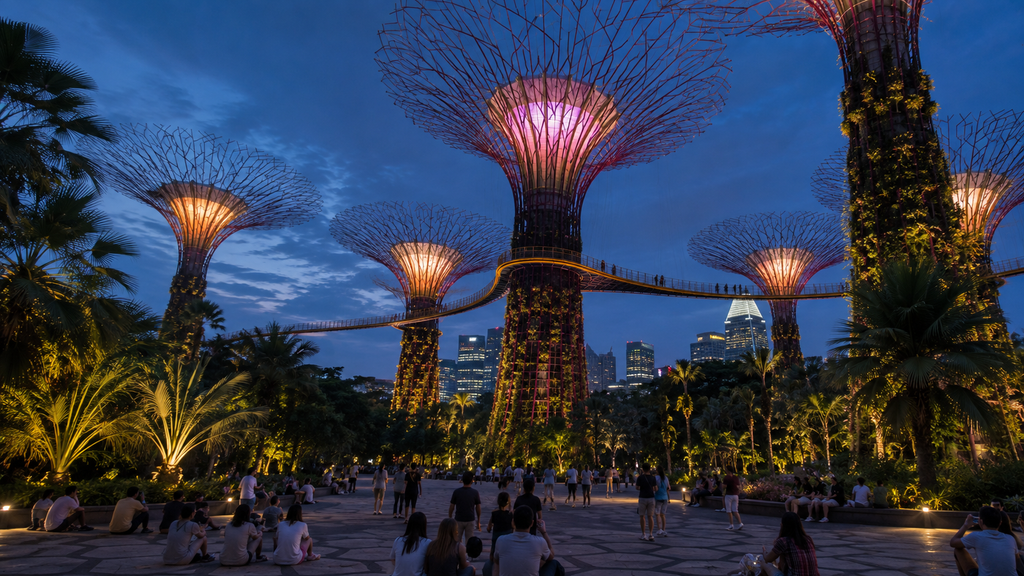
This is why I recommend arriving in the afternoon.
During daylight, the Supertrees are interesting.
After dark, they become something completely different.
As evening arrives, the temperature becomes more comfortable and the entire garden begins changing atmosphere.
Find a position around Supertree Grove before the evening light-and-music show.
You do not need the perfect Instagram spot.
Lie on the ground if there is space.
Look up.
Let everyone else hold their phones above their heads.
The combination of enormous illuminated structures, music and tropical vegetation is strange in the best possible way.
It is futuristic without feeling like a theme park.
And it is one of the few famous Singapore experiences that I would happily repeat.
Dinner: Do Not End Day 1 in an Expensive Mall Restaurant
After Marina Bay, it is tempting to eat somewhere directly beside the attractions.
You can.
But I would use dinner as the first opportunity to experience Singapore’s food culture.
Head toward a hawker centre.
Lau Pa Sat is convenient if you are around the central business district.
It is tourist-friendly and certainly not Singapore’s only hawker experience, but for a first evening it works well.
The building itself is distinctive, and at night the nearby satay area becomes particularly lively.
Order several things if you are traveling with someone.
Share.
Singaporean food becomes much more interesting when dinner is not one plate per person.
Then go back to the hotel.
Do not schedule another attraction.
You have probably walked enough.
Day 2: Chinatown, Kampong Glam and Little India
The second day is where Singapore begins feeling less like a futuristic postcard and more like a real city with layers.
Three neighborhoods make a natural cultural day:
Chinatown.
Kampong Glam.
Little India.
Technically, you can move through all three quickly.
I would not.
The point is noticing how dramatically Singapore can change within a few MRT stops.
Start Early in Chinatown
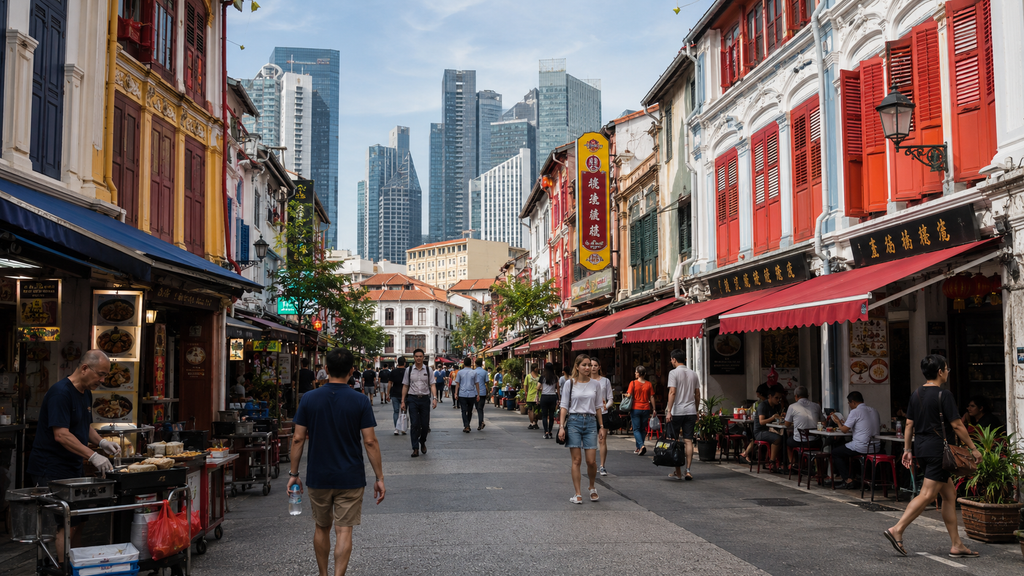
Morning is a good time to explore Chinatown before the heat becomes exhausting.
The neighborhood is compact and easy to walk.
Traditional shophouses sit beneath modern towers.
Temples, restaurants, markets and souvenir shops compete for space.
Some streets are heavily oriented toward visitors.
Walk beyond them.
The most interesting part of Chinatown is the contrast between old and new.
Look up occasionally.
A colorful historic shophouse may have a glass office tower rising directly behind it.
That visual contrast is Singapore in one frame.
Buddha Tooth Relic Temple
Even if you are not particularly interested in religious architecture, the Buddha Tooth Relic Temple is worth seeing while you are in Chinatown.
The building immediately stands out.
Inside, remember that this is an active religious site rather than simply an attraction.
Dress appropriately.
Move quietly.
Pay attention to signs regarding photography.
You do not need to understand every religious detail to appreciate the atmosphere.
One thing I enjoy about Singapore is how temples, mosques and churches are often integrated into busy neighborhoods rather than isolated as monuments.
They remain part of daily life.
Walk to Sri Mariamman Temple
A short distance away, the atmosphere changes again.
Sri Mariamman Temple is Singapore’s oldest Hindu temple and provides an immediate visual contrast with the surrounding Chinatown streets.
That proximity is important.
A major Hindu temple sitting in Chinatown tells you something about Singapore that a museum description cannot communicate as effectively.
The city’s cultural communities have distinct identities, but their histories overlap.
Singapore makes more sense when explored on foot for exactly this reason.
Lunch at a Hawker Centre
By now, I would be hungry.
Good.
Do not save hawker centres for a separate “food tour.”
They are part of normal Singapore travel.
Maxwell Food Centre is one of the obvious choices around Chinatown.
It is famous and can be busy.
That is fine.
Walk around before ordering.
See which stalls have queues.
Look at what local diners are eating.
You do not need to order the most famous dish from the most famous stall.
Chicken rice is an easy introduction.
The dish sounds almost too simple: chicken, rice and sauces.
Then you taste rice that has absorbed chicken stock and aromatics and understand why simplicity is not the same thing as boring.
Add something else.
Maybe dumplings.
A fresh juice.
Something you cannot immediately identify.
Hawker centres reward curiosity.
How Hawker Centres Actually Work
The first time can feel slightly chaotic.
Find a table or understand the seating situation first when it is busy.
Note the table number if the stall requires it.
Order directly from the stall.
Some vendors expect immediate collection while others may deliver depending on the setup.
Payment options vary.
Carry an appropriate payment method and some cash rather than assuming every small stall will handle your preferred international card.
And when you are finished, follow local tray-return practices.
It is not complicated once you observe what everyone else is doing.
The best strategy is to watch for two minutes before acting like you know everything.
Take the MRT to Kampong Glam
After lunch, head toward Kampong Glam.
The visual center of the neighborhood is Sultan Mosque.
Its large golden dome appears above the surrounding streets and gives the area an immediately recognizable identity.
But do not simply photograph the mosque and leave.
Walk the nearby streets.
Arab Street.
Haji Lane.
The surrounding blocks contain textile shops, restaurants, cafés, boutiques and colorful facades.
Haji Lane is particularly photogenic, which means it can also become crowded.
I enjoyed it, but I would not mistake it for the entire neighborhood.
Spend time on the quieter surrounding streets too.
Singapore Is More Colorful Than the Skyline Suggests
Before visiting, most of my mental images of Singapore involved silver skyscrapers and Marina Bay Sands.
Kampong Glam corrected that.
Colorful shophouses.
Murals.
Fabric stores.
Golden mosque domes.
Small restaurants.
Narrow streets.
This side of Singapore feels very different from Marina Bay.
That is exactly why I would put it on Day 2.
If you spend your entire visit around Marina Bay and Orchard Road, Singapore can appear almost unnaturally polished.
The historic neighborhoods add texture.
Continue to Little India
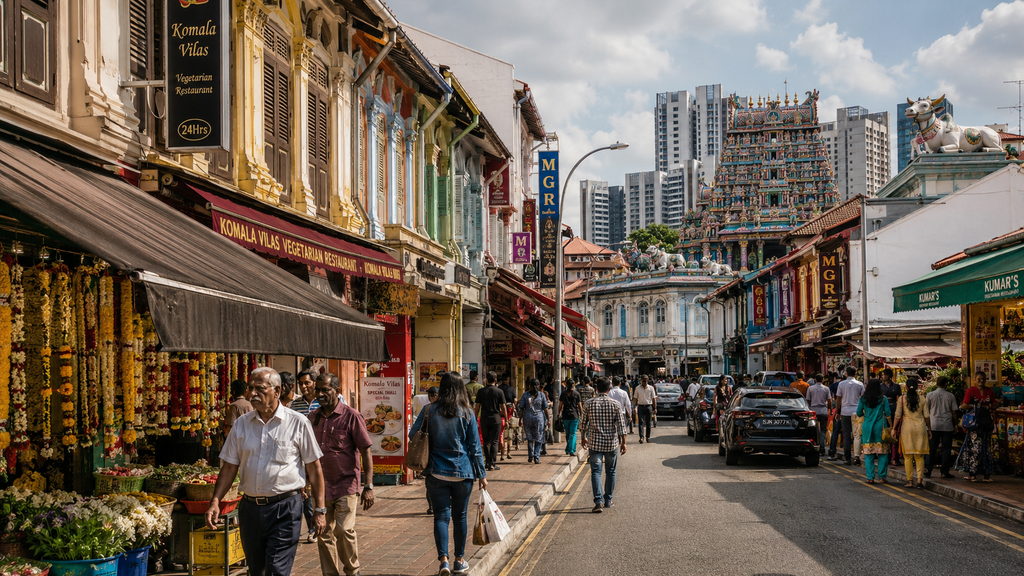
Later in the afternoon, move toward Little India.
You will notice the change quickly.
The streets become busier.
Indian restaurants appear everywhere.
Spice shops, jewelry stores, flower garlands and colorful storefronts change the sensory experience.
Music spills from shops.
Food smells become stronger.
Traffic feels more noticeable.
Singapore’s famous order has not disappeared.
The atmosphere has simply changed.
Walk rather than trying to identify every attraction immediately.
Little India is one of those places where the street itself is the experience.
Sri Veeramakaliamman Temple
One of the neighborhood’s most recognizable landmarks is Sri Veeramakaliamman Temple.
Its entrance is covered with intricate colorful figures and immediately draws attention from the street.
Again, remember that this is an active place of worship.
Be respectful.
If visitors are allowed inside during your visit, take time to observe rather than simply walking in, taking a photograph and leaving.
Religious sites are some of the best places to understand Singapore’s cultural diversity, but only when treated as living spaces.
Stay for Dinner in Little India
This is where I would finish the second day.
Do not return to Marina Bay for dinner.
Eat here.
The choice can be overwhelming.
South Indian food.
North Indian food.
Biryani.
Dosa.
Curries.
Vegetarian restaurants.
Small casual places.
Larger dining rooms.
I would choose somewhere busy rather than somewhere with the most polished exterior.
A dosa after a full day of walking is difficult to regret.
And after dinner, I would stop.
Again, resist adding another nighttime attraction simply because Singapore feels safe and efficient enough to continue forever.
Four days is enough.
You do not need to exhaust yourself on Day 2.
Day 3: Singapore Beyond the Famous Landmarks
By the third day, I would deliberately slow the pace.
This is the day to see why Singapore is called a City in Nature rather than simply a city with a few parks.
Start at the Singapore Botanic Gardens.
Morning at the Singapore Botanic Gardens
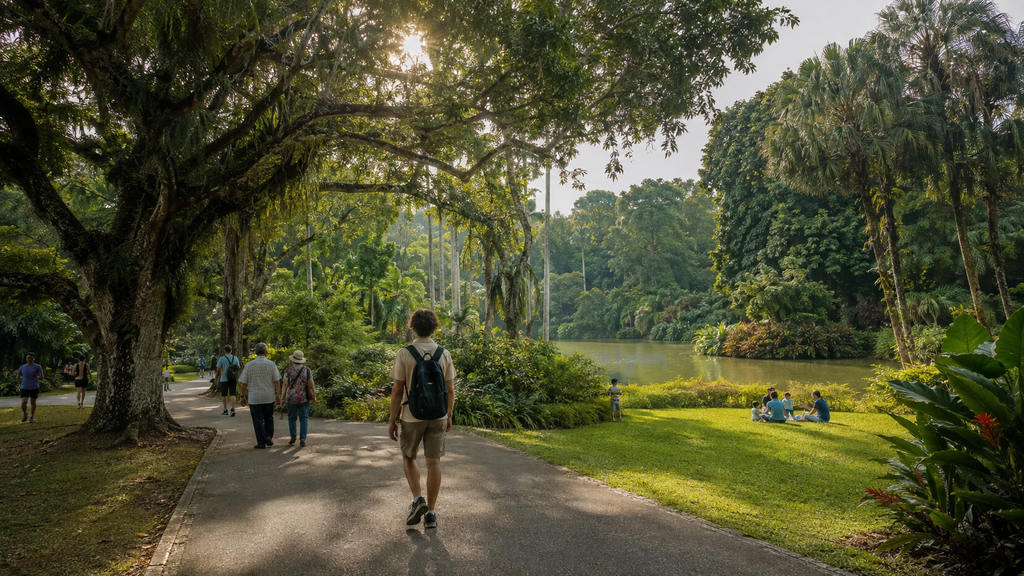
Go early.
This advice has nothing to do with avoiding tourists.
It is about temperature.
Singapore’s tropical climate is much easier to enjoy in the morning.
The Botanic Gardens are not a small decorative park.
You can walk for hours.
Large lawns, tropical vegetation, lakes and landscaped areas create a completely different environment from downtown Singapore.
You will see runners.
Families.
People walking.
Residents exercising.
This is another place where tourism and everyday life overlap.
The gardens do not feel preserved exclusively for visitors.
They feel used.
National Orchid Garden
If flowers interest you even slightly, the National Orchid Garden is worth considering.
Singapore takes orchids seriously.
The collection is extensive, colorful and extremely well maintained.
But even here, I would avoid turning the visit into a checklist.
You do not need to photograph every flower.
Walk.
Enjoy the shade.
Notice how much effort Singapore puts into landscaping.
This becomes more interesting when you realize that the greenery visible throughout the city is not accidental.
Why Singapore Feels So Green
Singapore is densely populated and heavily urbanized.
Yet trees appear almost everywhere.
Major roads are lined with vegetation.
Buildings incorporate gardens.
Parks connect with residential areas.
Nature reserves survive surprisingly close to dense development.
This does not mean Singapore is untouched nature.
Much of the landscape is carefully managed.
But the result still changes how the city feels.
Concrete does not dominate every view.
After several days, I began noticing how much greenery softened the density.
Lunch Somewhere Ordinary
By Day 3, I would stop searching for famous restaurants at every meal.
Find a food court or hawker centre near wherever you happen to be.
This is one of the advantages of Singapore.
Good inexpensive food is not restricted to one special neighborhood.
Try something different.
Laksa.
Noodles.
Fish soup.
Nasi lemak.
Char kway teow.
Singapore is one of those destinations where eating the same familiar meal repeatedly feels like a wasted opportunity.
Afternoon: Tiong Bahru
For the afternoon, I would choose Tiong Bahru.
This neighborhood offers a completely different side of Singapore again.
Low-rise residential architecture.
Older apartment blocks.
Independent cafés.
Traditional food businesses.
Quiet streets.
The neighborhood has become fashionable, so it is not some undiscovered local secret.
But it still works well as a contrast to Marina Bay.
Walk without a strict route.
That is important.
You have already spent two days following attractions.
Give yourself an afternoon where turning down the wrong street is allowed.
Tiong Bahru Market
If you arrive at the right time, Tiong Bahru Market is worth exploring.
The food centre gives you another opportunity to eat like a normal human being rather than someone conducting a research project into Singapore cuisine.
Order what looks good.
Sit down.
Watch the neighborhood.
Travel writing sometimes makes every meal sound transformative.
Most meals are not.
Sometimes you are hot, hungry and want a cold drink with something good to eat.
Singapore is excellent at providing exactly that.
Evening at Orchard Road — Or Skip It
Orchard Road is Singapore’s famous shopping district.
Whether you should spend much time there depends entirely on you.
If you enjoy shopping, go.
The malls are enormous, polished and useful for escaping afternoon heat.
If luxury shopping does not interest you, do not spend half a day there because an itinerary says Orchard Road is mandatory.
I would perhaps visit in the evening, walk around briefly and have dinner nearby.
Then move on.
There are more interesting parts of Singapore for travelers who are not interested in retail.
An Alternative: Return to Marina Bay at Night
If you loved Marina Bay on the first day, this is a good evening to return without an itinerary.
The skyline is completely different after dark.
Walk along the waterfront.
Sit somewhere.
Watch the buildings reflect on the water.
Singapore is one of those cities where repeating a place at a different time of day does not necessarily feel repetitive.
The atmosphere changes enough to justify it.
Day 4: Sentosa or a More Local Singapore
For the final day, I would give yourself a choice.
This is important because not everyone should spend their last day in the same place.
If you want attractions, beaches and entertainment, go to Sentosa.
If you want more neighborhoods, food and ordinary Singapore, stay in the city.
Neither choice is more correct.
Option 1: Sentosa
Sentosa is essentially Singapore’s recreation island.
Beaches.
Resorts.
Universal Studios Singapore.
Aquarium attractions.
Cable cars.
Family entertainment.
You could spend an entire day here easily.
But decide why you are going.
If Universal Studios is important to you, make that the focus.
Do not combine a full theme park day with six other attractions.
If you mainly want to see Sentosa, ride the cable car, walk around and spend some time at the beach, you can have a much more relaxed day.
Singapore Beaches Are Not the Main Reason I Would Visit
Sentosa has beaches.
They are pleasant.
But I would not travel to Singapore specifically for a tropical beach holiday.
Southeast Asia has countless destinations with more spectacular natural beaches.
What makes Sentosa interesting is convenience.
You can spend the morning surrounded by skyscrapers and the afternoon beside the sea without leaving Singapore.
Think of the beach as part of the experience rather than the country’s greatest natural attraction.
Option 2: See More of Everyday Singapore
Personally, on a first four-day trip, I might choose this option.
Take the MRT somewhere outside the main tourist core.
Walk through a residential area.
Visit a neighborhood hawker centre.
See HDB housing estates.
Spend time in a park.
You do not need to wander randomly into private spaces.
The point is simply to see how most Singaporeans actually live.
The famous skyline represents Singapore.
It does not represent all of Singapore.
HDB Neighborhoods Changed My Impression of the City
Singapore’s public housing system shapes much of the country’s urban landscape.
Large residential developments appear throughout the island.
From a tourist perspective, they may not seem like attractions.
They are not supposed to be.
But seeing ordinary neighborhoods helps explain how Singapore functions.
Residential blocks are often connected with public transport, food options, schools, playgrounds and everyday services.
You begin understanding that the highly organized city center is not an isolated showcase.
Planning extends into residential life.
That does not mean every estate is perfect or every resident has the same experience.
But it adds an important layer to understanding Singapore beyond tourism.
Have One Final Hawker Meal
For the last meal, I would return to the thing Singapore does exceptionally well.
Eat somewhere casual.
By this point, the hawker centre should feel less confusing.
You know how to look around.
You know not to choose the first stall automatically.
You have probably developed opinions about chicken rice.
Maybe you discovered that laksa is the dish you want to eat again.
Maybe you have been drinking kopi every morning.
That familiarity is one of my favorite parts of a short trip.
A place that felt foreign four days ago begins feeling slightly understandable.
Not familiar.
But understandable.
What About the Night Safari?
Singapore’s Night Safari is extremely popular and can fit into a four-day itinerary.
I would treat it as an optional evening rather than something everyone must do.
If wildlife attractions interest you, plan for it properly.
Do not spend an exhausting day walking around Singapore and then add several more hours at the Night Safari simply because there is an empty box on your itinerary.
If you choose it, make it the main evening activity.
This principle applies to almost everything in Singapore.
The city makes it physically possible to do a lot.
That does not mean doing a lot is always enjoyable.
The MRT Makes This Itinerary Work
Without Singapore’s public transport, this four-day itinerary would feel much more complicated.
With the MRT, moving between neighborhoods is straightforward.
Stations are clean.
Signs are clear.
Transfers are generally easy to understand.
Air conditioning becomes an unexpected bonus after walking outside.
For a first-time visitor, I would choose accommodation near an MRT station even if another hotel looks slightly nicer.
A beautiful hotel that requires an inconvenient journey every morning becomes less beautiful by Day 3.
Location matters.
You Probably Do Not Need a Car
I cannot imagine renting a car for a normal first trip to Singapore.
Public transport covers the city extremely well.
Taxis and ride-hailing services fill most remaining gaps.
Parking and the general cost structure around private vehicles make driving unnecessary for most visitors.
Walking plus MRT plus occasional taxi is enough.
More importantly, not driving allows you to experience the city rather than concentrating on roads.
Singapore Is Walkable — Until the Weather Reminds You It Is Tropical
Distances can look easy.
Then you step outside at 1 p.m.
Singapore is hot and humid throughout the year.
Walking ten minutes can feel completely different from walking ten minutes in London or Paris.
This changed how I planned days.
I stopped measuring only distance.
I started thinking about heat.
Can I walk this section in the morning?
Is there an indoor stop halfway?
Can I use the MRT instead?
Should I take a break before continuing?
This is not laziness.
It is sensible tropical travel.
Carry Water
Simple advice.
Important advice.
You will drink more than you expect.
Carry water, especially on days involving Gardens by the Bay, Botanic Gardens or long neighborhood walks.
Singapore is extremely developed, so you are rarely far from somewhere to buy a drink.
But having water already in your bag is easier.
I would also carry a small umbrella.
It helps with rain.
It can help with the sun.
In Singapore, both may become relevant on the same afternoon.
Tropical Rain Does Not Mean the Day Is Ruined
Singapore can produce serious rain.
Not gentle European drizzle.
Tropical rain.
The sky changes.
Then suddenly water seems to be falling from everywhere.
The first instinct is to panic because your itinerary says you should be walking around Chinatown.
Wait.
Heavy tropical showers can pass.
Use the time for lunch.
Go inside a mall.
Visit a museum.
Drink coffee.
Singapore has enough indoor spaces that bad weather does not necessarily destroy a day.
Flexibility matters more than trying to defeat the weather.
The Air Conditioning Can Be Surprisingly Cold
Outside:
Hot.
Humid.
Sweating.
Inside:
Why is this shopping mall Antarctica?
After several transitions between tropical heat and aggressively cooled interiors, I understood why carrying a light layer can actually make sense.
You probably will not need it while walking outside.
But cinemas, malls, museums and some restaurants can feel surprisingly cool after extended time inside.
It sounds ridiculous until you experience it.
How Expensive Is Singapore for a Traveler?
Singapore has a reputation for being expensive.
That reputation is both true and misleading.
Hotels can be expensive.
Major attractions add up.
Alcohol can be expensive.
High-end restaurants can become extremely expensive.
But eating well does not have to cost a fortune.
Hawker centres completely change the equation.
Public transportation is also efficient enough that you do not need to spend heavily moving around the city.
Singapore allows you to mix budgets in an unusual way.
You can look at one of the world’s most expensive hotels and then walk somewhere nearby for a relatively inexpensive local meal.
Your biggest decision is usually accommodation.
Where I Would Stay
For a first trip, I would prioritize MRT access over almost everything else.
Chinatown can be convenient.
Bugis works well for several central neighborhoods.
Areas around City Hall provide excellent access.
Orchard works if shopping and central convenience matter.
Marina Bay is spectacular if your budget allows it, but it is not necessary.
I would look at the map and ask:
How far is the hotel from an MRT station?
That question matters more than whether the rooftop pool photographs well.
After walking all day in Singapore’s humidity, an extra fifteen-minute walk back to the hotel feels much longer than it did while booking from home.
Four Days Is Enough for a First Visit
Could you stay longer?
Absolutely.
There are museums I have barely mentioned.
Nature reserves.
Pulau Ubin.
More neighborhoods.
More food.
More attractions.
But four days gives a first-time visitor enough time to understand the basic shape of Singapore without rushing constantly.
Three days can work.
Five gives you more flexibility.
Four is a comfortable middle ground.
I would rather spend four well-paced days here than three days trying to complete a seven-day itinerary.
What I Would Skip on a First Trip
I would skip attractions that interest me only because they appear on lists.
That sounds obvious.
It is surprisingly difficult in Singapore.
The city is full of things marketed as must-see experiences.
Observation decks.
Museums.
Theme parks.
Shopping centers.
Gardens.
Animal attractions.
Beaches.
Neighborhoods.
Food markets.
You cannot experience all of them properly in four days.
Choose.
I would prioritize Marina Bay, Gardens by the Bay and the historic neighborhoods.
Everything after that depends on your interests.
What I Would Book in Advance
I would book accommodation before arriving.
Obviously.
For major ticketed attractions that I definitely wanted to visit, I would also check whether advance booking makes sense.
But I would leave parts of each day flexible.
Weather matters.
Energy matters.
Jet lag matters.
Sometimes you discover somewhere you want to stay longer.
A good itinerary gives you direction without turning your holiday into an appointment schedule.
Do Not Ignore Singapore’s Rules
Singapore’s reputation for strict rules is famous enough that some travel advice makes the country sound intimidating.
It did not feel intimidating to me.
It felt organized.
Still, visitors should respect local laws and regulations.
Do not assume something acceptable at home is automatically acceptable here.
Pay attention to signs.
Follow public transport rules.
Dispose of rubbish properly.
Understand regulations around smoking and restricted items.
And if you are uncertain about an important legal or entry requirement, check official Singapore sources rather than relying on social media.
You do not need to spend the trip worrying.
You simply need to behave like a responsible visitor.
What Surprised Me About Singapore
I expected skyscrapers.
I expected cleanliness.
I expected Marina Bay Sands.
I expected excellent public transport.
What I did not expect was how much variety could fit into such a compact city.
One morning can begin in a Chinese temple.
Lunch happens at a hawker centre.
The afternoon is spent beside a mosque in Kampong Glam.
Dinner is dosa in Little India.
The next day you are walking through tropical gardens.
Then you are standing beneath artificial Supertrees while music plays above you.
Singapore is small geographically.
It does not feel small experientially.
What I Would Do Differently Next Time
I would spend less time trying to see attractions.
More time eating.
More time walking through neighborhoods.
I would probably dedicate a day to places farther from the central tourist areas.
I would consider Pulau Ubin for a completely different view of Singapore.
I would return to the Botanic Gardens early in the morning.
And I would stop pretending that I could comfortably walk everywhere at midday.
Singapore taught me to respect humidity.
My Realistic 4-Day Singapore Itinerary
If you just want the basic structure, this is the version I would actually use.
Day 1: Marina Bay and Gardens by the Bay
Arrive around the Civic District in the afternoon, walk toward the Merlion and Marina Bay Sands, continue into Gardens by the Bay, visit Cloud Forest and stay for the Supertree light show. Finish with dinner at a hawker centre.
Day 2: Chinatown, Kampong Glam and Little India
Start early in Chinatown, visit the main temples and explore the surrounding streets. Have lunch at a hawker centre, continue to Kampong Glam in the afternoon and finish the day exploring and eating in Little India.
Day 3: Botanic Gardens and Tiong Bahru
Visit the Singapore Botanic Gardens early, consider the National Orchid Garden, have a relaxed lunch and spend the afternoon around Tiong Bahru. Use the evening for Orchard Road or return to Marina Bay.
Day 4: Sentosa or Local Singapore
Choose Sentosa if you want attractions, beaches or Universal Studios. Otherwise, explore more residential neighborhoods, visit another hawker centre and spend the final day seeing a quieter side of Singapore.
That is enough.
Do not add another six attractions simply because you found an empty hour.
Final Thoughts
Singapore is one of the easiest cities in Asia to travel around.
That can become a trap.
Because transportation works so well and distances appear small, you begin believing you can see everything.
Marina Bay in the morning.
Chinatown before lunch.
Little India in the afternoon.
Sentosa at sunset.
Night Safari after dinner.
Technically, perhaps.
Enjoyably, probably not.
My favorite moments in Singapore happened when I stopped treating efficiency as a challenge.
Walking around Marina Bay as the temperature dropped before sunset.
Sitting in a hawker centre deciding what to order next.
Watching the streets change between Chinatown and Little India.
Escaping a tropical shower without worrying that the itinerary had been ruined.
Seeing office towers behind old shophouses.
Watching people use parks and food centres as ordinary parts of daily life.
Four days gives you enough time to experience those contrasts.
Singapore can look almost impossibly polished from a distance.
Up close, it becomes much more interesting.
It is a city of skyscrapers and hawker tables.
Luxury hotels and public housing.
Artificial Supertrees and real tropical forest.
Historic temples and automated trains.
Different languages, religions and cuisines sharing a remarkably small island.
For a first trip, do not try to understand all of it.
Give yourself four days.
Learn the MRT.
Eat whatever smells good.
Carry an umbrella.
Avoid planning long outdoor walks at midday.
And leave enough empty space in the itinerary for Singapore to surprise you.